


Christmas leave is where many private households discover, too late, that they've been treating holiday time as a favour instead of a legal entitlement. A live-in nanny wants Christmas Eve off, the family assumes bank holidays are automatically extra, and the rota collapses because nobody wrote the rules down. That's how a routine scheduling question turns into a trust problem, a payroll problem, and sometimes a compliance problem.
When a Festive Dispute Exposes a Holiday Knowledge Gap
The dispute usually starts small. A principal says, “We always give the nanny Christmas Day off anyway,” while the nanny points out that she has worked every school break, covered late finishes, and never had her entitlement explained properly. In a private household, that misunderstanding spreads quickly because the person booking flights, arranging travel cover, or coordinating grandparents is often not the person who drafted the contract.
What makes this awkward is that the law does not care how warm the family feels about the arrangement. Statutory holiday entitlements are a legal floor, not a goodwill gesture, and many families still underestimate what that means in practice. GOV.UK confirms that almost all workers are entitled to 5.6 weeks of paid holiday, which is 28 days for someone working five days a week, and Acas uses the same 5.6 formula for calculating days off (GOV.UK holiday entitlement rights).
In private households, the key pressure points are usually bank holidays, live-in arrangements, and changing rota patterns. Some families assume bank holidays are automatically extra. Others treat a live-in nanny as if being on site means being off. That is where the holiday record starts to matter, especially if the contract shifts around travel, maternity cover, or swaps between family members and agency staff.
Practical rule: if the contract does not say how Christmas, bank holidays, and rota weeks are handled, the household is relying on memory instead of compliance.
A good holiday policy removes the emotional element. It states what the nanny accrues, when leave can be taken, what happens on bank holidays, and how holiday pay is handled. In elite households, that written clarity protects everyone, because the most expensive holiday mistake is rarely the day off itself. It is the absence of a clean record when someone later disputes what was agreed.
What Statutory Holiday Entitlements Mean
A statutory holiday entitlement is the minimum paid leave the law says a worker must receive. In the UK, that entitlement sits at 5.6 weeks a year, which is 28 days for a full-time worker on a five-day week. That figure is the legal floor, so a private agreement can improve it, but it cannot replace it.
Who qualifies and why the wording matters
The UK framework is broad. Almost all people classed as workers are entitled to this leave, and the modern rules still sit on that 28-day minimum even as working patterns change. For private households, that includes most employed nannies, rota staff, and maternity nurses, although the way leave is worked out still depends on the contract and the pattern of hours.
The US picture is different. Statista's comparison shows the UK's guaranteed time off at 28 days, while the United States has no federal minimum paid holiday baseline in the same way (Statista statutory minimum paid leave and public holidays). That is why US private-staff contracts rely so heavily on written terms. If a family moves a household between jurisdictions, or employs staff across borders, the holiday rules do not transfer automatically.
| Dimension | United Kingdom | United States |
|---|---|---|
| Legal baseline | 5.6 weeks, or 28 days for a five-day week | No federal minimum paid holiday baseline in the same way |
| Who it applies to | Almost all workers, subject to the rules on status | Mostly contractual, with state variation |
| Bank holiday treatment | Can be included within the 5.6 weeks if the contract says so | Usually handled by contract or state law |
| Private household practice | Often written into nanny and household contracts | Often negotiated package by package |
For households, the practical point is straightforward. A London contract still follows the employment law that applies to the role, even if payroll, travel, or family administration is handled from New York. That is why the first holiday conversation should cover jurisdiction, contract wording, and working pattern, not whatever the household has “normally” done with Christmas or bank holidays.
How Entitlement Accrues and Is Calculated
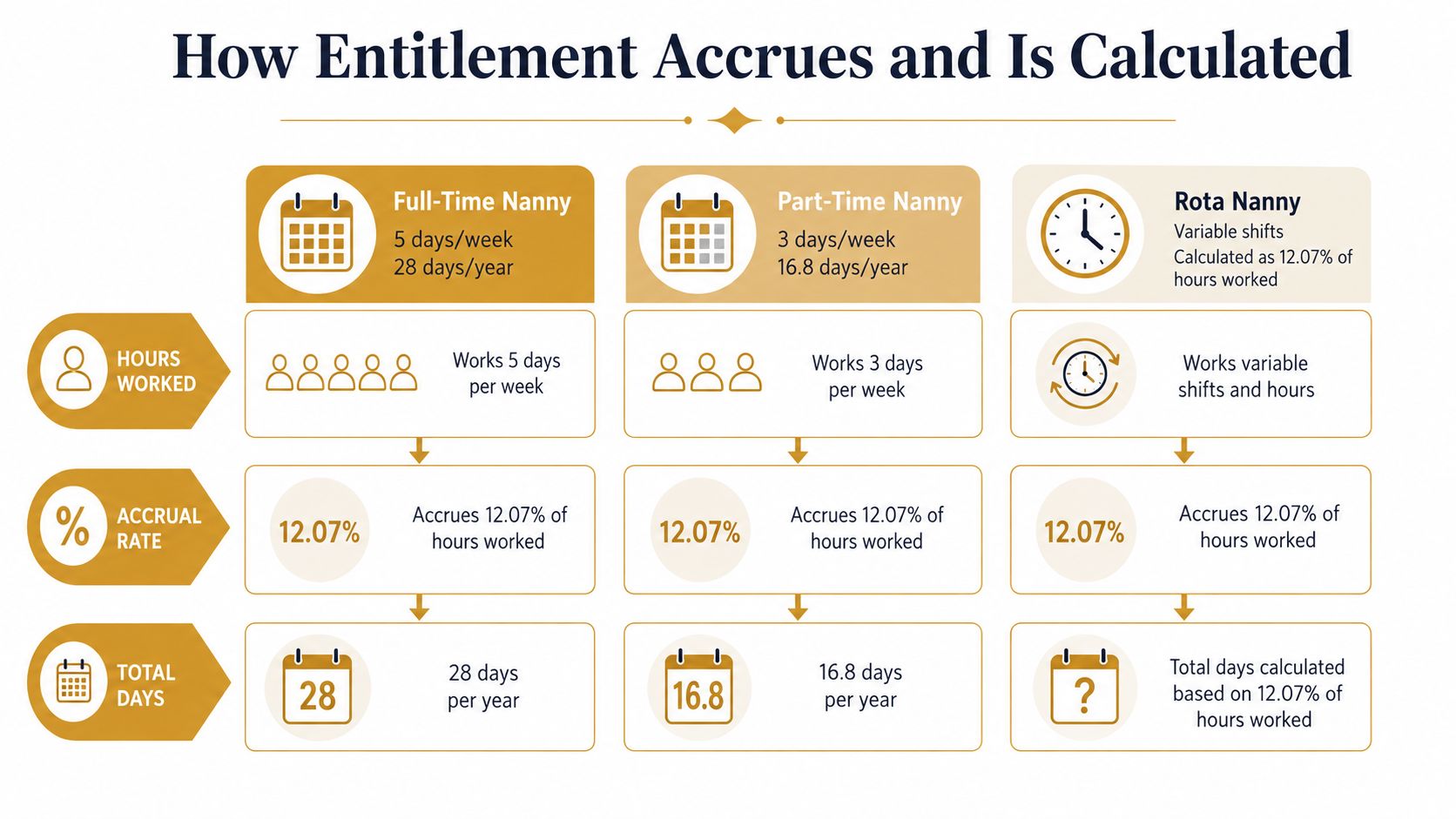
Holiday accrues as work is done, then it is translated into days or hours based on the working pattern. For a standard full-time nanny on five days a week, the UK formula is straightforward, 5 working days x 5.6 = 28 days. For a three-day-a-week nanny, that same formula gives 16.8 days, which is why part-time households should never round by instinct or “tidy up” the figure to suit the rota.
A household that changes hours, travel demands, or live-in arrangements mid-year needs to recalculate, not carry on as if the old pattern still applies. That is where written records matter. If the contract says one thing and the rota has drifted, the employer ends up guessing at entitlement, and that is where disputes start.
Variable hours need a different method
Rota nannies, maternity nurses, and part-year staff create the most errors because their schedules do not fit a tidy monthly pattern. Government guidance says irregular-hours or part-year workers can accrue leave using 12.07% of hours worked in each pay period, while still staying within the statutory cap of 28 days. That method matters in rota-heavy households because payroll has to follow actual hours, not a guessed annual allowance. The calculation also needs to be aligned with the current working pattern, especially where shifts, sleep-in arrangements, or alternating days change from one quarter to the next.
A weekly split can look like this in practice:
- Full-time nanny: 5 working days a week, entitlement lands at 28 days under the statutory formula.
- Part-time nanny: 3 working days a week, entitlement is 16.8 days using the same 5.6 multiplier.
- Rota nanny: variable shifts, accrual is commonly tracked at 12.07% of hours worked.
- Leaver or joiner mid-year: holiday has to be pro-rated against the actual employment period, then checked against what has already been taken.
The carry-over point is where households often slip. If a nanny moves from fixed days to a travel-heavy pattern, or from live-out to live-in, the entitlement may still be the same in principle, but the way it is earned and recorded changes. That is why the safest approach is to keep accrued, taken, and paid leave separate in payroll records, then update the holiday calculation the moment the working pattern changes.
If the rota changes halfway through the year, do not leave holiday on the old schedule. Recalculate from the date the pattern changed and record the revision in writing.
The 28-day cap still matters even when hours-based accrual suggests more leave in theory. For household employers, that cap stops holiday being overstated on paper, then overpaid in payroll. It also gives a clean check where a nanny's pattern shifts between standard days, variable rota work, and short periods of leave or handover.
Comparing UK and US Entitlement by Jurisdiction
Private families often assume holiday rules travel with the role because the job looks the same. They do not. In the UK, statutory leave sits inside a defined legal structure, with a 4-week EU-derived core plus 1.6 weeks of additional UK leave, giving the 5.6 weeks already discussed. In the US, holiday entitlement is usually set by contract, workplace policy, or state-level rules rather than a single federal paid-leave floor, which makes the wording of the offer letter matter far more than many families realise.
That difference changes how elite households draft terms. A New York family hiring a UK-based nanny cannot rely on the same assumptions they would use for a domestic employee in the States, and a British family that temporarily relocates staff abroad needs to check which location governs the working arrangement. Cross-border payroll and tax alignment often needs coordinated advice, especially where holiday, overtime, and deductions interact.
The issue is sequencing. In the UK, employers have to separate what is statutory from what is contractual. In the US, employers often define the whole package contractually from the start, so the offer letter needs to spell out holiday, paid time off, and any bank-holiday treatment with care.
For families who also need to think about US household employment tax treatment, this 2026 household employee tax guide is a useful companion reference when the contract spans payroll, tax, and leave.
What travelling households should check
- Country of employment: the legal system usually follows the actual role and work location, not the family's passport.
- Contract wording: bank holidays, travel days, and call-out cover need to be written down.
- Payroll method: UK leave and US leave are not calculated the same way.
- Agency handover: if a placement changes jurisdiction, the holiday clause should change with it.
Families moving between France, Germany, Switzerland, the UAE, and Hong Kong need the same discipline. A clause that works in one market can be wrong in the next, which is why a one-page holiday agreement from one country should never be pasted into another without review.
How Holiday Pay Is Calculated in Practice
Holiday pay is where many households get the calculation wrong even when they know the entitlement number. From 1 January 2024, the UK rules distinguish between the first 4 weeks of statutory leave, which must be paid at a worker's normal rate of pay, and the remaining 1.6 weeks, which can be paid at basic rate (GOV.UK holiday pay and entitlement reforms from 1 January 2024). That split matters in households where the nanny's real earnings include more than the base hourly figure.
What counts as normal pay
CIPD says normal pay can include commission, overtime, bonuses, and other allowances where they form part of regular remuneration (CIPD holidays guidance). In private staffing, that catches out families who pay extra for late finishes, overnights, or weekend cover and then try to holiday-pay the nanny on base hours alone. If those amounts are part of regular pay, the holiday bill rises mechanically.
A simple way to keep it clean is to mirror the pay structure in the holiday clause and the payroll system. If the nanny regularly covers nights or travel, the holiday reference period has to reflect that reality. Using a flat daily rate when the role includes variable allowances is one of the most common underpayment mistakes.
Holiday pay should reflect the way the person actually earns, not the cheapest version of the role on paper.
Households that want a tidy audit trail should keep the entitlement and pay record together. A digital family file for HR like Family Folder's HR tool can help keep the contract, rota, holiday requests, and payroll evidence in one place, which is far safer than leaving everything spread across emails and text messages.
A practical payroll check looks like this:
- Confirm the leave bucket, first 4 weeks or remaining 1.6 weeks.
- Check the reference pay, including regular allowances.
- Match the pay method to the contract, not to habit.
- Record the payment basis, so the final payslip is defensible.
For families with household payroll running through a tax process too, the holiday clause should sit beside the rest of the employment documents. Nanny tax obligations guidance belongs in the same file as the leave policy, because the same payroll data usually supports both compliance checks.
Special Rules for Live-In Staff and Parental Leave
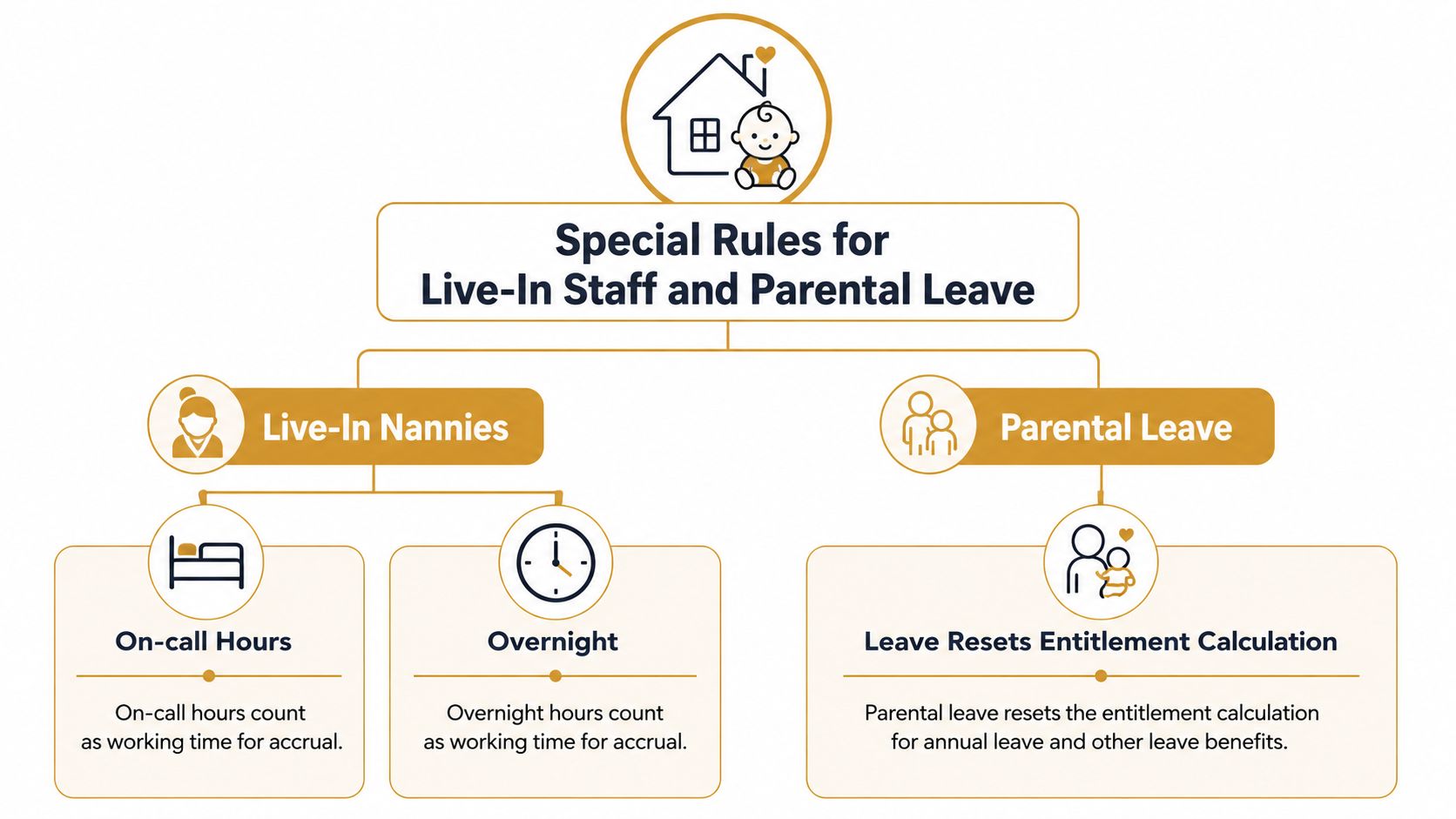
Live-in arrangements are where holiday policy gets messy fastest. A nanny who sleeps in the house is not automatically “off duty” just because the family has gone out for dinner. If she is on call, answering overnight needs, or expected to remain available, the household has to be precise about whether that time is working time, rest time, or another category in the contract. The wording matters, because private households often blur the line between presence and availability.
Live-in cover needs explicit boundaries
A 24/6 arrangement only works cleanly if the contract sets out real rest periods and real leave booking rules. Families often forget that the more flexible the household, the more detailed the paperwork needs to be. Without that, every favour turns into precedent, and precedent turns into entitlement disputes. For live-in placements, the working pattern should also be set out in a proper live-in nanny contract rather than left to informal messages.
Parental leave adds another layer. Holiday continues to accrue during maternity, paternity, and shared parental leave in the ordinary course of employment, so the household should not assume holiday stops just because the nanny is off work caring for her own child. That point matters when a family plans a return date around school holidays or travel, because the leave balance may be tighter than it first appears.
For US households comparing the issue with federal family leave concepts, the Family Medical Leave Act reference from Nick Norris, P.A. is a useful reminder that leave rights and holiday rights are separate questions. They can overlap in practice, but they are not the same thing, and a contract has to deal with both.
The bank-holiday question is the one that gets missed most often. Bank holidays are not automatically paid on top of annual leave, and employers can include them inside the 5.6 weeks if the contract allows it. That is why the answer to “If my nanny works a bank holiday, do I owe extra holiday entitlement or premium pay?” is usually contractual, not automatic.
In households with Christmas travel, Easter cover, and summer turnover, that single clause can save a great deal of friction. If the contract says bank holidays are included in the statutory allowance, the family knows how much leave remains. If it does not, the household is improvising.
Sample Clauses and Best-Practice Records for Households
A good holiday clause doesn't need legal theatre. It needs to say, in plain English, what the entitlement is, how it accrues, what pay basis applies, and whether bank holidays are inside or outside the allowance. If the family uses a rota or live-in model, the clause should also say how to record changes in pattern during the year.
For drafting ideas, the Action Accountants Limited contract guide is a sensible place to compare basic employment wording before tailoring it to a private household. For a nanny contract that already needs cleaner leave language, the right starting point is a written template that fits the role, not a generic staff handbook. Nanny contract templates are useful only if they're amended for the actual working pattern.
What to put in writing
- Entitlement statement: say the worker receives 5.6 weeks' paid annual leave.
- Accrual method: specify whether leave is calculated by days or by 12.07% for variable-hours staff.
- Pay basis: say whether the first 4 weeks are paid at normal rate and the remaining 1.6 weeks at basic rate.
- Bank holidays: state clearly whether bank holidays are included within the allowance.
- Booking rules: require written notice and managerial approval before leave is confirmed.
- Carry-over and leavers: explain what happens at year end and on termination.
The recordkeeping is just as important as the clause. Keep a running log of holiday accrued, holiday taken, holiday paid, and any changes to the working pattern. When the payroll file, contract, and rota all say the same thing, disputes become much easier to resolve.
If the household has a cross-border posting, a live-in role, or a mid-year change from fixed days to rota cover, bring in counsel before the change starts. That's the point where informal practice usually stops being safe.
Superstar Nannies works with private households that need holiday terms, rota cover, and employment documents to line up properly from the start. If you're reviewing a nanny contract, planning a live-in placement, or trying to clean up holiday compliance before the next leave request lands, visit Superstar Nannies and arrange a conversation about the right structure for your household.