


You may be at the point where you've found an excellent nanny, everyone gets on well, and it feels awkward to introduce paperwork. In private households, that's exactly when problems begin. A live-in arrangement asks one person to be both a trusted childcare professional and a resident inside your home. Goodwill alone rarely carries that complexity for long.
The strongest live in nanny contract doesn't signal mistrust. It creates calm. It tells the nanny what success looks like, tells the family what service they can properly expect, and gives both sides a written reference point when routines change, travel is added, or boundaries start to blur. For UHNW and VIP households, generic templates almost always miss the clauses that matter most, especially around confidentiality, multiple residences, household staff lines, and international movement.
Why a Handshake Is Not Enough
A verbal agreement often sounds perfectly reasonable at the start. The nanny will “help with the children”, “be flexible when needed”, and “live as part of the household”. Everyone means well. Then ordinary life intervenes.
A parent has a late dinner. A child wakes in the night. Grandparents arrive. The family travels for a week. Another member of staff asks the nanny to handle laundry “just this once”. None of those moments feels significant in isolation. Together, they create a second job description that no one agreed to.
What strains a relationship isn't usually one dramatic event. It's repeated uncertainty. If the nanny is in the house, is she working? If she travels with you, which hours count as duty time? If she has a private room, can children enter it freely? If the role ends, how long does she have to vacate the accommodation? These issues need drafting, not assumptions.
A live-in contract works best when it's treated as a professional courtesy, not a legal weapon.
In practice, the most common source of conflict is vague language. Industry guidance warns that terms such as “help around the house” or “flexible hours” create disputes, while stronger contracts convert the role into measurable clauses such as exact weekly hours, overtime triggers, guest policies, and confidentiality terms, as noted in live-in nanny contract guidance from Hello Nanny.
For UK families, written clarity matters even more because most nannies are treated as household employees rather than independent contractors, and domestic employers may need to operate PAYE if earnings meet the threshold. National Minimum Wage rules also apply to live-in domestic workers, which is why the agreement should clearly cover pay, hours, overtime, duties, confidentiality, tax handling, and termination terms, reflected in sample domestic employment agreement guidance.
A well-drafted contract protects more than the employer. It protects the nanny's rest time, privacy, compensation, and dignity. That usually leads to better retention, cleaner communication, and a more stable home.
The Core Components of Your Nanny Contract
The contract should read like an operating manual for the placement. If a clause can be interpreted in two ways, rewrite it. Precision is far kinder than flexibility dressed up as generosity.
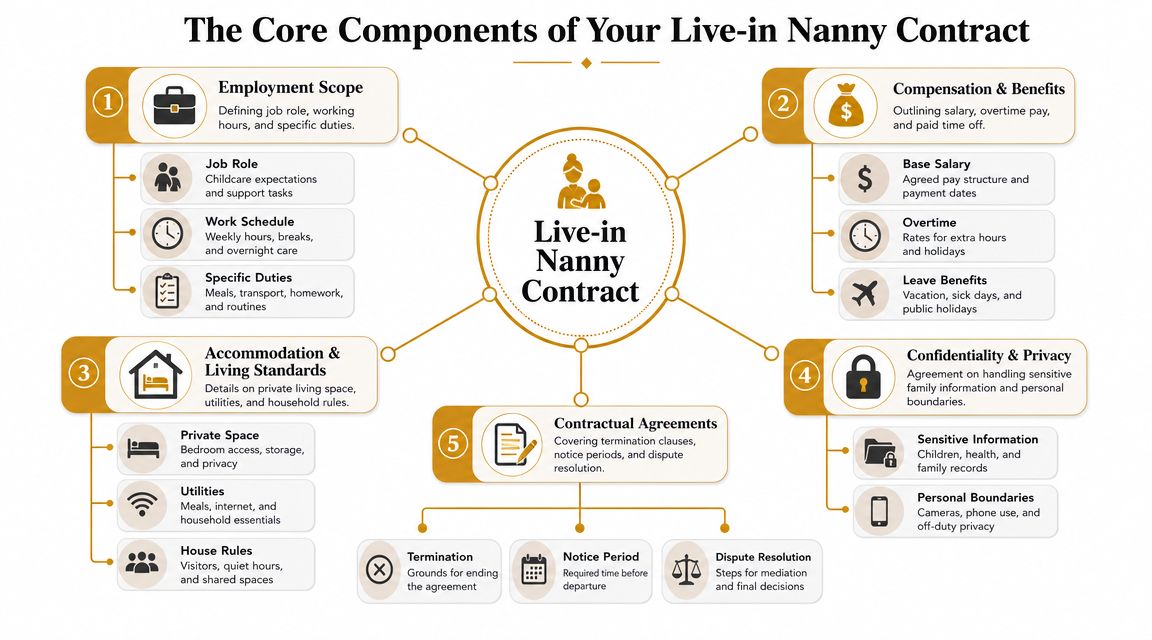
Employment status and framework
Start by stating the legal relationship plainly. In most household settings, the nanny is an employee. The contract should identify the employer, the employee, the work location or locations, the start date, and whether there is an agreed probationary period.
For families who want a broader reference point for how written terms support healthy employment relationships, this blueprint for employer-employee relationships is a useful companion read. It isn't nanny-specific, but the underlying principle is the same. Clarity early prevents friction later.
Include practical identifiers such as:
- Named employing entity if the nanny is hired by an individual, a couple, or a family office
- Primary residence and secondary residences where services may be performed
- Reporting line so the nanny knows whether instructions come from parents, a chief of staff, a house manager, or another designated person
This matters in staffed homes. A nanny shouldn't be taking ad hoc direction from everyone in the building.
Compensation and benefits
Compensation clauses need to do more than list salary. They should show how and when pay works.
At a minimum, set out:
- Gross pay and payment frequency
- Overtime terms and the trigger for overtime
- Any agreed non-cash benefits in one place
- Reimbursements for authorised childcare expenses, travel costs, and out-of-pocket purchases
- Paid leave categories such as holiday, sick leave, and family travel arrangements
If your household is building a more advanced package, this guide to an elite nanny compensation package is a practical reference for the commercial side of the offer.
For UHNW families, include clauses for international travel days, overnight proxy parenting, high-season schedule changes, and whether discretionary bonuses exist. If they do, describe the basis for them carefully. A vague promise of a bonus tends to disappoint both sides.
Working hours and rota
Many live-in nanny contracts fail because the schedule should be drafted operationally, not socially.
Use language such as:
- Regular hours with start and finish times
- Days off and weekly rest periods
- Overnight expectations, if any
- Split shifts where relevant
- Weekend or evening cover that is built into the role
- Procedure for additional hours, including who authorises them
For UK-specific compliance, contract guidance for live-in placements stresses that the written terms should distinguish active duty from rest time, identify overnight or split-shift expectations, and explain overtime handling, as outlined in live-in nanny contract advice focused on avoiding misunderstandings.
Practical rule: If you can't place a task into a time block, a pay category, or a clear duty list, it probably isn't drafted well enough.
Duties and boundaries
Do not write “general household help”. That phrase causes endless arguments.
A stronger duties clause separates responsibilities into categories:
| Area | Better wording |
|---|---|
| Childcare | Sole charge care, school runs, nursery routines, developmental activities, bath and bedtime |
| Child-related household tasks | Children's laundry, playroom organisation, meal preparation for children, packing for outings |
| Admin | Managing school bags, children's calendars, wardrobe rotation, travel packing lists |
| Excluded duties | Deep cleaning, adult laundry, service for dinner parties, pet care unless expressly agreed |
If you expect support beyond childcare, say so directly. In a fully staffed home, the nanny's duties should also state what belongs to the housekeeper, chef, tutor, maternity nurse, or governess. Clear division reduces status tension among staff.
Travel, confidentiality and contract mechanics
A bespoke contract for a high-profile household usually needs clauses that generic forms ignore.
Consider adding:
- Travel protocol covering passport custody, visas, travel class, private aviation etiquette, overnight room arrangements, per diems or reimbursed expenses, and who covers emergency return costs
- Multi-property terms stating whether the nanny may be required to work in London, New York, the country estate, or on yachts and seasonal residences
- Confidentiality and privacy covering family information, routines, children's identities, photographs, guest lists, household systems, and social media restrictions
- Variation clause so any changes to hours, salary, or scope must be agreed in writing
- Signatures and retained copies for both parties before the start date
The strongest contracts don't try to sound impressive. They remove guesswork.
Defining Accommodation and Household Standards
The accommodation clause is where a live-in arrangement becomes real. A bedroom is not the clause. The clause is the full set of living conditions, boundaries, and practical rights tied to that room.

In the UK, room and board in a live-in arrangement is commonly estimated at £150–£300 per week, or £7,800–£15,600 per year, according to guidance on live-in nanny costs and accommodation value. Because accommodation can materially affect the value of the package, the contract should state exactly what is included, including housing, utilities, and meals, and what happens to housing when employment ends.
For families considering the practical realities of this model, these notes on live-in nanny arrangements are helpful when pressure-testing whether your home and schedule suit a resident employee.
What the accommodation clause should say
A proper clause should identify the living space with enough detail that neither side has to guess later.
Include points such as:
- Private room and whether it is for the nanny's exclusive use
- Bathroom access and whether it is private or shared
- Use of kitchen and laundry facilities
- Utilities and Wi-Fi included as part of the arrangement
- Meals and whether the nanny is included in household catering, pantry access, or a separate food arrangement
- Storage for luggage, uniforms, and personal items
- Parking or transport access if relevant
In UHNW homes, I'd also spell out whether the nanny has access to staff quarters only, family areas during off-duty time, a separate entrance, staff dining arrangements, and use of a household vehicle.
Privacy has to work both ways
A live-in role breaks down quickly if off-duty time is treated as informal availability.
The contract should deal with:
- Off-duty privacy and whether children may enter the nanny's room
- Quiet hours in staff or residential areas
- Guest policy including whether visitors are permitted and whether overnight guests are prohibited
- Use of shared spaces such as gym, pool, cinema room, staff kitchen, or garden
- Security and access protocols including alarm codes, keys, and restrictions on sharing entry credentials
If the nanny is off duty, physically being in the house shouldn't convert rest time into working time.
That sentence sounds obvious. In many homes, it is not.
Housing on termination
This clause is often left until emotions are already high. Don't do that.
State in plain language:
- When occupation ends after resignation or termination
- Whether a short transition period applies
- How belongings will be collected
- What happens to access cards, keys, devices, and staff passes
This protects the household operationally and gives the nanny a fair, dignified exit process. In a well-run home, boundaries are not cold. They are respectful.
Legal Guardrails Confidentiality Safeguarding and Termination
A principal is due to leave for Courchevel on Friday. The children are splitting time between London and the chalet. The nanny will travel with the family, work around security protocols, and sleep in staff accommodation at both properties. On Thursday evening, a disagreement over notice, phone use, or who can access the children's photos becomes far more expensive than it should be. In UHNW homes, this section of the contract protects privacy, safety, and continuity when pressure rises.
Confidentiality is a working term, not a courtesy
For a high-profile household, confidentiality belongs near the front of the agreement and often in a separate NDA. A generic promise to “keep family matters private” is too vague for a home with multiple residences, household staff, close protection, private travel, and active press interest.
The clause should define what is confidential, how it may be used, who may receive it, and what continues after employment ends. That usually includes:
- Family identity, routines, and whereabouts
- Children's schools, tutors, therapists, and extracurricular schedules
- Photographs, videos, voice notes, and social media restrictions
- Medical, educational, and behavioural information
- Guest lists, travel plans, floor plans, and security procedures
- Rules for messaging apps, cloud storage, home Wi-Fi, and personal devices used for work
Many families also need the contract to address practical points templates miss. Can the nanny discuss the children with staff at another property? Can she carry school or medical information across borders on a personal phone? What happens to contact lists, photos, and WhatsApp threads when the role ends?
For more detailed drafting on this point, this guide to private staff non-disclosure agreements for UHNW families is a useful specialist reference.
Safeguarding has to be documented, not assumed
A strong vetting process is only the start. The written agreement should preserve the standards the family expects once employment begins, especially in homes where several adults share responsibility for the children across properties and time zones.
I advise clients to cross-reference the contract to written policies or schedules covering:
- Safeguarding duties and reporting lines
- Medical authorisation and emergency consent procedures
- Transport rules, car seat standards, and driver approvals
- Supervision rules for pools, beaches, ski trips, and public outings
- Digital safety for children's devices, photographs, and location sharing
- Incident reporting after accidents, injuries, or concerning behaviour
This matters most in complex households. If a child is injured at a secondary residence, or a travel day changes the nanny's hours and chain of command, written procedures reduce hesitation and finger-pointing.
For agencies and household employers managing employment infrastructure at scale, some families and firms also look at operational support models such as nanny agency PEO solutions. The point is straightforward. Payroll, compliance, and documentation need systems.
The contract matters most when the relationship is under strain, or when an urgent decision has to be made fast.
Termination terms should work in real life
Termination clauses fail when they are either too vague to follow or so aggressive that they invite dispute. The better approach is clear, restrained drafting that reflects how a private household operates.
For UK households, the contract should be consistent with employee status, set out notice clearly, distinguish working time from rest periods, and record the agreed process in writing before the role begins. Generic US nanny templates often miss those points, and they are particularly risky in a live-in arrangement.
A sound termination section usually covers:
- Notice by either party
- Whether payment in lieu of notice is permitted
- Summary termination for serious misconduct
- Immediate return of keys, passes, devices, and household records
- Data deletion and confirmation that confidential material has been returned or erased
- The timetable for ending access to staff or family accommodation
- A written handover covering routines, medication, school matters, and upcoming travel
For VIP households, I also recommend a transition clause suited to the family's operating style. If the nanny supports children across New York, Palm Beach, and the South of France, the handover should deal with much more than toys and bedtime. It should cover calendars, medical notes, packing preferences, security contacts, dietary issues, and any standing instructions from parents, estate managers, or family office staff.
Handled properly, termination protects both sides. The household keeps continuity and confidentiality. The nanny gets a fair process, clear timing, and a dignified exit.
Navigating UK vs US Nanny Employment Laws
International families often make the same mistake. They assume a strong contract from one country can be reused in the other. It can't. The employment relationship may look similar, but the legal architecture around pay, tax, working time, and termination is different.
The UK position
For UK families, one of the biggest compliance traps is assuming that accommodation changes the nanny's legal status. It doesn't. Guidance aimed at household employers warns that families often wrongly assume a live-in nanny can be treated as self-employed because accommodation is provided, when the burden remains on the employer to operate PAYE correctly and document wages, deductions, and lawful termination terms, as explained in guidance on creating a live-in nanny contract.
That means your UK live in nanny contract should be built around:
- Employee status, not informal contractor language
- PAYE handling and wage documentation
- National Insurance considerations
- Working time structure that distinguishes duty from rest
- Notice and termination terms that can be followed in a domestic setting
The US position
US families face a different framework. The classification point still matters, but the practical administration often centres on household payroll, tax reporting, state-specific wage rules, and local labour protections. A contract drafted for a New York household may need materially different treatment from one used in Florida or California.
For globally mobile families, I usually suggest thinking in layers:
Jurisdiction of employment
Where is the nanny primarily working?Jurisdiction of travel
Is travel occasional, seasonal, or integral to the role?Residence pattern
Is the nanny attached to one home, multiple homes, or a rotating international schedule?
If you need a deeper operational view from the US side, this US household employee tax guide for elite families is a practical reference point.
A side-by-side drafting mindset
A useful way to think about UK and US contracts is that the same headings appear, but the legal weight behind them changes.
| Contract area | UK focus | US focus |
|---|---|---|
| Employment status | Employee status and PAYE compliance | Household employee treatment and state-specific payroll handling |
| Working time | Distinguish active work from rest time | Define hours clearly and account for applicable overtime rules |
| Accommodation | State what is included and how housing ends | Address housing terms, move-out expectations, and local labour issues |
| Termination | Written notice process and lawful termination terms | Contractual notice where agreed, plus state-specific enforcement realities |
| Travel | Timekeeping, duties, and remuneration during travel | Multi-state and travel compliance, expenses, and role scope |
Families who also employ a housekeeper sometimes find it useful to compare role structuring across resident staff positions. This comprehensive London live-in housekeeper guide is relevant for that reason. It helps clarify how accommodation, boundaries, and job scope can diverge between childcare and household operations roles.
The safest approach is simple. Draft for the country where the work is actually performed, then add travel clauses for the exceptions.
That is much more reliable than trying to force one global template across every residence.
Conclusion Your Contract Checklist and Next Steps
A live in nanny contract should do two things at once. It should protect the household from ambiguity, and it should give the nanny a professional, workable employment structure she can trust. When those two aims are drafted properly, the contract becomes a stabilising document rather than a tense one.
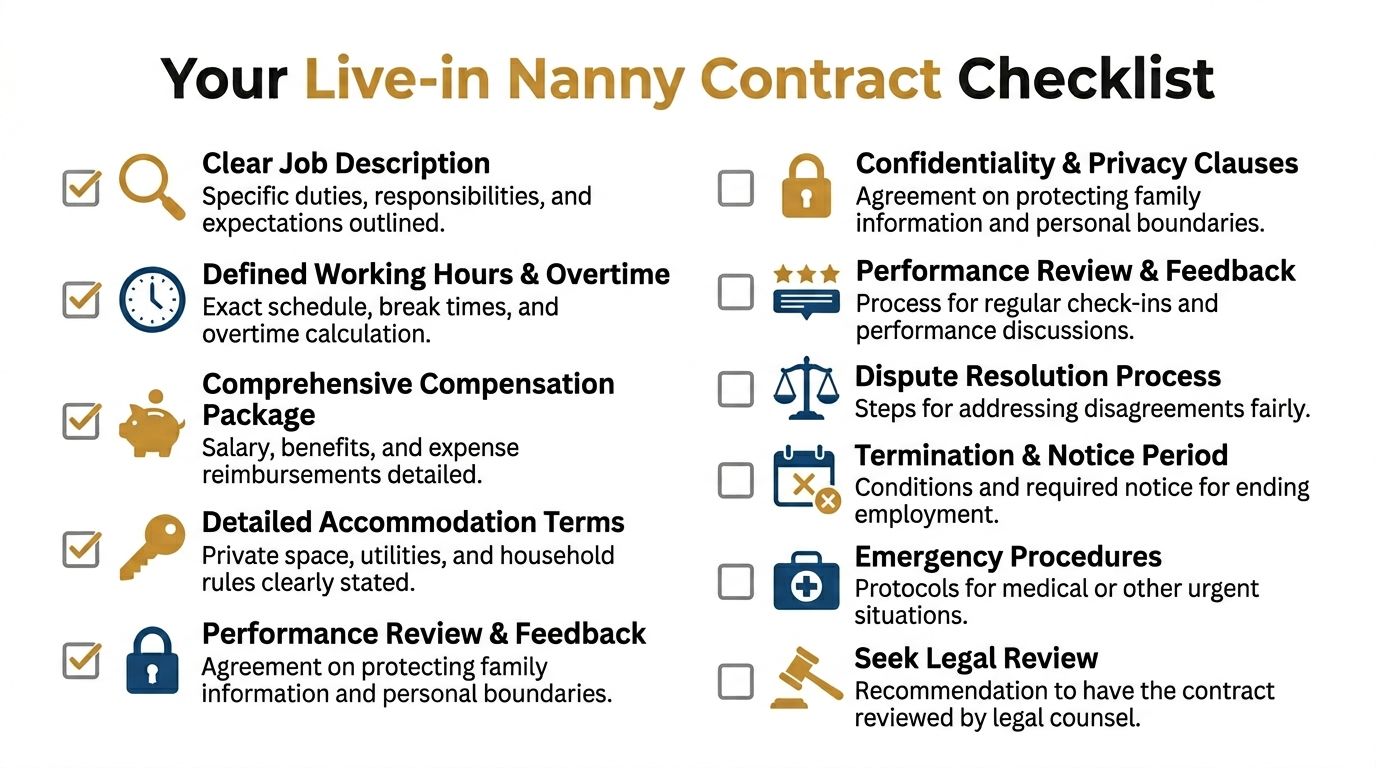
The quickest way to assess your current agreement is to ask whether it clearly covers the points below.
- Role definition with named duties and excluded duties
- Schedule with exact hours, nights, weekends, and travel expectations
- Compensation with pay mechanics, reimbursements, and benefits
- Accommodation with room details, meals, utilities, privacy, and move-out terms
- Confidentiality with social media, data handling, and household privacy rules
- Safeguarding with emergency and reporting procedures
- Termination with notice, handover, return of property, and housing exit steps
- Written amendments so changes don't drift into informal custom
A contract is usually at its weakest where the family says, “We'll sort that out as we go.” Live-in arrangements do not reward improvisation.
Frequently Asked Questions
| Question | Answer |
|---|---|
| Should a live-in nanny contract include a trial period? | Yes, if both sides want one. The useful point isn't the label. It's documenting what happens during that period, who can end the arrangement, what notice applies, and whether accommodation ends immediately or after a short transition. |
| Can I change the nanny's duties after she starts? | You can, but it should be done in writing and agreed by both parties. Small practical adjustments are normal. Major changes to hours, travel, household tasks, or reporting lines should never be left informal. |
| Does a live-in nanny count as working all the time because she lives in the house? | No. A live-in arrangement should distinguish active duty from rest time. If the contract doesn't do that clearly, misunderstandings around availability, overnight care, and time off usually follow. |
| Do I need separate confidentiality wording if my family is high-profile? | In most VIP or public-facing households, yes. A short generic confidentiality line is rarely enough. The contract should address family information, children's identities, images, routines, travel details, devices, and social media. |
| What is the biggest mistake families make with a live in nanny contract? | Ambiguity. The phrases that sound flexible at the start often become the clauses that cause friction later. Specific drafting is more respectful than broad language. |
If you're hiring for a live-in role across one residence or several, don't start with a generic online template and try to patch it later. Start with the actual realities of your household, then draft around them.
If you'd like support structuring a live in nanny contract for a London, US, or international placement, Superstar Nannies can help you think through the practical terms that generic documents usually miss, including confidentiality, travel, multi-property working patterns, and accommodation boundaries before the placement begins.