

Securing your peace of mind starts before the first day of work. A nanny can be exceptional with children and still walk into a role that becomes strained because the terms were vague, copied from the wrong jurisdiction, or never discussed properly. That's why nanny contract templates matter. They turn assumptions into written terms on wages, hours, notice, duties, and practical household expectations before the role begins. Guidance aimed at employers also stresses that a nanny agreement should be completed before the start date and should set out legal name, contact details, work address, schedule, gross pay, overtime rate, payment frequency, and termination terms in writing, alongside items like emergency contacts, confidentiality, and signed copies for both parties in order to reduce disputes from day one, as outlined in GTM's nanny contract guidance.
For elite, international, and high-profile households, standard nanny contract templates usually stop too early. They cover pay and holidays, then ignore privacy, travel, multiple residences, immigration, rota arrangements, or cases where your nanny may be working between London, New York, Monaco, or a yacht itinerary. If you're comparing formats right now, SheetMergy's guide to contract elements is a useful companion reference. Below are the templates I'd shortlist, with clear notes on when each works, where each falls short, and what needs bespoke drafting.
1. International Nanny Employment Agreement (IHSA Standard)
When a nanny will cross borders with the family, a domestic template from one country rarely holds up well on its own. An international agreement is the better starting point because it forces everyone to spell out where the work happens, who pays for travel, and what happens when local rules conflict.

A strong version suits families relocating between London, New York, and Monaco, bilingual nannies travelling with children across school holidays, and live-in roles where accommodation terms need separate detail. It also helps if the nanny's normal week changes depending on which residence the family is using.
Where it works best
This format is strongest when the nanny's role is continuous but the geography isn't. I'd use it for a Norland-trained nanny joining a family with a London base and regular international travel, or for a travel-heavy rota arrangement where one employment relationship covers several countries.
What works:
- Travel responsibilities are explicit: visas, flights, hotels, insurance, and per diem arrangements don't get left to informal texts.
- Accommodation is documented: live-in expectations, bedroom privacy, use of household space, and time off while travelling are easier to manage.
- Confidentiality can be layered: elite families can attach a separate privacy schedule without rebuilding the whole agreement.
What doesn't work is assuming the international template is enough by itself. It isn't. It still needs local legal review in every country where the nanny will work.
Practical rule: If the nanny will perform childcare in more than one country, draft one master agreement and then check whether local addenda are needed for pay, leave, working time, and termination.
Another common mistake is writing a glamorous travel clause that ignores fatigue. If the nanny is expected to manage overnight flights, unfamiliar time zones, and children in hotels, the contract should reflect recovery time, private sleeping arrangements, and who covers incidental travel costs.
2. Nanny Contract Template from the Department for Education (DfE) UK Government Resource
A family hires a nanny in London, agrees the hours over WhatsApp, and assumes the rest can be sorted once everyone settles in. Three weeks later, the problems start. Is school pick-up included if the child stays late for an activity? Does babysitting on Saturday count as overtime or part of salary? Who covers overnight care when parents travel? A DfE-style UK template helps prevent that kind of drift.
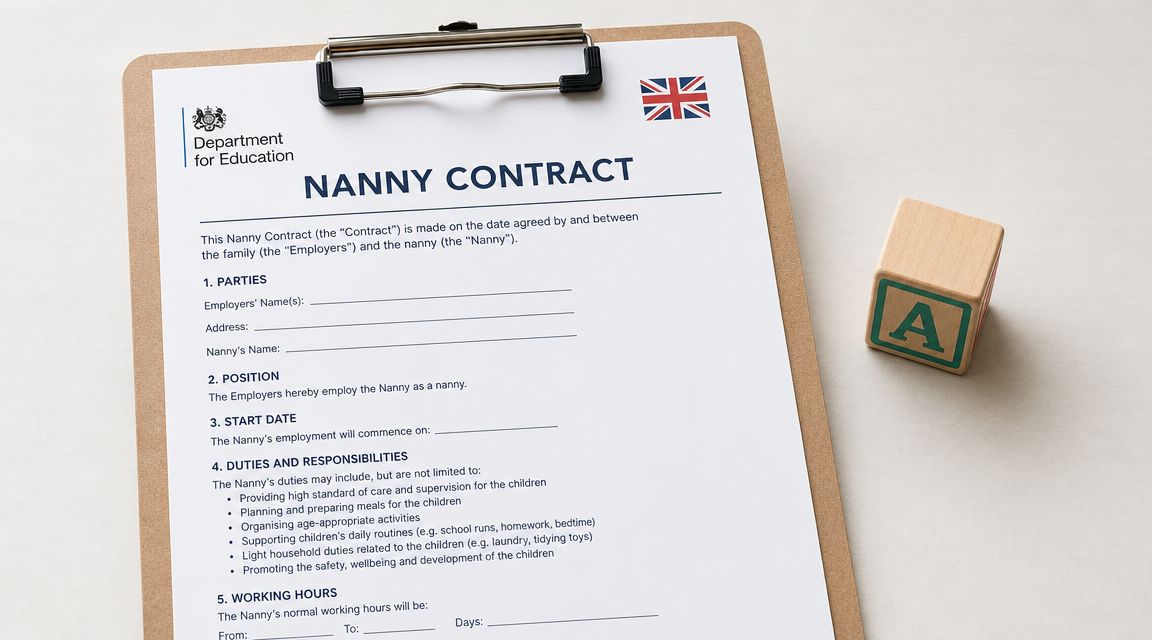
For a straightforward UK hire, this is often the cleanest starting document. It suits London families employing a daily nanny, agencies placing candidates into clearly defined childcare roles, and households where the nanny will handle nursery runs, homework supervision, and child-related tidying, but not broader house management. In larger homes, it also helps draw a proper line between the nanny, housekeeper, tutor, driver, and PA. That line protects everyone.
Why UK-first drafting matters
The strength of a government-style template is not sophistication. It is discipline. It prompts the family to put the core employment terms in writing before the role starts, including pay, hours, holiday, notice, and basic duties. In UK household employment, that baseline structure does a lot of work. It reduces avoidable ambiguity and gives both sides a document they can refer back to when memory becomes selective.
It also exposes weak instructions early. If a parent cannot describe the nanny's normal week, on-call expectations, or boundaries with other staff, the contract process usually reveals that gap before it turns into resentment.
This is particularly important for live-in roles, weekend-heavy schedules, and any arrangement that includes proxy parenting outside standard daytime hours. Those jobs often sound manageable in conversation and become contentious in practice.
Where the template falls short for private households
For elite and international families, the DfE model is rarely enough on its own. It is built for general UK employment clarity, not for the operational reality of a high-profile household with travel, security protocols, or cross-border planning.
I would treat it as the legal spine, then attach schedules that reflect how the family lives:
- Confidentiality and privacy: restrictions on social media, photography, guest information, children's routines, addresses, and anything learned inside the residence
- Security procedures: access codes, key handling, driver coordination, staff-only areas, and reporting lines if there is a breach or concern
- Travel and mobility terms: who holds passports, who arranges visas, what counts as working time in transit, sleeping arrangements, insurance, and time off in lieu
- Role boundaries in multi-staff homes: what remains childcare, what shifts to a governess or tutor, and what is outside scope entirely
That last point is one I see mishandled often. In UHNW homes, a nanny can gradually become part childcare professional, part family assistant, part travel coordinator, and part emotional shock absorber. If the family wants that breadth, the contract should say so and the compensation should reflect it. If they do not, the document should set hard edges.
A UK-compliant base document is still the right foundation for a London or England-based role. It just needs careful tailoring before it reaches the standard expected in a luxury household.
3. Nanny Contract Template from the International Nanny Association Professional Standard
Some nanny contract templates are legally tidy but operationally thin. They say when the nanny starts, what the pay is, and how much notice applies, but they don't say enough about the standard of childcare expected. That's where a professional-standard template is useful.
This style suits families who want to frame the nanny as a childcare professional rather than a general domestic helper. It works especially well for households employing a highly trained nanny, supporting multiple children with different developmental stages, or expecting structured communication about routines, milestones, school readiness, and behaviour.
Best use for professional households
I like this kind of template when parents want sophistication without turning the contract into a personality test. The document can define:
- Development-focused duties: reading plans, language exposure, activity design, and age-appropriate routines.
- Professional development expectations: paediatric first aid refreshers, continuing education, and role-relevant training.
- Communication standards: daily logs, handovers, travel briefings, and parent updates.
That helps avoid a common mismatch. Parents think they've hired a career nanny who will proactively manage child development. The nanny thinks she's been hired for safe, loving care with no requirement to produce detailed reporting. A better contract closes that gap.
A professional nanny contract should protect standards as well as employment terms. If you want educational structure, developmental observation, or language goals, write them down.
The limitation is simple. These templates often read beautifully and still need legal adaptation. They shouldn't replace country-specific employment advice on pay, leave, working time, or tax treatment. They're strongest when attached to a jurisdiction-specific agreement or used as a schedule that expands the job description and performance framework.
4. Household Employment Contract Template from American Nanny Institute and Household Employment Tax Providers
For U.S. placements, families often underestimate how quickly a nanny contract becomes a payroll and classification issue. The legal language may look routine, but the operational burden sits in wage rules, overtime handling, eligibility paperwork, and state law differences.
This template is most useful for families with homes in more than one U.S. state, live-in placements, and households that don't want ambiguity around employee status. It's also practical when a London-based family is adding a U.S. residence and wants one coherent onboarding process for domestic staff.
Where this format earns its place
In the U.S., household employment documents need to work alongside payroll systems, onboarding forms, and state-specific rules. A decent template won't just state salary. It will prompt the family to define hours worked, overtime treatment, reimbursements, holidays, and the line between child-related tasks and wider household duties.
If your family has a U.S. home, pair the contract with operational tax guidance. The 2026 US household employee tax guide for elite families is a sensible next step because the contract and payroll setup should agree with each other.
Common drafting errors
I see the same problems repeatedly:
- Employee status is blurred: the family uses contractor language because it sounds simpler.
- State issues are ignored: one template is used across residences without checking local requirements.
- Hours are too vague: “flexibility required” becomes a substitute for proper scheduling language.
UK readers should pay attention here too. A major trap in nanny contract templates is employment status. Guidance aimed at the UK market is explicit that many domestic workers are treated as employees when the family controls their work, and U.S.-style “independent contractor” wording can be wrong in the UK context. That matters for tax, National Insurance, holiday pay, sick pay, and pension duties, especially as flexible working has become more common. In 2025, the UK had about 4.21 million employees with flexible working arrangements.
If a template uses contractor language casually, I'd treat that as a warning sign.
5. Luxury Household Nanny Contract with a Confidentiality-Forward Agency Model
For public figures, entrepreneurs, royals, diplomats, and families with meaningful security concerns, confidentiality isn't a paragraph near the end. It's part of the role from the first interview.

This template style is built for households where the nanny will hear private conversations, see guest lists, travel itineraries, children's school details, and often the rhythms of the family's business life. In those homes, ordinary nanny contract templates are too generic.
What a strong confidentiality model includes
A serious luxury-household contract should cover more than “do not disclose private information”. It should identify the categories of information that are protected and describe how privacy is maintained in ordinary life.
That usually means clauses on:
- Digital discretion: no photos, no tags, no family details in social media captions, and no casual sharing in messaging groups.
- Household information: addresses, routines, travel dates, staff names, guest identity, and children's schools.
- Post-employment obligations: privacy duties continuing after the role ends.
For families refining these provisions, this guide to private staff confidentiality for high-profile families is worth reviewing alongside the employment agreement.
The balance that matters
The trade-off is enforceability. Overreaching confidentiality clauses can make a contract look impressive and function poorly. A nanny still needs the ability to report safeguarding concerns, speak to relevant professionals where authorised, and understand what information can be shared for legitimate work reasons.
Client note: The best confidentiality clause is specific, teachable, and realistic. If the nanny can't explain it back to you in plain language, it's too vague.
I'd also separate confidentiality from control. A family may want privacy around children and the residence, but that doesn't automatically justify invasive monitoring or unfair restrictions unrelated to the job.
6. Nanny Contract Template for Specialised Roles
A night nanny, maternity nurse, and rota nanny don't work in the same way. Yet families still try to force these roles into standard nanny contract templates. That usually creates confusion within weeks.
This category needs role-specific drafting. A night nanny requires overnight expectations and rest provisions. A maternity nurse needs a tightly defined scope around newborn care and postpartum support. A rota nanny needs precise scheduling, handovers, and consistency across changing weeks.
Match the contract to the role
A specialised template should answer the practical questions that normal daytime nanny contracts miss.
For example:
- Night nanny roles: define active duty hours, whether the nanny is expected to remain awake, what counts as an emergency, and how relief cover works.
- Maternity nurse roles: define the temporary nature of the engagement, newborn-focused responsibilities, feeding support boundaries, and coordination with medical professionals.
- Rota nanny roles: define the rotation pattern, handover expectations, travel overlap, and what happens if one side of the rota changes.
Families deciding between early newborn support and longer-term childcare should also review this comparison of maternity nurse and nanny roles for elite parents.
What families often miss
The biggest drafting mistake is assuming flexibility will solve everything. It won't. In specialised roles, flexibility without detail usually means sleep disruption, unclear authority, and resentment about “unspoken” expectations.
One legal issue deserves special attention in UK contracts. Under the National Minimum Wage framework, live-in domestic workers can be exempt from hourly minimum wage only in narrow cases, while other domestic workers generally must be paid at least the applicable minimum wage for hours worked. That's why contracts using gross hourly rates and overtime clauses need explicit schedule tracking and pay terms, as reflected in the sample nanny employment agreement used in household employment guidance.
If a specialised role includes overnight care, weekend work, or additional hours, I'd never leave those points implied.
7. Portable Nanny Contract Framework for Travel and International Mobility
Some families don't need a single-country nanny contract. They need a portable framework that can travel with the household and still stay intelligible. That's a different drafting exercise.
This is the right model for a travel nanny supporting children across several residences, a diplomatic or security-conscious household, or a family whose year moves between London, New York, the Gulf, Europe, and seasonal travel. The purpose isn't to replace local compliance. It's to create a stable backbone for a mobile role.
What belongs in a portable framework
A portable travel-nanny contract should deal with the parts of the job that repeat regardless of destination:
- Travel logistics: who books transport, what class of travel applies, baggage expectations, and reimbursement timing.
- Accommodation standards: private room requirements, proximity to children, and whether the nanny is considered on duty overnight.
- Authority and emergencies: who the nanny contacts in a medical issue, what authority she has while abroad, and how local care is accessed.
For families hiring into this kind of role, this guide to travelling nannies for international families is a useful operational companion.
The hidden pressure points
Mobility clauses fail when they romanticise travel and ignore admin. Visas, work permission, insurance cover, tax handling, and local rest expectations should sit in the agreement or its schedules. If the family wants the nanny to be endlessly adaptable, the contract must be equally disciplined.
Travel nanny contracts should read like working documents, not aspirational brochures. Every repeated travel problem should have a written answer.
The best versions also define which jurisdiction governs disputes, where notices are served, and how updates are handled when travel patterns change. That keeps the agreement usable when the household's movements shift mid-year.
7-Template Nanny Contract Comparison
A family with homes in London, New York, and the South of France does not need the same contract as a family hiring one local after-school nanny. That is where template comparisons usually fall short. They rank forms by length or popularity, rather than by the pressure points that cause disputes in high-value households: confidentiality, travel, immigration status, overnight boundaries, and cross-border pay.
Use the table below to match the template to the household, then review the gaps before anyone signs. A polished document can still be the wrong document.
| Template | Core focus and legal coverage | Target audience | Key strengths | Limitations and considerations |
|---|---|---|---|---|
| International Nanny Employment Agreement (IHSA Standard) | Cross-border hiring terms for the UK, US, and EU. Covers confidentiality, safeguarding, live-in terms, payroll, tax, and travel. | Elite international households with staff working across countries | Strong on multi-country issues. Balances family protection with fair employee terms. Usually includes the clauses standard domestic templates miss, especially travel and privacy. | Needs local legal review before use. Too detailed for a simple local role. Must be updated if the family's residence pattern changes. |
| Nanny Contract Template (DfE, UK Government Resource) | UK employment basics, including safeguarding, pay minimums, statutory leave, and standard procedures. | UK-based families and agencies hiring for straightforward domestic roles | Clear, familiar, and grounded in UK employment practice. A sensible starting point for families who want written terms that cover the basics properly. | Built for general use, not private office level risk. It will not go far enough on confidentiality, media exposure, complex schedules, or multi-residence living. |
| Nanny Contract Template (INA Professional Standard) | Job duties, child development expectations, training, conduct, and review structure. | Families who want a highly professional nanny and clear standards around the role | Good for setting expectations around childcare quality, communication, and professional conduct. Helpful in placements where parents want clear developmental responsibilities written in. | It is more operational than legal. Employment status, tax, and local law points usually need separate drafting. Can feel heavy if the role is informal or narrow. |
| Household Employment Contract Template (American Nanny Institute and Household Employment Tax Providers) | US household employment terms, payroll handling, worker classification, tax, and state-level compliance points. | US UHNW families, family offices, and households employing across more than one state | Strong practical value for payroll and tax handling. Useful where the real risk is misclassification, overtime errors, or inconsistent state compliance. | US only. Families still need state-specific review. Less useful for international travel, visas, or privacy-sensitive households unless extra clauses are added. |
| Luxury Household Nanny Contract with a Confidentiality-Forward Agency Model | Privacy clauses, data handling, social media restrictions, household security rules, and dispute terms. | Royal, celebrity, political, and UHNW households where discretion is a hiring condition | Better suited to visible families than generic templates. Addresses reputational risk directly and sets clearer boundaries around phones, photos, guest information, and staff conduct. | Can be too restrictive if badly drafted. Some clauses may be hard to enforce in certain jurisdictions. Overly aggressive language may also put off excellent candidates. |
| Nanny Contract Template for Specialised Roles | Terms for night nannies, maternity nannies, rota nannies, and other specialist childcare posts. Covers schedule structure, premiums, handovers, and role-specific duties. | Families hiring for newborn care, night coverage, rota positions, or other specialist support | More accurate for unusual schedules and skill sets. Helps avoid disputes about sleep breaks, handovers, premium pay, and the limits of the role. | Needs careful customization to the actual job. Shared-care and rota arrangements often break down if responsibilities and reporting lines are vague. |
| Portable Nanny Contract Framework for Travel and International Mobility | Travel schedules, visas, work permission, accommodation, insurance, tax handling, emergency authority, and repatriation terms. | Ultra-mobile households with regular international travel or multiple residences | Particularly useful for families who move often. Keeps recurring travel problems in writing instead of relying on goodwill or last-minute texts. | High admin burden. Usually requires input from immigration, tax, and employment advisers. If travel patterns change often, the contract will need active management rather than one-off drafting. |
The practical question is not which template looks most formal. It is which one matches the way the household operates.
For a local nanny working fixed hours in one country, a government or professional-body template is often enough with sensible edits. For UHNW and international households, the safer starting point is usually the opposite. Begin with the clauses that protect privacy, define travel authority, and handle cross-border employment properly, then scale down if the role proves simpler than expected. That approach reduces the chance of finding the gap only after a problem has started.
Finalise Your Nanny Agreement with Expert Support
The right nanny contract template saves time. The wrong one creates false confidence. That's the key distinction.
For a straightforward local hire, a solid domestic employment template may be enough once it's adapted for the role. For elite households, though, the pressure points are rarely basic. They sit in confidentiality, travel, rota scheduling, multi-residence logistics, accommodation boundaries, employment status, and what happens when the family's lifestyle changes faster than the paperwork does.
That's also why copying language from a random online contract is risky. Many nanny contract templates are written for the wrong country, the wrong role, or the wrong level of household complexity. In the UK especially, status and pay terms need careful attention. Written terms should be completed before the start date, and they should state core points such as schedule, gross pay, overtime, payment frequency, and termination. If the role involves live-in care, overnight support, weekend work, or travel, those details should be drafted with precision rather than left to goodwill.
The other practical point is fairness. A strong agreement doesn't just protect the family. It also gives the nanny a clear framework for success. Good contracts reduce misunderstandings because both sides can see the same expectations in black and white. That usually leads to better retention, calmer communication, and fewer avoidable disputes.
If you're hiring for a high-profile, international, live-in, rota, or travel-heavy role, bespoke drafting is usually the sensible route. A consultant or solicitor can adapt the right template, align it with the actual working arrangement, and make sure the clauses are enforceable and proportionate. If you're working with an agency, ask whether they provide a sample contract of employment and whether that sample can be customized to your household structure.
Superstar Nannies is one option for families who want support with discreet placements and the employment framework around them. Choosing the right nanny contract template is the first step. Customising it properly is what protects the relationship.
If you'd like personalized guidance on nanny contract templates, confidential household terms, or employment agreements for international and high-profile roles, contact Superstar Nannies for a private consultation.