

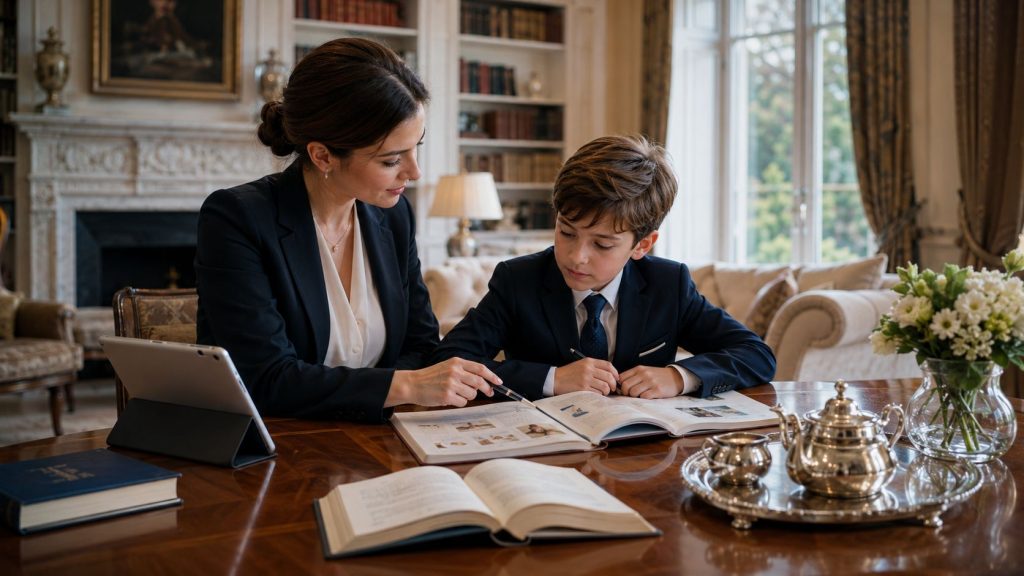
You're juggling school runs, travel, and a calendar that never quite clears, yet your child still needs calm, consistent academic support at home. That is where a private teacher becomes more than a convenience, especially for families who want learning to fit around household life rather than the other way round.
In the UK, this is no longer a niche arrangement. The Sutton Trust's 2026 report says 29% of secondary school students in England and Wales have had private tutoring at some point, up from 18% twenty years earlier and 27% in 2019, with 45% in London compared with 27% in the rest of England and 24% in Wales (Sutton Trust 2026 private tutoring figures). For UHNW families, that matters because the right private teaching arrangement can look less like after-school help and more like an integrated part of the home's educational rhythm.
Introduction to Private Teachers for Modern Families
A family may seek a private teacher when school alone cannot accommodate the child's timetable, learning pace, or wider circumstances. One child may need exam preparation, another a steadier routine, while a third needs consistent teaching during term time, travel, and holidays.
Household-based teaching provides a familiar setting and a dependable adult. Lessons can follow the child's school, interests, and goals rather than a generic syllabus. The benefit is continuity: progress, confidence, and daily habits are easier to maintain when teaching does not restart with a different tutor each week.
The role also changes with the household's rhythm. A live-in governess-tutor may teach in the morning, remain available during family travel, and keep learning structured through school breaks. A live-out teacher may provide focused lessons on set days, then leave responsibility for the rest of the day with parents or household staff. Neither arrangement is automatically better. The right choice depends on privacy, travel, supervision, and how closely education must follow family life.
For parents, subject knowledge is only part of the brief. A suitable teacher must also work respectfully around other staff, communicate with parents, and coordinate learning without disrupting the home. Subject-specific shortages can make this combination harder to find than a standard tutor.
A tutor supports a subject. A private teacher helps hold together the child's wider educational routine, so the hiring brief must assess teaching ability, household fit, and continuity together.
What a Private Teacher Is and How the Role Works
A private teacher sits between classroom teaching and casual tutoring. A gym class follows one plan for a group. A personal trainer watches one person closely, adjusts the work, and catches problems early. Private teaching works the same way, because the lesson content, pace, and feedback are built around one child or a small sibling group.
That setup can be live-in, live-out, travelling, full-time, or part of a governess-tutor hybrid. In a larger household, the role may also include pastoral support, diary management, and educational coordination, especially where several adults already shape the child's day. A school tutor after dismissal usually handles one subject block. A private teacher in the home may handle curriculum planning, parent communication, and coordination with other staff as part of the same brief.
Historically, this kind of one-to-one teaching is not new. By the eighteenth century, it was already a preferred option among upper classes in England and Scotland, and parental spending is now estimated at around £2 billion per year, rising to as high as £6 billion in 2026 reporting (historic and spending context). That history matters because it shows private teaching has long been tied to continuity, status, and individual instruction.
Practical rule: if the child needs more than homework help, and the home needs teaching to fit around family life, you are looking for a private teacher rather than a casual tutor.
For parents comparing roles, explore education exam prep can help frame the gap between subject support and more structured academic planning. The key question is not only “Can they teach?” but “Can they teach inside this household, to this child, with this level of consistency?”
Typical Duties and Specialist Roles Inside Elite Homes
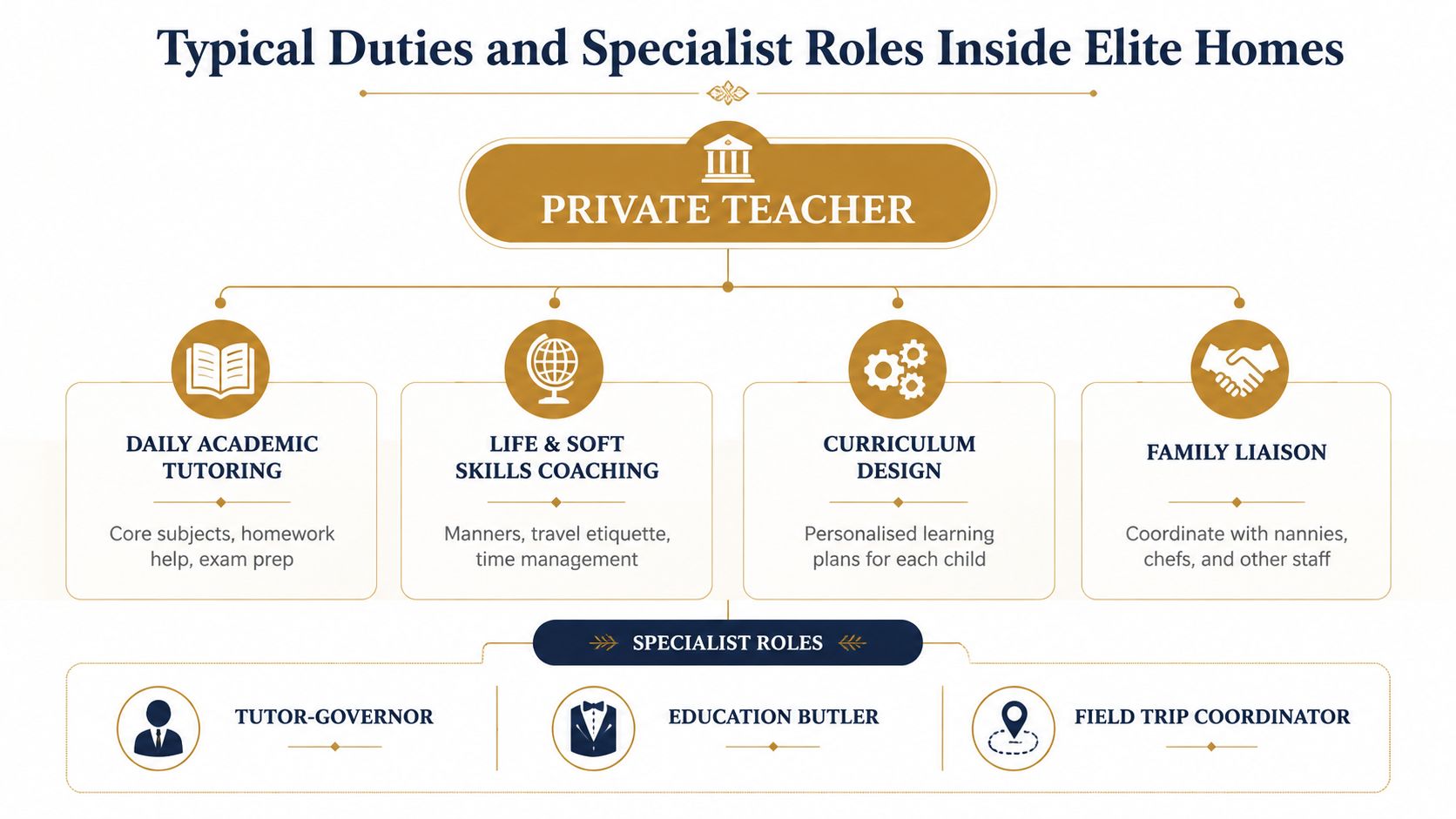
The strongest private teachers don't just deliver lessons. They build a working system around the child, so school learning, homework, revision, and character development all pull in the same direction. In a fully staffed home, that can mean operating as the educational anchor while nannies, house managers, and parents handle everything else around it.
Core academic work
The daily job often starts with curriculum planning. A private teacher may map the week around school topics, exam dates, and gaps spotted in previous sessions. That includes homework support, mock paper review, and short, focused teaching when a child is tired or distracted.
For older pupils, the remit can stretch into exam preparation and structured revision. For younger children, it may look more like literacy building, numeracy fluency, and a calm routine that stops learning from becoming a battle.
Wider household education
A good private teacher often supports more than grades. Language immersion, reading habits, discussion skills, etiquette, and time management all sit comfortably within the role when the family wants a broader educational finish. In international homes, that can include careful alignment with British, IB, or US expectations, so the child doesn't end up with mixed messages from school and home.
The strongest results come from diagnostic teaching, not broad enrichment. The Education Endowment Foundation's synthesis found one-to-one tuition delivers about +5 months of additional progress on average, while small-group tuition delivers about +4 months, with the strongest gains when tutoring is tightly aligned to the school curriculum and delivered regularly over time (EEF synthesis summary). That is why serious households expect a teacher to spot exact gaps, not just “go over work.”
How the role looks in practice
A private teacher should leave a child clearer, calmer, and more organised after the session, not just busier.
Common household uses include:
- Primary years support, reading fluency, spelling, number confidence, and routines that make learning feel steady.
- Secondary exam support, especially where the family wants weekly continuity and close school alignment.
- Language-focused teaching, where the child needs active speaking practice, grammar correction, and cultural confidence.
- All-round governess style support, where the teacher also guides manners, presentation, and study habits.
If you're weighing in-home education against homeschooling support, private tutor for homeschooling the elite guide to bespoke in-home education 2026 gives a useful frame for how the role can sit inside a broader household structure.
Qualifications Vetting and Safeguarding You Should Expect
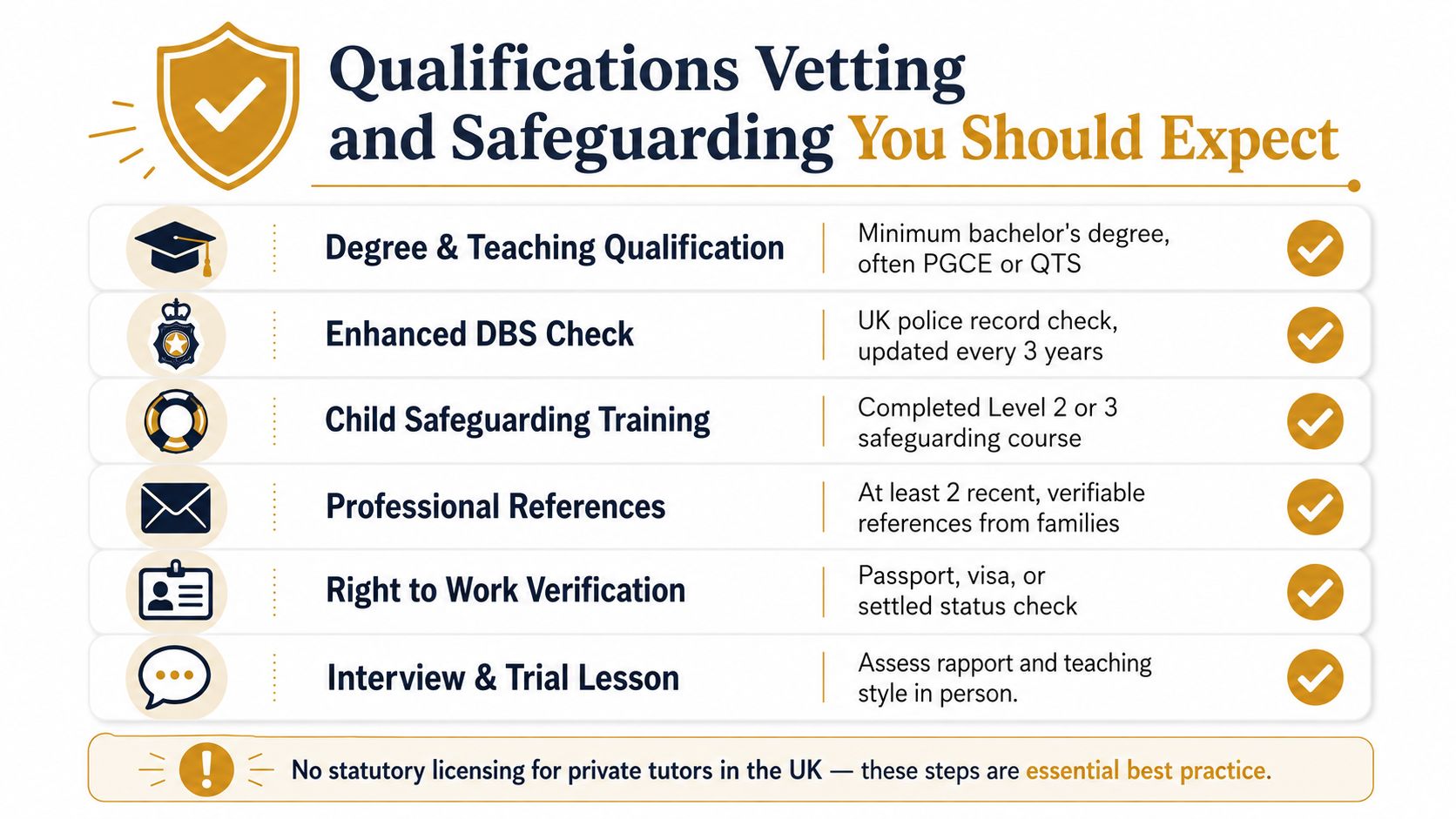
A household hiring a private teacher should start with a simple fact. In the UK, there is no single statutory licensing system for this work, so safety depends on checking credentials, references, and hiring process with care. A 2025 academic review noted that England has never had unified statutory regulation for private tutors, which is why families rely on safeguarding checks, local guidance, and school policies rather than one national rulebook (academic review on regulation gaps).
That matters because the right check depends on the setting. A live-out tutor who visits for an hour needs a different level of oversight from a governess-tutor hybrid who may be working around the child's daily routine, household staff, and wider family schedule.
Prospects says most private tutors have a degree, there are no formal entry requirements, and agency placements often ask for degree-level qualifications (Prospects private tutor profile). For UHNW homes, that means subject strength and trust signals usually carry more weight than a single certificate.
What to compare before you hire
A careful shortlist should include:
- Degree-level subject background, because older pupils need real command of the material.
- Teaching credentials such as PGCE or QTS, where relevant, because they show classroom training as well as subject knowledge.
- Recent, verifiable references, ideally from families who can speak to consistency, discretion, and communication.
- Child safeguarding training, especially if the teacher will spend long periods in the home.
- Trial lesson performance, because paper credentials do not show how the teacher settles a child or adapts in the room.
An enhanced DBS check is not automatically required in every one-to-one tutoring arrangement, even though many platforms ask for it. The route you hire through, and whether an intermediary is involved, changes the compliance picture.
For families comparing routes, private tutor qualifications is a practical reference point. It helps separate minimum standards from stronger signals and reassuring evidence.
If the role will sit inside a broader family structure, the most useful question is whether the teacher can work safely and consistently around the child's real day, not just deliver a polished interview.
How Families Choose the Right Private Teacher for Their Household
Choosing the right private teacher is less about ticking boxes and more about fit. A brilliant chemistry graduate can still be the wrong hire if your child needs patience, bilingual delivery, or someone who can travel without the teaching collapsing. Start with the child's real needs, then shape the brief around them.
Build the brief around the child
Ask yourself three questions. What does the child need help with now? What kind of adult do they respond to? What setting will the teaching happen in most often? The clearer those answers are, the easier it becomes to decide whether you need a subject specialist, a governess-style educator, or a hybrid.
Watch for supply gaps
Recent UK platform data shows sharp subject-level imbalances. Piano has roughly six times more demand than tutor supply, with 2.38% of requests vs 0.41% of tutors, and languages including Italian, Arabic, Japanese, Portuguese, German, and Korean also show demand outpacing supply by two to four times. Glasgow and Edinburgh were the only cities where demand consistently exceeded supply (UK tutoring supply and demand data).
That matters because families often search too narrowly. If you need a niche subject, start early and be open about travel, rota structure, and level of fluency. For German specifically, compare IB and Goethe German tutors is a useful lens for families deciding between exam-led and conversation-led teaching.
Interview for judgement, not charm
A strong interview should test how the teacher thinks. Useful questions include:
- How do you find gaps quickly?
- How do you adjust when a child resists a topic?
- How do you report progress to parents?
- How do you handle school coordination and confidentiality?
The essential questions to ask a potential governess resource is especially helpful if you are deciding whether your brief needs an academic tutor, a governess, or both.
How Agencies Place Private Teachers for UHNW and VIP Households
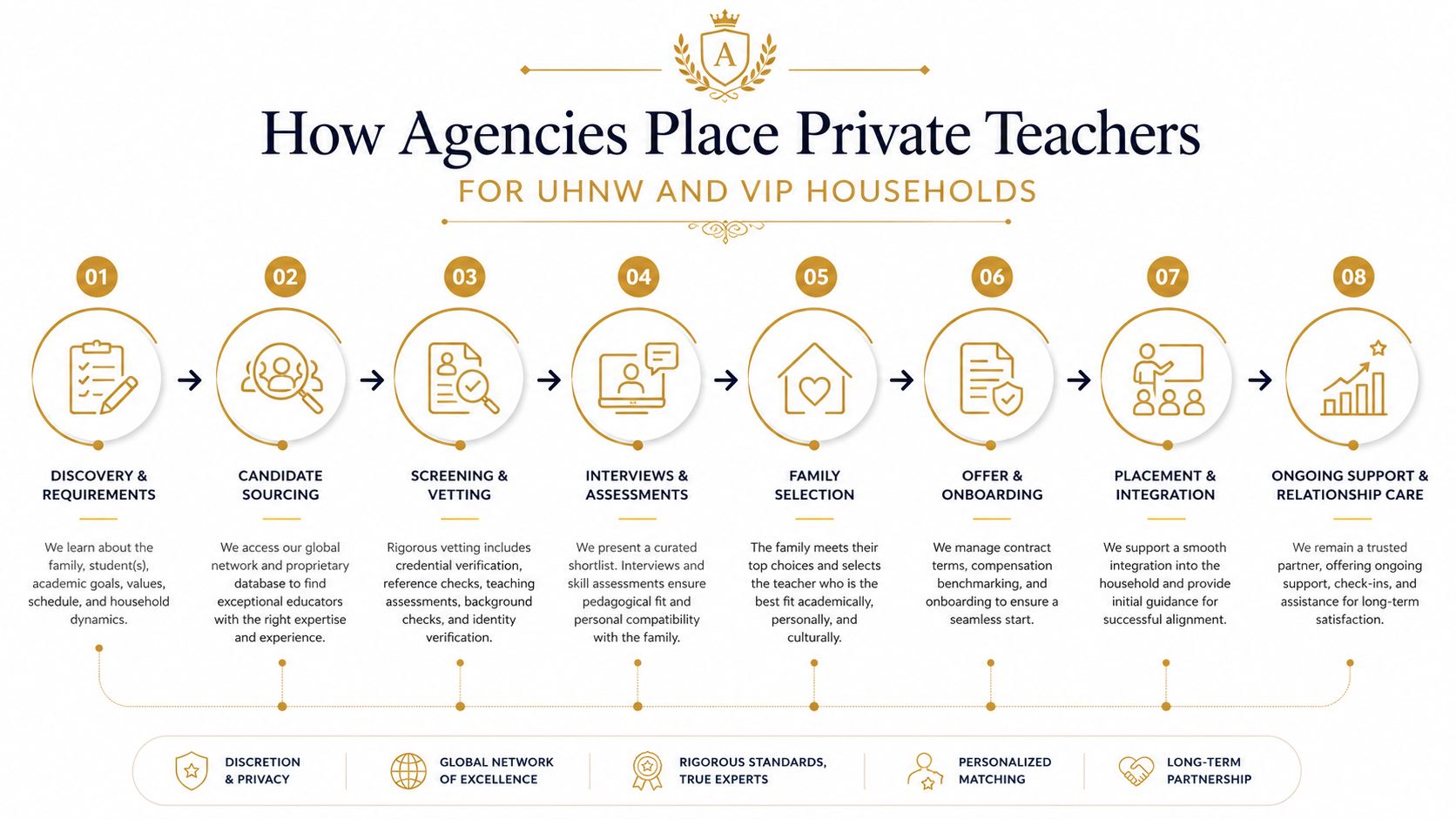
A discreet agency search starts with the household, not the CV. Families are usually asked about schooling, travel, languages, privacy, age range, values, and how much contact the teacher will have with parents and other staff. That first conversation sets the whole brief, because the role may be a subject tutor, a governess, or a broader educational figure inside the home.
The next stage is matching, reference checks, and screening. In UHNW placements, the unseen work often matters most. The agency is not forwarding candidates. It is checking whether the teacher can work within the family's routines, keep confidence, and adapt to international schedules without friction.
What the placement flow usually includes
The process often moves through these stages:
- Briefing
- Search and shortlist
- Credential review
- Reference verification
- Interviews
- Trial period
- Contract finalisation
- Ongoing support
That structure matters in international households, where expectations can shift between London, Europe, the Middle East, and Asia. A family may need someone who can support exam preparation and also fit the household's culture, schedule, and level of formality.
Subject shortage also shapes the search. Some families need a teacher for piano, languages, or a specific curriculum, and the pool can be thin. In those cases, agencies often widen the brief, for example by considering whether the role should be live-in or live-out, or whether a governess-tutor hybrid would suit the child better. international governess agency a guide for elite families is a useful reference for how that kind of cross-border placement is usually handled.
Compliance and safeguarding need the same level of care. Government guidance updated in 2026 says tutoring intermediaries may fall under employment agency rules, they cannot charge tutors for work-finding services, and one-to-one private tutoring is not automatically regulated activity, so an enhanced DBS check is not legally required in every case (2026 tutoring intermediary and DBS guidance). For UHNW homes, that means agencies must go beyond a standard DBS assumption and look at the full picture, including references, discretion, household fit, and the setting in which the teaching will happen.
Bringing Trusted Education Into Your Home With Confidence
A private teacher does more than fill a timetable. The right person gives a child structure, momentum, and a sense that learning belongs naturally inside the home. For UHNW families, the benefit is not only convenience, it is education delivered with discretion, continuity, and the right level of household integration.
The strongest placements usually rest on three things working together, a clear brief, proper vetting, and a match that suits the family's culture as well as the child's needs. That is why private teaching should never be treated as a quick hire. It is a relationship role, and the best placements are built for stability.
In practice, that can mean a live-in or live-out governess-tutor style arrangement, or a subject-specific teacher for a gap that is hard to fill. The search often needs more care than a standard DBS check suggests, because references, discretion, household fit, and the teaching setting all matter.
If you want an academic figure who can support homework, exam preparation, or a broader governess-tutor arrangement, Superstar Nannies can help you define the brief and handle a discreet search. Speak with Superstar Nannies for a consultation shaped around your household, your standards, and your child's learning needs.