


You're in a kitchen or hallway at the end of a long day, and a simple instruction has already gone sideways. One person thought “breakfast by 7.30” meant a target, another heard it as a flexible wish, and no one is quite sure who was supposed to confirm what. That is the work of communication across cultures in private homes, where fluent English can still leave families, nannies, tutors, and house managers working from different assumptions.
The challenge isn't usually vocabulary. It's the hidden rules behind hierarchy, privacy, directness, response time, and who gets to decide what counts as “done”. In the UK, that matters in ordinary life, not just in global business, because the 2021 Census counted 14.6% of residents as born outside the UK, and England and Wales recorded 18.7% of residents born outside the UK in the same census NYU guide, ONS census release. In homes where staff move between different cultural expectations all week, communication becomes a practical operating system, not a personality test.
When Fluent English Is Not Enough
A nanny hears, “Could you make sure breakfast is sorted by half past seven?” The words are polite, and nobody sounds upset. She treats it as a preference, starts a few minutes later than expected, and the parent reads that delay as unreliability because the underlying expectation was never made explicit.
That kind of mismatch happens even when everyone speaks English well. Communication across cultures is often less about language ability and more about whether people share the same sense of urgency, authority, and acceptable tone. The British Council's intercultural guidance points out that meaning is often carried by indirectness, politeness, and unstated assumptions, so households get better results when they replace idioms and “read between the lines” instructions with clear tasking and written confirmation British Council guidance.
Why softened wording causes confusion
In many homes, people soften requests because they want to sound considerate. “Whenever you get a moment” can mean “this morning” to one person and “today if possible” to another. That gap matters most when children are involved, because meal times, school departures, bedtime, and medications need precision rather than vibes.
Practical rule: if the task affects a child, travel, safety, or privacy, state the owner, deadline, decision threshold, and escalation path in plain English.
A useful habit is to hear yourself as if you were new to the house. If the instruction depends on cultural context that hasn't been shared, it probably needs rewriting. That is why communication across cultures works best as a repeatable process, not as a test of who is more culturally aware or more accommodating.
A job title can also hide confusion. A tutor may assume the parent wants initiative, while the parent expects regular approval before any change. A house manager may think discretion means keeping everything quiet, while the family expects selective reporting and immediate escalation for anything involving children or safety. The fix is rarely more politeness. It's more clarity.
Accent reduction training for household professionals can help with pronunciation confidence, but it won't solve mismatched expectations on its own.
Six Cultural Lenses That Shape Household Communication
A private home is not a seminar room. It's a working environment shaped by schedules, emotions, children, visitors, and confidential information. That's why cultural theory becomes useful only when it turns into a few simple lenses people can use at the breakfast table, in a WhatsApp message, or during handover before school.
The six lenses in plain language
Context asks how much meaning is carried in the words themselves versus the situation around them. Power distance looks at whether people expect hierarchy, permission, and senior approval. Time orientation checks whether punctuality is treated as strict or flexible, and whether a schedule is a promise or a guide.
The other three matter just as much at home. Directness shapes whether feedback sounds respectful or blunt. Nonverbal communication covers pauses, eye contact, gesture, and personal space. Privacy concerns what should stay confidential, who may hear it, and how much detail is appropriate in front of children or other staff.
Here's a simple comparison for the same household instruction.
| Communication lens | Higher-context expression | Lower-context expression | Useful household response |
|---|---|---|---|
| Time | “We'll sort breakfast early.” | “Breakfast must be ready by 7.30 a.m.” | Confirm the exact time in writing |
| Directness | “Could we perhaps adjust the routine?” | “Please change the routine today.” | Ask which part is firm and which part is optional |
| Power distance | “I'll wait for your approval.” | “I'll make the call unless told otherwise.” | Name who decides and when escalation is required |
| Privacy | Said quietly, in private | Said openly and specifically | Move sensitive feedback out of shared spaces |
A framework like this is also useful outside households. If you want a broader organisational angle, the guide for CHROs on culture is a helpful reminder that shared norms shape how people interpret the same message.
Some people think clear communication is cold. In practice, clarity is what protects dignity when the household is busy, emotional, or multilingual.
Superstar Nannies' cultural sensitivity training sits naturally beside these ideas when a family wants support in turning theory into day-to-day practice.
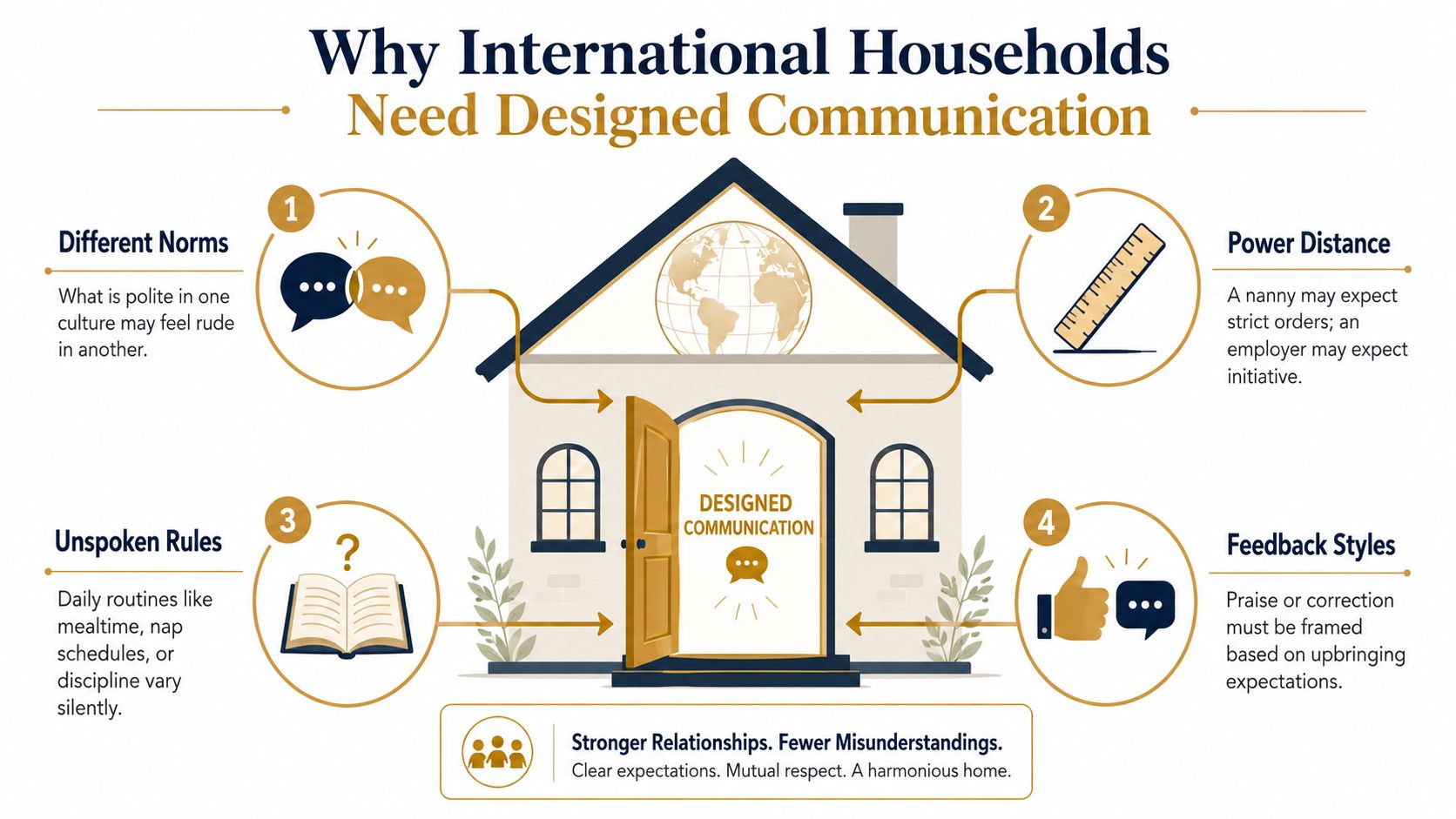
Why International Households Need Designed Communication
International homes are exposed to interpretation at every turn. A nanny may move from a British household to a family with Middle Eastern or Asian norms in the afternoon, then deal with a European tutor by evening. The home itself also has its own culture, shaped by family habits, class expectations, professional routines, and each person's personality. That's why the same instruction can land differently even before language becomes an issue.
The safest areas to standardise are the ones where a mistake affects a child or the family's logistics. Think childcare rules, dietary requirements, travel plans, emergency contacts, media permissions, security routines, and household standards. If those are left to assumption, staff spend time checking, second-guessing, or apologising for avoidable errors.
Simple systems do the heavy lifting
The most useful tools are ordinary ones. A shared glossary stops “packed lunch”, “snack”, and “snack box” from meaning three different things. Written minutes help the adults remember what was agreed. A named owner prevents the common problem of everyone assuming someone else has handled the task.
Closed-loop confirmation is even better. That means the person receiving the instruction repeats back the action, deadline, and escalation condition in their own words. It sounds basic because it is basic, and basic systems save time when everyone is moving quickly.
Household rule: if the instruction can affect a child, a car journey, a medicine, a visitor, or a bedtime routine, don't leave it floating in conversation.
For families building onboarding from scratch, the Intonetic cross cultural training guide is a useful reference point for the kind of structure that turns awareness into usable habits.
What a well-run household makes visible
- Who owns each decision: no guessing about whether the nanny, parent, or house manager is expected to act.
- What must be written down: routines, restrictions, and exceptions that staff need to follow consistently.
- How fast a reply is needed: not every message needs urgency, but some do.
- Where discretion begins: children, visitors, finances, and family privacy need clear boundaries.
Superstar Nannies also places bilingual nannies, including Mandarin and Russian bilingual nannies, which can support families that need language comfort alongside household professionalism.
Childcare and Household Scenarios That Commonly Go Wrong
A child refuses to eat lunch, and the nanny offers a replacement meal because that's what worked in her last role. The parent later feels ignored, not because the food itself was wrong, but because the rule was never stated as firm. The underlying problem was incomplete information, not bad intent.
Another day, a tutor waits for sign-off before sending revised homework because the parent sounded cautious in the first meeting. In that case, hesitation looked like respect to one person and delay to another. A simple line such as “You may adjust the worksheet without approval, but check with me before changing exam prep” would have removed the uncertainty.
Where misunderstanding usually hides
Some errors are obvious. Others hide inside tone, silence, or everyday habits.
- Humour and idioms: “You're on fire” can sound encouraging in one setting and bizarre in another.
- Silence: a pause can mean thoughtfulness, discomfort, disagreement, or a polite wait for more detail.
- Punctuality: one person hears “around eight” as a small window, another hears it as a commitment with flexibility.
- Eye contact and proximity: direct gaze may signal respect to one person and pressure to another, while standing too close can feel efficient or intrusive depending on the person.
A house manager can also get caught in the middle. If feedback is delivered at the breakfast table in front of the children, the problem may not be the content of the correction. It may be the loss of face. A private conversation later in the day preserves dignity and usually gets a better result.
Ask first, “What was missing from the instruction?” before asking, “Why didn't they understand?”
That question changes the whole conversation. It moves the household away from labelling someone as careless, difficult, or indirect, and towards checking whether the message was complete enough to work. Families and staff both benefit when they treat confusion as a signal to improve the system rather than a reason to blame a person.
Hiring and Onboarding for Clear Mutual Understanding
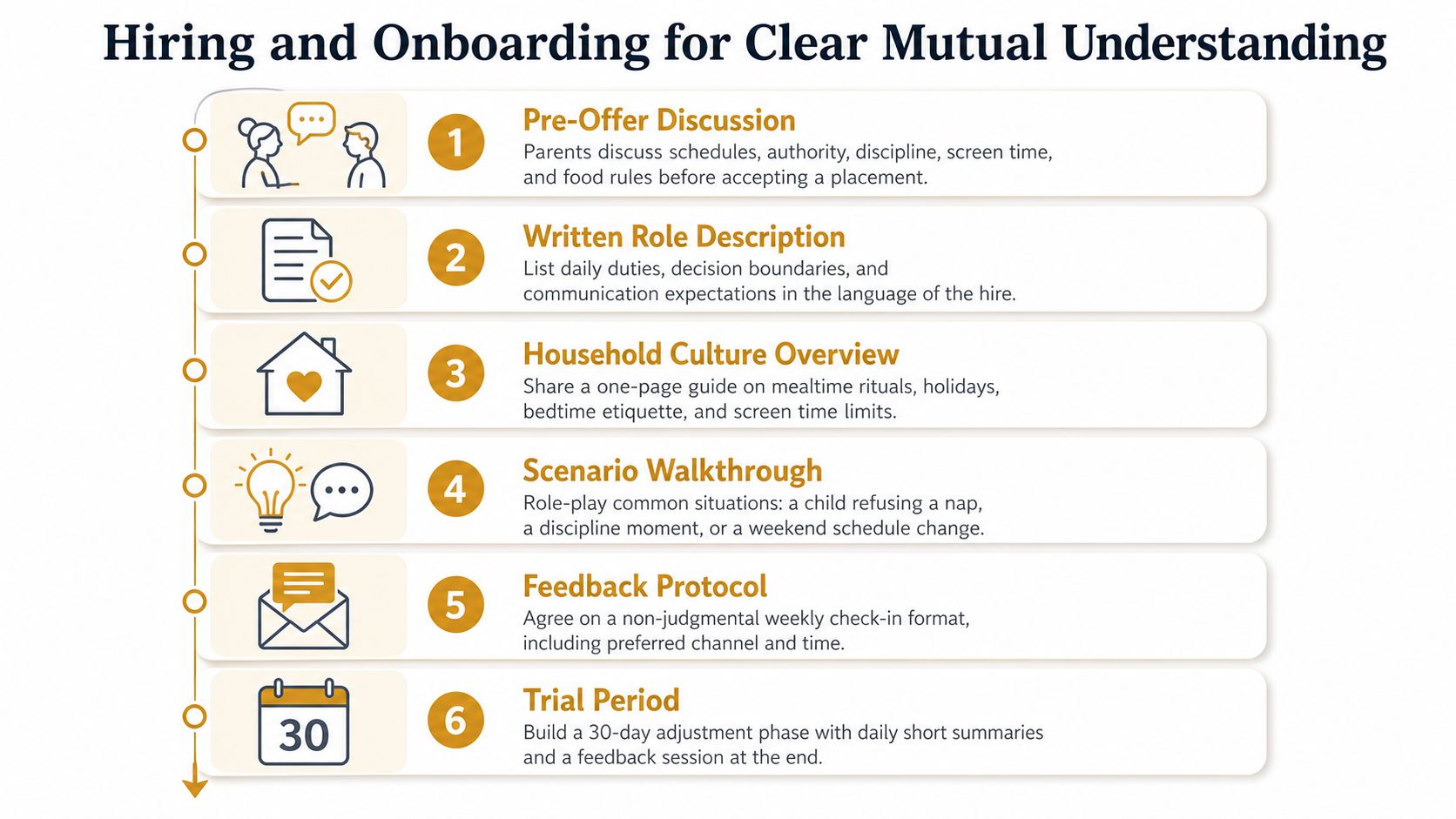
Good onboarding starts before the placement is accepted. Parents, nannies, and household managers need the same core subjects on the table early, because once the role begins, people are already trying to perform under pressure. Clear discussion about schedules, authority, discipline, screen time, nutrition, travel, privacy, phone use, emergency decisions, and feedback style prevents a lot of avoidable friction later.
A role-specific onboarding checklist
- Write the role down: a short role profile should list daily duties, decision boundaries, and who signs off on exceptions.
- Share household norms: mealtimes, bedtime rituals, dress codes, screen limits, and the family's preferred level of formality.
- Agree on communication channels: decide what goes by text, what needs a call, and what should be saved for a face-to-face check-in.
- Use demonstration, not assumption: show how the pram, car seat, pantry, laundry system, or security entry works.
- Confirm understanding in the hire's own words: repeat-back is more reliable than “does that make sense?” because people often nod out of politeness.
- Set review points: a weekly check-in helps surface small misunderstandings before they harden into habits.
Nannies should be invited to say how they prefer to receive correction, what decisions they are comfortable making alone, and what religious or caring commitments might affect availability. Household managers need the family's expectations translated into routines and escalation paths, not left to guesswork. That also means they shouldn't be asked to act as a cultural gatekeeper for everyone else in the house.
If a family is also reviewing recruitment channels, inclusive recruitment practices can help them look at the process with more care and less assumption.
When language support is the right tool
Some roles need more than patience and good will. If a task has safety implications, or if the hire and the family have very different levels of English confidence, professional language support can be useful. Children shouldn't be used as interpreters for adult responsibilities, because that creates pressure and blurs boundaries.
The simplest standard is this. If a job can affect a child, a car, a passport, or a medical decision, it deserves clear written follow-up. Not because the people involved are untrustworthy, but because the stakes are too high for memory alone.
Daily Protocols for Travel and Changing Household Norms
Travel exposes every weak point in household communication. The house becomes a hotel, the routine shifts, and people start making quick decisions in unfamiliar settings. That's when response windows, written records, and named approval rights stop being administrative fuss and start being safety tools.
What to confirm before the trip
Before departure, check passports, permissions, addresses, medical details, dietary rules, local emergency contacts, and who may approve changes to the plan. If a family uses multiple residences, add time zones, local staff contacts, and any house-specific procedures that may differ from the main home. Small things matter too, such as whether shoes are removed at the door, whether phones can be used at the table, or whether photography is welcome around guests.
A concise briefing works best. Use one primary channel for urgent matters, keep a written record of decisions, and agree on a reply window so nobody is left guessing whether a message has been seen. The same habit supports etiquette in shared spaces, because staff can't guess whether a new residence treats punctuality, dress, or introductions differently from the last one.
A useful closed-loop exchange
Parent: “Please confirm the children's passports are in the travel folder, and tell me if anything is missing by 5 p.m. If there's a problem, message me and the travel coordinator immediately.”
Nanny: “I'll check the passports now, put them in the travel folder, and send you a written update by 5 p.m. If one is missing, I'll contact you and the travel coordinator straight away.”
That exchange works because it names the action, the deadline, and the escalation condition. It also leaves less room for polite ambiguity, which is often where travel errors begin.
Resolving Conflict Without Stereotypes or Loss of Dignity
Conflict in a private home can feel heavier than conflict in an office because the relationship is personal, the work is intimate, and the consequences affect children and references. The safest approach is private, specific, and calm. Talk about the behaviour you observed and the impact it had, not about what you assume the person meant.
If a nanny missed a school pickup, the conversation should start with the facts. Ask her to explain her understanding of the instruction, then listen for role ambiguity, timing confusion, or a mismatch between the written rule and the informal wording she heard. In some cases the issue is not resistance at all. It's that the household's expectations were never made visible enough to follow.
A respectful way to correct and repair
Directness is appropriate when safety or a child's welfare requires clarity. Respect still matters, so the correction should stay private, measurable, and free from embarrassment. The goal is to preserve dignity while making the standard unmistakable.
- State the observable issue: say what happened, where, and when.
- Describe the impact: explain the effect on the child, family routine, or household operation.
- Ask for understanding: let the employee restate how they understood the instruction.
- Agree the change: write down what will be done differently next time.
- Set a follow-up point: check again after the agreed change has been in place.
For staff who work across borders or cultures, it also helps to name feedback style openly. Some people expect criticism in private and in very soft language, while others want blunt clarity and immediate correction. If the family and employee can discuss that preference early, they're less likely to read feedback as disrespect or vagueness.
For a broader context on cross-border misunderstandings and repair, conflict resolution skills for expats in Italy is a useful reference point.
Conflict resolution strategies for household staff are most effective when they combine clear standards with written follow-up and a chance to respond.
A Communication Agreement for a Harmonious Home
A calm home runs on shared rules that everyone can follow. Start before placement with clear conversations about who decides what, who should be informed, and how quickly a reply is expected when something changes. Put important instructions in writing, use language that leaves little room for guesswork, and set private review points before small misunderstandings turn into tension.
In international private households, communication functions like the home's operating system. A request may be perfectly polite and still fail if it ignores hierarchy, privacy, or the speed at which someone is expected to respond. One family may expect a quick text update about a child's schedule, while another may prefer a quiet report later in the evening. Naming those habits early helps everyone avoid reading silence, directness, or delay as carelessness.
Cultural frameworks should guide better questions, not become labels for predicting behaviour. A communication agreement works best when it spells out practical details, such as how corrections are given, what must stay confidential, and when an issue should be raised immediately instead of waited on. That kind of clarity protects dignity on both sides, especially in homes where staff and family members come from different communication traditions.
For families seeking support with international household staffing, Superstar Nannies can help with confidential recruitment and placement conversations that fit the home's routines and values.