


You've found the right nanny. She's calm under pressure, the children adore her, and your household finally feels properly supported. Then the admin starts. Payroll, tax withholding, employment status, insurance, pension duties, right-to-work checks, and different rules if your family splits time between London, New York, Palm Beach, or Dubai.
Many families make expensive mistakes.
Nanny tax obligations aren't a technical afterthought. They are part of employing someone lawfully, protecting your household, and treating a valued employee properly. If you're hiring directly, you are taking on employer responsibilities whether you intended to or not. Families considering a long-term live-in arrangement often focus first on logistics and fit, but practical planning matters just as much. This overview from Bornbir to hire a live-in nanny is useful for thinking through the structure of the role before payroll and compliance are built around it.
For internationally mobile families, the risk is higher. A nanny may work in one country, be paid from another, and travel with the family into a third. If you don't set the arrangement up correctly at the start, the cleanup is usually far more painful than the setup.
Introduction The Hidden Responsibilities of Hiring a Nanny
Hiring a nanny feels personal. Tax law treats it as employment.
That distinction matters because many families still approach childcare arrangements too casually. They agree a salary, transfer funds each week or month, and assume the nanny will sort out her own taxes. In a typical household employment arrangement, that's the wrong approach in both the UK and the US.
The better view is simple. If you employ a nanny, you should run that role like any other serious employment relationship. That means clear documentation, proper payroll, timely filings, and a structure that protects both sides. Families who get this right usually avoid stress later. Families who improvise often end up dealing with back taxes, penalties, and strained staff relationships at exactly the wrong moment.
Practical rule: The easiest time to solve nanny tax obligations is before the nanny's first working day.
For high-net-worth households, this matters even more. Rota schedules, travel, multiple residences, estate staff coordination, and confidentiality requirements add complexity quickly. A basic internet checklist won't cover realities of a family office environment. You need a defensible process, not guesswork.
Employee or Contractor The Foundational Nanny Tax Question
Most nanny tax problems begin with one wrong assumption. The family treats the nanny as a contractor.
That is usually incorrect.
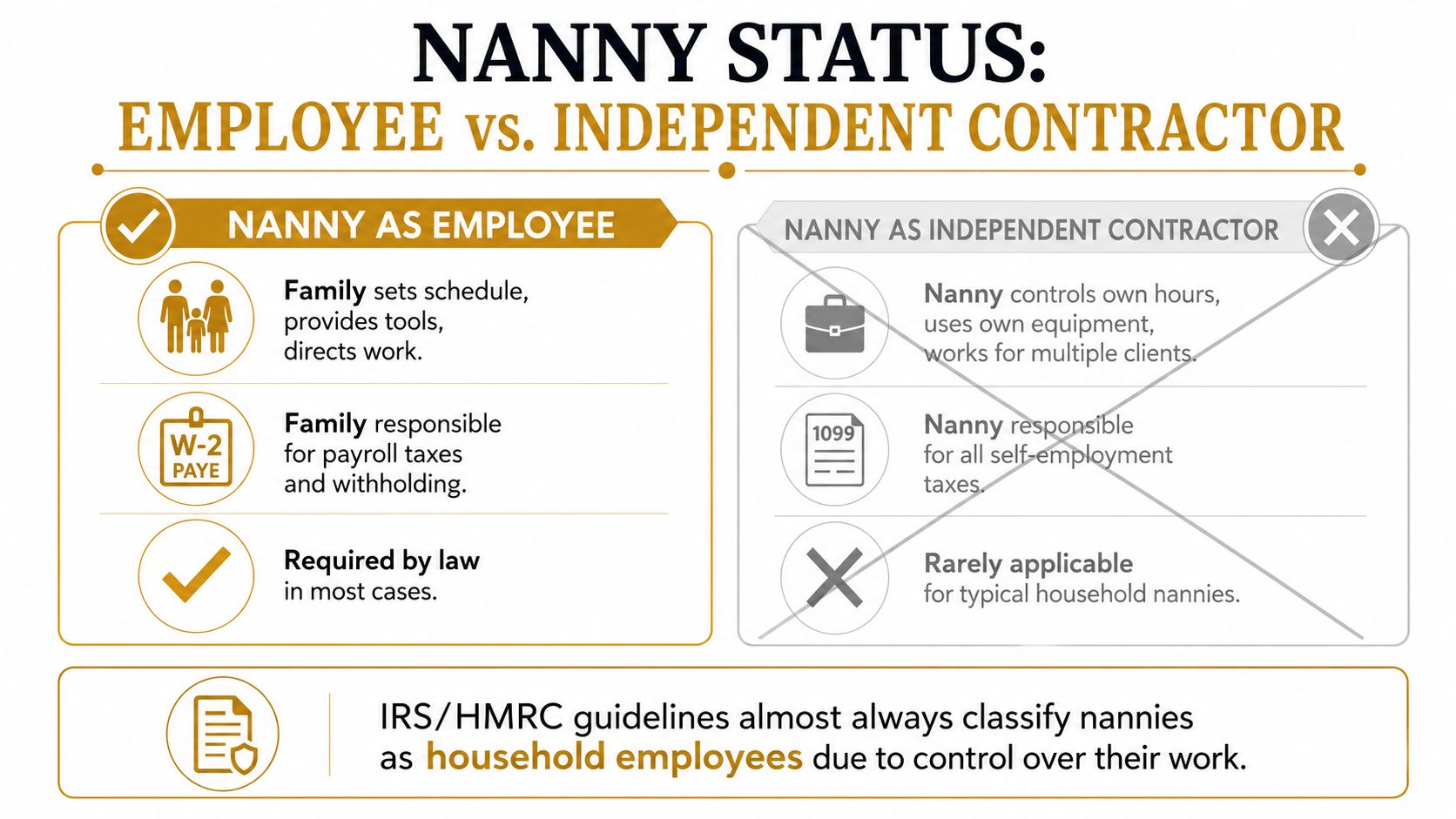
Why most nannies are employees
If you set the nanny's schedule, decide the children's routine, specify duties, provide the workplace, and control how the role is performed, you are dealing with an employee, not a self-employed contractor. That is the core logic in both HMRC and IRS analysis.
In the UK, this is especially clear. Employers are legally required to deduct and pay Income Tax and National Insurance on a nanny's behalf, and failure to comply can result in monthly fines of £100 per non-compliant instance, according to Taxfix's explanation of UK nanny tax rules. The same source states that the law explicitly prohibits asking a nanny to be self-employed unless they are a registered childminder or work for three or more families.
The control test is what matters
Families often get distracted by labels. Calling someone “freelance” in a contract doesn't make them self-employed.
Use this practical test:
- You control the hours. If you decide when the nanny starts, finishes, travels, or sleeps over, that points to employee status.
- You control the duties. If you assign nursery drop-off, meal prep, travel packing, homework support, or bedtime cover, that points to employee status.
- You control the environment. If the work happens in your home, your residences, or during family travel under your direction, that points to employee status.
A genuine contractor usually markets services to multiple clients, controls their own workflow, and bears business risk. That's rare in a standard nanny arrangement.
Misclassification doesn't save money. It usually delays the bill and increases the mess.
If you want a broader framework for thinking about the legal logic behind status decisions, this guide to mastering employee classification for service businesses is a useful companion. The underlying principle is the same. Control drives classification.
The mistake wealthy families make most often
International families sometimes assume a highly paid nanny, rota nanny, or travel nanny can invoice the household. That is still usually the wrong answer if the family controls the role. Higher compensation doesn't convert employment into independent contracting.
Treat the classification decision as foundational. Everything else in your nanny tax obligations follows from it.
Navigating UK Nanny Tax HMRC PAYE and National Insurance
A family relocates from New York to London, brings in a full-time nanny, pays by bank transfer, and assumes payroll can wait until routines settle. That is the kind of administrative shortcut that creates HMRC exposure fast. In the UK, a nanny hired directly by the household is usually an employee, and the tax system expects employer action from the start.
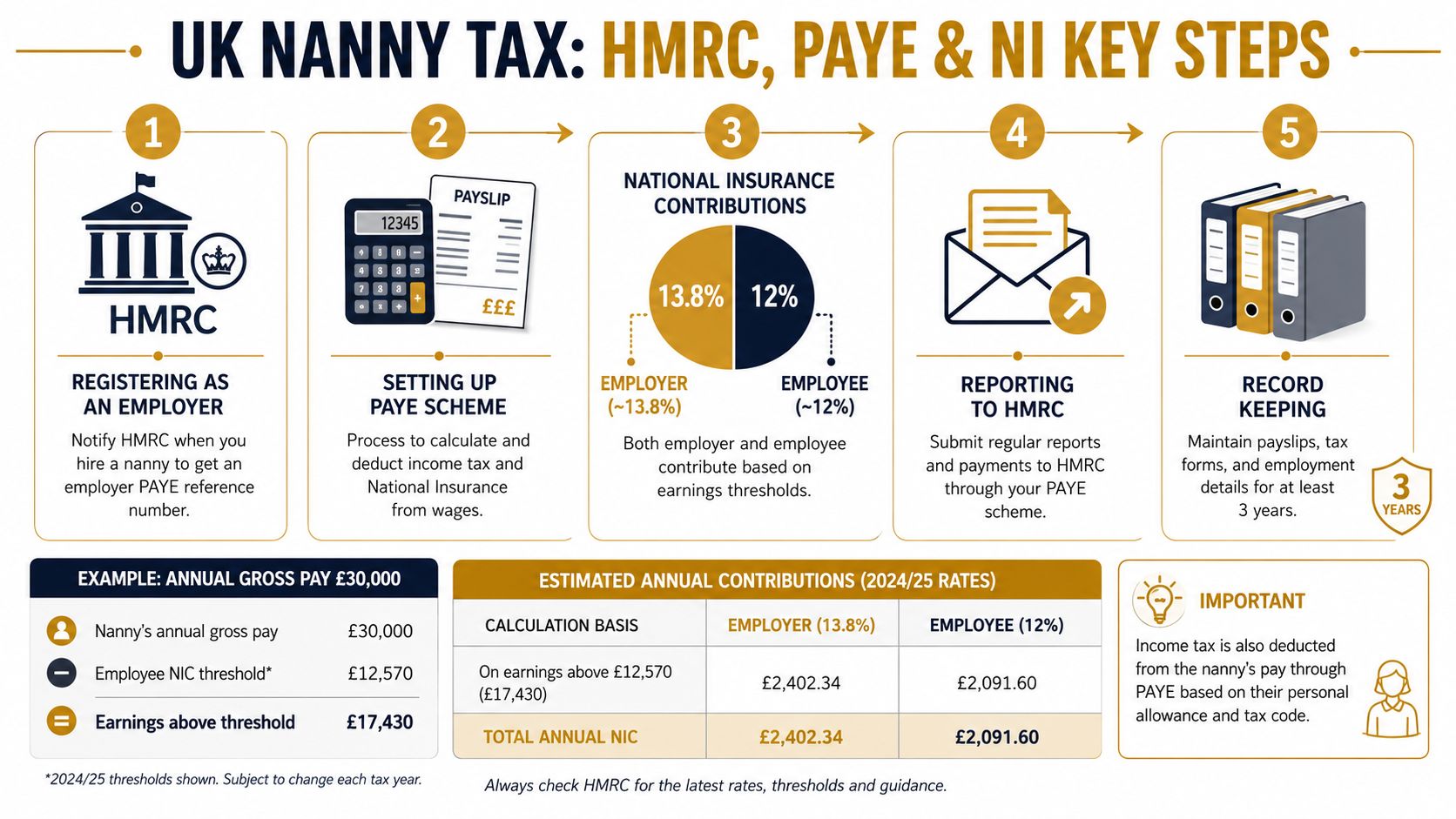
For internationally mobile families, the risk is higher. A London base, overseas principals, travel between residences, and rota coverage do not relax UK payroll rules. They usually make recordkeeping, tax residency questions, and benefit reporting more sensitive.
What a UK household employer must put in place
Start with the employer setup and document trail. HMRC expects a real payroll process, not informal payments followed by year-end cleanup.
A compliant household should:
- Register with HMRC as an employer
- Set up a PAYE scheme
- Check the nanny's right to work in the UK
- Run payroll every pay period and report through RTI
- Deduct Income Tax and employee National Insurance where required
- Pay employer National Insurance where required
- Keep payroll records and issue payslips
- Put employers' liability insurance in place
Use a written contract that matches how the role functions. If the nanny will travel, sleep over, rotate with other staff, or split time across residences, spell that out before the first payroll run. This UK nanny contract template for elite households is a practical starting point.
PAYE and National Insurance start earlier than many families expect
HMRC's Employer further guide to PAYE and National Insurance contributions sets out the operating rules. In plain terms, once earnings cross the relevant thresholds, the household must withhold tax and National Insurance correctly and pay employer amounts on time.
The point for a private household is simple. You cannot judge payroll duties by annual salary alone. Weekly or monthly pay levels matter, and they can trigger deductions much earlier than principals expect, especially with overtime, overnight cover, or travel-day pay added in.
National Insurance also affects the nanny's contribution record. Even where no employee NI is deducted at a lower band of earnings, the role can still count toward state benefit entitlements if handled properly through payroll. Informal payment arrangements put that at risk.
Budget for total employment cost, not just salary
Salary planning is where affluent households often get this wrong. The quoted wage is only one line item. Employer National Insurance, pension duties where auto-enrolment applies, insurance, holiday pay, statutory payments, and payroll administration all sit on top.
The ONS earnings and hours data is a better benchmark source than relying on agency marketing material alone. Market pay for experienced childcare staff, especially in London and for bilingual, travel-ready, or rota roles, can move quickly. Build a budget that reflects the actual market and the full employer burden.
| UK payroll item | What matters |
|---|---|
| Gross pay | The agreed salary is only the starting point |
| Employee deductions | PAYE and employee NI may need to be withheld |
| Employer cost | Employer NI increases cost above salary |
| Pension duties | Auto-enrolment can apply depending on age and earnings |
| Insurance and records | Required administration, not optional extras |
The UK errors that create the biggest problems
High-net-worth families usually make the same mistakes:
- Paying informally: Cash, transfers, and reimbursements can all be taxable pay.
- Starting work before payroll is live: Late setup creates reporting gaps and rushed corrections.
- Ignoring travel and multi-residence working patterns: Cross-border schedules complicate tax, immigration, and working time records.
- Using the wrong employing entity: If a family office, trust structure, or overseas principal is involved, assign the employer role clearly at the outset.
- Treating payroll as an admin task instead of a risk issue: HMRC, pension duties, insurance, and employment rights all depend on clean setup.
A professionally run household has payslips, documented terms, and records that stand up to scrutiny.
For senior nannies, long-term staff, and rota teams, assume full employment obligations will apply and build the system properly from day one. That is the right approach for compliance, for staff retention, and for protecting the principal.
Understanding US Nanny Tax Federal and State Obligations
The US system is different in structure but similar in principle. If you hire a nanny directly, you are generally a household employer. That means federal responsibilities, state responsibilities, and a filing trail that needs to match the wages you pay.

Start with the employer setup
The practical first step in the US is obtaining a federal Employer Identification Number, then establishing payroll and state unemployment registration where required. You also need onboarding documents that align with wage withholding and year-end reporting.
This is not an area for loose administration. If your household pays regular wages, reimburses expenses, pays bonuses, or runs a travel schedule with overnight expectations, your payroll records need to be clean from day one. For a more detailed US-specific walkthrough, review this 2026 US household employee tax guide for elite families.
What federal nanny tax usually includes
In the US, families generally need to think about four buckets:
- Social Security taxes
- Medicare taxes
- Federal unemployment taxes
- State unemployment and state payroll obligations
The wages may also involve federal income tax withholding if the arrangement is structured that way. Some household employers choose to assist with withholding to avoid unpleasant surprises for the employee later.
Why US families should avoid informal payment arrangements
The most common operational failure is paying a nanny through personal transfers without a payroll system. That creates problems immediately. You lose consistency, you weaken your records, and you make year-end reporting harder than it needs to be.
A better workflow looks like this:
- Run every wage payment through payroll
- Keep records for wages, reimbursements, bonuses, and time worked
- Separate household employment from personal banking noise
- Coordinate federal and state filings with your adviser or payroll provider
If your accountant only notices the nanny in March, you started too late.
Cross-border families need one lead adviser
US households with a UK home, or UK households spending substantial time in the US, often make a structural mistake. They ask local advisers in each jurisdiction to solve only their own piece. That can leave major gaps.
A family office or lead adviser should coordinate the full picture:
| Cross-border issue | Why it matters |
|---|---|
| Where the work is performed | Local employment rules may attach where services are physically delivered |
| Who pays the wages | Payment source and household structure affect reporting |
| Travel and temporary residence | A nanny accompanying the family can create jurisdictional questions |
| Multiple homes | Payroll needs to match the actual employment arrangement |
The right mindset is disciplined, not reactive. Build a formal payroll structure first. Then let your tax and legal team adapt it to the family's movement and staffing model.
Your Practical Compliance Workflow and Checklist
Most families don't need more theory. They need an execution plan.
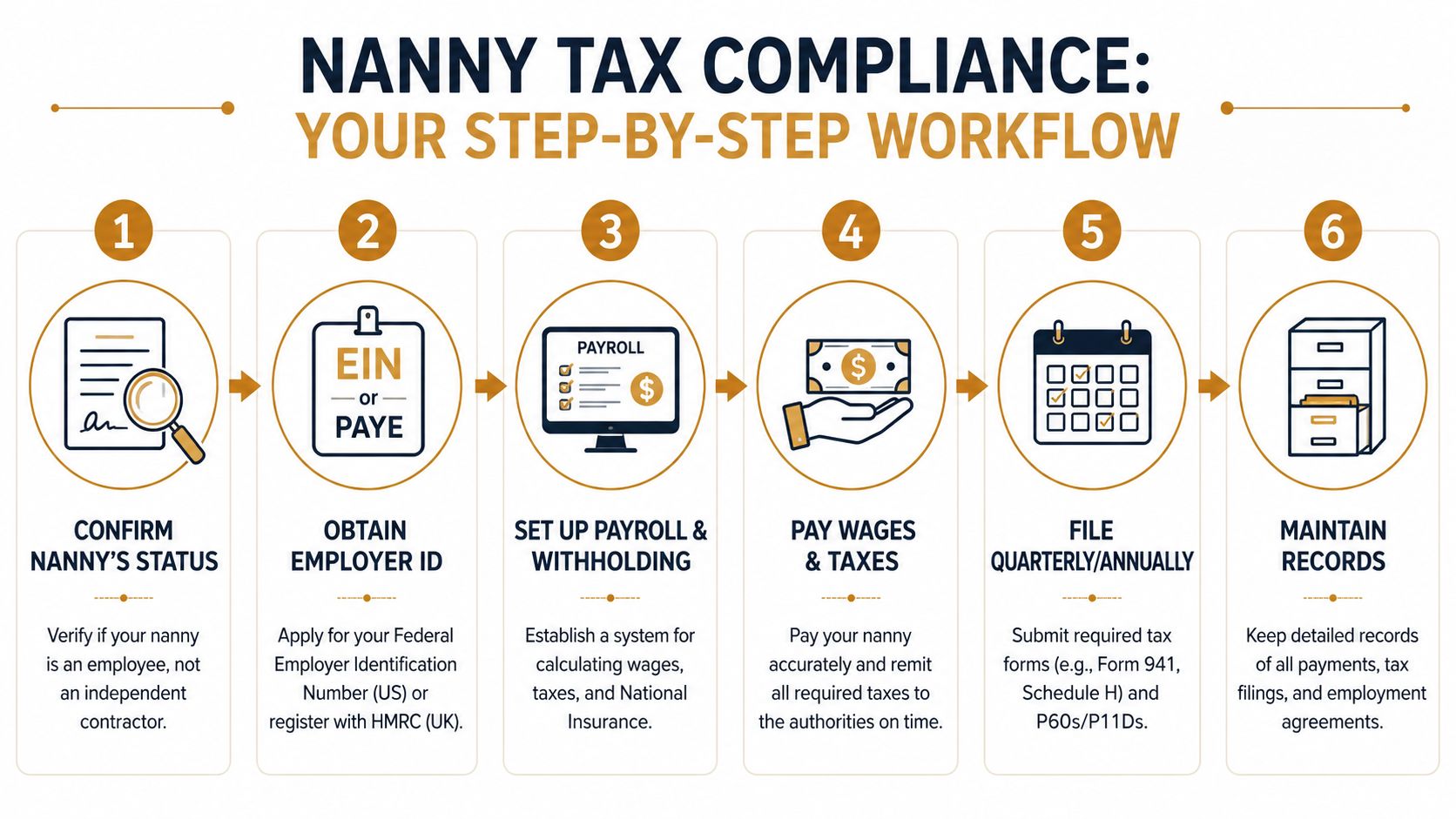
Before the nanny starts
Start with the role itself. Confirm job title, duties, normal working location, schedule, overnight expectations, travel expectations, confidentiality requirements, and reporting line. If the nanny supports more than one residence or works with other household staff, document that too.
Then collect the core onboarding information. In the UK, that includes right-to-work evidence and payroll details. In the US, it includes the tax and employment forms your payroll provider or adviser requires.
The working checklist
Use this order and don't skip steps:
Confirm employment status
If the family controls the work, treat the nanny as an employee.Register the household correctly
UK families should register with HMRC and set up payroll. UK employers must register with HMRC and set up payroll, as the law prohibits asking a nanny to be self-employed. This also helps nannies build a verifiable work history and protects employers from off-payroll penalties that can reach 150% of unpaid taxes, as noted in this discussion of payroll compliance risks.Choose a payroll method
Use specialist household payroll support, dedicated software, or a capable accountant who understands domestic employment. Don't run this manually from a notes app and online banking.Define gross and net pay clearly
If the family and nanny are not aligned on this point, disputes start early. This guide on gross pay vs net pay is useful for avoiding exactly that confusion.Set up record keeping from day one
Keep signed contracts, payslips, timesheets where relevant, benefit records, leave records, and proof of tax filings.
What to review during the year
Don't treat compliance as a one-off setup.
- Review pay changes: Salary increases, bonuses, and overtime treatment should flow through payroll properly.
- Check travel patterns: If the nanny works across jurisdictions, revisit your assumptions.
- Audit documents: Make sure the contract, payroll records, and actual working pattern still match.
- Coordinate with the family office: Household staffing should sit inside the broader risk framework, not outside it.
Good household compliance is boring by design. If it feels improvised, it probably is.
Advanced Considerations for High-Net-Worth Families
A family spends part of the year in London, keeps an apartment in New York, rotates two nannies across long shifts, and expects the childcare schedule to travel with them. That setup creates employer risk fast. Tax, payroll, immigration, insurance, benefits, and working time rules can stop lining up the moment the nanny starts working in more than one place or under a more complex rota.
This is the point where high-net-worth households get into trouble. The contract may look straightforward, but the actual working arrangement often is not. If a nanny also travels with the family, covers nights, coordinates with tutors or security, or splits time between residences, your household needs a structure that matches reality and stands up to scrutiny.
Issues that require active oversight
- Rota nanny arrangements: Two nannies covering one function can trigger separate entitlement, payroll, rest break, and holiday calculations. Treat each worker as an individual employee with their own records and statutory position.
- Cross-border workdays: Tax and social security exposure often turns on where the work is physically performed, who directs the work, and which entity or individual pays the salary. Do not assume your home-country payroll solves this.
- Travel, housing, and reimbursements: Flights, accommodation, meals, and car use can create taxable benefits or reporting obligations if you handle them casually.
- Role expansion: A nanny who regularly takes on family assistant or household management duties may still be a domestic employee, but the job scope should be documented clearly so payroll, insurance, and working time treatment stay aligned.
- Insurance coordination: Employer liability, workers' compensation where relevant, travel cover, and household policies should match the actual employment model. Review insurance for a nanny alongside the contract and payroll setup, not after a claim.
For internationally mobile families, one mistake causes others. A poorly documented travel pattern can affect payroll withholding. A casual housing arrangement can create a benefit issue. A rota built for convenience can produce disputes over holiday accrual, overtime, or rest periods.
US households should also review whether childcare costs intersect with broader tax planning. If you offer reimbursements or structure benefits around childcare, check how they relate to qualifying dependent care expenses before finalising compensation.
The right approach is disciplined and boring. Put the employment model in writing, map where the nanny works, align payroll and insurance with that pattern, and have your tax adviser and family office review any cross-border arrangement before it starts.
Conclusion Your Partner in Household Compliance
Hiring a nanny means taking on real employer duties. Nanny tax obligations are not optional, and they are not something to sort out later. Done properly, compliance protects your family, protects your employee, and prevents avoidable disputes, penalties, and reputational risk.
Busy households should treat this like any other serious hire. Classify correctly, document clearly, run payroll properly, and review the arrangement when the family's circumstances change.
If you want peace of mind and a household structure that works from day one, contact Superstar Nannies today for a consultation on navigating your household employment responsibilities.
Frequently Asked Questions About Nanny Taxes
Can I pay my nanny in cash and avoid payroll?
No. A common misconception is that paying a nanny in cash or via digital apps like Venmo exempts an employer from tax obligations. HMRC in the UK and the IRS in the US treat all such payments as taxable earnings requiring full reporting, as explained in this nanny tax FAQ on payment methods.
If my nanny works for multiple families, is she automatically self-employed?
No. In the UK, a nanny cannot be treated as self-employed unless she is a registered childminder or works for three or more families under the relevant rules already discussed above. In practice, status depends on the actual working arrangement, not the family's preference.
Do bonuses and extra payments count?
Yes. If you pay wages through employment, additional cash compensation should be treated consistently with the payroll structure. Don't make separate off-payroll payments and assume they sit outside the employment relationship.
What if my nanny travels with us internationally?
Treat travel as a trigger for review. Cross-border work can affect payroll, tax reporting, immigration compliance, insurance, and local employment rights. For internationally mobile families, household payroll consequently needs adviser oversight, not guesswork.
If you're hiring a nanny in London, New York, Miami, Palm Beach, Paris, Monaco, Dubai, or across multiple residences, Superstar Nannies can help you approach the hire properly from the outset. Their team supports elite families with discreet placements and practical guidance so your household employment structure is professional, compliant, and built to last.