


You're probably looking at Scottish couple jobs because one partner already has the right experience, the other is equally employable, and neither of you wants a role that looks tidy on paper but becomes awkward in week three. That instinct is right. In private households, the job is never just the job. It's the accommodation, the rota, the commute, the weather, the village, the isolation, and whether both partners can still work well if one of you is on call and the other wants a normal evening off.
Couples jobs in Scotland can work brilliantly, but only when the household is organised and the placement is built around real life, not a listing headline. The scale is there, too. Scotland's Census 2022 recorded 1,251,600 households containing couples, up from 2011 and 2001, and the balance has moved steadily towards cohabitation rather than only marriage or civil partnership, which tells you the couple household market is broad and changing ONS Scotland families and labour market dataset. If you want a serious placement, you need a serious filter.
Why Most Couples Job Listings Miss the Real Questions
A couple can spend an evening scrolling listings and still learn almost nothing useful. One advert offers separate accommodation, another demands driving, another says “seasonal,” and none of them explains what happens if one partner's hours change or if the housing is cramped after the first month. That's the problem with most couples jobs in Scotland, the listing is transactional, but the decision is long term.
The hidden test is coordination
The biggest issue isn't whether two people can do the work. It's whether the household can absorb two work patterns without friction. Scotland's labour market data show a broad level of working households, with an employment rate of 74.7% for people aged 16 to 64 in September to November 2025 Good Jobs in Scotland report, but a household still has to solve the daily logistics of childcare, shifts, and rest time.
Remote Highland and island placements make this sharper. If there's no meaningful commuting alternative, the quality of the accommodation and the predictability of the rota become part of the job itself. A smart couple asks not just, “What's the salary?” but “Can we both live there comfortably, and can we both leave without causing a family crisis if one role changes?”
Practical rule: if a listing doesn't explain housing, hours overlap, and what happens when one partner leaves, it's not a complete offer.
What couples should read between the lines
A private estate role, a hotel placement, and a campsite contract can all sit under the same search term, but they are not remotely the same career move. Estate work usually suits couples who want continuity and structure. Seasonal hospitality often suits people who can tolerate uncertainty and short notice changes.
The unanswered question is simple. Is this a proper household placement, or just two jobs being sold together because the employer wants convenience? For families, that distinction matters. For couples, it matters even more, because one weak element in the package can make the whole move expensive and frustrating.
Where to Find Quality Domestic Couple Vacancies
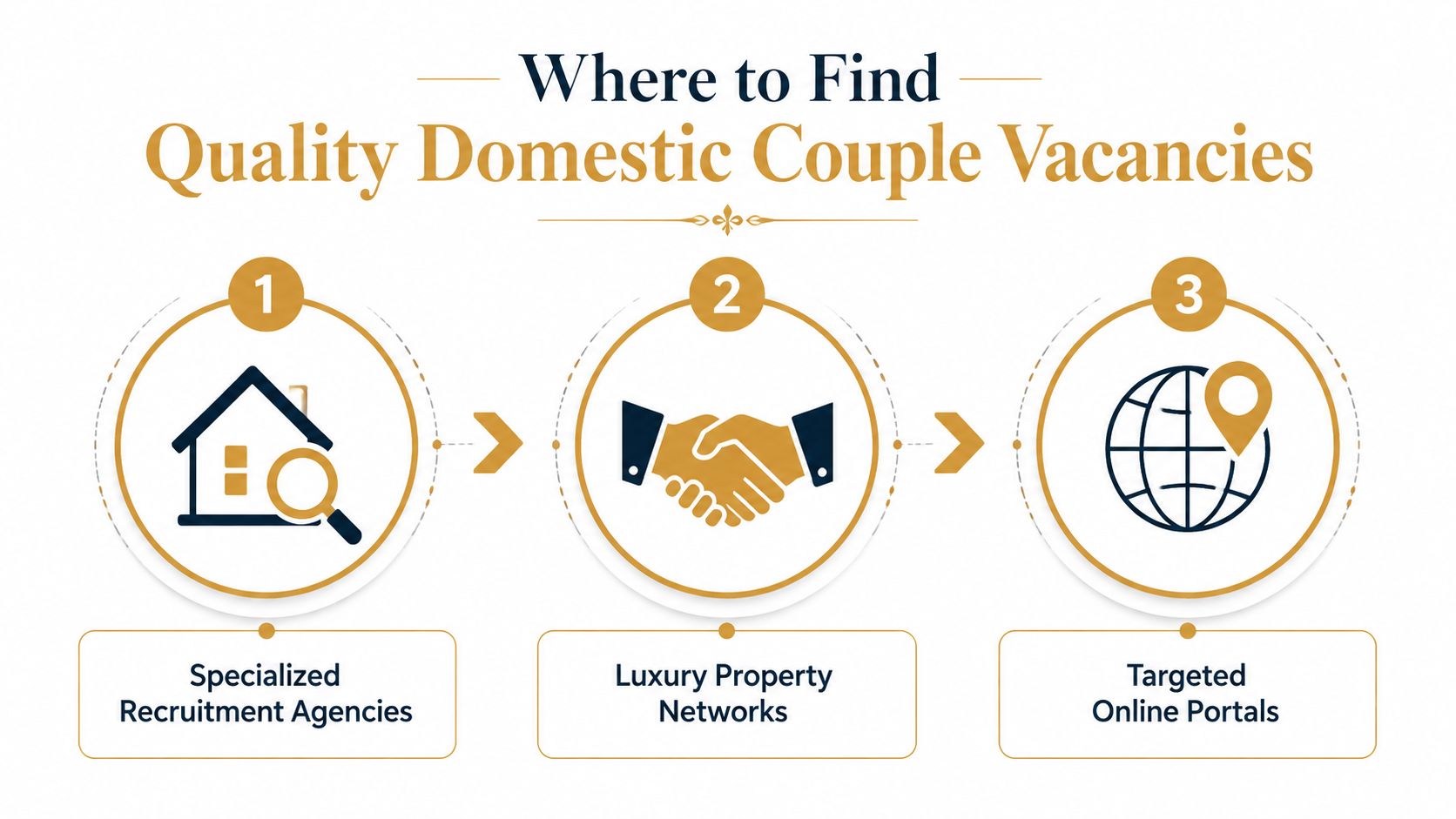
Start with specialist recruitment. That is where the proper roles usually appear, because private households that need a domestic couple don't always want public visibility. They want screening, discretion, and somebody who understands how to match a household's rhythm with two careers, not one.
Focus on the right channels
Specialist agencies are the first place to look if you want a proper domestic placement. Superstar Nannies' Domestic Couple Agency is one example of the kind of service households use when they need two people matched to interior and exterior duties in a structured way. That usually includes housekeeping, gardening support, driving, errands, pet care, and coordination around maintenance.
Private household managers and estate offices are the next channel. They often know about openings before they are advertised, especially when a role sits inside a fully staffed residence or a seasonal estate operation. If you're only checking public boards, you're seeing the surface, not the market.
For a quick search sweep, some candidates use a board aggregator to find open positions fast, but don't confuse volume with quality. A pile of listings doesn't tell you which role has proper housing, clear duties, or a household that's organised.
How to read the market properly
The best Scottish couple roles tend to surface through a mix of private networks, agency introductions, and direct relationships with household managers. Timing matters too. Estate recruitment often follows seasonal cycles, so a couple with a strong profile should apply before the pressure peak, not after every good placement has already been filled.
Watch for signals of good management. Clear job scope, named reporting lines, accommodation details, and realistic rotas usually mean the household knows what it wants.
A fragmented advert with vague duties, rushed start dates, and no mention of living conditions usually means trouble later. In private staffing, the cleanest processes usually lead to the cleanest placements.
Crafting a Joint Application That Wins Interviews
A joint application should make one thing obvious. You are not two random candidates hoping to be tolerated side by side. You're a coordinated unit, and that should reduce management pressure for the household. That is how you get attention in a competitive market.

Make the application read like one decision
Lead with a short shared profile. Say what the couple brings together, not just what each person has done in isolation. One partner may be stronger on housekeeping and guest-facing standards, while the other handles driving, grounds support, or maintenance coordination. The household wants to see how that combination reduces friction.
If one of you has much more experience, don't hide it. Present the stronger background clearly, then position the other partner as reliable, trainable, and comfortable in a supporting or complementary function. What you must not do is overcompensate with vague claims that you'll “do anything.” That reads as desperation, not flexibility.
What to include before the first interview
A strong joint application normally includes the basics that families and household managers expect to see upfront.
- Professional summary: a short note explaining the pairing, the roles you're seeking, and the kind of household you suit.
- Separate CVs: still essential, because each partner needs a clear work history and reference trail.
- Shared availability note: explain whether you need live-in accommodation, seasonal flexibility, or school-term alignment.
- References and vetting documents: present these early so a household can move quickly if the fit is right.
The useful part of a good cover letter is clarity. If you want a clean structure, the Resumatic cover letter guide is a practical template for keeping the tone concise and organised.
Recruiter's view: the strongest couples frame themselves as a household asset, not as two separate people asking to be managed with extra patience.
For families comparing options, you can also view private household staffing roles as a useful benchmark for how clearly duties and standards should be described.
Understanding Salary Expectations and True Relocation Costs
Headline salary is only the first number. In Scotland, it can be misleading if the role is remote, the accommodation is poor, or one partner has to give up more earning power than the job description admits. Search results show domestic couple and estate roles in the low-£40ks to around £70k combined, while hospitality listings can sit much lower, so the only sensible comparison is net value after living conditions and relocation costs Greycoat Lumleys couple jobs.
Compare the package, not just the pay
A lower salary can still be the better offer if the housing is a separate flat, the commute disappears, and the household is stable. A higher salary can be a bad deal if you're sharing cramped rooms, covering your own travel, and dealing with seasonal instability. In rural Scotland, those trade-offs matter more than the headline figure.
The public listings gap is obvious here. Search results often mention separate accommodation or flexible placement, but they rarely explain whether that housing is suitable for two adults long term. That's where a recruiter's judgement matters. Families who want retention often compete on accommodation quality and flexibility, not just pay.
Scottish Couple Role Compensation Overview
| Role Type | Combined Salary Range | Typical Accommodation | Contract Structure |
|---|---|---|---|
| Domestic couple in a private household | Often in the low-£40ks to around £70k | Separate flat, shared estate housing, or on-site rooms | Permanent or long-term placement |
| Estate couple role | Often in the low-£40ks to around £70k | On-site living, sometimes bundled with driving or grounds duties | Permanent, seasonal, or mixed |
| Hospitality couple role | Usually lower on an hourly or seasonal basis | Staff rooms or local housing, if available | Seasonal or fixed-term |
What to negotiate first
Ask about utility responsibility, travel to and from the property, and whether the accommodation is separate or just described that way in the advert. If one partner is seasonal or on call, you also need to know how the household handles rest time and roster changes. Those details affect whether the placement still works after the novelty wears off.
For salary context and package comparison, the private staff salary guide for UHNW families is worth using as a reference point when you're assessing whether the offer is realistic.
Navigating Visa Requirements and Employment Rights
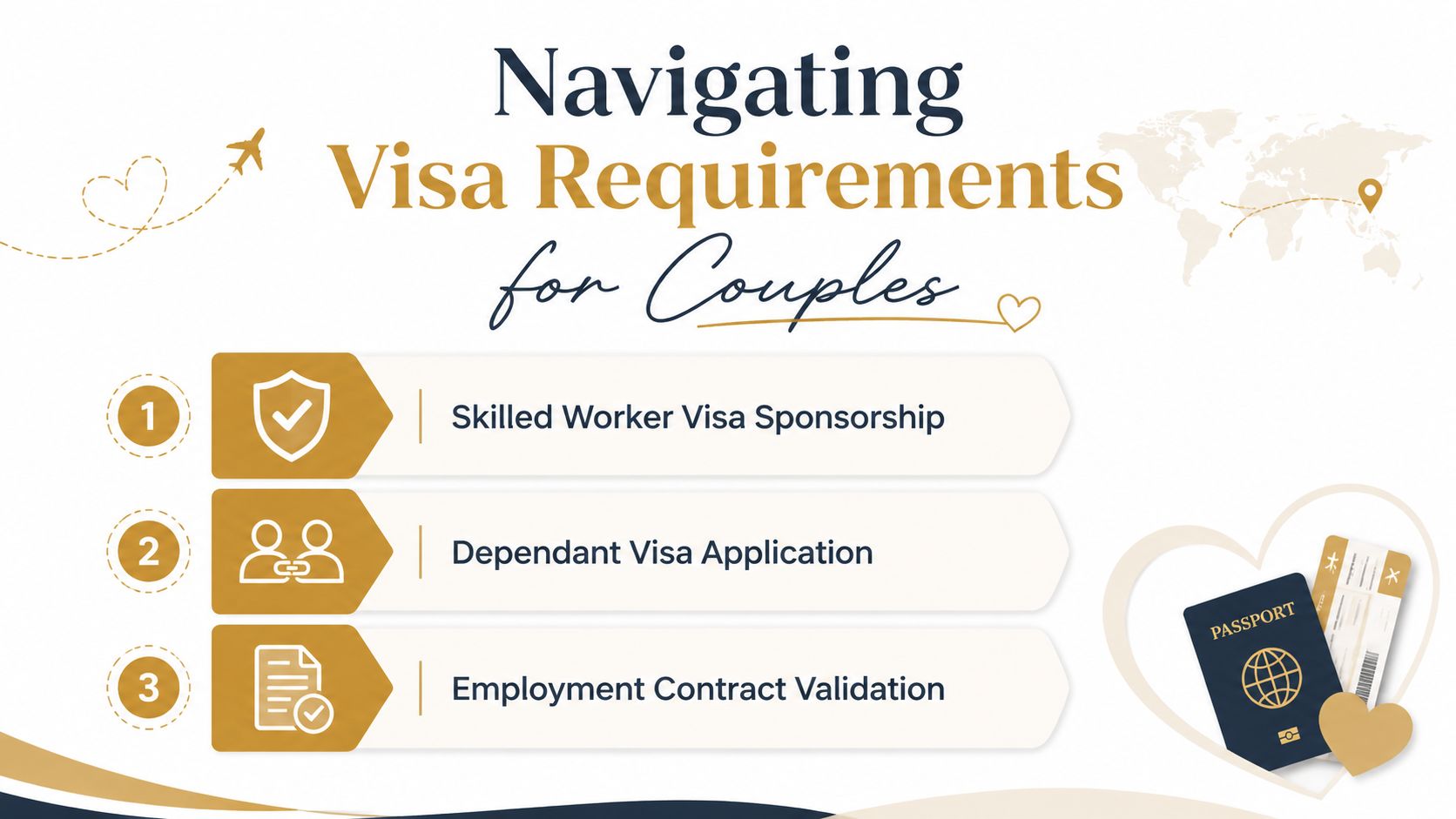
If you're moving from outside the UK, get the visa position right before you fall in love with a role. A spouse or partner visa in the UK allows the holder to work with no restrictions for up to two-and-a-half years Scottish Migration Service visa routes, which gives one partner real flexibility while the other settles into work. That can make or break a couple's move to Scotland.
Know which route fits your household
For Skilled Worker dependants, a partner can qualify if they're a spouse, civil partner, or unmarried partner, provided the couple has been in a relationship for at least two years. Each dependent must apply separately and pay their own fee, with published examples of £285 for a partner, £315 for one child, and £200 for each additional child Scottish Migration Service Skilled Worker visa. That is the sort of cost that should be on your spreadsheet before you accept anything.
UK family visa rules are also precise. Both partners must be at least 18, the sponsoring partner must be British or Irish, settled in the UK, or in some cases an EU, Swiss, or EEA national with pre-settled status who started living in the UK before 1 January 2021, and the visa is initially granted for up to 2 years and 9 months GOV.UK partner visa rules.
Rights matter because your rota does
Scottish workplace rights cover working hours, rest breaks, time off, sick pay, holidays, maternity and parental rights, and statutory maternity pay can be paid for up to 39 weeks Workplace rights and benefits in Scotland. The same source notes that a partner can have up to two weeks of paternity leave, with shared parental leave also available.
Don't accept a conditional offer until you've checked right-to-work status, dependent status, and whether the household's start date actually matches your paperwork.
For a practical verification checkpoint, use right to work verification guidance before any contract is signed. In cross-border placements, the legal fit should be confirmed early, not after the family has already planned around you.
Regional Opportunities Across Edinburgh and the Highlands
Edinburgh and the Highlands attract different couples for different reasons, and you should be honest about which environment suits your partnership. Edinburgh is the better fit if you want urban convenience, transport links, and roles tied to townhouse or city household management. The Highlands and islands are better if you want immersive estate life, stronger separation from city noise, and the trade-off of isolation.
City placements suit routine, not romance
In Edinburgh, the work is usually more structured. Families often want polished household support, strong organisation, and easy access to amenities, schools, and travel connections. That makes the city useful for couples who want to stay professionally active without giving up every urban comfort.
There's also a practical difference in exit options. If a city role doesn't work out, there are more alternatives nearby. That's not a small point. A couple can recover from a poor fit more easily when they aren't stranded by geography.
Rural roles demand a different mindset
The Highlands and island placements can be excellent if the accommodation is strong and the household is well run. They can also be brutally difficult if the couple romanticises the scenery and underestimates the isolation. The role may come with better living space, but that doesn't fix weak rota planning or an unclear chain of command.
Remote positions often depend on on-site living, and the lived reality matters as much as the view. You need to ask about local shops, transport, weather disruption, and what happens when one partner is seasonal while the other is permanent. A beautiful location doesn't solve a broken schedule.
Bottom line: choose the region that suits your relationship under pressure, not the one that looks best on a listing.
Making the Final Decision and Avoiding Common Mistakes
The final decision should be boring in the best way. If the offer is good, every practical question gets answered cleanly. If it isn't, the gaps show up fast. That is how experienced couples avoid expensive mistakes in Scottish placements.
The questions that expose weak offers
Ask who manages the household day to day, how duties are divided, and what happens if one partner leaves. If the answer is vague, the role is probably vague too. You should also ask whether accommodation is separate, who pays the utilities, and whether the contract includes a realistic notice period.
Common red flags are easy to spot once you know what matters. Poorly described housing, no clarity on reporting lines, shifting duties, and a rush to fill the role without reference checks usually point to a household that hasn't thought the placement through. That's where a specialist agency earns its keep, because a good recruiter will test the offer before you waste time on it.
Use a short pre-acceptance checklist
- Confirm accommodation: check photos, layout, privacy, and whether both partners can live there comfortably.
- Test rota compatibility: compare work patterns, rest days, and childcare needs before accepting.
- Check exit terms: understand notice, trial period, and what happens if the arrangement fails early.
- Verify paperwork: make sure visa status, references, and right-to-work documents are complete.
- Assess long-term fit: ask whether the role still works if one partner's circumstances change.
The right move isn't always the first offer. It's the offer that still makes sense after the first month, after the weather turns, and after the household stops trying to impress you.
If you're considering couples jobs in Scotland and want a placement that works for both partners, speak to the team at Superstar Nannies. We place domestic couples with discretion, careful screening, and a clear view of the practical realities that matter in private households, especially when accommodation, rota compatibility, and long-term fit are essential.