

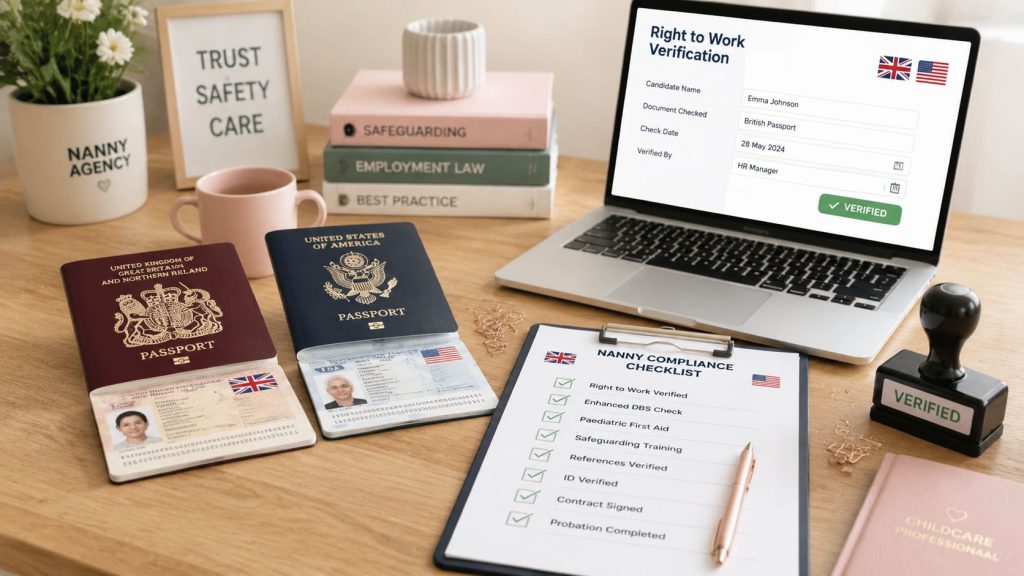
If you're onboarding a nanny, housekeeper, or rota candidate this week, the pressure is usually the same. A family wants someone in place quickly, the CV looks strong, and the last thing anyone wants is a compliance issue slowing the placement down.
That's exactly where right to work verification earns its keep. Done properly, it protects the household, gives the agency a clean audit trail, and stops a hurried hire from turning into a costly mistake.
Why Right to Work Verification Matters for Domestic Staffing
The first time I saw a placement stall over missing right-to-work evidence, it was a classic domestic staffing mess. The family had already chosen the nanny, the start date was fixed, and the candidate was ready to travel, but the documents didn't match the correct verification route. That kind of delay feels small in the room, then becomes a compliance problem the moment an inspector asks for proof.
For private households, the stakes are easy to underestimate because the work happens behind closed doors. That's a mistake. The Home Office has made clear that employers must check original documents or use the online service, and enforcement history shows this is not a box-ticking exercise. Its employer research found that around 1 in 4 employers had not conducted a right-to-work check on at least one worker, and civil penalties can reach up to £20,000 per illegal worker under the current regime, according to Home Office reporting on employer awareness and compliance and enforcement practice (Home Office employer awareness and compliance research).

What elite households actually expect
UHNW families tend to expect two things at once, speed and discretion. They don't want a long compliance lecture, but they do want an agency that can place vetted staff without scrambling when a passport, visa, or share code needs checking. A strong verification process becomes a quiet sign of professionalism, especially when a family hires across borders or rotates staff between homes.
Practical rule: if the verification step is unclear to your team, it will be unclear to the client later.
That is why agencies that treat right to work verification as part of the service, not an afterthought, tend to look sharper in front of demanding clients. It also helps that modern compliance is more recordable than the old paper-only approach. The UK's digitised checking route has made the process more scalable, with the 2022 scrutiny note estimating that about 2,317,000 checks per year could be done digitally once fully in use, based on an assessed pool of 3,682,000 checks requiring verification (UK digital verification scrutiny note).
For agencies placing domestic staff, that matters because frequent onboarding is normal, not exceptional. A clean process reduces friction for both the household and the agency.
Learn how careful screening supports safer placements
UK Right to Work Verification Pathways Explained
A UK household or agency has to choose the right right to work verification route before a nanny starts. The Home Office recognises three compliant pathways, and the mistake I see most often is teams applying the wrong one because they are trying to move quickly. The available routes are an in-person check of original documents, the online checking service, or an approved identity service provider using Identity Document Validation Technology, IDVT (Home Office RTW checks guidance).
Match the route to the worker
The online route is for workers who hold digital immigration status. IDVT is narrower, it applies to British and Irish citizens with valid passports. Manual checks are still the fallback for everyone else who presents acceptable original documents, so a passport scan on its own does not complete a manual check (practical route overview).
For agencies placing nannies into UK, US, and overseas households, route selection has to be handled at the point of instruction, not after the candidate is already in front of the family. That is also where a related check can sit in the wider vetting pack, including child safety and vetting context for household placements, because right to work is only one part of a safe file.
The Home Office checklist separates evidence into List A and List B. List A is for people with an ongoing, unrestricted right to work. It includes, for example, a current or expired British passport, a current or expired Irish passport or passport card, and certain birth or adoption certificates only when they are paired with an official document showing the person's permanent National Insurance number (Home Office RTW checklist).
How the manual check works in practice
A compliant manual check is straightforward, but only if staff follow the same sequence every time.
- Obtain original documents. Copies do not prove identity for a manual check.
- Inspect the person and the document together. Photo, expiry date, spelling, and permission to work all need to line up.
- Make and retain a clear copy. Record the check date at the same time (Home Office guidance).
In domestic staffing, that discipline matters because candidates often move quickly between interviews, trials, and starts. If a candidate's permission is time-limited, the employer must complete a follow-up check before it expires. People with unrestricted status under List A do not need repeat checks once the right to work has been established (Brightmine overview of requirements).
Agencies working across borders also need to think about where a worker will be deployed. A nanny who is fully cleared for a UK post may still need a different document route before a move to another country, and that is where planning matters as much as the check itself. For example, any household placement tied to the UAE should be mapped against the family's visa and sponsorship position, and the operational timing can be compared with the Smart Classic Business Hub visa guide.
A practical rule holds up in audits, if the file does not show why a route was chosen, the verification is probably too weak.
US I-9 Requirements and International Placement Challenges
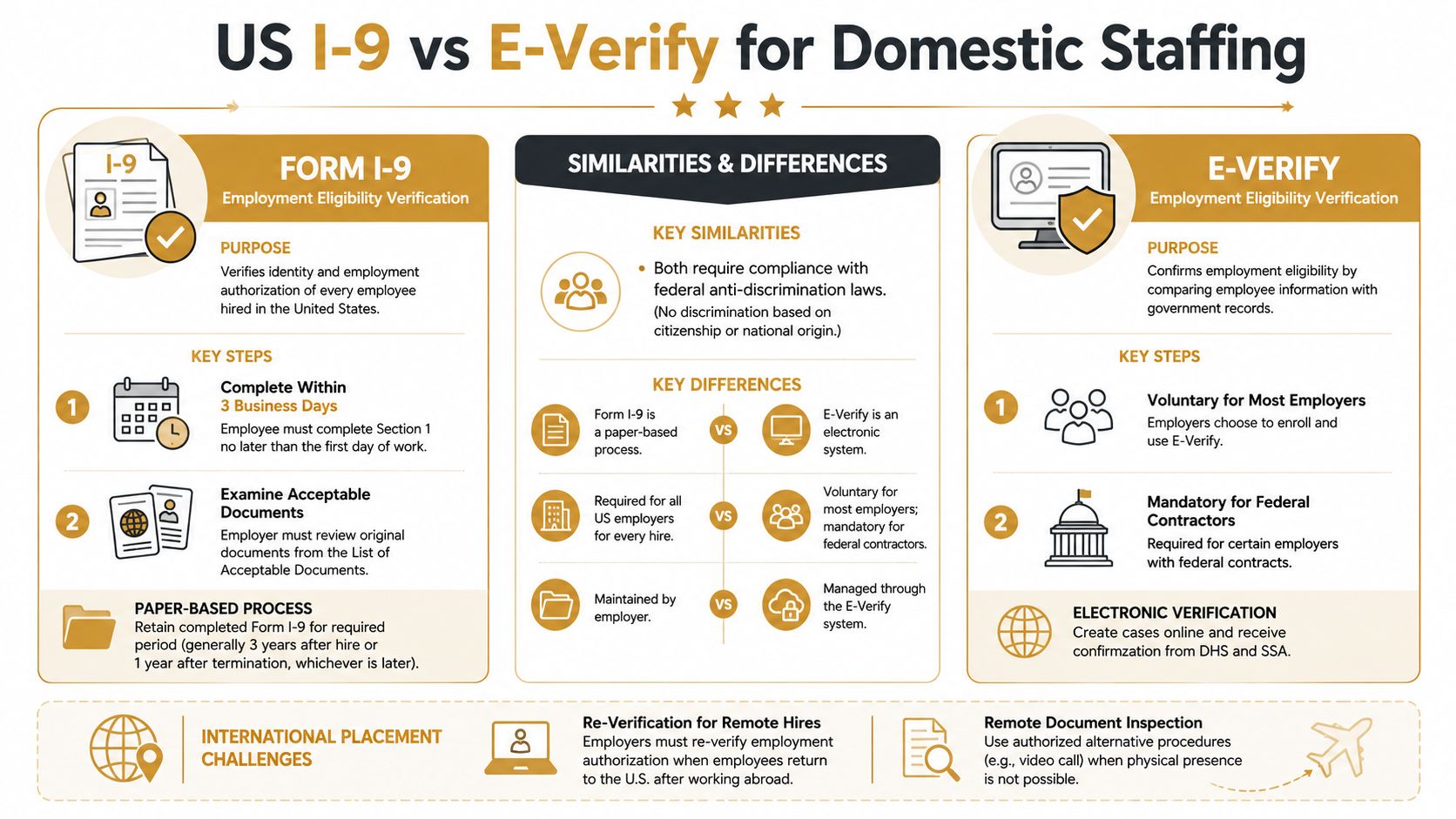
In the US, the compliance rhythm is different. Households and agencies use Form I-9 to verify work authorisation, and the practical pressure point is the three-day window for completing Section 2 after the employee starts work. That is where UK-trained teams often make mistakes, because they expect the same share-code logic to work everywhere.
UK and US checks are not interchangeable
UK right-to-work checks are built around the worker's status and the Home Office route used to prove it. US verification is built around Form I-9 document review, with acceptable document combinations presented by the employee and examined by the employer. That means a candidate who is perfectly compliant in the UK still needs a separate US work-authorisation review when placed into a US household.
For international placements, the cleanest approach is to decide responsibility before the candidate starts. The contract should say whether the agency is gathering documents, whether the household employer is completing the form, and who stores the final record. Without that clarity, errors usually happen at handover, not at interview.
Cross-border placements need tighter timing
Remote hiring made verification more flexible in some settings, but it also created new weak spots. International placements often involve a nanny relocating from the UK to the US, or a family splitting time between homes in different jurisdictions. In those cases, the agency has to keep the country-specific rules separate in its workflow, not blend them into one general onboarding pack.
For broader visa context, the Smart Classic Business Hub visa guide is a useful reference when a placement also involves Gulf-region sponsorship questions. It's a reminder that household staffing compliance changes quickly once employment crosses borders.
A placement that looks simple on paper can involve three different compliance calendars, one for the agency, one for the household, and one for the candidate's permission to work.
That complexity matters most with visa categories, travel assignments, and families who expect a staff member to move between countries without interruption. Agencies that map the jurisdiction first, then the hiring timeline, usually avoid the messy last-minute scramble.
How global nanny placements are structured in practice
Common Compliance Mistakes and How to Avoid Them
The most common failure I see is not a dramatic fraud case. It's a quiet method error. Someone uses the wrong verification route for the candidate's status, then assumes the file is fine because a document was seen at some point.
The mistakes that cause real trouble
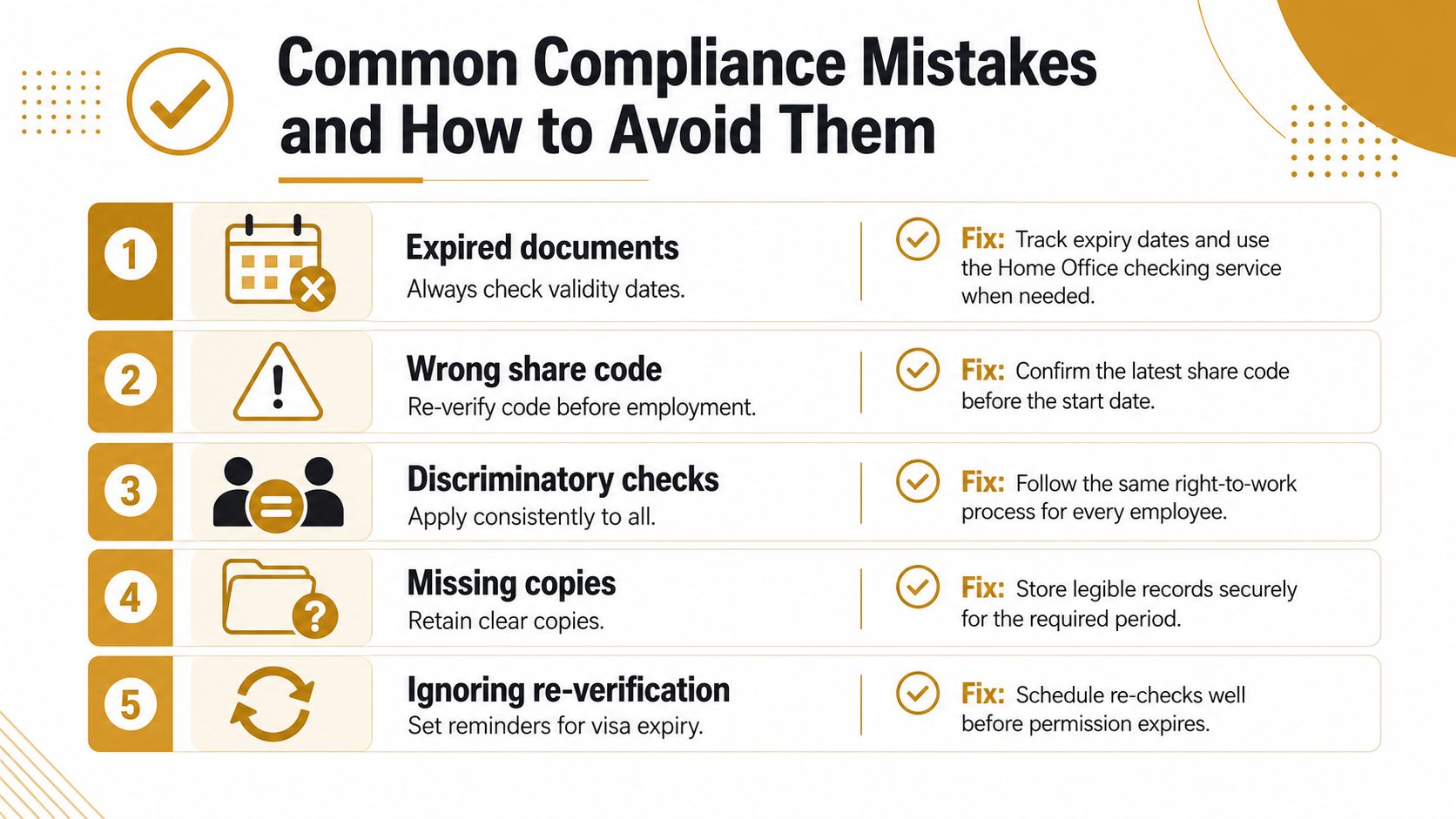
- Expired documents. A passport or visa that looks familiar can still be invalid. Fix: check the expiry date before the interview is marked complete.
- Wrong share code. A code can be entered incorrectly or linked to the wrong permission. Fix: re-check the code before relying on the online result.
- Discriminatory checks. Some candidates get checked thoroughly, others get waved through. Fix: apply the same process to every hire in the same category.
- Missing copies. If there's no retained record, there's no proof the check happened. Fix: save a clear copy and record the date immediately.
- Ignoring re-verification. Time-limited permissions need a reminder system. Fix: build follow-up prompts into the onboarding calendar.
What strong files look like
A good file is boring in the best way. It shows the right route was chosen, the original or online evidence was handled correctly, and the employer can prove what happened later if asked. That matters because Home Office guidance makes record retention part of the control, not an optional admin task.
If the candidate's status is unclear, pause the placement. Don't guess, don't “accept for now”, and don't let a client pressure you into papering over the gap. The clean move is to escalate for legal review, explain to the family that onboarding is pending compliance clearance, and keep the conversation factual.
Track the red flags early
- Documents that don't match names or dates.
- Candidates who present copies instead of originals for a manual check.
- A share code that doesn't resolve cleanly.
- Permissions that are about to expire.
- Candidates who cannot explain their current work status clearly.
The agencies that stay out of trouble usually catch these issues before the final interview. They make right to work verification part of the screening flow, not the closing step.
Compliance support for household staffing teams
Building a Compliant Verification and Recordkeeping System
A workable system beats a clever one. Agencies that depend on memory, inbox searches, and one compliance-focused employee usually find gaps as soon as placement volume rises or that person is away. The point is to make the process repeatable enough that another trained teammate can step in without guessing, especially when a nanny is being placed into a UK household, then moved into a US assignment, or introduced to a family overseas with different rules.
A practical operating model
Start with a short screening checklist before the interview is booked. Ask whether the candidate holds unrestricted status, digital status, or time-limited permission, because that determines the verification route. Then route the file to the correct reviewer before documents arrive, so nobody is trying to decide method at the front desk.
Storage matters too. Records should be easy to retrieve, hard to alter, and tied to the actual placement file rather than someone's email trail. That approach matters in international domestic staffing, where the agency may need to show what was checked, who checked it, and how the evidence was handled after the family moved between countries or employers changed.
A clean file also helps if an audit question comes back later. Keep the evidence together with the check outcome, the date, the reviewer, and any follow-up action. If a household employer later asks why a placement was delayed, the file should show a clear compliance reason instead of a vague note.
A simple document control table
| Document Category | Examples | Follow-up Required | Retention Period |
|---|---|---|---|
| List A evidence | British passport, Irish passport or passport card, certain birth or adoption certificates with NI proof | No ongoing repeat check once established | Duration of employment plus 2 years |
| List B evidence | Time-limited permission evidence | Yes, before permission expires | Duration of employment plus 2 years |
| Online check result | Share code outcome from the Home Office service | If status is time-limited, yes | Duration of employment plus 2 years |
| IDVT verification | Certified digital identity service result for eligible British or Irish passport holders | No ongoing repeat check if unrestricted status is established | Duration of employment plus 2 years |
How teams keep the process alive
- Set reminders: Put expiry alerts into the placement workflow, not into personal inboxes.
- Limit access: Only staff who need the file should see it.
- Audit monthly: Sample active placements and closed files for missing evidence.
- Train by route: Manual, online, and IDVT checks need different handling.
A file review should also test whether the team can explain the decision in plain language. If the candidate has time-limited permission, the record needs to show the follow-up plan before the placement becomes operational, not after the family has already counted on cover for a nanny rota or holiday travel.
Teams that work across regions also benefit from comparing their records against the broader standards used in other regulated sectors, including the key compliance rules for South African firms. The useful lesson is simple. A process only matters if someone can prove it happened later, and if insurance is part of the agency's risk plan, the terms of employment liability coverage for household staffing teams should be checked with the same care.
Liability Mitigation for International Domestic Staff Placements
The liability problem often starts before the placement begins. A household may sign the contract, but if the agency handled the screening, framed the status advice badly, or stayed silent when the candidate's permission changed, the agency can still be pulled into the dispute. In international domestic staff work, the safest position is built on clean paperwork, a clear handover, and a written line on who owns each part of right to work verification.
Put responsibility in writing
Placement agreements should say who completes verification, who keeps the evidence, and who carries out re-checks for time-limited permissions. That language matters when a nanny is introduced through the agency and later hired directly by the family, because the paper trail then decides whether the agency still has a compliance role or only an introductory one.
Indemnity terms can help, but they only work if they are drafted with the actual workflow in mind. If a family moves a household employee between homes, changes the rota, or switches the arrangement from agency placement to direct hire, the agreement should make clear which party is responsible for fresh checks and ongoing records. Without that clarity, the agency is left arguing about expectations after the fact.
Insurance needs the same level of scrutiny. A professional liability policy may cover some errors and exclude others, so the wording has to be read line by line, not assumed. If the position is unclear, the agency should document each verification step carefully and ask counsel to review the exposure before the placement goes live. The same discipline applies to broader employment protection, including employment liability coverage for household staffing teams, because the policy needs to match the way the agency works.
International movement needs legal support
Travel nannies, estate staff, and families who split time between the UK, the US, and overseas homes create status questions that do not always show up in a standard intake form. A candidate may be lawful in one place, eligible to work in another, and still need fresh advice before a rotation starts. For families with cross-border staff, consulting a Spanish immigration lawyer for expats can clarify status questions before travel begins.
A pending immigration application should be treated as a legal review point, not a green light. If the file is unclear, the agency should pause and confirm what the candidate can do, where they can do it, and under what conditions. That is how you protect the family from avoidable mistakes. It is also how you avoid promising cover for a nanny rota or holiday travel that cannot legally happen.
A firm compliance position also supports premium pricing. UHNW clients pay for discretion, reliability, and low drama, and rigorous right to work verification is part of that promise.