


Running a substantial home with separate hires often looks sensible on paper. In practice, it can become a daily coordination exercise: the housekeeper needs the driver, the gardener needs access, the cook needs timing from the family office, and no one fully owns the handovers. Standards slip in the gaps.
That's where a Domestic Couple Agency becomes strategically useful. For a UHNW family, the right couple isn't just two employees. It's a tightly coordinated operational unit that can stabilise the household, reduce management friction, and protect continuity. If you're balancing multiple residences, frequent travel, security concerns, or a property that needs year-round oversight, this is often the cleaner solution.
Introduction Streamlining Your Household Management
Most families who enquire about a domestic couple are already feeling the strain. The issue usually isn't a lack of staff. It's fragmented coverage, blurred accountability, and too many moving parts for a principal, EA, or house manager to monitor every day.
A good domestic couple solves that by bringing built-in coordination. One person may anchor the interior standards, guest readiness, laundry systems, and kitchen support. The other may cover driving, maintenance oversight, grounds, security awareness, and external contractors. Together, they close the gaps that separate hires often leave open.
That's why choosing through a Domestic Couple Agency matters. You're not buying convenience. You're buying structure, discretion, and reliability. The family that hires well gets a home that runs smoothly and predictably. The family that hires casually usually ends up rehiring.
Practical rule: If your household needs coverage across both interior and exterior operations, treat this as an estate management decision, not a housekeeping search.
Defining the Domestic Couple A Unified Household Team
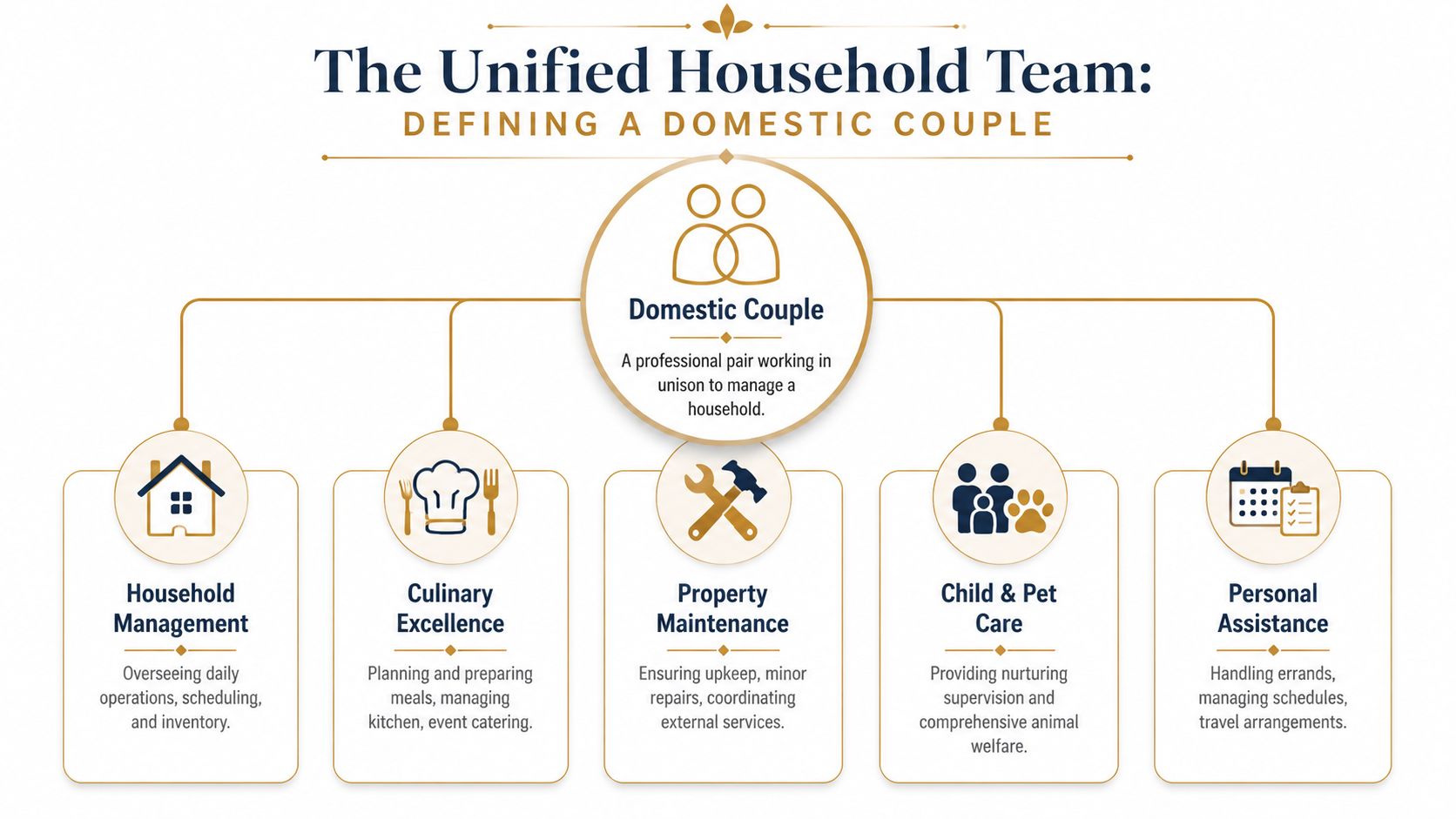
A domestic couple in the UK private-staff market is a two-person household-management unit that combines inside and outside duties. That structure improves coverage on large properties because the pair can split housekeeping, laundry, cooking, maintenance, driving, and grounds or security-related tasks without requiring multiple single-role hires, as outlined by Eden Private Staff's guidance on professional domestic couples.
How the role works in real life
The mistake many families make is assuming a domestic couple is “a housekeeper and a handyman”. That's too narrow. In a well-structured placement, the couple functions as a shared operating system for the property.
Typical coverage includes:
- Interior management: housekeeping, laundry, wardrobe care, bed turn-down, provisioning, table service, guest room preparation
- Kitchen support: family cooking, informal meals, pantry management, kitchen organisation, supplier coordination
- Exterior oversight: gardening support, maintenance coordination, property checks, seasonal setup, vehicle readiness
- Logistical support: driving, errands, airport collections, contractor access, deliveries, basic reporting to principals or the family office
- Lifestyle continuity: pet care, occasional childcare support where appropriate, holiday house opening and closing, event assistance
Why the pairing matters
The value isn't only in the tasks. It's in the coordination between the two people doing them.
A professional pair already understands how to divide labour without constant supervision. One can pivot to guest-facing service while the other manages a last-minute contractor issue. One can keep the house running while the other handles airport runs or estate checks. That flexibility is why this model is often more economical and more adaptable than hiring several separate individuals for overlapping responsibilities.
A strong domestic couple doesn't wait to be directed every hour. They notice, prioritise, and hand off cleanly.
For larger homes, country estates, and internationally used residences, that unified structure is often the difference between a property that feels fully supported and one that always feels slightly behind.
The Strategic Advantage Over Separate Hires
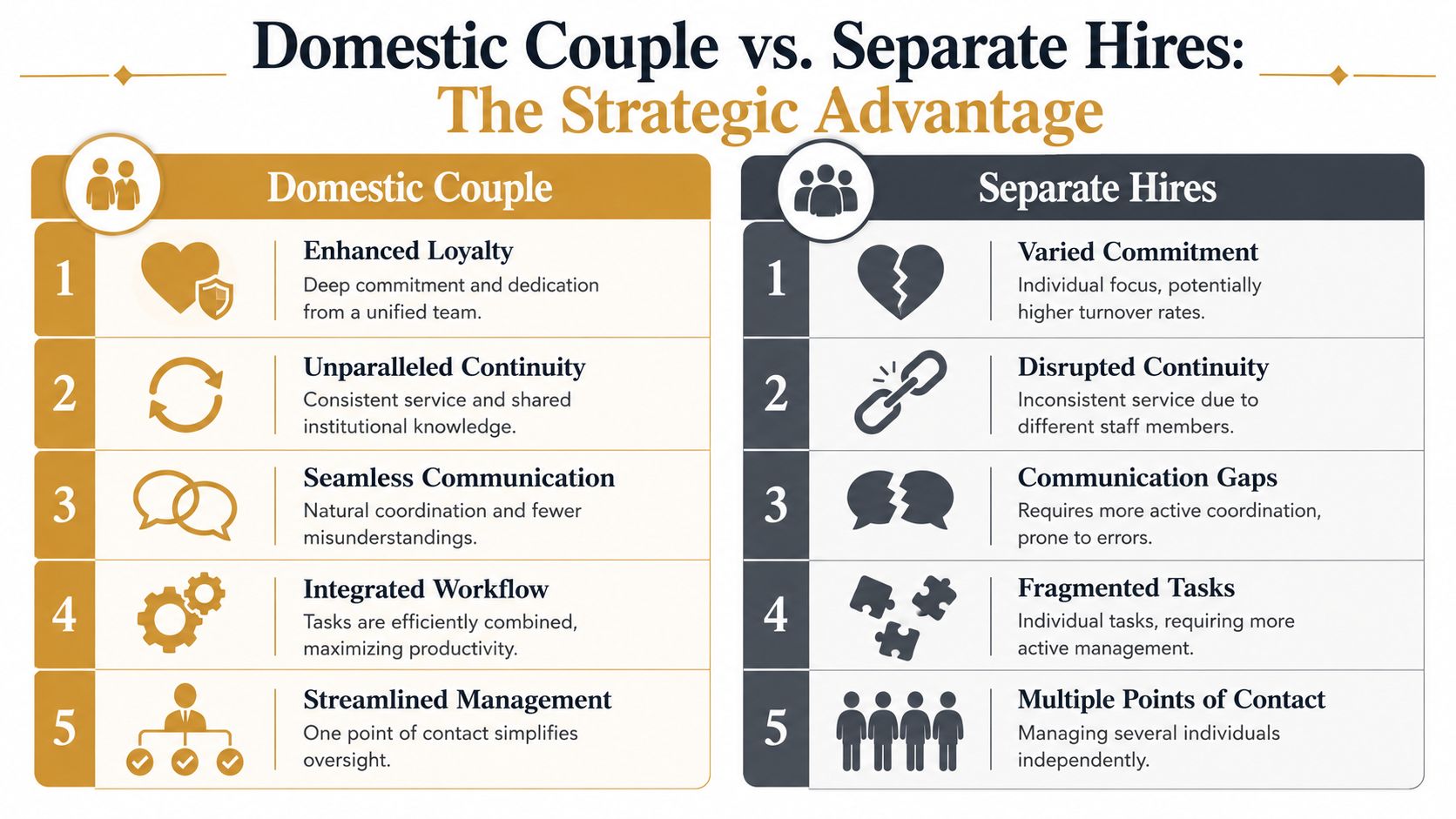
The strongest argument for a domestic couple isn't romance, loyalty, or the idea of “two for one”. It's operational coherence.
Separate hires can work well in a heavily staffed home with a strong house manager. But if you want a leaner structure, a couple often gives you better continuity. They already share routines, communicate naturally, and understand each other's pace. That reduces missed handovers and cuts down the need for constant instruction from the principal's office.
When separate hires create more work
Two individual employees may appear simpler. Often they are not.
Common problems include:
- Split accountability: one person assumes the other handled the task
- Uneven standards: the house presents differently depending on who is on duty
- Higher management load: someone in the family office ends up mediating schedules, priorities, and disputes
- Weak contingency cover: if one employee is absent, the other may not be able to bridge the gap
A proven couple usually handles these issues better because their workflow is already integrated.
The real financial question
The cost comparison needs discipline. Don't ask only what two salaries look like. Ask what the full employment model looks like once payroll, accommodation, legal compliance, and replacement risk are included.
The economics can tighten quickly. HMRC's Employment Allowance is only up to £5,000 per year for eligible employers, and National Minimum Wage rates increased again in April 2026 to £12.71 for workers aged 21+ and £10.85 for ages 18 to 20. At the same time, the Office for National Statistics reported 819,000 vacancies in the three months to May 2026, which reinforces a basic market reality: scarcity raises the value of reliability. That context is summarised in Pavillion Agency's discussion of the value of a domestic couple.
The strategic question is simple. If one proven couple gives you stable coverage, lower management friction, and less rehiring risk, that can be the better financial decision than two disconnected hires. For broader context on structuring private household teams, review this guide to hiring private household staff in 2026.
If your household runs across long hours, guest turnover, or multiple properties, pay for continuity first. Administrative simplicity comes second.
Contracts Salary and Global Placement Logistics
Budget first. Then draft properly. Then think about relocation.
In the UK, domestic couple salaries are stratified by experience. Entry-level roles typically start around £25,000 per person annually, mid-level roles command £40,000 to £55,000 per person, and senior couples in complex UHNW estates can earn £60,000 to £75,000+ each, placing the annual household cost for a couple at roughly £50,000 to £150,000+ according to Perfect Household Staff's domestic couple salary guidance.
What the contract must settle early
Families get into trouble when they hire informally and “work out the details later”. That approach is expensive. A domestic couple contract needs precision because the role usually blends live-in practicalities with high trust and broad responsibility.
At minimum, address:
- Accommodation terms: whether the couple lives on site, where exactly, what privacy they have, and what happens to occupancy if employment ends
- Role split: who owns which responsibilities, what is shared, and what sits outside scope
- Working patterns: core hours, flexibility around events or travel, rest periods, and arrangements during family absence
- Vehicle use: whether a service vehicle is provided, who may use it, and for what purpose
- Benefits and payroll: holiday pay, pension contributions, and any reimbursed expenses
- Confidentiality: NDA obligations, household privacy standards, guest discretion, and device or photography rules
If you want to streamline contract creation, use a structured legal drafting tool to organise clauses before counsel reviews the final document. It won't replace bespoke advice, but it can help families and chiefs of staff avoid vague instructions that later become disputes.
Global households need a placement plan, not just a hire
International families often underestimate the logistical side. If the couple will support a London base, a country estate, and seasonal travel, you need to decide whether this is one UK-based role with occasional travel, a broader international placement, or a rotation-supported structure. Each setup changes the contract, tax exposure, accommodation plan, and expectations around availability.
Questions to settle before offer stage:
- Will the couple remain attached to one primary residence?
- Are they expected to travel with the family or prepare houses ahead of arrival?
- Who covers relocation costs and move-in logistics?
- Is there separate accommodation at each property?
- Who manages payroll if the family operates through a household company or international structure?
For compensation benchmarking across household roles, this private staff salary guide for UHNW families is a useful planning reference.
The Hallmark of a Premier Agency The Vetting Process
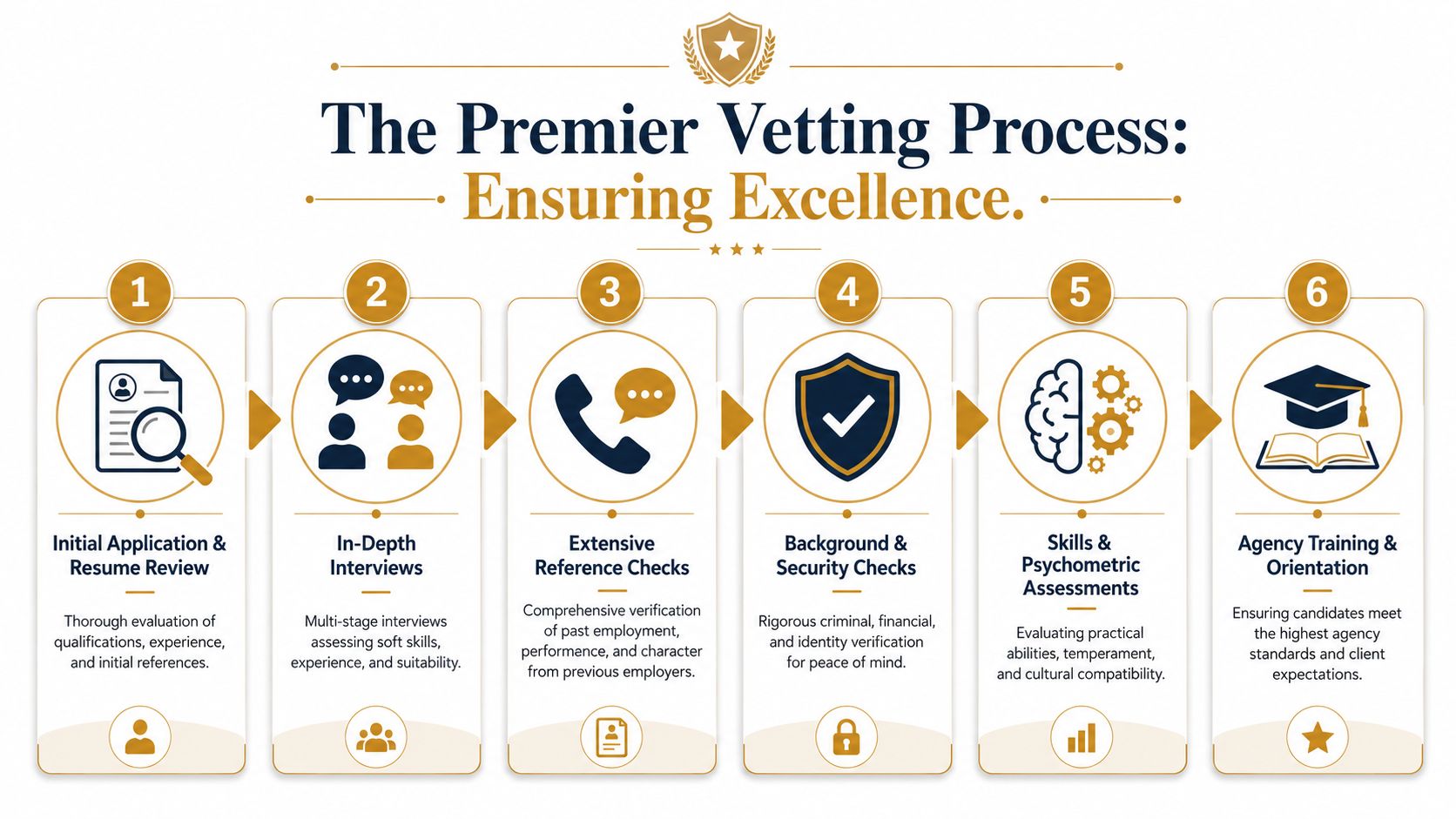
A domestic couple hire is only as safe as the vetting behind it. A genuine agency earns its fee through its vetting process.
The first filter shouldn't be charm, presentation, or even an elegant CV. It should be pair-level continuity. Household Staff Agency states that top agencies require a minimum of 5 years working together in HNW or UHNW households, or as yacht crew, with verifiable references covering the partnership itself. That standard matters because you are hiring a working unit, not two unrelated candidates assembled for convenience. The same source also highlights the compliance risk around right-to-work checks. The Home Office has increased the civil penalty for employing someone without the right to work to £45,000 per worker for a first breach and £60,000 for repeat breaches, making diligent verification imperative, as noted by Household Staff Agency's domestic couple hiring guidance.
What a serious vetting process includes
A credible Domestic Couple Agency should verify far more than basic identity documents.
Look for process discipline in these areas:
- Partnership references: previous employers must speak to how the couple worked together, not merely whether each person was pleasant individually
- Role-specific checks: driving history, service standards, maintenance competence, guest interaction, and household systems knowledge
- Right-to-work compliance: documents checked correctly, retained properly, and revisited where status changes
- Lifestyle fit: comfort with children, pets, formal service, travel, rural isolation, or highly visible principals
- Security and discretion: confidentiality expectations tested in interview, not left to an NDA after placement
Why behavioural fit matters
Technical competence gets a couple shortlisted. Behavioural consistency keeps them in post.
That's why many discerning employers now use structured assessments to identify communication style, stress response, and likely friction points. If retention matters, it's worth reviewing how employers boost retention with behavioral data before final interviews. In private households, interpersonal strain rarely announces itself early. It shows up later in guest periods, travel weeks, or when a principal's routines change abruptly.
A polished interview is not proof of household suitability. Pressure tolerance and partnership stability matter more.
For a practical benchmark on screening standards in sensitive households, see this guide to uncompromising private staff vetting.
Finding Your Perfect Match with Superstar Nannies
The right match is rarely the most decorated CV. It's the couple whose operating style fits your household without friction.
Some families need warm, unobtrusive all-rounders who can maintain a family home with children and dogs underfoot. Others need polished estate professionals who can receive guests, coordinate contractors, and maintain formal standards across multiple residences. Those are different briefs, and a smart agency treats them differently.

A consultative search should examine more than duties. It should map household rhythm, reporting lines, privacy expectations, guest frequency, travel patterns, accommodation standards, and how much initiative you want staff to take. Superstar Nannies' elite placement service for UHNW families sits within that wider private-staff model, where childcare and household operations often need to align cleanly under one brief.
Questions every family should ask a Domestic Couple Agency
- How do you verify the partnership itself: Ask whether references cover the couple as a working team, not only the individuals.
- How do you assess discretion: You want specifics on confidentiality, boundaries, and conduct in high-visibility households.
- What is your process for right-to-work and document checks: If the answer is vague, walk away.
- How do you handle replacement risk: Ask what happens if one partner exits, underperforms, or proves unsuitable after placement.
- How do you assess fit for children, pets, and guests: Practical lifestyle compatibility matters as much as technical experience.
- Can you advise on contracts and accommodation terms: A placement without employment structure is unfinished work.
Choose the agency that asks difficult questions back. That usually means they understand what can go wrong.
Conclusion Your Partner in Household Excellence
A domestic couple is not a shortcut hire. It's a deliberate operating decision for families who want strong coverage, fewer handover failures, and quieter household management.
The upside is substantial when the match is right. You gain continuity, broader practical support, and a team that can hold standards without constant intervention. The risk is also real if contracts are weak, compliance is sloppy, or the pair has never worked well together.
That's why a specialist Domestic Couple Agency matters. The value isn't only in finding candidates. It's in defining the role properly, stress-testing the partnership, and protecting the household from avoidable mistakes.
If you're considering a domestic couple for your home, estate, or international residence portfolio, contact Superstar Nannies for a confidential consultation.
Frequently Asked Questions
| Question | Answer |
|---|---|
| Should we offer a trial period to a domestic couple? | Yes. A trial is sensible, but it should be structured. Define duties, reporting lines, standards, accommodation arrangements, and confidentiality expectations before the trial starts. Don't use a vague “let's see how it goes” approach. A domestic couple can perform well in interview and still struggle with your household pace, privacy needs, or family dynamics. |
| What happens if one partner is strong and the other is not? | This is exactly why pair-level vetting matters. In some homes, one weaker partner can still destabilise the entire placement because tasks and trust are shared. Decide early whether you are hiring a fixed team or whether the role could be restructured if one person exits. Most UHNW households should treat the couple as one operational hire and avoid improvised compromises. |
| Can a domestic couple also support childcare? | Sometimes, yes, but don't blur the role carelessly. Some couples can support school runs, child supervision, or family logistics alongside household duties. That does not make them a substitute for a dedicated nanny or governess where children need developmental support, educational structure, or consistent sole-charge care. Keep the core function clear and build childcare support around it if needed. |
If you want discreet help defining the brief, stress-testing the logistics, and hiring with proper compliance in place, speak with Superstar Nannies.