

A live-in nanny uploads a birthday photo to her private Instagram. A mutual follower shows it to the family, and the trust in the house changes overnight. That's the problem with social media guidelines for household staff, they're not about corporate polish, they're about protecting children, privacy, and the relationship between employer and employee before one careless post turns into a breach.
In UHNW homes, the risk sits with the people who know the family best. Nannies, maternity nurses, governesses, housekeepers, house managers, butlers, chefs, chauffeurs, and gardeners can all see routines, locations, visitors, and private moments that should never become content. Once you treat social media guidelines as part of the employment contract, not a vague house rule, the standard becomes clearer and the arguments become shorter.
Why Every Household Needs Clear Social Media Guidelines
A household that has no written social media rule is relying on memory, goodwill, and luck. That works until the first photo appears, then everyone discovers they had different ideas about what “private” meant. In a home where staff move through children's bedrooms, school runs, travel schedules, and family events, that kind of ambiguity is expensive.
The legal and reputational backdrop matters too. The UK's CAP Code has applied to marketing communications across media, including social platforms, since the mid-2000s, and the ASA enforces it. UK social media advertising spend reached £9.7 billion in 2023 (Statista), which is why identifiable, non-misleading, properly targeted online conduct is no longer a side issue in the UK market. For any family that appears in public through a household staff member's posts, the stakes are real.
Practical rule: if a post would make you phone the principal before sending it, it does not belong online at all.
The family home is not a workplace in the usual sense. It is a private environment, often with children, security arrangements, travel routines, and sensitive staff information all happening at once. A written policy gives the employer a clean line to point to when a post crosses it. That is far easier than trying to repair trust after the fact.
For families who already keep strict confidentiality standards, this should sit beside the wider privacy framework. Private staff confidentiality guidance belongs in the same conversation because social media exposure and general secrecy problems usually start in the same place, which is casual oversharing.
The Five Pillars of a Strong Household Social Media Policy
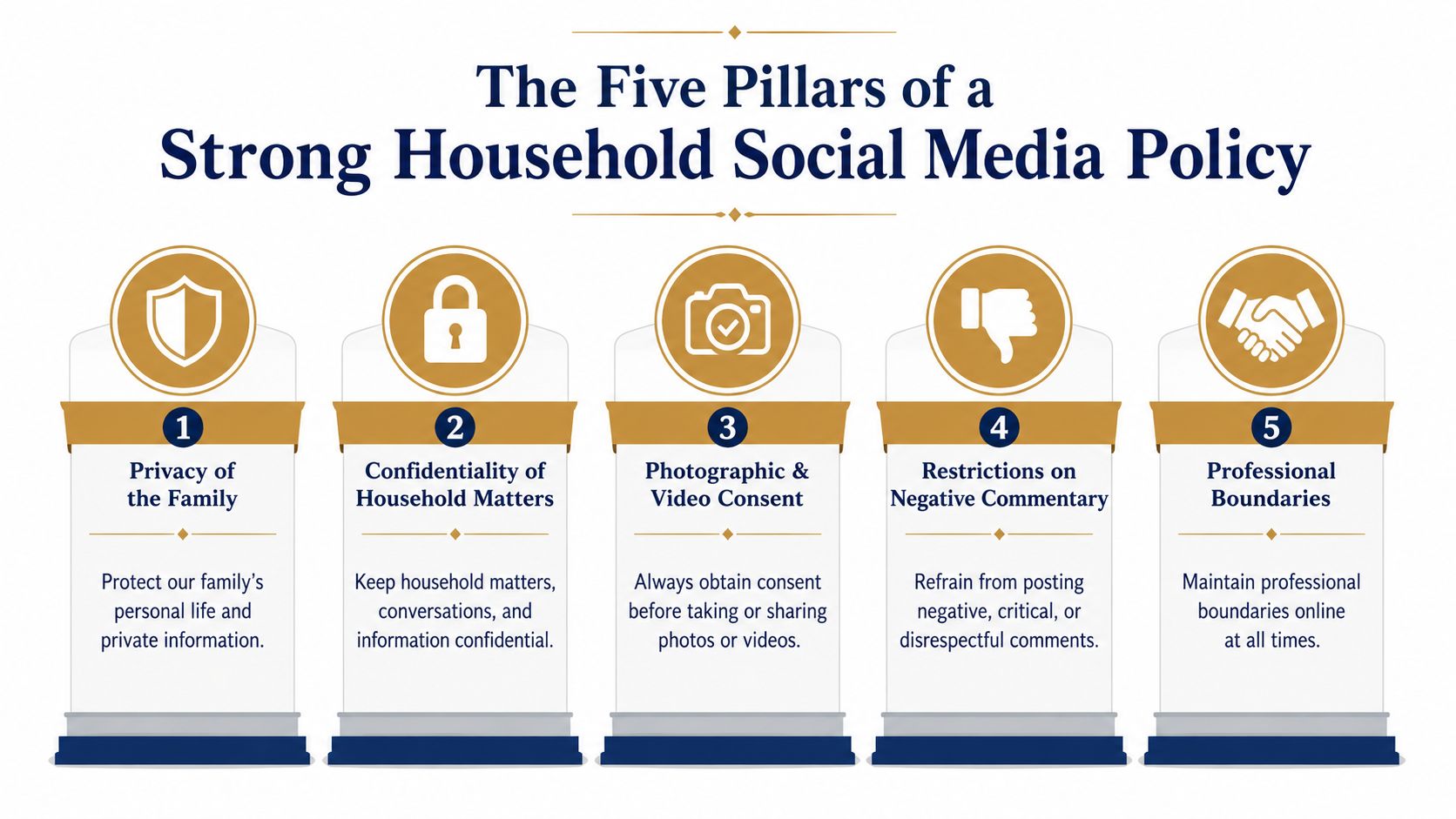
The policy should apply to everyone who touches the household's private life, not just the nanny. That means nannies, maternity nurses, night nannies, governesses, tutors, housekeepers, house managers, butlers, chefs, chauffeurs, and gardeners. If they see the family's daily life, they need the same boundaries.
Privacy of the family
This covers names, faces, locations, routines, school details, and travel patterns. Without it, staff can accidentally turn a home into a public story.
Confidentiality of household matters
This covers conversations, schedules, internal tensions, visitors, suppliers, and anything learned through work. A remark in a story or comment can reveal far more than staff realise.
Photographic and video consent
This covers children, pets, rooms, events, luggage, and travel scenes. A harmless-looking clip can expose a child's identity or the family's whereabouts.
Restrictions on negative commentary
This covers complaints, jokes, venting, sarcasm, and “anonymous” posts. A staff member who criticises the role online is already damaging trust, even if the family never sees it immediately.
Professional boundaries
This covers personal use of accounts, work-time scrolling, direct messages from potential clients, and how staff represent themselves online. A household employee should not be building a personal brand off the back of a private placement.
A good moderation mindset helps here too. If you need a practical lens for handling posts and comments, the logic behind moderating harmful user content is useful because it shows why a policy needs rules, review, and consequences, not just polite reminders.
Do's and Don'ts for Nannies Posting Online
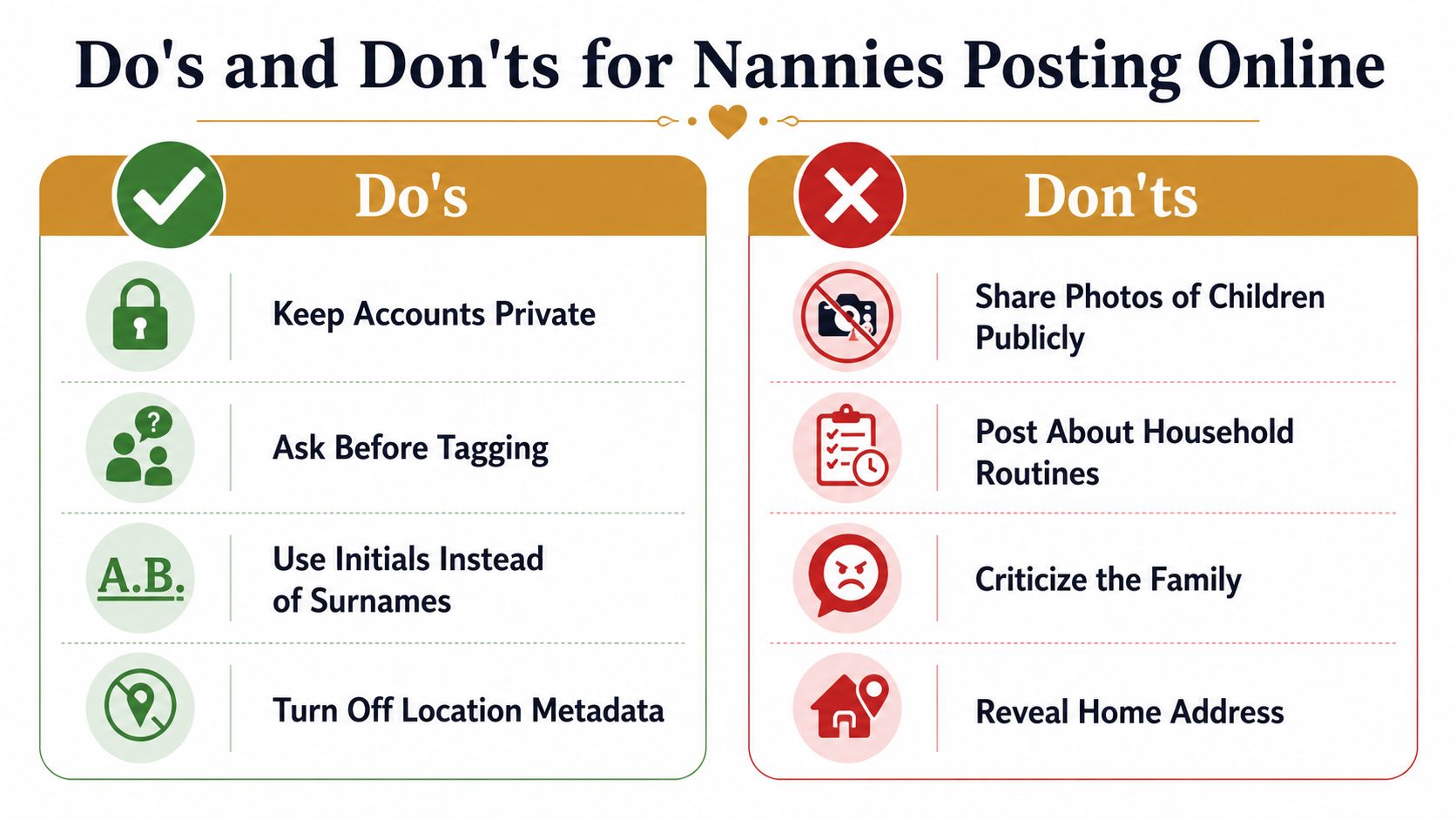
Keep the rules simple enough that a tired nanny can remember them at 9 p.m. after bedtime. The safest version is usually the plainest version.
Do
- Keep accounts private. Public accounts turn private life into public material.
- Ask before tagging anyone. Tags can expose names, networks, and locations.
- Use initials instead of surnames. That reduces searchability and casual identification.
- Turn off location metadata. Geotags make it too easy to identify the home or travel pattern.
Useful boundary: if you need to explain a post afterwards, the post was too risky to send.
Don't
- Don't photograph children for personal posting. Children need the highest level of protection.
- Don't name the family or the household staff. Naming people creates a breadcrumb trail.
- Don't discuss schedules or routines. A travel departure or nursery routine can be security-sensitive.
- Don't share complaints. Frustration online becomes a breach of trust fast.
- Don't accept new clients via DMs during work. That blurs the role and invites conflict.
- Don't use work phones for personal social media. Work devices are for work, and they should stay that way.
If a nanny needs a rule that fits on one line, use this one. If it happened in the home, it stays out of personal social media. That is the standard that keeps everybody out of trouble.
Photographic and Video Consent Explained
Consent for images is not a casual “yes, that's fine” in the hallway. It should be written, time-limited, revocable, and renewed regularly so everyone knows exactly what has been agreed. A family that assumes silence means permission is building on sand.
The consent should name the scope clearly. That means whether staff may photograph children, the home, pets, travel, or holiday settings, and whether those images can ever be shared, stored, or forwarded. It also needs to cover the difference between a family WhatsApp message and any wider online use, because those are not the same thing.
Edge cases cause most disputes. A nanny's own child in the background still counts if the family home is visible. A tutor filming a lesson needs the same discipline. A maternity nurse taking “just one” photo for relatives can still create a disclosure problem if the setting is recognisable.
The same goes for personal versus work devices. A private phone does not make a post safe, and a work phone does not make a post acceptable. If the image identifies the household, it is still a household image.
For families worried about the long tail of children's digital exposure, removing your child's online info is a useful reference point, because once content escapes into the wild, removal becomes a separate job from prevention.
Risky Posts That Have Cost Nannies Their Jobs
A live-in nanny in Mayfair posted a geotagged story while the family was in Tuscany. The family realised before the holiday ended. The problem wasn't the picture, it was the live location trail.
A maternity nurse in Manhattan vented on a parenting forum about sleep training under a username she thought was anonymous. The family found the thread anyway. The mistake was assuming online anonymity survives determined attention.
A governess in Geneva shared a short video of a child meeting a head of state. That is the kind of moment that should never leave the room unless the employer has explicitly approved it in writing. Milestones can become breaches when they identify the child or the setting.
A housekeeper in Dubai posted a story showing the inside of a wardrobe during a VIP fitting. That exposed the level of access and the kind of visitors in the home. Even a small clip can say too much.
For families who think these events are rare, they're not. They're just embarrassing, so people don't talk about them openly. If a role involves high-profile living, staff need a wider context, and how celebrity nannies navigate the high-profile lifestyle is a relevant benchmark for the standards those placements demand.
Sample Contract Clauses You Can Paste into Your Nanny Agreement
The contract has to say the quiet part out loud. If you want the rule enforced, write it as a term of employment, not as a house preference.
| Clause | Scope | Key Obligation |
|---|---|---|
| Confidentiality of family identity and routines | Names, address, travel, school, visitors, schedules, and household matters | Do not disclose, publish, discuss, or infer any private family information online or offline |
| Social media and personal device use | Personal accounts, work hours, work phones, and content about the role | Do not post about the family, do not use personal social media during childcare hours, and do not use work devices for private posting |
| Photographic and video consent | Images, video, audio, and any recognisable household content | Only capture or share media with written consent, for the stated purpose, during the stated period, and until revoked in writing |
Clause 1. The Employee must keep strictly confidential all information relating to the Family, including but not limited to identity, address, travel plans, routines, household arrangements, children's activities, visitors, and any matter observed or learned in the course of employment. The Employee must not disclose such information on social media, in messages, in photographs, or in conversation with any third party.
Clause 2. During working hours, the Employee must not use personal social media except in an emergency or with prior permission from the Employer. The Employee must not post, comment on, or indirectly refer to the employment, the Family, the household, or the children on any platform, and must not use any work device for personal posting.
Clause 3. The Employee may only take, store, or share photographs, video, or audio of the children, the home, pets, or family activities where the Employer has given prior written consent. Any consent is limited to the stated purpose and may be withdrawn at any time in writing, after which all permitted use must stop immediately.
These clauses belong in a wider agreement, not as loose house rules. Use nanny agreement templates to structure the wording, then tailor it to the actual duties, the household profile, and the devices the employee will handle.
If the role includes rota changes, live-in duties, travel, or temporary cover, the language needs to be tighter. AI contract drafting can help you draft the first pass, but a human still needs to check the final version for fit, clarity, and enforceability.
Monitoring and Enforcing the Policy Without Micromanaging
A policy without enforcement is just paper. Families need a clear process that shows staff the rules matter and that breaches will be handled the same way every time. That protects trust without turning the home into a watched workplace.
Use limited, visible monitoring. Review public-facing accounts at agreed intervals, keep a signed consent register, and hold short check-ins when the household changes, such as a new child, a move, or a travel period. Do not cross into private messages, password demands, or location tracking that has nothing to do with the role. One approach is proper governance, the other is intrusion.
Keep the rules in writing and keep the process simple. Staff should know who reviews complaints, who records the issue, and who decides whether the matter stays informal or moves to formal discipline. For households that need stronger confidentiality protection, the social media policy should sit alongside a private-staff NDA, such as the one set out in this guide to private staff non-disclosure agreements for UHNW families.
Good practice: keep monitoring visible, limited, and documented. Hidden surveillance makes the household look worse, even when the policy itself is sound.
Use a graduated response. Start with an informal conversation. Move to a written warning on file if the breach is real. Escalate to a final warning with a review period when the conduct is serious. Treat gross misconduct involving children, location disclosure, or deliberate sharing as a dismissal issue. For UHNW homes, that fast escalation is usually the right call.
If an agency is involved, it should support the process with reference checks, replacement cover, and discreet handling of the fallout. The household should not be making up procedure in the middle of a breach.
A Five-Point Checklist to Implement This Week
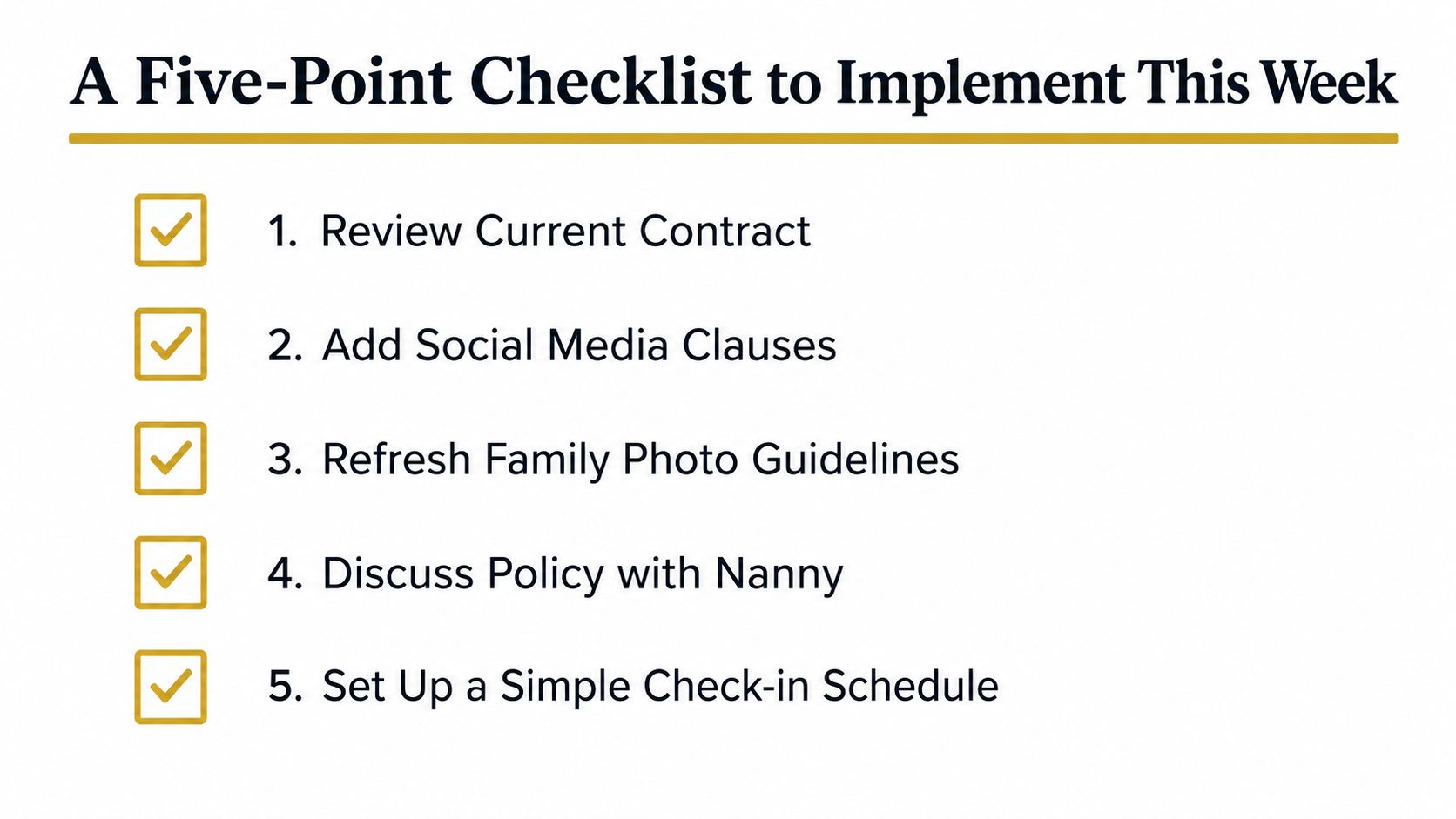
A family can get this done in a working week if the household manager leads it properly.
- Review the current contract. Check whether social media, confidentiality, and device-use terms already exist, then mark what's missing.
- Add the social media clauses. Insert the confidentiality, posting, and consent wording into the next contract version.
- Refresh the family photo guidelines. List what may be photographed, what never may be photographed, and who can approve exceptions.
- Discuss the policy with the nanny. Hold a face-to-face briefing and get acknowledgement in writing.
- Set up a simple check-in schedule. Revisit the rule before travel, school transitions, or any change in staffing.
If your household needs a bespoke version that fits London, New York, Dubai, or another high-profile setting, get it written properly and get it implemented quickly. Superstar Nannies can help you shape a private-staff policy that covers confidentiality, consent, and conduct without creating unnecessary friction in the home.
If you want social media guidelines that work in a private household, Superstar Nannies can help you build them into your staffing documents, not just leave them in a handbook no one reads. Speak to the team if you need a confidentiality and consent policy for nannies, maternity nurses, or wider household staff, and bring your current contract to the conversation so it can be tightened properly.