


You're trying to hire a driver for school runs, appointments, airport transfers, and the odd late finish. The clean CV and polished references look reassuring, but in the UK that's only the front door, not the compliance check. If you hire casually, you can end up with a driver who looks suitable on paper and still leaves you exposed on licensing, right to work, and duty-of-care.
Why Hiring a Driver in the UK Requires More Than a CV Check
A family often starts with the wrong assumption, that hiring a driver is just another household recruitment task. It isn't. In practice, hiring a driver in the UK sits between employment law, transport regulation, and household risk management, so the process needs structure from the outset.
The market itself tells you this role isn't niche. Analysts at the RAC Foundation found that 17.4% of all UK job advertisements in 2023 required applicants to be able to drive, and that level stayed above every pre-Covid year in the dataset. Driving is a baseline requirement in many roles, so a strong driver candidate is usually choosing between several employers, not waiting around for a household vacancy, RAC Foundation analysis of UK job adverts.
The supply side is active too. For household employers, that means the labour pool is moving, candidates are comparing offers quickly, and delays in your process will cost you the right person. The fastest route is rarely the safest one, but the slowest route is usually the most expensive because good candidates accept another role while you are still checking paperwork.
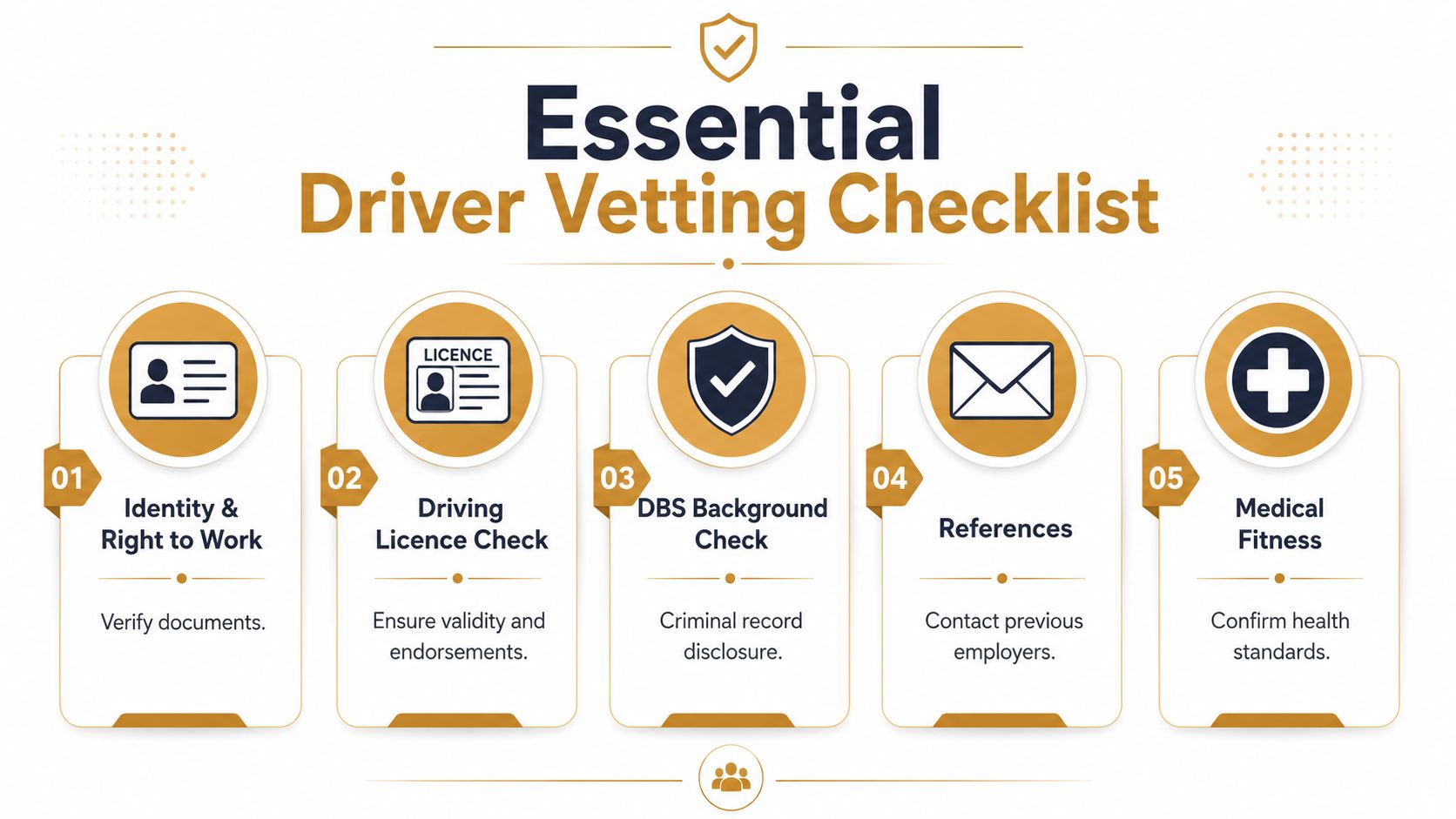
A disciplined hiring process starts with the legal basics, not the interview script. Before you discuss schedules or vehicle preferences, you need to verify identity, permission to work, and the level of screening the role demands. That applies even more sharply where the driver will be around children, vulnerable family members, confidential travel patterns, or estate staff.
If you want a proper document trail for household recruitment, the guidance on Right to Work and DBS checking is a sensible reference point for the compliance side of the process. Use it to tighten your checks, then apply the transport-specific screening that a private driver role requires.
The hiring route matters as well. A specialist household recruitment agency can remove some of the admin burden and help you avoid obvious compliance gaps, while a private search gives you full control but also full responsibility for record-keeping, document collection, and the timing of each check. If you want a clearer breakdown of those options, see how a specialist driver agency works.
For UHNW households, the issue is exposure. A polished CV does not show whether a candidate understands confidentiality, can handle changing schedules without improvising badly, or knows how to work around family routines without creating friction. That is why the legal framework, vetting depth, and employment structure all need to be settled before the first interview is arranged.
Choosing Between Agency and Private Hiring Routes
The first decision is simple, and it changes everything else. Either you use a specialist agency, or you run the search privately and own every stage yourself. There's no neutral middle ground, because the compliance burden sits somewhere, and if it isn't with the agency, it's with you.
A specialist route is usually the right answer for households that want speed, discretion, and a cleaner paper trail. A private search gives you more control, but it also means you're responsible for chasing documents, checking licences, recording consent, and deciding what happens when a candidate's paperwork stalls halfway through onboarding.
| Factor | Agency Recruitment | Private Recruitment |
|---|---|---|
| Candidate access | Pre-vetted shortlist | You source everyone yourself |
| Compliance burden | Shared with the agency | Sits with the household |
| Speed | Usually faster | Usually slower |
| Confidentiality | Better managed through process | Depends on your own controls |
| Cost | Higher upfront fee | Lower direct fee, higher admin load |
| Best fit | UHNW homes, urgent hires, sensitive roles | Families with time and in-house HR capability |
The trade-off is not subtle. Agencies charge for process, and that process is what protects you when the role is sensitive or time-limited. If you want a plain breakdown of what an agency for driver route looks like, that service model is worth comparing against your own capacity before you start advertising.
Private hiring can work when the role is straightforward, the household has someone disciplined enough to run checks, and the timeline is flexible. It fails when people rely on first impressions. That's when missing documents, weak reference handling, and informal “we'll sort it later” onboarding create avoidable risk.
Do this if the role is live-out, confidential, or time-sensitive: use an agency or a specialist recruiter. The cost is easier to justify than a bad hire.
Building a Vetted Driver Candidate Profile
Begin with the role requirements, then assess the person against them. The HSE says driver recruitment should start by defining the exact vehicle and job duties, then checking physical and mental fitness, competence, and the correct certificates before the start date, HSE recruitment guidance for transport personnel. Families that reverse that order waste time on candidates who were never suitable for the assignment.
The checks that belong in every file
Build the file in layers. A loose pile of PDFs is not a process.
- Licence validation: confirm the licence is current, genuine, and suitable for the vehicle.
- Right to work evidence: do not move to interview stage without it.
- References from previous employers: ask about punctuality, route discipline, attitude, and confidentiality.
- Medical and eyesight fitness: especially where long hours, night driving, or older vehicles are involved.
- Driving-record consent: if the candidate will not authorise a proper licence record check, stop there.
Aviva's fleet-risk guidance says selection should include a full driving-licence check, evidence of UK work eligibility, accident-history review, and a skills and behavioural assessment, and that is the right standard for household work too. For a practical overview of why structured pre-employment screening matters, the piece on streamlined hiring with background checks is useful context.
CVs are easy to polish. A driver can present years of experience and still be the wrong hire if they are vague about route discipline, impatient with instructions, or casual about vehicle care. In a private home, those weaknesses show quickly because the role depends on trust as much as driving ability.
Household standard: if a candidate cannot explain how they handle confidential journeys, last-minute schedule changes, or unfamiliar roads, they are not ready for a premium household post.
A strong profile also sets behavioural expectations in plain language. Specify discretion, communication style, appearance, child-friendliness if relevant, and whether the driver is expected to wait, assist, or run errands. That turns vague “good service” into a usable brief. If you want a practical reference point for the career path itself, how to become a chauffeur is a useful benchmark for the standards many candidates should already understand.
Navigating UK Driver Licensing and Legal Requirements
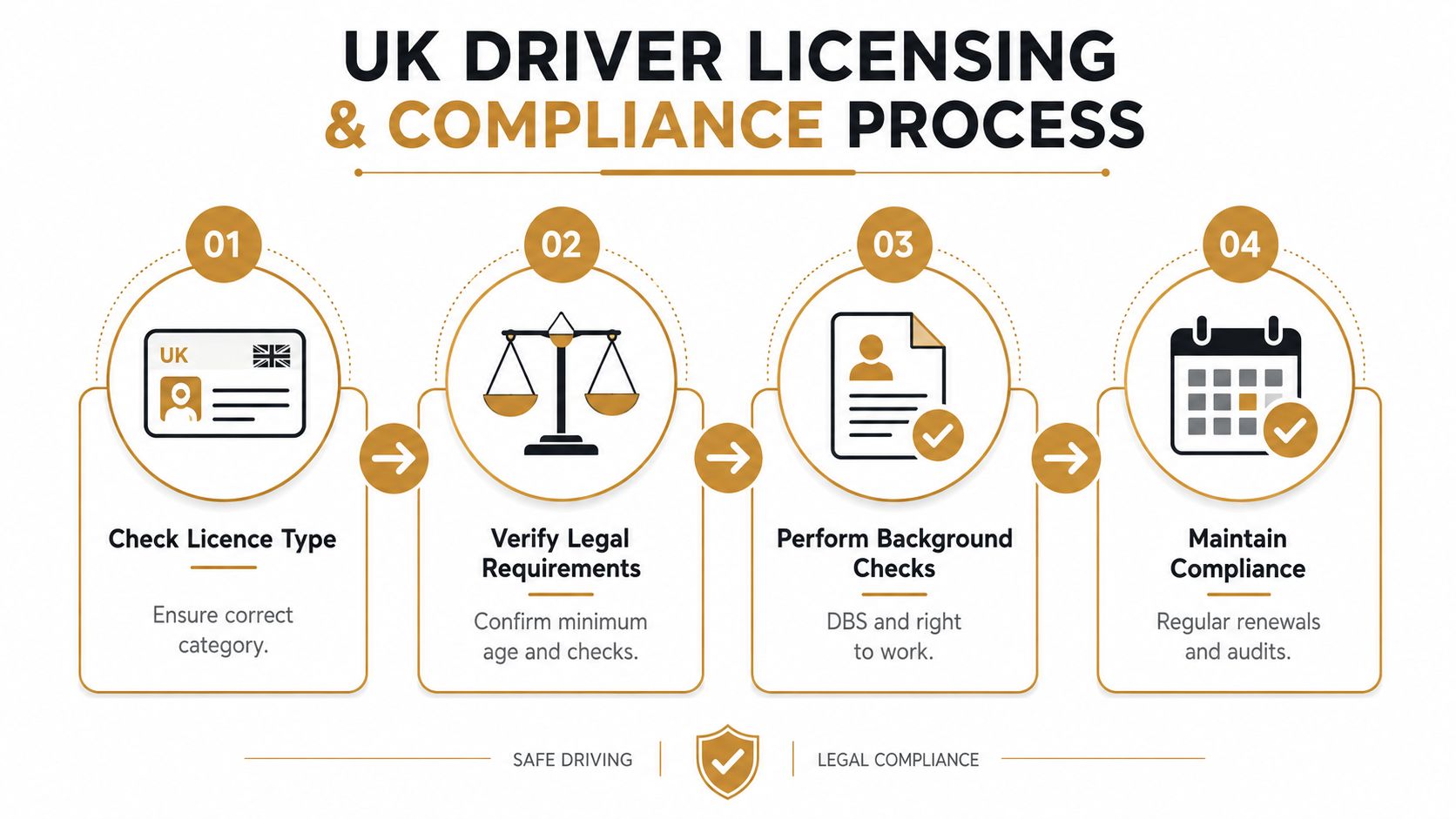
Many households get it wrong. They assume a private driver is just a member of staff with a car, when the arrangement may sit inside a much more formal licensing framework. For private-hire or chauffeur-style roles, the technical benchmark is the licensing stack itself: applicants must be at least 21, have the right to live and work in the UK, hold a valid UK or equivalent EU driving licence that is at least 3 years old, pass a medical exam, complete an enhanced DBS check, and pass a topographical skills test before approval, Addison Lee private hire licence guide.
The classification question matters first
Before you worry about interview questions, decide whether the arrangement may trigger private-hire scrutiny. The UK government's Best Practice Guidance looks at whether the arrangement produces commercial benefit, whether the vehicle carries fewer than nine passengers, whether the driver is already vetted for the wider service, and whether the driver is doing duties beyond driving and basic luggage help, Best Practice Guidance for taxi and private hire licensing.
That is the gap most generic household advice misses. A chauffeur who also handles errands, itinerary support, security-related movement, or broader household duties may be sitting in a more complex compliance zone than a simple school-run driver. Families and family offices should not guess here.
London adds another layer. Transport for London requires applicants to be at least 21, hold a full DVLA, Northern Ireland, or EEA licence that is at least 3 years old, and pass mandatory assessments including a topographical assessment, an English language requirement, and a Safety, Equality and Regulatory Understanding assessment, TfL private hire driver licence requirements. Across England and Wales, taxi and private hire drivers usually need a licence from the local licensing authority or TfL and must be a fit and proper person, with extra checks depending on the role and location, GOV.UK taxi driver licence guidance.
For a more operationally focused route into the profession, this guide on how to become a chauffeur shows how the licensing and role expectations sit together in real hiring.
Compliance rule: if the role looks like professional passenger transport, don't treat it like ordinary domestic employment until you've checked the licensing position.
Structuring Employment Terms and Pay Packages
A polished hire falls apart quickly if the contract is vague. The driver needs to know what the job is, what it is not, and how far their responsibilities stretch. Clear terms prevent disputes about hours, errands, standby time, and vehicle use.
Structure the offer around real responsibilities
Start with the base package, then build in the conditions that matter in a household setting. For senior chauffeur roles in London, pay is often shaped by experience, vehicle type, and whether the role includes estate or security duties. If you want a sense of how the market is usually framed, this overview of how much a personal chauffeur costs is the right place to compare expectations before you draft an offer.
Your contract should cover:
- Hours and overtime rules: define start, finish, standby, and overnight expectations.
- Vehicle use: specify whether the driver uses one car, multiple cars, or a household fleet.
- Live-in or live-out terms: accommodation and utilities for live-in roles, transport or fuel support for live-out roles where relevant.
- Confidentiality and data handling: include confidentiality clauses and UK GDPR awareness where the role exposes the driver to family schedules, addresses, or travel habits.
- Social-media restrictions: set a clear boundary on posting family-related material.
- Discipline and review: say how performance issues will be handled.
Payroll needs to be clean from day one. If the driver is employed directly, National Insurance, tax, and pension administration need to be handled properly. If the household uses a payroll provider or umbrella structure, make sure the arrangement is lawful and documented, not just convenient.
My recommendation: do not improvise chauffeur contracts from a generic domestic-staff template. The cost of a proper household employment agreement is lower than the cost of a dispute about hours, vehicle damage, or disclosure.
Elite households also need to control role creep. A driver can be asked to help with logistics, but if you keep adding errands, security support, and administrative tasks without redrafting the contract, you end up with an unclear role and an unclear pay structure. That is how good hires leave.
Running Effective Interviews and Trial Periods
A driver interview should feel more like an operational assessment than a chat. You're not looking for charm alone, and you're definitely not hiring on confidence alone. You need to see how the candidate thinks, how they handle pressure, and how they behave when the road doesn't cooperate.
Ask about judgment, not just mileage
The useful questions are the ones that force specifics.
- Route judgement: ask how they'd manage a known bottleneck, a school-run delay, or an unfamiliar address.
- Confidentiality: ask what they'd do if a family member was running late and pressuring them to disclose location details.
- Household rhythm: ask how they adapt to recurring routines without being told the same thing twice.
- Pressure handling: ask for a real example of a late pickup, diversion, or vehicle issue.
- Presentation and discretion: watch how they speak about former employers.
A trial period should be supervised and practical. Put the candidate on your actual routes, not a staged circuit that tells you nothing about real life. Observe punctuality, parking discipline, vehicle handling, and how they behave around family members, staff, and reception desks.
The strongest hire is often not the flashiest one. It's the person whose record is clean, whose paperwork is complete, and whose behaviour stays steady when plans change. That logic is why a structured process matters more than a polished interview performance.
If you want a repeatable hiring framework, this resource on how to hire a chauffeur aligns well with a household trial structure because it keeps the focus on verification, not guesswork.
Red flag: if a candidate downplays route planning, dismisses confidentiality, or acts irritated by process, don't rationalise it away. That attitude gets worse after onboarding, not better.
Onboarding and Retaining Your Private Driver
Onboarding is where compliance becomes day-to-day behaviour. If you skip it, the driver starts work with gaps in route knowledge, security expectations, and vehicle standards. If you handle it properly, the household gets consistency and the driver understands how the home operates.
The first week should cover document sign-off, vehicle familiarisation, emergency contacts, route mapping, parking expectations, and household security protocols. Put the standards in writing, then keep them easy to find. A driver who knows the family routine from day one makes fewer mistakes later, and the household wastes less time correcting avoidable issues.
Retention depends on whether the role feels orderly. Good household drivers leave when expectations shift without warning, pay is handled badly, or the family treats scheduling as something to improvise every day.
Keep the good ones by being predictable
- Review pay openly: don't let frustration build around money or overtime.
- Protect working hours: fatigue is a safety issue, not a style issue.
- Give clear escalation routes: drivers should know who to contact when plans change.
- Respect confidentiality: gossip from principals or staff pushes good people out.
- Document performance: praise and corrections should both be recorded.
A driver who feels trusted and managed fairly is more likely to stay. A driver who is treated like a disposable errand-runner will leave, and in a premium household, replacement time hurts more than salary adjustments ever do.
Superstar Nannies provides specialist recruitment support for private household staffing, including chauffeur placements for families that need a discreet and compliant search process. If you are ready to hire properly, visit Superstar Nannies and speak with a team that understands household compliance, private transport roles, and the standard of service elite homes expect.