


Most advice around “private hire drivers wanted” starts with the wrong assumption: that a job advert proves operators can't find enough drivers. In practice, “wanted” often reflects a licensing and compliance bottleneck, not a shortage of people willing to drive. Applications can stall around identity checks, criminal-record checks, medical assessments, testing, vehicle approval and licensing throughput before a candidate is legally able to accept a first fare.
That distinction matters whether you're applying for app-based work, recruiting for a corporate account or hiring a discreet chauffeur for a private household. A candidate may be interested today but unavailable for weeks, while an operator may keep advertising to maintain a pipeline for expansion, seasonal demand or unexpected departures. If you're hiring for a family, the right question isn't “Can this person drive?” It's “Can this person be licensed, trusted and operationally reliable for this household?”
What “Private Hire Drivers Wanted” Really Means in 2026
The phrase private hire drivers wanted covers several different labour markets. Treating them as one category leads to poor applications and weak shortlists.
The first group consists of app-based PHV drivers working through platforms such as Uber, Bolt or Addison Lee. They usually prioritise control over when they work, but they also carry responsibility for licensing, vehicle costs, insurance, tax administration and periods when demand is too low to justify being on the road.
The second group includes salaried chauffeur drivers serving corporate accounts. These roles tend to place more weight on presentation, punctuality, route planning and consistent customer care. The third includes private household chauffeurs, who may drive children to school, manage errands, keep vehicles presentable and support a family's wider daily logistics. A private household may also require live-in or live-out availability, travel flexibility and strict confidentiality.
Recruiter's rule: Apply for the operating model, not just the driving job title.
For candidates considering household work, hiring a driver in the UK requires a different assessment from selecting an app-based operator. Families often look for calm judgement, discretion and continuity of service, not just the ability to complete a high volume of journeys.
Operators advertise continuously because they need a ready pool of compliant candidates. A vacancy can appear filled while the business still needs people who are already licensed, properly insured and able to pass its onboarding checks. That's why a driver with organised paperwork and relevant references can move ahead of a more experienced applicant who hasn't prepared for the administrative stage.
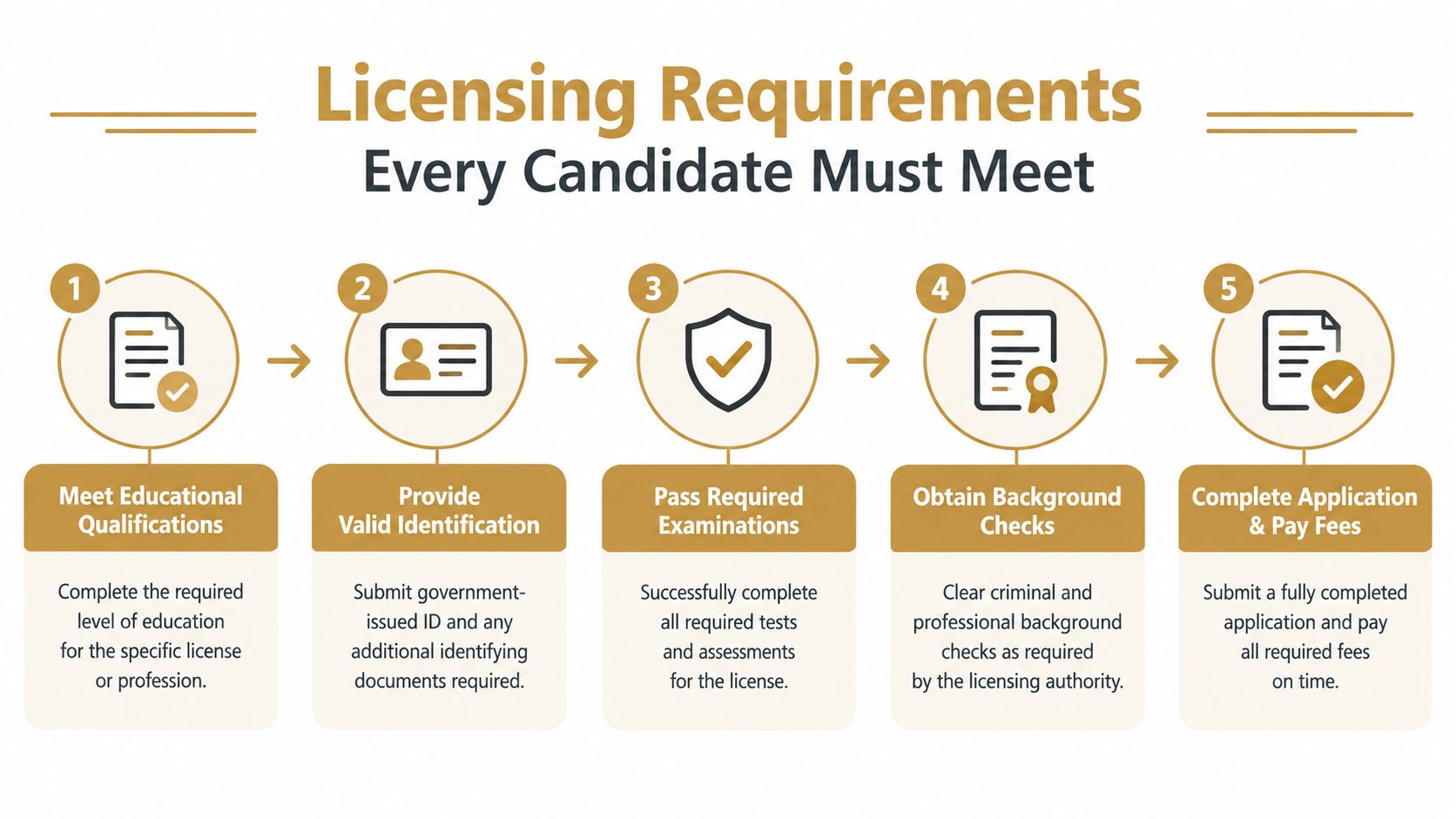
Licensing Requirements Every Candidate Must Meet
There isn't one single UK private hire licence. London is governed by Transport for London, while licensing authorities elsewhere set local requirements. Across England and Wales, anyone driving a taxi or private hire vehicle must hold a licence and be legally allowed to work in the UK. Applicants will usually need to have held a full British, Northern Irish or EU driving licence for at least 12 months, although local authorities can impose further conditions. The GOV.UK taxi driver licence guidance explains the national starting point.
London has a more specific framework. TfL requires a private hire driver to be at least 21, hold a full eligible driving licence that has been held for at least three years, and have the right to live and work in the UK. New applicants must complete an enhanced DBS check, meet the Group 2 medical standard and pass topographical, English-speaking and listening, and SERU assessments. These requirements are set out in TfL's private hire driver licence criteria.
The practical sequence
Confirm the licensing authority. London applicants deal with TfL. Elsewhere, check the council responsible for the intended operating area because local rules can differ.
Prepare identity and work documents. Right-to-work evidence and driving-licence documentation must be complete and consistent. Missing information creates avoidable correspondence.
Complete checks and assessments. DBS screening, medical requirements and any local knowledge, language, safeguarding or disability-awareness training must be dealt with before a licence can be issued.
Confirm the vehicle position. Your own vehicle may need approval, suitable insurance and inspection. If an operator supplies the vehicle, confirm precisely what remains your responsibility.
Keep the legal boundaries clear. A private hire driver cannot ply for hire or collect street hails. The journey must be pre-booked through a licensed operator, as explained by High Peak District Council's private hire operating guidance.
For owner-drivers, administration doesn't stop when the badge arrives. A structured owner driver licence management process can help keep licence checks, renewals and supporting records organised. Candidates moving into chauffeur work can also review this guide on how to become a chauffeur, particularly if they're considering private household employment rather than platform driving.
Chauffeur Roles in Private Households Versus App-Based Hire
The most important career choice is whether you want a client relationship or a marketplace relationship. Household chauffeur work is personal and service-led. App-based hire is flexible and volume-led.
A private household may expect the chauffeur to handle school runs, errands, vehicle presentation and discreet coordination with other staff. The family normally wants one dependable person who understands routines and communicates appropriately. App-based work offers more control over shifts, but the driver absorbs more exposure to fluctuating demand, vehicle overheads and platform decisions.
| Factor | Household Chauffeur | App-Based Private Hire |
|---|---|---|
| Earnings structure | Usually agreed employment terms or a fixed arrangement | Variable income linked to bookings, platform rules and operating costs |
| Schedule control | Set around the household's routine, with agreed availability | Greater control over when to log on |
| Vetting depth | Often extensive, with references, discretion checks and household suitability | Licensing and operator checks remain central, with additional platform screening |
| Vehicle responsibility | May be supplied or managed by the household | Often carried by the driver or arranged through an operator |
| Tax treatment | Depends on the employment arrangement and jurisdiction | Depends on the legal structure, contract and individual circumstances |
| Career progression | Can develop into senior chauffeur, driver-manager or household operations work | Can lead to fleet, operator or account-based work |
No applicant should accept a platform arrangement without understanding who pays for insurance, servicing, fuel, cleaning, licensing and downtime. Likewise, a family shouldn't describe a role as “flexible” if it demands constant standby availability.
For employers, engagement matters because a driver who feels treated as a replaceable booking resource may not deliver the calm, consistent service a household expects. Resources such as this driver employee engagement guide are useful when an operator is building retention practices around communication and recognition.
The UK Private Hire Market by the Numbers
The market supports ongoing recruitment, but a vacancy does not automatically prove a driver shortage. Licensing capacity, vehicle supply and operating costs determine how quickly a role can start and what income remains after expenses.
The Department for Transport recorded 313,008 licensed taxis and private hire vehicles in England on 1 April 2024, up 8.2% from 2023 and 70% from 2005. It also recorded 381,092 active driver licences, including 69% classified as private-hire-only licences and 20% as dual licences. Private hire vehicles made up 82% of all licensed vehicles, while only 2% of PHVs were wheelchair accessible, according to the Department for Transport's 2024 statistics.
London requires separate scrutiny. TfL recorded 106,468 licensed private hire drivers in 2024/25, compared with 106,267 in 2023/24 and 101,535 in 2022/23, as reported in TaxiPoint's analysis of TfL data. That pattern points to a workforce stabilising after recovery, not a simple collapse in supply.
| Metric | England, 2024 DfT | London, 2024 TfL | England, 2026 |
|---|---|---|---|
| Active or licensed driver licences | 381,092 | 106,468 | 417,300 |
| Licensed PHVs | PHVs formed 82% of licensed vehicles | London-specific vehicle figure not stated here | 290,000 |
| PHV-only share | 69% | Not stated here | 71% |
| Direction of change | Up from 2023 and 2005 | Stabilising after recovery | Driver licences up 9% from 2024, PHVs up 13% |
The 2026 England figures show 417,300 taxi and PHV driver licences and 290,000 licensed PHVs as of 1 April 2026, increases of 9% and 13% respectively compared with 2024, according to the Department for Transport's 2026 statistics. Candidates should treat those totals as evidence of opportunity, not guaranteed take-home income. Competition, licensing delays and vehicle costs still affect the result. Families should distinguish a licensed PHV from a dedicated household chauffeur before comparing available drivers. London-specific context is also useful when reviewing our chauffeur hire London prices guide.
What Employers and Households Vet Before Hiring
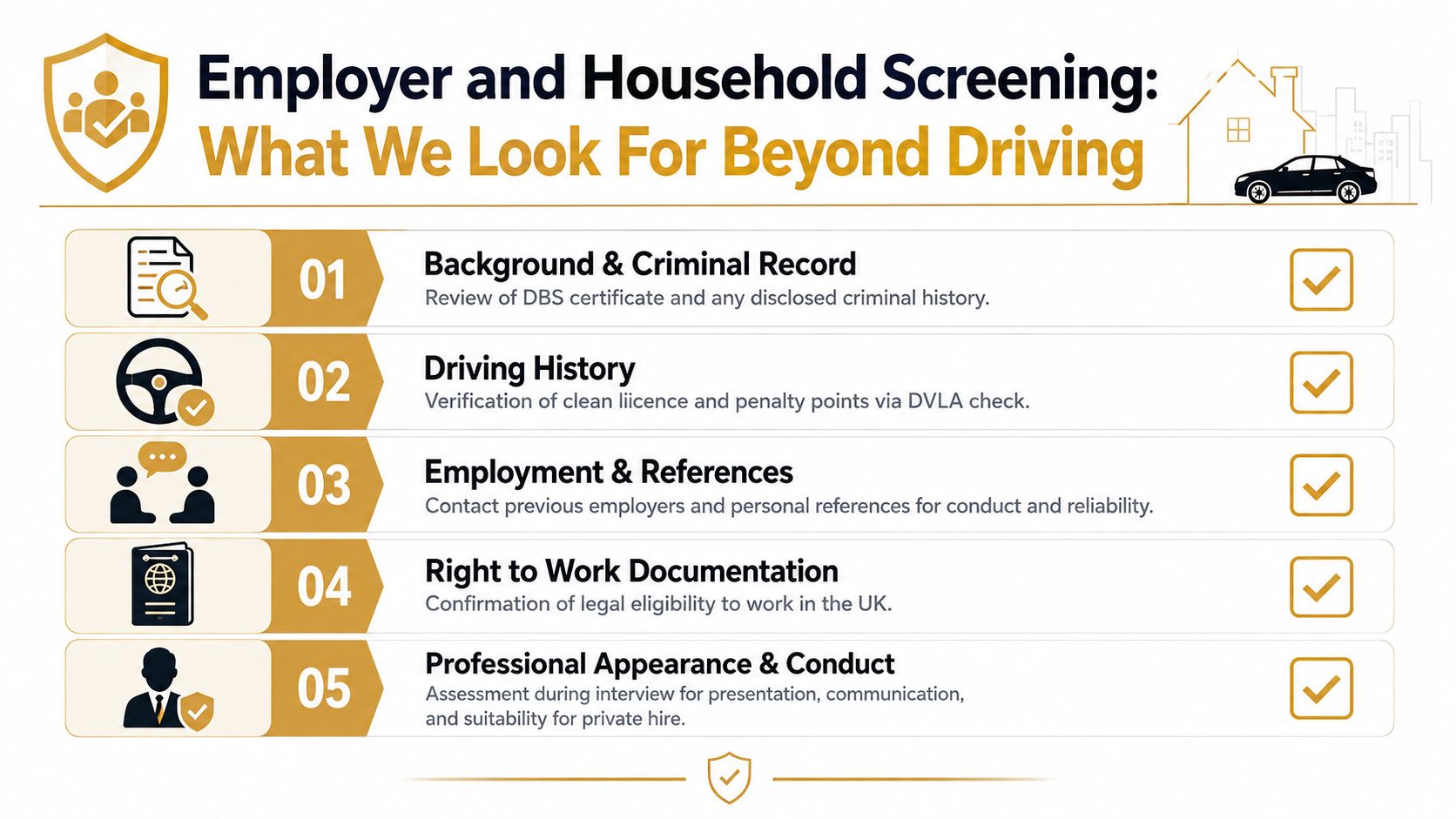
A driving licence gets a candidate into the process. It does not prove that the person is safe, reliable, discreet or suitable for the passengers. Employers and households should build the shortlist around evidence, because missing documents and slow checks can delay a start by weeks or months.
Begin with the legal file. Verify the private hire licence, driving entitlement, relevant DBS position and right to work. Confirm that medical fitness records and any required driver-fitness declarations are current. TfL requirements can also include a Certificate of Good Conduct for new and renewing applicants who have lived outside the UK for one or more continuous periods of three months or more during the last 10 years, subject to the stated licensing conditions. Check the TfL operator licensing information directly rather than accepting an applicant's summary.
What separates a licence check from a proper shortlist
- Driving history: Review the licence position and declared incidents against the available records.
- Employment history: Request a coherent work history and speak to previous employers where appropriate; see our employment history verification guide for the process families typically follow.
- References: Ask about punctuality, temperament, confidentiality and conduct under pressure.
- Identity and address: Check that the documents, application and background information match.
- Household suitability: For family placements, assess boundaries, communication with children and cooperation with household managers.
- Discretion: Set confidentiality expectations before the first assignment, especially where the driver will access a private residence or sensitive itinerary.
Some households also request insurance-grade driving information, drug and alcohol testing or social-media screening. These checks depend on the role and the family's risk policy. They supplement statutory licensing checks, which should remain clearly documented and explained to the candidate.
Fleet managers can follow the Fleetalyse licence checking guide to structure licence verification. Families should also record consent, references and role-specific checks through a secure process, including live-in or rota arrangements. Candidates who submit a complete, current file reduce compliance friction and give the household a clearer hiring decision.
How to Stand Out When You Apply
Most applications fail before the driving ability is properly considered. A vague CV, missing dates or an unexplained gap tells a recruiter that onboarding may be difficult.
Put the operational facts at the top of a one-page CV:
- Licence status: State the issuing authority, licence category and current validity.
- Driving background: Describe executive saloons, electric vehicles, wheelchair-accessible vehicles, school transport or corporate work only where you have genuine experience.
- Compliance file: Include DBS status or issue date where appropriate, medical position and relevant training.
- Employment record: Give clear dates, role titles and named referees who have agreed to be contacted.
- Service strengths: Mention punctuality, calm communication, route planning and passenger care.
Your cover note should identify the operator, company or household role. “I'm looking for driving work” is weak. A better approach explains why your experience suits that specific environment, such as early school runs, airport coordination, corporate etiquette or working alongside a household manager.
Bring evidence, not promises
Arrive with your driving licence, badge details, right-to-work documents, DBS information, medical documentation and reference contacts organised. Don't send sensitive documents through an unverified channel, and don't claim a licence is complete when an application is still pending.
Recruiters also notice the small signals. Arrive early, dress neatly, answer directly and explain how you'd handle a delayed passenger, a changed school collection or an unfamiliar route. A household chauffeur must show judgement under pressure without turning every problem into a drama.
Before accepting an offer, ask who supplies the car, who pays running costs, how hours are recorded, what happens during family travel and which operator holds the booking responsibility. Clear questions at the start prevent disputes later.
A Practical Checklist Before You Start
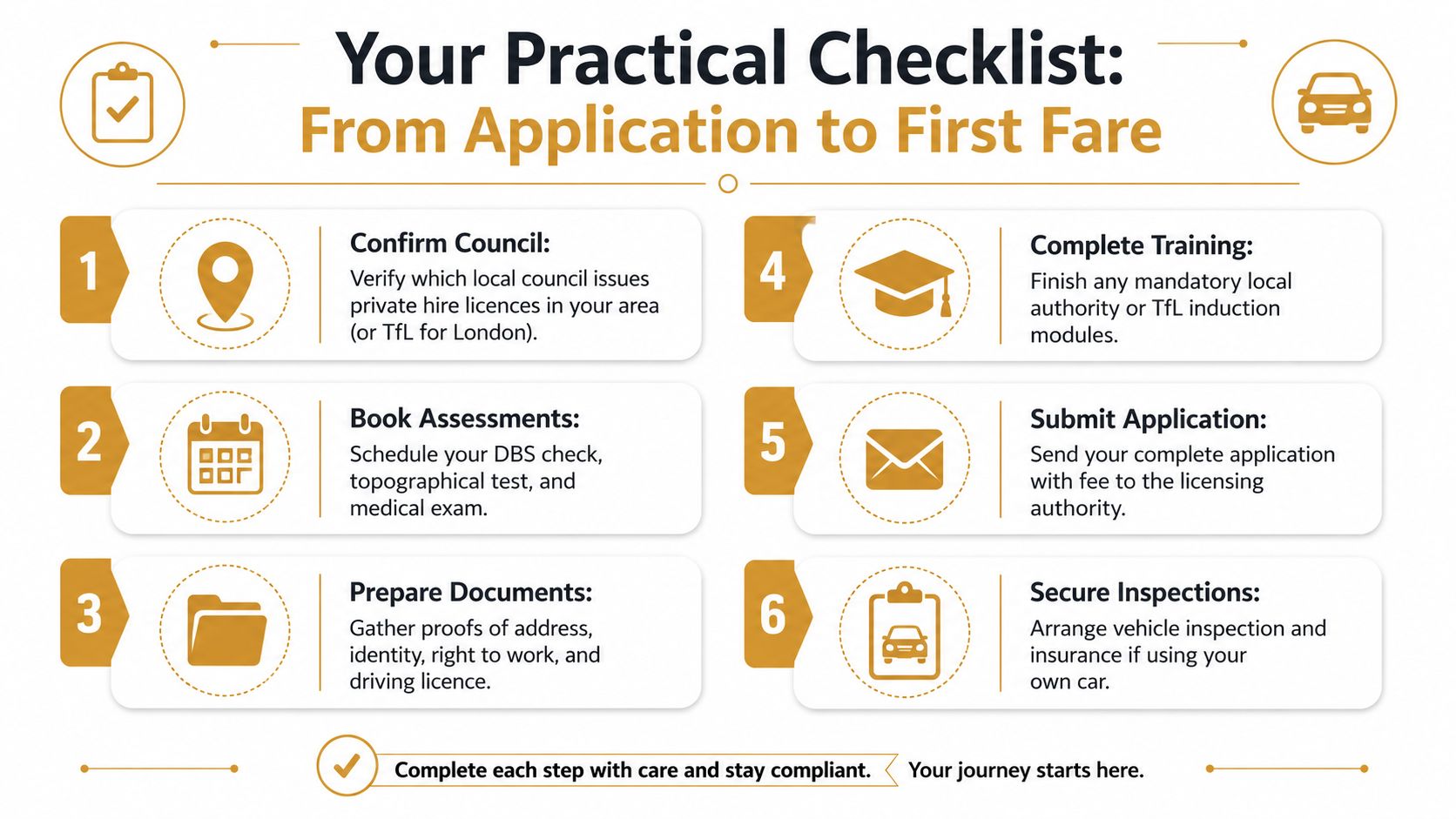
Use the following list as a working plan, not a vague promise to “get the paperwork sorted”.
Confirm the authority. Identify the council responsible for the private hire licence, or TfL if you'll operate in London.
Book the checks. Arrange the enhanced DBS process and medical assessment. If your authority requires additional tests or training, schedule those early.
Assemble documents. Prepare identity evidence, right-to-work documentation, driving-licence details, proof of address and any overseas good-conduct documentation that applies to your circumstances.
Resolve the vehicle position. Decide whether you'll use an operator's vehicle or your own. Confirm insurance, inspection and licensing responsibilities in writing.
Apply with a complete file. Check every form, date and signature before submission. A missing document can create more delay than a difficult interview.
Prepare for the employer. Write the CV, secure references and practise situational questions about discretion, punctuality, passenger safety and changing instructions.
Your start date depends on the authority, the completeness of the application and the checks required. TfL's process includes multiple assessments, while local councils can apply their own testing and medical conditions. Don't resign from existing work or promise availability to a household until the licensing position, insurance and operator arrangement are confirmed.
Employers should verify the candidate's badge or licence number, medical certificate position and driving record before signing a contract. A private household should also agree reporting lines, working hours, vehicle care, travel expectations and confidentiality terms in writing.
Write a one-page action plan for the next thirty days. Put each task beside an owner and a date, then update it whenever the authority or employer requests further information.
Superstar Nannies sources and vets private chauffeurs for confidential household placements, matching families with drivers whose experience, discretion and working preferences suit the household's actual routine. If you're hiring a private driver or seeking a professionally managed chauffeur role, visit Superstar Nannies to discuss the right next step.