


Complex households rarely struggle because they employ too few people. More often, they struggle because authority, accountability, and operating procedures are not clearly defined. The housekeeper does not know who approves repairs. The chef is waiting for a confirmed travel schedule. The grounds team is following outdated instructions. The staff may be capable, but reporting lines, priorities, and decisions remain unclear.
In that context, hiring an estate manager may be the right step, but it is rarely the only one. The more important question is whether the household already has the operating structure that allows an estate manager to succeed.
A qualified estate manager can bring discipline, accountability, and continuity to a complex private residence. However, the right estate manager agency should also assess the structure around the role. One household may need a senior manager to lead an established team. Another may require a broader review of reporting lines, additional hires, and operational processes across multiple residences. That distinction matters, because even an exceptional individual cannot compensate for a poorly designed household operation.
Why UHNW Families Turn to an Estate Manager Agency
A family with a principal residence in London, a country estate, and homes used during international travel does not necessarily have a recruitment problem. In many cases, it has a coordination problem. Staff are hired at different times, each property develops its own routines, and the family gradually becomes the only consistent point of connection across household operations.
That model becomes vulnerable as soon as travel increases or schedules intensify. A housekeeper may understand one residence but not another. A private chef may receive instructions through a personal assistant rather than an operational lead. Maintenance contractors may be approved without a defined budget owner. The result is predictable: the family spends time resolving issues that should have been handled before they became visible.
The UK property management market reflects the scale of the wider environment in which these disciplines sit. Property Management Services were estimated at £17.8 billion in 2026, with 20,266 businesses operating in the sector, and revenue forecast to grow at a 3.8% compound annual rate from 2021 to 2026, according to IBISWorld's UK property management industry data. Private household estate management is more discreet and significantly more personal, but it still depends on the same fundamentals: planning, contractor control, budget oversight, and long-term asset care.

The role sits above individual staff members
An estate manager may oversee housekeepers, nannies, chefs, chauffeurs, groundskeepers, maintenance teams, security personnel, and event staff. Published private household role descriptions also include rotas, payroll, recruitment, training, HR, household security, fire safety procedures, risk assessments, inventories, bills, and service standards such as formal table service and wine cellar management, as outlined by Staff of Distinction's estate manager responsibilities.
This breadth explains why generalist recruitment often falls short. A recruiter may understand domestic staffing, yet still miss the difference between a polished housekeeper and a genuine operational leader who can direct a dispersed team, challenge contractors, manage budgets, and protect the family's privacy without constant supervision.
Recruiter's view: Hire an estate manager to match the operational complexity of the household, not the prestige of the title.
tailored family support service
A specialist agency should function as a structural adviser, not simply a sourcing partner. It should assess whether the family needs one senior appointment, a house manager beneath an estate manager, stronger domestic supervision, or a full staffing model.
Core Services Offered by Estate Manager Agencies
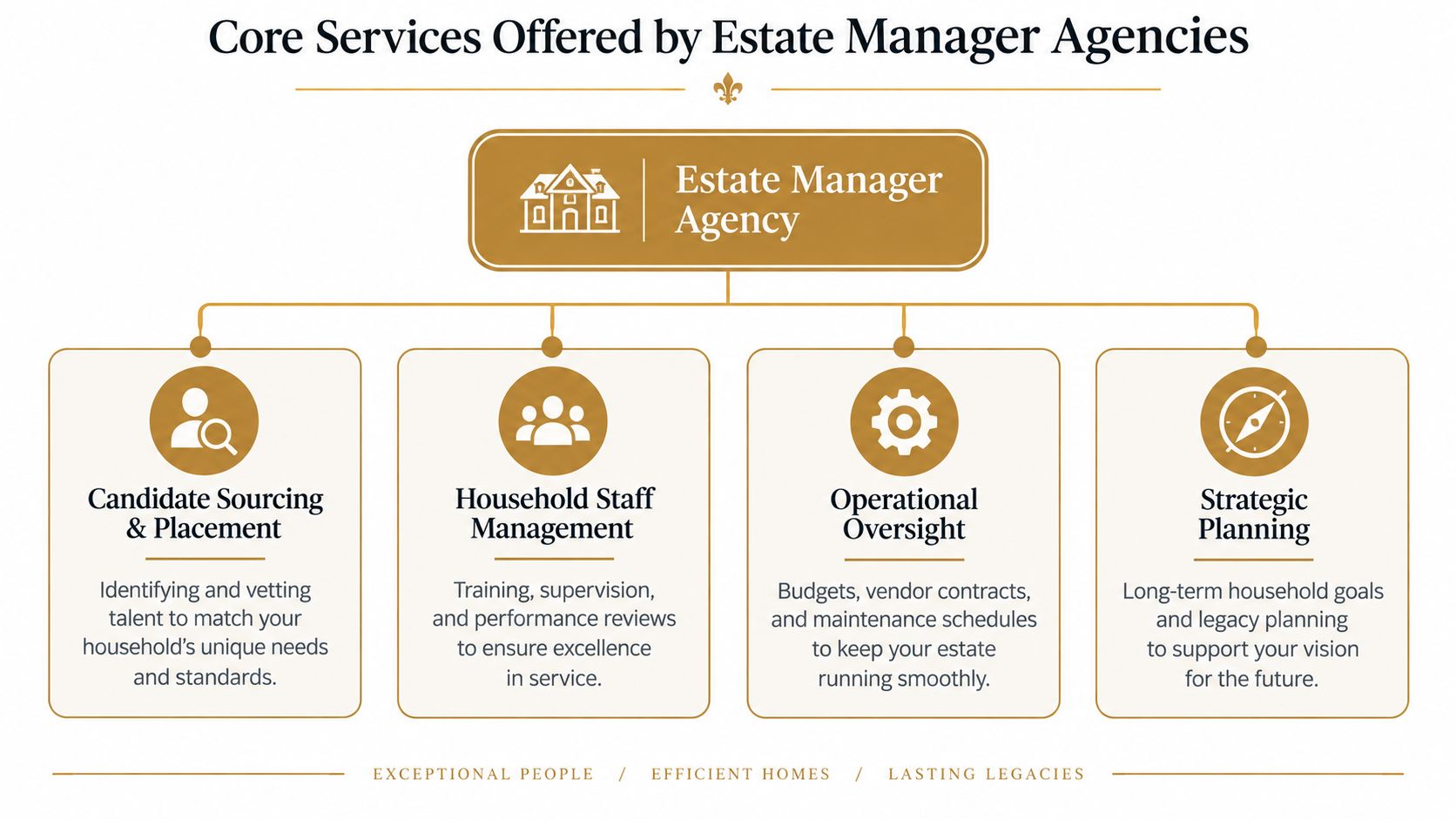
A capable estate manager agency should provide more than polished CVs. Its value lies in understanding how the household functions as a system, then identifying professionals who can perform effectively within that system.
Candidate sourcing and placement
The most visible service is the search itself. Agencies may identify and assess estate managers, house managers, butlers, domestic couples, private chefs, chauffeurs, gardeners, and other household professionals. The brief should define the reporting structure, property locations, travel expectations, staff culture, decision making authority, and the family's expectations regarding discretion.
OPLU's private household estate manager resource
Prospects' estates manager profile
An estate manager's responsibilities often include maintenance, repairs, staff leadership, budgeting, contractor management, events, administration, and estate planning. In the private household market, compensation is typically higher than general estates management benchmarks. Current sector guidance places many UK private household estate manager roles in the region of £55,000 to £100,000, with larger London portfolios and multi residence appointments frequently reaching £120,000 to £150,000 or more, depending on complexity, staffing scope, and travel expectations. These figures remain indicative and should be tested against the actual scope of the role.
Household staff management
The estate manager often becomes the operational lead for a team that includes housekeepers, nannies, chefs, grounds staff, chauffeurs, security, and maintenance personnel. The agency should therefore test whether a candidate has real experience recruiting, scheduling, training, supervising, and managing performance across those functions.
For families reviewing the wider property management context, hiring a property manager tips can offer useful general preparation. Private household staffing still requires a more discreet and tailored assessment because domestic staff work inside the family's personal environment.
Operational oversight and planning
A specialist agency should also understand the operational infrastructure behind the appointment. This includes budgets, supplier relationships, maintenance schedules, inventories, travel between residences, and clear escalation procedures. A detailed estate manager role description for multiple properties highlights responsibility for domestic staff, budgets, repairs, utilities, and travel between homes.
Families should commission a wider staffing review when they are acquiring a property, adding residences, rebuilding after turnover, or relying on family members to resolve recurring operational issues. For a fuller explanation of the leadership dimension of the role, read what an estate manager does in a UHNW household.
How Agencies Vet Estate Manager Candidates
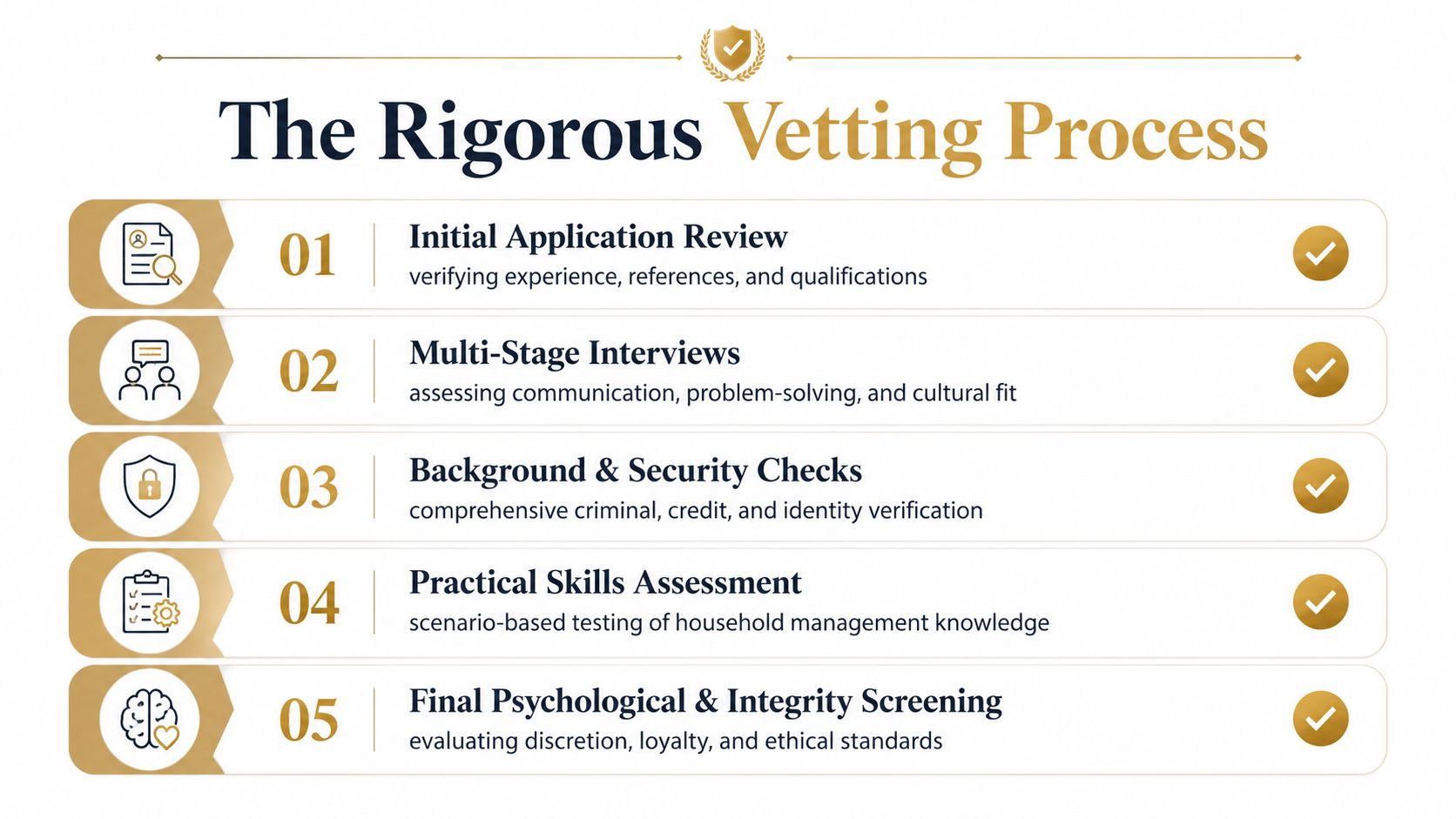
A strong CV does not establish that a candidate can run a household. It establishes only that the candidate presents experience worth examining in detail.
The first stage of assessment should define scope. Did the candidate manage one residence or multiple properties? Did they supervise a small domestic team or lead a broader operational structure? Were they directly responsible for budgets, contracts, maintenance, payroll, and staff performance, or were they supporting someone else who held that authority?
Test operational competence
Private estate management is inherently multidisciplinary. Lantra's private estate manager information describes responsibilities that include maintenance, staff, budgeting, contractors, events, administration, and estate planning. A specialist recruiter should ask candidates to explain how they prioritised competing demands, handled underperformance, challenged poor supplier work, and reported decisions to the principal or family office.
A practical interview may explore a leaking roof during a planned event, a rota dispute between senior staff, or a contractor exceeding an agreed scope. The important question is not whether the candidate gives the most polished answer. It is whether they identify risk, establish authority, communicate clearly, and document the next step.
Verify judgement and discretion
References must come from people who can speak directly about the candidate's actual responsibilities. A former employer should be able to confirm the scale of the household, the candidate's reporting line, the reason for departure, and the way the candidate handled sensitive information and difficult staffing matters.
The family should also expect identity, employment, and relevant background checks to be handled lawfully and consistently. The agency must explain what it checks, what the candidate has authorised, and which matters remain for the household's own legal or employment advisers.
Superstar Nannies' private household vetting approach
The critical question is not whether a candidate appears discreet in interview. It is whether previous employers trusted that individual with access, information, people, and decision making authority.
Cultural fit matters, but it should never replace evidence. A warm and polished manner may help a candidate integrate, yet the role still requires authority, boundaries, and operational discipline.
Single Estate Manager Hire Versus Full Estate Staffing
The correct approach depends on whether the household already has a functioning structure. If the team is established but lacks leadership, appoint the leader. If the family is still assembling staff across properties, placing one person into the role without designing the wider structure may simply move the confusion upward.
| Criteria | Single Estate Manager Hire | Full Estate Staffing Structure |
|---|---|---|
| Primary need | Leadership for an existing team | Design or restructuring of the household operation |
| Typical scope | One estate or a defined portfolio | Multiple residences and several staff functions |
| Family involvement | Reduced after a successful handover | Intensive during the design phase, then reduced through clear reporting |
| Recruitment work | One senior appointment | Coordinated recruitment across domestic, hospitality, childcare, grounds, and support roles |
| Best fit | An established household with a clear staffing model | A new acquisition, expansion, major turnover, or fragmented operation |
A single hire works when the family already understands what the estate manager must inherit. The job description, staff list, supplier arrangements, budget authority, and reporting line should already be broadly defined. The manager can then improve standards without having to design the entire organisation from first principles.
Full staffing is different. The agency may need to map the household, define roles, remove duplication, recruit several specialists, and determine how information should move between residences. That service requires more time and higher professional fees, but it addresses the hidden coordination burden that direct hiring often leaves with the family.
Families assessing a broader solution can use Superstar Nannies' household staffing agency guide as a reference point when deciding whether the requirement is a single placement or a complete staffing brief.
My recommendation: If the family is still answering basic questions about reporting lines and decision making, do not begin with a CV search. Begin with an operational review.
The Hiring Process and Contract Options
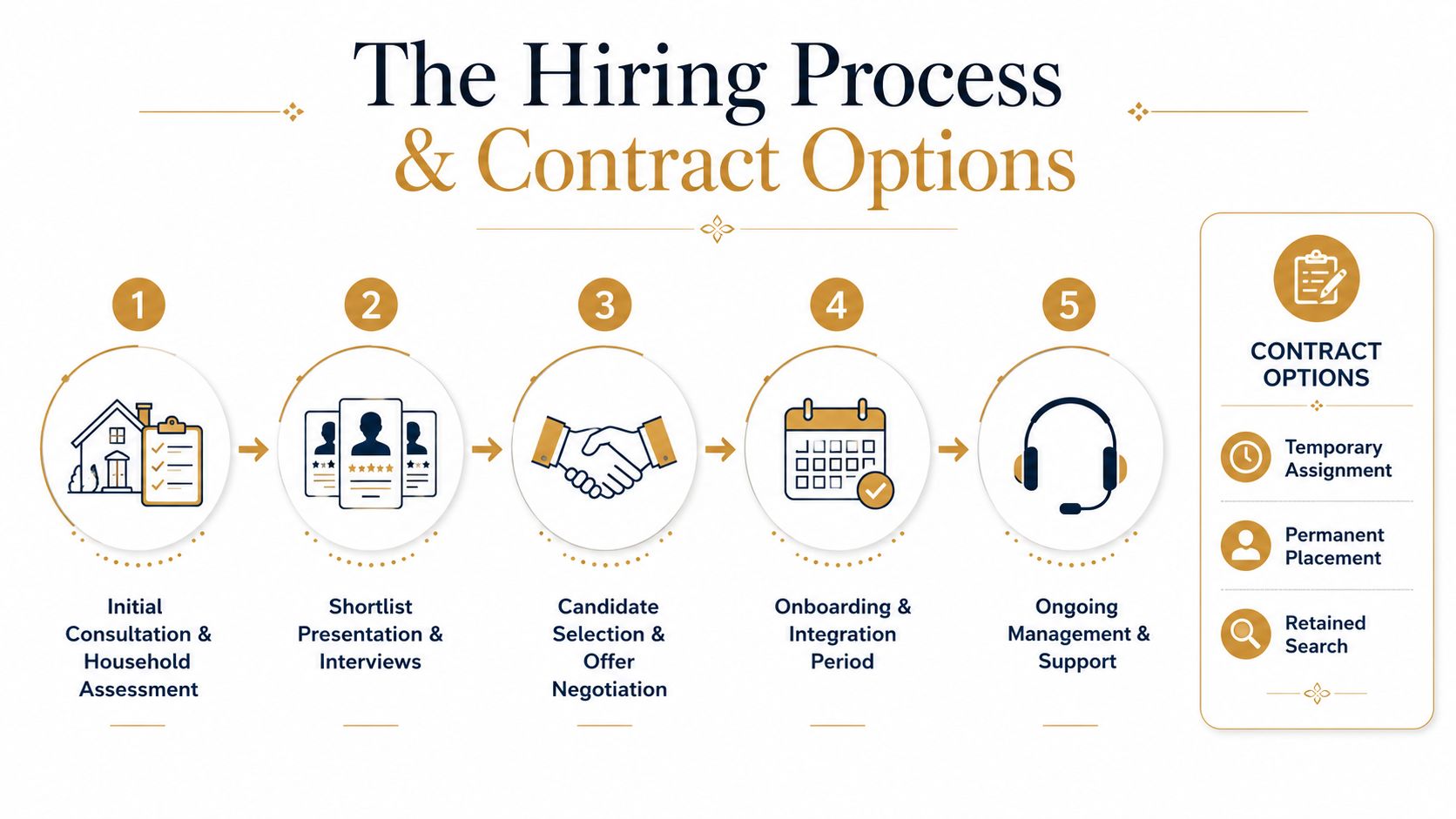
The search should begin with a household assessment, not a job advertisement. An agency needs to understand the properties, staffing structure, family schedule, travel patterns, decision making authority, and the specific operational problems the new appointment is expected to solve.
Build a brief that reflects reality
A useful brief should specify:
- Operational scope: Identify each residence, the staff functions involved, and the level of travel expected.
- Authority: State which decisions the estate manager may make independently and which require approval.
- People leadership: Describe responsibilities for recruitment, rotas, training, performance management, and conflict resolution.
- Standards: Define expectations for confidentiality, presentation, communication, service, and record keeping.
- Employment structure: Confirm whether the role is live in, live out, temporary, permanent, or part of a rota.
The agency should then present a focused shortlist, coordinate interviews, verify references, support offer discussions, and assist with onboarding. Families should expect clear updates, candid feedback about the market, and a written explanation when a candidate is rejected.
Choose the arrangement carefully
A live in estate manager may suit a property that requires continuous presence, but the family must define working hours, private time, accommodation, and emergency expectations. A live out manager may provide clearer separation between home and work while still handling daily operations. A rota arrangement can suit multiple residences or a household that needs continuous coverage through a team rather than a single individual.
The contract should address duties, pay, working patterns, notice, confidentiality, expenses, leave, accommodation where relevant, and the process for performance review. Trial and probationary arrangements should be drafted with appropriate professional advice for the relevant jurisdiction. An agency can support communication and onboarding, but it should not replace employment, tax, or legal counsel.
Understanding Costs and Budgeting for Estate Managers
Budgeting should begin with the complexity of the role, not a single salary figure. A country estate with one established team and a London based manager overseeing several residences are fundamentally different searches, even if both roles use the title estate manager.
The UK market provides useful reference points, but private household salaries should be separated from the broader estates management category. A 2025 UK salary report places general estate management compensation at around £60,000 on average, rising to approximately £63,000 in Greater London, according to Macdonald & Company's 2025 UK Estates Management Salary Report. In the private household sector, current guidance more commonly places estate manager compensation at £55,000 to £100,000, with senior London and multi property roles often reaching £120,000 to £150,000 or more. These figures should be treated as indicative rather than predictive for a specific appointment.
Calculate the complete employment cost
The family should budget for more than base salary. Depending on the arrangement and jurisdiction, the full employment picture may include:
- Agency fees: Confirm whether the fee is calculated on salary, paid as a retained search, staged across milestones, or subject to a replacement provision.
- Employer costs: Discuss National Insurance, pension contributions, payroll administration, insurance, and any other obligations with a qualified UK employment adviser.
- Working resources: Consider equipment, communications, travel between residences, training, uniforms, and role specific tools.
- Accommodation: For live in roles, assess whether suitable private accommodation exists and how the arrangement affects the employment package.
- Household support: Include the cost of payroll, accounting, legal, or HR support where the family does not have those capabilities internally.
London roles and larger portfolios command higher compensation because they usually combine greater property complexity, broader staff leadership, more contractor oversight, and heavier travel or compliance demands. Families should ask an agency to separate salary, employer costs, recruitment fees, and operating expenses rather than presenting one seemingly simple total.
Red Flags and Common Hiring Mistakes to Avoid
The most expensive mistake is hiring for charm. Estate managers work closely with principals, but this is fundamentally an operations appointment. A candidate who is personable yet unable to manage a budget, challenge a supplier, or lead under pressure will create more work for the family, not less.
Warning signs in an agency
Be cautious when an agency:
- Avoids scope questions: It talks about finding a “perfect fit” without asking about residences, staffing, authority, or travel.
- Cannot explain verification: It offers vague assurances instead of describing how references and checks are handled.
- Presents volume instead of judgement: It sends multiple CVs without explaining why each candidate matches the operational brief.
- Uses unclear terms: Its proposal does not set out fees, replacement provisions, communication, or the family's responsibilities.
- Overpromises speed: It treats a complex senior appointment like a standard vacancy.
A credible agency should be willing to challenge the family's assumptions. If the proposed budget does not match the required level of experience, the recruiter should say so before interviews begin. If the family wants an estate manager but will not delegate authority, the agency should question whether the role can succeed.
Warning signs in a candidate
Employment gaps require a clear explanation, but gaps alone do not prove misconduct. More concerning are inconsistent dates, references that do not match the claimed level of responsibility, reluctance to discuss staff departures, or an inability to describe practical decisions the candidate personally made.
Families also create avoidable problems by failing to define reporting lines. An estate manager cannot lead effectively if the principal, family office, personal assistant, and senior housekeeper each issue conflicting instructions. Establish one operational chain, document it, and communicate it clearly to the household.
Do not assign responsibility without authority. If the estate manager is accountable for standards but must seek permission for every routine decision, the role will deteriorate quickly.
Your Next Steps for Engaging an Estate Manager Agency
Before contacting an agency, prepare a concise household brief. List each property, current staff, known gaps, travel expectations, the family's preferred working arrangement, and the decisions the new estate manager must own.
Ask these questions during the first consultation:
- What level of estate complexity does the agency regularly recruit for?
- How will it test budgeting, contractor oversight, and people leadership?
- Which references will it verify, and who will conduct those conversations?
- Will the agency recommend one hire or review the wider staffing structure?
- What support will it provide after the candidate starts?
- Which costs sit outside the quoted recruitment fee?
Then compare proposals by quality of diagnosis, not presentation. The agency that asks the most precise questions may prove more valuable than the one that produces the fastest shortlist.
A family office should leave the consultation with a clear decision: appoint one estate manager to lead an existing structure, or commission a staffing review that connects household, property, hospitality, childcare, and support roles. That choice helps avoid the common failure of placing a senior individual into an operation that has never been properly designed.
Superstar Nannies can assess your household structure, recruit a vetted estate manager, or support a broader private household staffing plan across the UK and international residences. For a confidential consultation about your requirements, visit Superstar Nannies.