

You've passed your test, you're comfortable behind the wheel, and you're thinking chauffeuring is just driving a nicer car for better clients. That's where most newcomers get it wrong. Your first proper assignment might be an airport collection for a principal, a school run for children with a nanny in the back, or a late-night transfer where one mistake with timing, discretion, or etiquette ends the job before it starts.
How to become a chauffeur isn't complicated, but it does require discipline. You need the licence first, then the driving polish, then the judgement, then the presentation. If you want to work with private families and VIP households, you also need to understand service, not just transport. A personal driver who can handle routine, privacy, children, luggage, staff coordination, and last-minute changes will always beat a driver who only talks about horsepower.
If you're aiming for private household work rather than standard app-based driving, study the standards expected of a personal driver in London. That market rewards calm operators who make busy lives feel organised.
Introduction to Chauffeur Career Pathway
A new chauffeur's first week usually looks polished from the outside and chaotic on the inside. You're checking the route twice, wiping fingerprints off the rear door handles, adjusting the cabin temperature before pickup, and wondering whether you should speak first or wait for the client to set the tone. That tension is normal. The job carries more pressure than people admit.
In private service, you're often the first person a client sees that day and the last one they deal with at night. They'll judge your punctuality, your grooming, how you open a door, whether you interrupt, and whether you can adapt when the itinerary changes without turning it into their problem. That's why how to become a chauffeur is really about becoming dependable under pressure.
Practical rule: A chauffeur's value isn't measured by speed. It's measured by how little friction the client feels.
Some drivers enter the field through corporate work. Others move in from security, executive support, or household staffing. Either way, the route is the same. Get legal first. Build advanced skills next. Then learn the standards of service that make agencies and private employers trust you with high-value clients, children, confidential schedules, and expensive vehicles.
Meeting Licensing Requirements
If you want this career, start with the legal basics and get them right the first time. Most failed applications come from sloppy preparation, not lack of potential.
What London requires
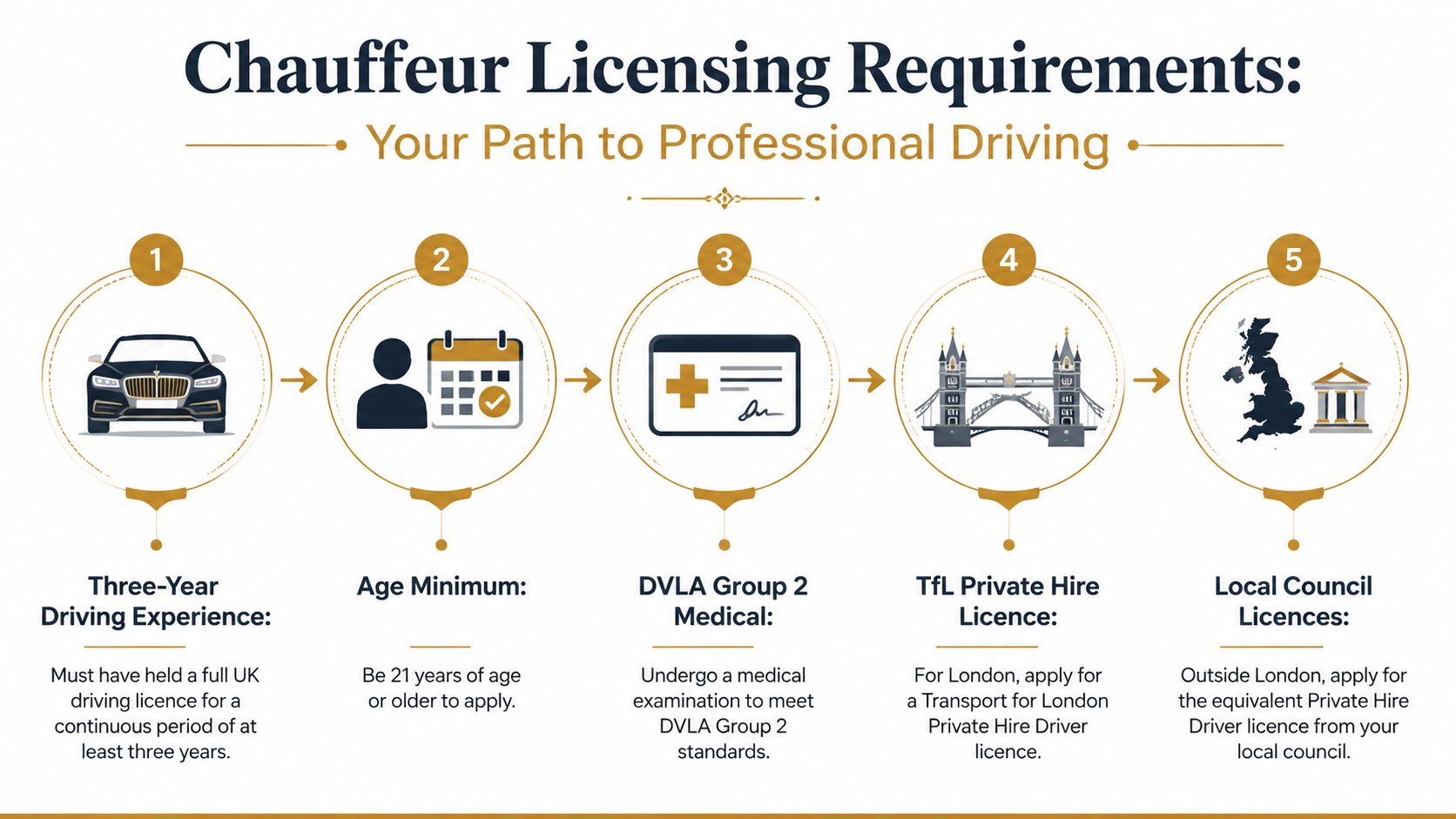
In London, the usual route is the TfL Private Hire Driver licence. The baseline is strict. You must be at least 21 and hold a full UK driving licence for three continuous years before you apply. You also can't have more than 6 active penalty points on your licence. TfL's application fee was £124 as of 2024, and processing usually takes 12 to 16 weeks after checks are complete, according to GM Direct Hire's London chauffeur licensing guide.
You'll also need to meet the medical standard. London applicants must complete a medical declaration to DVLA Group 2 standards, pass background screening including an enhanced DBS check, and prove English ability at B1 CEFR level through a SELT if they don't already hold an approved qualification, as outlined by Landmark Executive's chauffeur guide.
The full process is easier to understand visually:
What catches applicants out
The necessity of a licence is well-known. However, fewer applicants grasp the specific factors that delay or invalidate an application.
- Licence history problems. The rule is three continuous years, not roughly three years or three years with gaps. Crownwood Charters' overview of becoming a chauffeur in the UK makes that distinction clear.
- Medical paperwork delays. London uses a GP-signed medical declaration form, and incomplete forms stall the process.
- Serious motoring offences. Drink-driving or dangerous driving can lead to automatic disqualification under the London standards described in the earlier licensing sources.
- Poor document discipline. If your proof of right to work, address history, or background documents don't line up, expect delays.
Outside London, the route changes slightly. You apply for a Private Hire Driver licence through your local council, not TfL. Across the wider UK, the normal benchmark is still three years' driving experience and age 21 plus, with councils commonly requiring an enhanced DBS check, a medical, and proof of right to work. Those licences are typically valid for three years, and the application process usually takes 8 to 16 weeks, according to Indeed's UK chauffeur career advice.
My recommendation
Treat your application like a job file, not casual admin.
- Check your eligibility first. Confirm your licence history is continuous and your points are within limit.
- Book the medical early. GP schedules cause avoidable delays.
- Prepare for the English requirement. Don't assume conversational English is enough if TfL needs formal proof.
- Keep one document pack. Scan everything clearly and store it in dated folders.
- Run a background check on yourself mentally. If there's anything that might appear in screening, deal with it directly.
For drivers who want a wider sense of professional licensing pathways in transport, A-1 Driving School's CDL training is useful as a comparison point for how formal driver qualification systems are structured. It won't replace UK private hire licensing, but it helps newer drivers think like professionals.
If you expect to work with international families, it's also smart to understand how agencies view vetting and identity documentation through services such as international background checks for household staff.
Completing Advanced Driving and Security Training
A licence gets you legal. It doesn't get you hired into premium work. That difference matters.

Why advanced qualifications matter
Across the UK, private hire driver licences usually require three years' driving experience and age 21 plus, but top agencies often expect RoSPA or IAM qualifications for executive and security transport roles, as noted in Indeed's UK chauffeur guidance. That's the split between average and premium work.
RoSPA and IAM both sharpen the same core habits. Observation. Space management. Hazard anticipation. Smooth braking. Controlled acceleration. Better positioning. In private service, that translates into a rear cabin that feels calm and a principal who never has to brace for your decisions.
If you're serious about how to become a chauffeur for VIP households, I'd prioritise advanced driving before you start worrying about luxury badges or wardrobe details.
A polished suit won't save a driver who brakes late, misses hazards, or gets flustered in traffic.
What training to add after licensing
Don't collect certificates for the sake of it. Build a stack that solves actual employer concerns.
- Advanced roadcraft training. Choose RoSPA or IAM if you want recognised proof of defensive driving ability.
- Topographical preparation. London work punishes weak route knowledge. Sat nav helps, but it won't cover road closures, event traffic, school restrictions, or estate access procedures.
- Security awareness. Executive households value drivers who understand surveillance awareness, arrival and departure discipline, and how to avoid exposing routines.
- Behaviour monitoring mindset. Even if you're not in an HGV environment, operational driving standards still matter. Reviews of HGV driver conduct insights can help you think more critically about consistency, risk, and professional road behaviour.
How to choose the right provider
The best provider isn't the one with the flashiest website. It's the one that gives you practical assessment, useful feedback, and standards employers recognise.
Ask these questions before booking:
| What to check | Why it matters |
|---|---|
| Provider reputation | Agencies notice recognised names |
| Real on-road assessment | Classroom-only training won't sharpen judgement |
| Executive driving relevance | Household work differs from standard fleet training |
| Feedback quality | You need correction, not praise |
| Follow-up support | Good providers tell you what to improve next |
Private employers also care about trust and fit. If you want to target agency placements, look at the standard expected by an agency for driver recruitment. The drivers who stand out usually combine advanced roadcraft with restraint, discretion, and clean presentation.
Mastering Soft Skills and VIP Etiquette
Many capable drivers lose good roles at a critical juncture. They focus on licensing and forget service.
A VIP client doesn't want chatter unless they invite it. They don't want you turning around during private conversations. They don't want to hear your views on their schedule, their staff, their children, or their guests. They want a driver who reads the room, protects privacy, and makes every movement feel effortless.
I've seen new chauffeurs greet a principal too casually, talk over household staff, or leave luggage handling to the client because they were afraid of getting it wrong. All of that reads as inexperience. The better move is simple. Confirm names without fuss. Open and close doors properly. Handle bags without fuss. Ask concise questions only when necessary. Keep your eyes forward and your phone out of sight.
What polished service looks like
- Communication that's measured. Speak clearly, briefly, and only as much as the client wants.
- Discretion that's instinctive. Anything seen or heard in the vehicle stays there.
- Grooming that matches the setting. Clean suit, clean shoes, tidy hair, neutral scent.
- Cultural awareness. Some clients prefer warmth. Others prefer distance. You need to notice the difference quickly.
A household assignment often involves more than the principal. You may be transporting children, coordinating with a nanny, waiting with security, or adjusting to a PA's revised plans. That means your tone has to stay professional with everyone, not just the person paying the salary.
If the client changes the itinerary at the last minute, your face should stay neutral and your response should be immediate: “Certainly.”
Small details that separate professionals
The strongest chauffeurs do the quiet things well. They check water is available if the household expects it. They know when valet parking is appropriate and when it isn't. They keep the cabin spotless. They avoid strong music, strong opinions, and strong reactions.
That's what VIP etiquette really is. Not theatre. Control.
Crafting a Standout CV and Agency Application
A weak chauffeur CV reads like a minicab profile. A strong one reads like a private service document. That difference decides whether an agency keeps reading.
What your CV must show fast
The top third of your CV should answer four questions immediately. Are you licensed? Are you safe? Are you discreet? Can you work in a formal private environment?
Use a clean, restrained format. No graphics-heavy template. No gimmicky profile statement. Put the essentials near the top, then back them up with specifics.
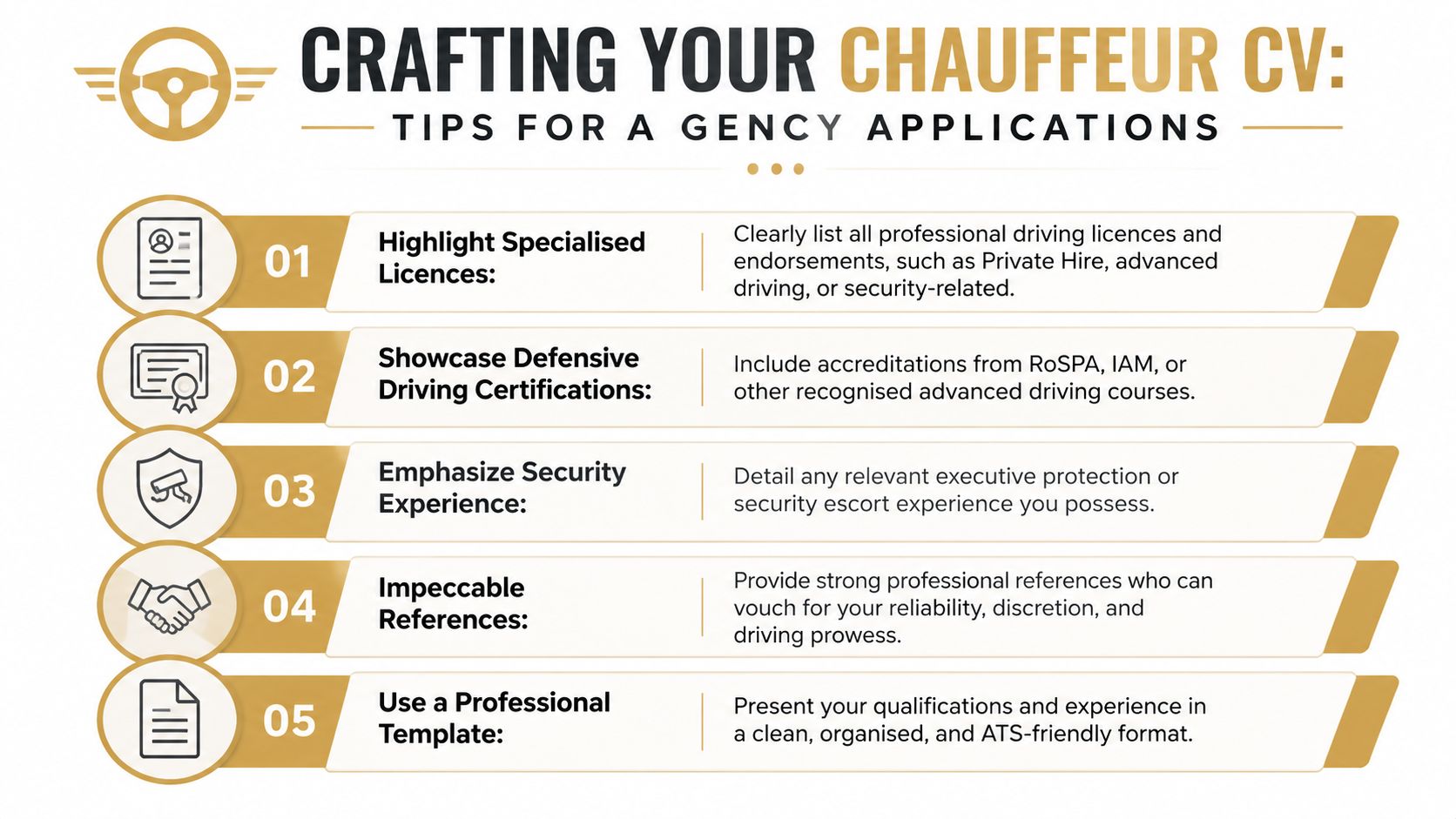
A practical structure looks like this:
Professional profile
State your licence status, vehicle experience, service style, and any private household or executive support background.Licences and compliance
List your Private Hire Driver licence and any advanced driving qualifications.Driving and service experience
Include executive transport, family driving, school runs, airport transfers, staff coordination, and security-adjacent duties if relevant.Training and credentials
Add RoSPA, IAM, first aid, security awareness, or language skills.References
Strong references matter more than inflated self-description.
How to write like a professional
Bad wording says you're “hard-working” and “passionate”. Good wording proves you can operate in a private setting.
Try lines such as:
Professional profile
“Discreet professional chauffeur with private household and executive transport experience, confident managing daily schedules, airport collections, school runs, and formal client service.”Experience bullet
“Provided polished door-to-door service for principals, family members, and guests, maintaining confidentiality and adapting to changing itineraries.”Reference framing
“References available from private employers and senior operational contacts who can speak to punctuality, judgement, presentation, and discretion.”
Agency insight: Agencies shortlist drivers who make life easier to assess. If your CV hides licences, dates, or references, expect silence.
The application and interview strategy
Tailor your cover letter to the role. A private family wants reassurance around trust, children, routine, and household manners. A corporate principal may care more about flexibility, travel logistics, and executive presentation. Don't send the same letter to both.
For interviews, expect scenario questions. You may be asked what you'd do if a child is sick in the car, if the principal changes destination midway, if press photographers appear outside a venue, or if two household staff give conflicting instructions. The right answer usually combines calm, safety, hierarchy, and discretion.
If you're applying through specialist household staffing channels, review what's expected in a personal driver job listing before you send anything. It helps you pitch your experience in the language agencies use.
Understanding Salary Expectations and Career Development
Pay in this field depends on the type of client, the hours, the city, the schedule complexity, whether the role is live-in or live-out, and whether you bring added value such as security awareness, child-friendly service, or multilingual communication. Anyone promising a universal figure is guessing.
Use this as a planning tool, not a guarantee.
| Experience | Entry Level (£) | Mid Career (£) | Senior Level (£) |
|---|---|---|---|
| Salary range | Varies by employer and location | Varies by employer and location | Varies by employer and location |
That table is deliberately blunt because the market is blunt. Entry-level chauffeurs with only the basic legal requirements usually compete on availability and presentation. Mid-career drivers start to earn better opportunities when they've proven reliability in formal settings. Senior chauffeurs command stronger packages because they reduce risk. They know protocol, understand household dynamics, and don't need hand-holding.
If you want better pay, don't chase it with talk. Earn it with sharper credentials and better references. Add advanced driving. Improve your route knowledge. Learn how to work around children, PAs, house managers, and security teams. If you can operate smoothly in a staffed residence and around UHNW routines, you become much harder to replace.
How to become a chauffeur is one question. How to become the chauffeur agencies call first is the better one.
If you want help turning your experience into a credible private household application, speak with Superstar Nannies. Their team places discreet, high-calibre chauffeurs and household staff with VIP and UHNW clients, and they understand exactly what private employers look for before they make an offer.