


Professionals seeking domestic couple jobs in the UK are often drawn to a compelling proposition: two partners living and working together in a well-managed private residence, with one overseeing housekeeping and service while the other handles driving, grounds care, maintenance or broader estate logistics. The opportunity can be highly attractive, but successful placements depend on far more than enthusiasm. Duties, accommodation, immigration status, remuneration, working patterns and personal boundaries must align from the outset.
A strong application demonstrates precisely how the couple will function as a professional unit, where each partner contributes measurable value and which responsibilities require further clarification. The guidance below examines role structure, joint CV preparation, visa and right-to-work considerations, agency selection, interviews, negotiation and onboarding, with particular focus on the compliance issues that often create difficulties after an offer is made.
Introduction to Domestic Couple Roles
A domestic couple may arrive at a country estate before the principals return from abroad. One partner prepares guest rooms, checks laundry standards and restores the household to operational readiness. The other inspects vehicles, completes minor repairs, coordinates deliveries and confirms that the grounds are prepared for the weekend. They work independently where appropriate, but remain in constant communication, providing cover when priorities change.
This arrangement can offer significant professional and personal advantages. It may provide shared accommodation, two complementary career paths and a stable, trusted presence for a family or estate. It can also expose weaknesses quickly. If both candidates expect to lead the same function, neither has the experience required for secondary duties, or one partner's right to work remains unresolved, the placement can become problematic before employment even begins.
The strongest domestic couple applications present the couple as one cohesive operational team with two clearly defined professionals. Employers need confidence in how duties will be divided, how busy periods will be covered and how the household's privacy will be protected. Candidates, in turn, need equal clarity on salary, hours, accommodation, travel expectations and legal status.
Understand the Role and Market
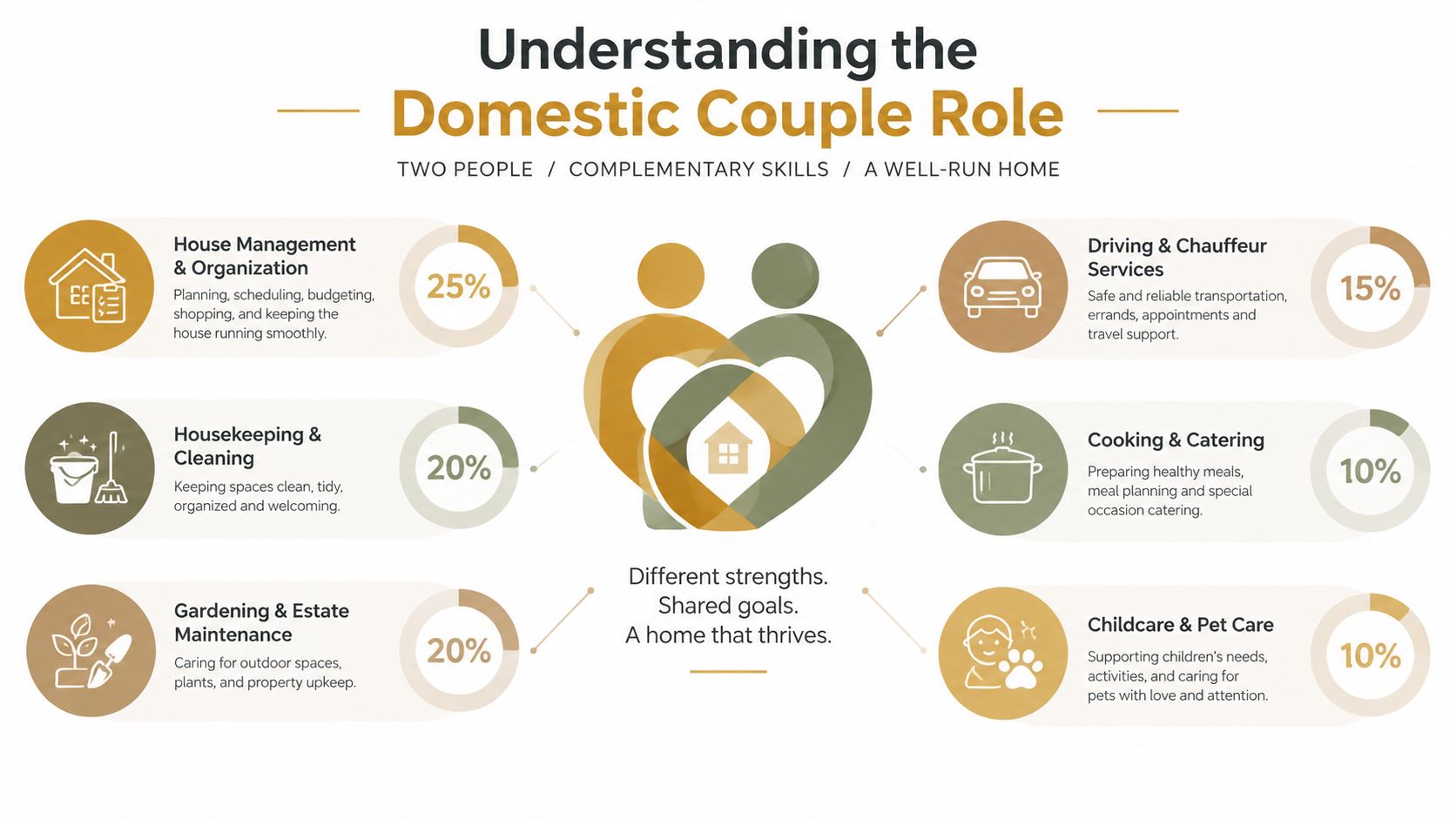
A domestic couple vacancy typically combines several household functions rather than offering two entirely separate positions. A principal may require house management, housekeeping, laundry, driving, errands, cooking support, pet care, gardening and minor maintenance. Those duties are then allocated according to each partner's proven ability, availability and willingness to provide support across the household.
The couple should therefore be assessed as one operating unit with two accountable professionals. The central question is whether their combined experience covers the household's day-to-day needs, including responsibilities that neither partner will lead directly.
Build a joint skill map
Prepare a duty matrix and classify every function as lead, support or not qualified. Add evidence beside each entry.
| Household function | Partner one | Partner two | Evidence to provide |
|---|---|---|---|
| House management | Lead or support | Lead or support | Household procedures, suppliers, inventories |
| Housekeeping and laundry | Demonstrated level | Demonstrated level | Private-home references, fabric care experience |
| Driving and errands | Licence and experience | Licence and experience | Driving history and vehicle familiarity |
| Gardening and maintenance | Practical capability | Practical capability | Estate, grounds or repair responsibilities |
| Cooking | Meal preparation level | Meal preparation level | Menus, dietary awareness and service experience |
| Pets or childcare support | Relevant experience | Relevant experience | References and clearly defined boundaries |
For example, a former butler paired with a hospitality-trained housekeeper may be especially well suited to a London townhouse. The butler may lead front-of-house service, driving, supplier coordination and guest arrangements. The housekeeper may lead interior presentation, laundry, wardrobe care and household organisation. Both may provide cover, but the application should still distinguish support capability from primary responsibility.
Private employers examine these distinctions closely. Experience maintaining a large garden does not establish formal service expertise. An excellent housekeeper may still have limited experience driving principals, supervising contractors or managing basic estate tasks. State those limitations clearly, then identify which partner can provide cover.
Recruiter's recommendation: Submit a duty map with the application. It gives the employer a faster, more accurate understanding than two generic CVs.
The UK market also presents regional variations in role design and property demands. Couples considering Scotland can review domestic couple jobs in Scotland and compare estate size, accommodation, travel expectations and access to local services before applying.
The employment pattern of couple families helps explain why households may value coordinated support. 73.9% of couple families with dependent children had both parents in employment in April to June 2021, according to UK domestic couple vacancy and household context. This does not guarantee demand for any individual candidate profile. It does, however, illustrate why a couple that reduces duplicated effort across housekeeping, driving, grounds care and household administration may represent a practical solution.
Before applying, confirm the division of duties, identify any uncovered function and ensure both partners can describe the arrangement consistently. This preparation also helps surface visa or right-to-work issues before the process reaches offer stage.
Navigate Legal Requirements and Visa Options
Immigration planning should take place before a couple accepts a role. Each partner has an individual immigration position, even where the employer intends to make a joint offer. A couple should never assume that one person's immigration status automatically grants the other the right to work.
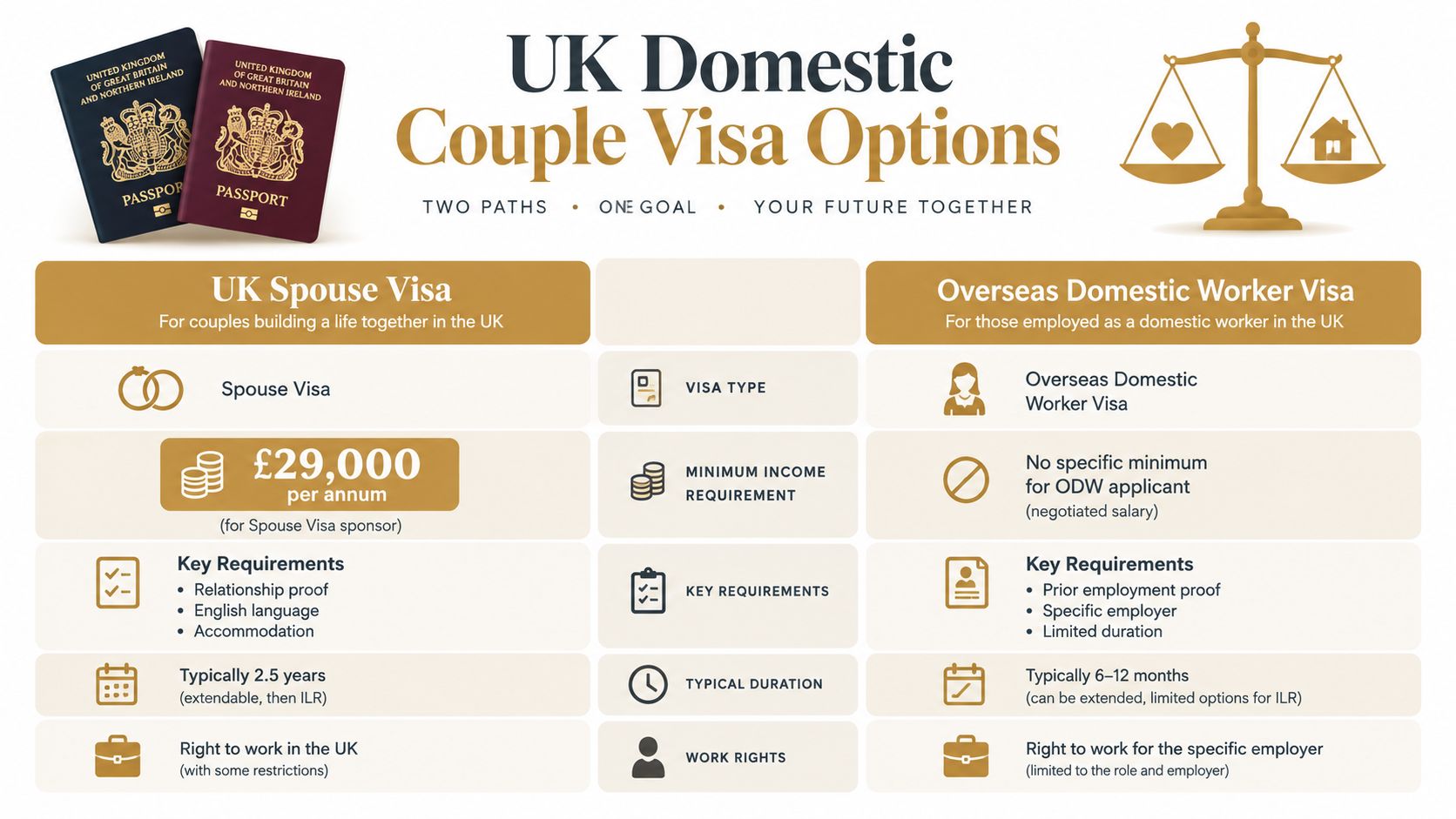
The UK spouse or partner route is tied to the sponsoring relationship and the applicable family immigration rules. The current minimum income requirement is £29,000 gross per year for the relevant spouse or partner visa circumstances, as set out in the UK spouse visa financial requirement guidance. Candidates should verify the full eligibility criteria, including relationship evidence, English-language requirements and accommodation arrangements, with an authorised immigration adviser or official UK guidance.
The Overseas Domestic Worker route serves a different purpose. It applies to a worker accompanying an overseas employer to the UK, with employment conditions that must include at least the National Minimum Wage and written terms. It is not a general route for placing an overseas couple into any UK household, and the employer, worker, duration and existing employment relationship all require careful verification.
Treat the two applications separately
Before submitting a joint profile, confirm:
- Permission to work: Identify the route that permits each partner to undertake the proposed duties.
- Employer status: Establish whether the household can lawfully employ the candidates under the relevant route.
- Written terms: Ensure duties, pay, hours, rest, holiday and accommodation are recorded for each worker.
- Timing: Allow for document collection and decision processes rather than promising an immediate start.
- Family arrangements: If a non-UK national needs to live with family members in Britain for more than six months, GOV.UK family visa guidance indicates that a family visa may be required.
This interaction is frequently misunderstood. The £29,000 threshold relates to a spouse or partner visa financial requirement, while an Overseas Domestic Worker must still receive lawful employment terms and at least the applicable minimum wage. One route does not replace the obligations attached to the other.
Use a dedicated right-to-work verification service before finalising a start date. A recruiter may help organise documents, but both candidates and employers should obtain current legal advice where circumstances involve dependants, overseas employers, changing visa conditions or uncertain work permissions.
Craft Joint CVs and Applications
A joint application should be easy to review in a matter of minutes. Place the couple's names, location, work authorisation, availability and preferred role type at the top, then present each partner's professional profile separately.
Use the following structure:
- Joint profile: Define the household environments you have supported, the type of residence you can manage and the operational strengths of the partnership.
- Partner profiles: Give each candidate an individual summary, followed by core skills and employment history.
- Shared responsibilities: Explain how duties were divided in previous roles, rather than suggesting that both partners handled every task.
- Evidence: Include references, driving information, relevant certificates and the details required for initial screening.
- Practical preferences: State live-in requirements, location flexibility, travel expectations and availability.
The cover letter should answer three key employer questions: Why this household, what does each partner lead and how will the couple perform under pressure? A concise paragraph may highlight one partner's strengths in interior service, the other's capability in estate operations or logistics, and the method by which they coordinate handovers.
Avoid duplicating strengths without explanation. If both candidates claim house management experience, specify who handled staff rotas, supplier invoices, inventories or maintenance scheduling. If neither partner drives, disclose that early. Concealing a practical gap wastes time and undermines trust during the interview process.
Application test: A family should be able to identify the lead person for every major duty without calling you for clarification.
References should confirm each individual's conduct and, where possible, the couple's ability to work effectively together. Candidates seeking broader private household opportunities can review private household staff jobs and tailor their profile to the specific role rather than submitting one unchanged application to every employer.
Secure Vacancies through Agencies or Private Hire
The choice between agency representation and private hiring affects screening, negotiation and compliance. A specialist agency can evaluate the couple's combined skills, verify references, clarify household expectations and manage communications. The trade-off may be reduced direct control for the employer and placement fees. Private hiring offers direct negotiation and potentially faster contact, but the household must then manage screening, contracts, right-to-work checks and any disputes.
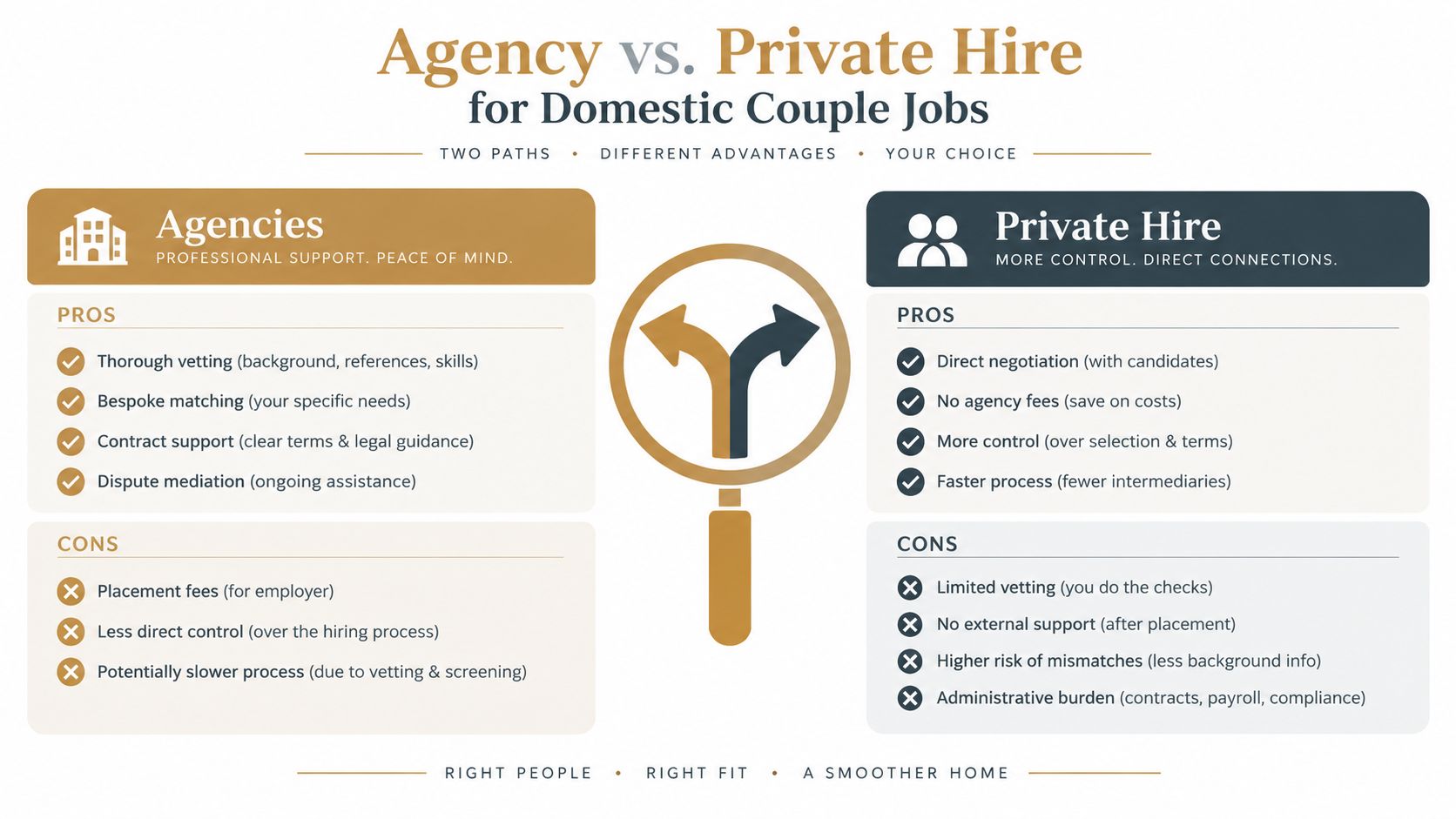
| Consideration | Specialist agency | Private hire platform |
|---|---|---|
| Matching | Curated against duties, household culture and availability | Candidate-led, with the family doing more interpretation |
| Vetting | May include structured references and identity checks | Depends on the family's own process |
| Negotiation | Recruiter can clarify expectations and mediate discussions | Employer and candidate negotiate directly |
| Speed | Can be efficient where a suitable database exists | Initial contact may be immediate |
| Administration | Agency may support contracts and onboarding | Family carries the administrative responsibility |
The UK domestic couple market is relatively narrow, which makes a precise application particularly important. Listings on UK domestic couple vacancy listings illustrate why candidates should apply promptly with a clear division of duties, rather than relying on an "all-rounders" CV. The employer should be able to identify immediately who leads housekeeping, service, driving, grounds care, maintenance or administration.
A joint application must also identify legal and practical gaps at an early stage. State each partner's right-to-work position, visa limitations, driving status and willingness to live in or travel. An agency may identify missing checks, but neither partner should assume that one person's immigration permission covers the other. Confirm the employment structure, accommodation terms, hours and responsibilities before accepting an offer.
Private hiring can work well when both sides are prepared to document the arrangement thoroughly. Use written terms covering responsibilities, pay, leave, notice, accommodation, confidentiality and any deductions. Confirm who will complete right-to-work checks and who will manage payroll. Direct contact may be faster, but speed should never replace verification.
For agencies reviewing enquiries, Recepta.ai's agency solutions may support recruitment workflow organisation. Candidates should evaluate an agency by the quality of its household brief, vetting process, communication and contract support. The right route is the one that preserves a clear division of duties and leaves no uncertainty around compliance.
Succeed in Interviews Negotiate Salary and Onboard
A domestic couple interview is designed to test how two professionals operate as one household team. Employers look for calm communication, dependable handovers, sound boundaries and decision-making that protects privacy without creating unnecessary disruption.
Prepare shared answers to practical scenarios, then allow each partner to explain their own responsibilities. If a principal's arrival changes the day's plan, identify who updates the house schedule, who checks vehicles and who informs other staff. If a contractor causes damage, explain who documents the issue and who contacts the supplier. This division should match the joint CV and prevent inconsistencies between stated responsibilities and actual coverage.
Make a trial day measurable
Before accepting a trial, ask the employer to confirm:
- Which rooms, tasks or outdoor areas take priority.
- Whether food service, driving, pets or family support are included.
- Who will provide feedback.
- Whether the trial is paid and how long it will last.
- What confidentiality standard applies.
During the trial, divide the work intelligently rather than competing for visibility. Communicate briefly, ask before acting in unfamiliar areas and leave the property more organised than you found it. Take particular care with valuables, security systems, children, pets and specialist materials. An effective trial demonstrates how the couple handles interruptions, changing priorities and tasks that sit between two role descriptions.
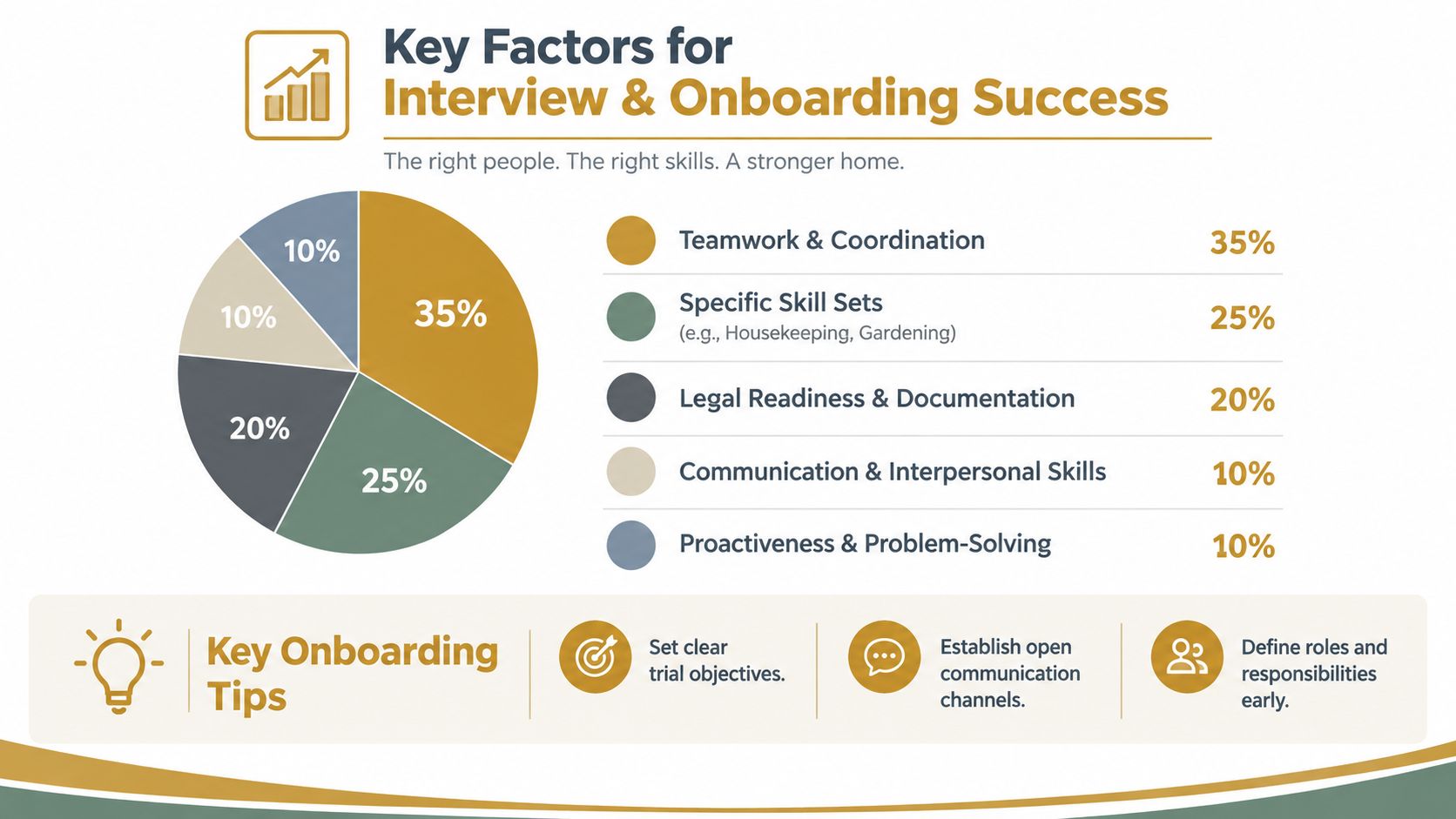
The supplied interview and onboarding visual identifies teamwork and coordination, specific skills, legal readiness, communication and problem-solving as central assessment areas.
Negotiate the complete package
Request a written offer that separates:
- Gross pay for each worker or for the couple, with payment arrangements clearly stated.
- Working days, rota expectations, weekends and additional hours.
- Rest breaks, weekly rest and paid holiday.
- Driving, travel and business expenses.
- Accommodation, privacy, utilities and access arrangements.
- Notice, probation and termination provisions.
- Duties for each partner, including secondary responsibilities.
- Immigration and right-to-work conditions.
Accommodation requires careful wording. HMRC states that accommodation is the only benefit in kind that can count towards National Minimum Wage pay when the employer provides qualifying living accommodation. The current accommodation offset is £11.10 per day, with a weekly maximum of £77.70 from April 2026, according to HMRC accommodation offset guidance. Free accommodation can affect the National Minimum Wage calculation, but it is not cash added to wages. A charge above the permitted offset can reduce the amount counted towards minimum wage compliance.
Worker-rights guidance records the April 2025 National Minimum Wage rate of £12.21 for workers aged 21 and over, alongside rights involving rest breaks, weekly rest, paid holiday and payslips, as summarised in UK employment and immigration guidance. Employers should obtain current advice before relying on any published salary guide, particularly where live-in accommodation and long hours are involved. The private staff salary guide for 2026 can provide additional context, but it should not replace advice tailored to the proposed arrangement.
For migrant domestic workers, Kalayaan's employer guidance states that workers are entitled to the National Minimum Wage and that employers must not deduct money for food. It also explains the accommodation deduction cap of £10.66 per day, or £74.62 per week from April 2025, with tax and National Insurance treated separately from gross pay. Confirm which rules apply to each partner before agreeing the package, especially where visa conditions differ.
Use a controlled onboarding checklist
On the first day, complete right-to-work verification for both partners, issue written employment terms and confirm who manages the household relationship. Walk through accommodation, keys, alarms, parking, utilities, maintenance reporting and emergency contacts. Both partners should know who can authorise purchases, approve contractors and receive incident reports.
During the initial working period, establish a short daily handover. Record recurring suppliers, cleaning products, vehicle routines, guest preferences and boundaries around personal time. Shared memory is not sufficient. Written records reduce dependency on one partner becoming the sole holder of household knowledge.
A review at the end of the initial period should confirm that duties match the offer, accommodation is suitable, payroll is functioning correctly and both partners know how to raise concerns. Resolve discrepancies early, before informal assumptions turn into disputes.
Conclusion and Next Steps
Domestic couple jobs in the UK reward preparation, clarity and professionalism. A strong application maps complementary skills, confirms each partner's right to work, separates individual responsibilities and secures written agreement on accommodation and remuneration. The strongest candidates do not simply describe themselves as adaptable. They show exactly how they will maintain standards, communicate under pressure and support the wider household team.
For international households or fully staffed residences, specialist recruitment support can help refine the brief and coordinate the process discreetly. Reviewed by the Superstar Nannies recruitment team.
Superstar Nannies can help domestic couples present a structured joint profile and identify private household opportunities suited to their skills, location and work authorisation. Visit Superstar Nannies to discuss a confidential, personalized placement enquiry with the recruitment team.