


The dinner service has just finished. You've pushed through another late close, the pass was relentless, and tomorrow looks exactly the same. If you're a strong chef wondering whether there's a smarter way to use your training, a private chef job UK role can be that turning point.
For the right chef, private service offers something restaurant work often doesn't. You cook with more intention, work closer to the people you feed, and build a reputation on consistency, trust, and judgement, not just speed. The problem is that this market is small, discreet, and full of unwritten rules. Talented chefs often miss out because they approach it like a restaurant move instead of a household appointment.
Your Path into the World of Private Chefs
Many chefs arrive at this stage in the same way. They're not falling out of love with food. They're tired of trading quality of life for service after service, and they want work that values craft, routine, and relationships.
A private chef role changes the setting, but it also changes the measure of success. In a private residence, nobody cares that you can shout over a busy brigade. They care that you can produce excellent food discreetly, adapt when plans change, and remember that a child won't eat mushrooms unless they're sliced a certain way. That's a different kind of professionalism.
Some chefs also explore related self-employed routes before moving fully into household work. If you're comparing private placements with launching a catering venture, it's worth understanding that catering rewards sales, operations, and event logistics, while private service rewards discretion, consistency, and long-term trust.
The strongest candidates usually treat this move as a career repositioning, not an escape plan. They tighten their CV, assemble a proper food portfolio, and target the right channels instead of sending generic applications into the void. That's why specialist household recruitment matters. Curated roles, including those listed through private household staff jobs in the UK, tend to reflect the standards and realities of domestic service far better than broad hospitality boards.
Private households hire for peace of mind as much as for food. If your application only proves you can cook, it's incomplete.
Understanding the Modern Private Chef Role
A private chef isn't only a cook. In a well-run household, the chef is part culinary specialist, part planner, part operator, and part trusted insider.

What the day-to-day actually looks like
Your remit often includes far more than breakfast, lunch, and supper. You may be expected to plan menus around school routines, wellness goals, travel schedules, and guests arriving with little notice. You might source specialist produce, prep children's food separately, manage freezer stock, or coordinate with a house manager on household rhythms.
Financial discipline matters too. Private chefs working in British private households commonly manage budgets and receipts as part of their role, with many employers expecting the chef to pass weekly shopping receipts and budget notes to the family office or principal. That kind of oversight is typical in structured London households, where the chef may also help shape a seasonal food budget with the household manager, as outlined by Household Staff Agency's overview of personal chef responsibilities.
That's why a serious chef learns to think beyond plating. Families hiring through private chefs for hire are usually looking for someone who can run a calm, orderly food operation inside a home.
The standards are high, but different
The best household chefs understand the difference between restaurant excellence and residential excellence. Restaurant cooking rewards flair under pressure. Household cooking rewards judgement under observation.
A family may want:
- Bespoke menus: Meals shaped around allergies, preferences, and changing routines.
- Low-drama service: Quiet competence matters more than performance.
- Kitchen stewardship: Clean resets, stock rotation, supplier management, and clear communication.
- Cultural awareness: Every home has its own customs, boundaries, and expectations.
Gender diversity in the sector
This part of the market also deserves a more modern conversation. UK-focused private chef content rarely addresses gender diversity, even though women remain underrepresented in senior chef and head chef roles across the wider hospitality pipeline, according to the discussion highlighted by MyStaffHQ on chef recruitment gaps. That matters because many private chef candidates come directly from those senior kitchen ranks.
Families and agencies that want broader talent pools should examine how briefs are written, how “presence” is described, and whether assumptions about stamina, authority, or household fit are coded in gendered terms. A strong placement process should focus on proven skill, discretion, organisation, and compatibility, not old clichés about who “looks right” in the kitchen.
Essential Skills and Qualifications Chefs Need
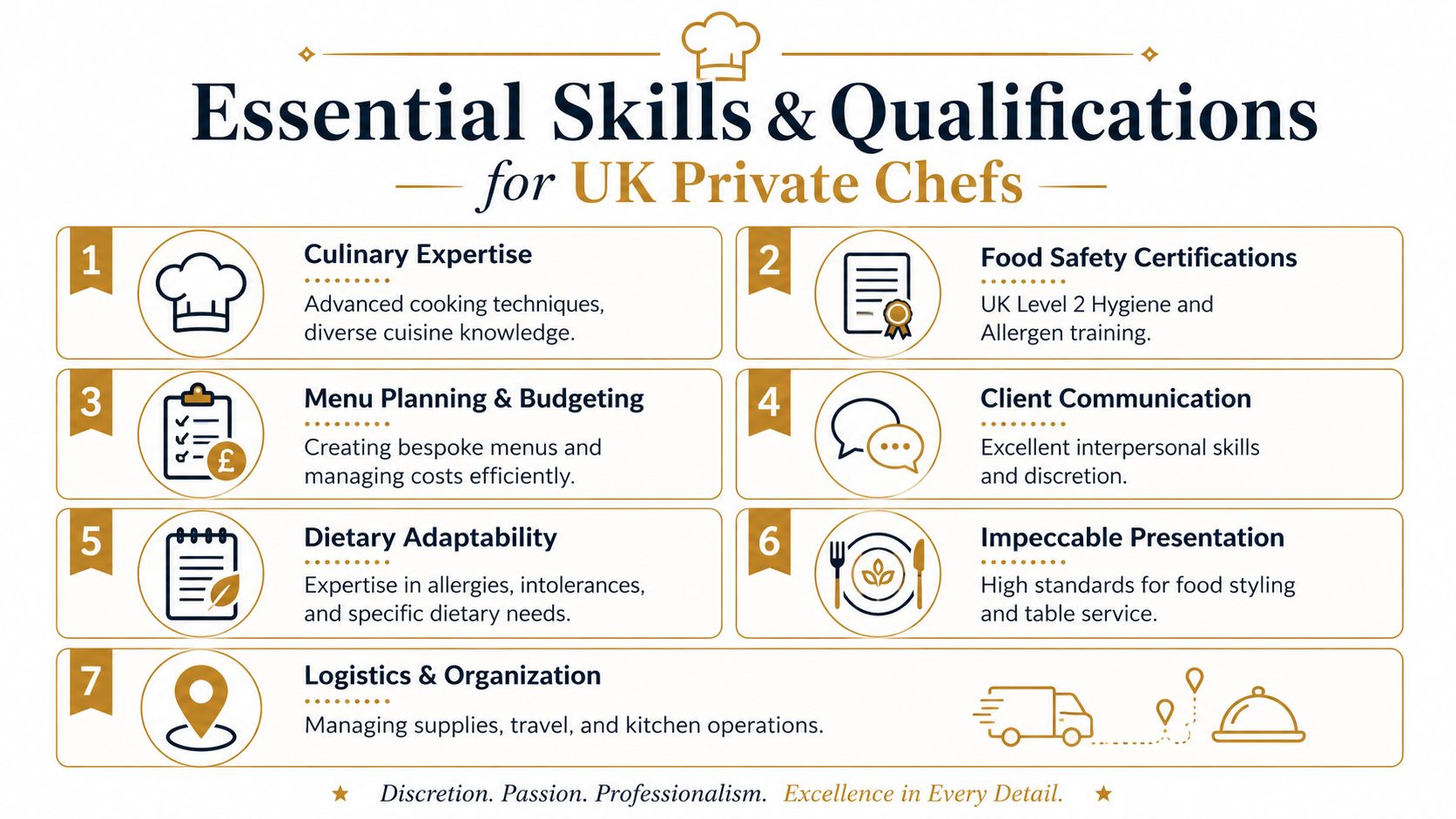
A chef can produce superb food in a restaurant and still struggle in a private house. The gap is usually not talent. It is whether you can work alone, stay composed, and meet exacting standards without the backup systems a brigade, purchasing team, or front-of-house structure would normally provide.
Core credentials households and agencies expect
Private households are selective for good reason. A principal is not hiring potential. They are hiring reliability, discretion, and judgement from day one.
In the UK, credible private chefs are typically expected to have at least one year of professional kitchen experience, with three to five years viewed as a stronger base. Many agencies and estates in the London market favour chefs who trained or worked in high-end restaurants or catering kitchens, including Michelin-starred or fine-dining environments, as noted by Le Cordon Bleu London's guide to becoming a personal chef.
Formal culinary training helps, but it does not secure a placement on its own. What matters more is whether your background proves consistency. Households want to see that you can maintain standards across breakfast, school lunches, wellness-led suppers, formal entertaining, and the odd last-minute guest request, all without fuss.
Agencies usually screen for four things first:
- Credible kitchen training: Fine dining, luxury hospitality, private members' clubs, premium events, or serious catering operations.
- Food safety discipline: Hygiene, allergen control, labelling, storage, and confidence around specialist diets.
- Range: Healthy family food, plated dinners, children's meals, travel prep, and guest entertaining.
- Verifiable references: Referees who can speak clearly about your standards, conduct, and consistency.
If your experience is strong but your paperwork is weak, fix that before applying. Specialist private household staff agencies in the UK will expect your CV, references, right-to-work documents, and training record to be in order before they put you in front of a serious client.
The professional habits that make chefs placeable
Technical skill gets you considered. Behaviour gets you hired.
Private households notice patterns quickly. Do you reply clearly? Do you arrive prepared? Do you adjust to changing plans without turning the kitchen into a theatre of stress? Those points matter more than many chefs expect.
The strongest private chef candidates usually show:
- Discretion: You will be trusted with access, routines, and private information. Loose talk ends careers in this sector.
- Calm adaptability: Guests stay over. Travel changes. Children refuse what they loved last week. The chef who adjusts smoothly is the chef who lasts.
- Concise communication: Principals want confidence and clarity. Household managers want timings, stock updates, and issues identified early.
- Self-direction: In many homes, nobody is standing over you. You need to prioritise, provision, prep, serve, reset, and plan the next day without hand-holding.
This is also where household culture becomes decisive. A chef who is brilliant on paper can fail a trial by being too familiar, too visible, too rigid, or too keen to impose a restaurant identity on a family kitchen. UHNW households tend to reward restraint, emotional control, and respect for boundaries.
Gender bias can shape hiring here as well, often in quiet ways. I have seen excellent women chefs underestimated for larger estates, and male chefs steered toward styles of service assumed to suit authority or formal dining. The stronger agencies and household decision-makers judge on proof of work, organisation, palate, discretion, and fit, not dated assumptions about who belongs in a principal's kitchen.
What a strong CV and portfolio should show
A private chef CV needs to answer practical household questions fast. Can this chef run the kitchen alone? Can they feed adults and children well? Can they shop intelligently, manage waste, and keep standards high across ordinary days and high-pressure ones?
A useful structure looks like this:
- Profile summary: Your cooking style, type of environments served, and level of household readiness.
- Core skills: Menu planning, dietary work, provisioning, budgeting, event cooking, nutrition awareness, and travel flexibility.
- Relevant experience: Roles that prove standards, trust, and breadth, not just prestige.
- Portfolio images: Clean photos of plated dishes, family-style spreads, breakfast setups, desserts, and table-ready event food.
- Practical details: Food hygiene certificates, allergen training, DBS status if held, driving licence, and right to work.
Keep the presentation polished. Sloppy formatting, inflated claims, and generic dish photos undermine confidence.
Knife work still counts because it reflects discipline. Chefs who look after their tools usually look after a household kitchen properly too. If you want a quick refresher, these tips for knife sharpening and maintenance are worth reviewing.
Navigating the UK Job Market and Agencies
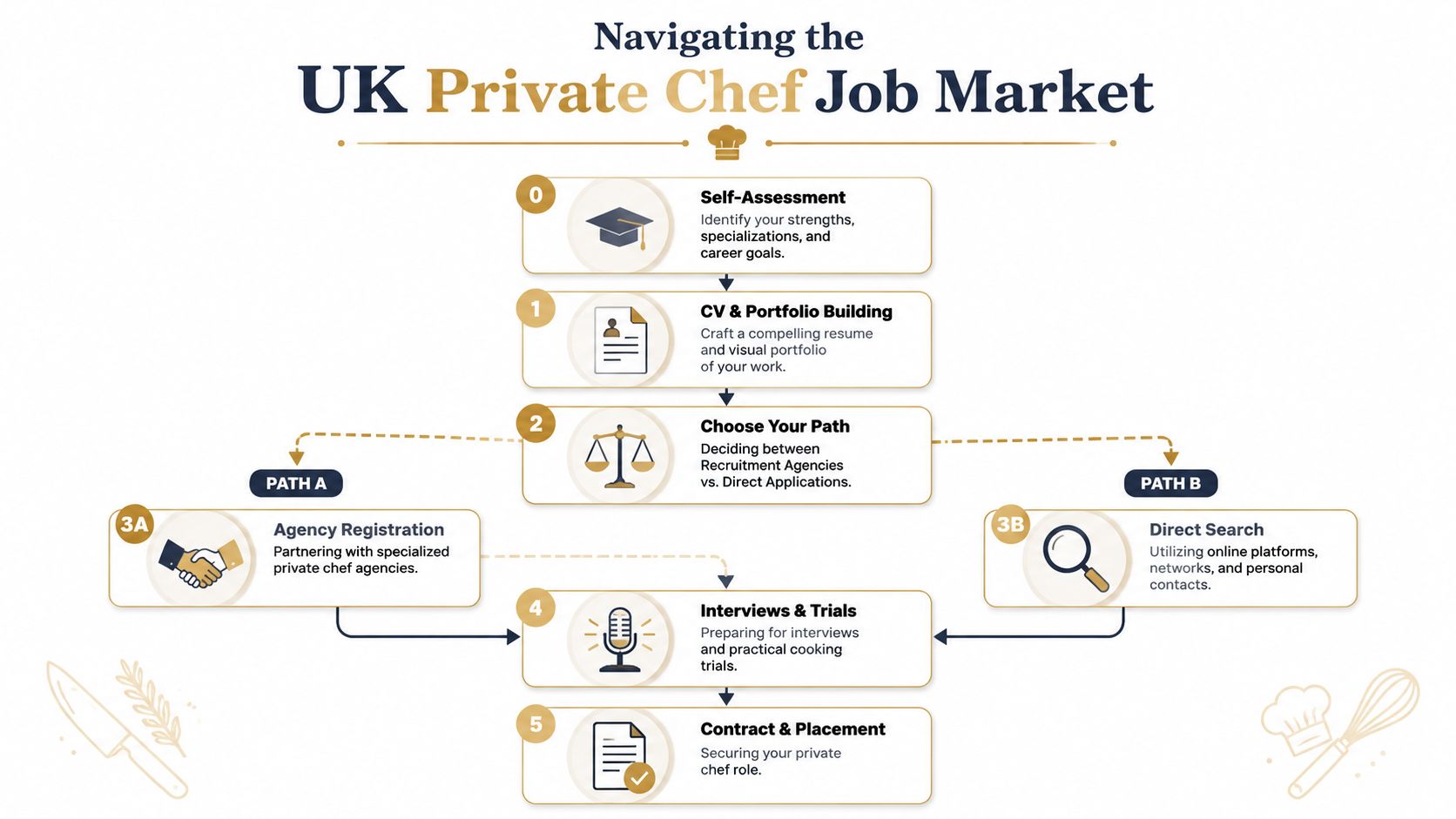
There are two main routes into a private chef job UK search. You can apply directly, or you can work through a specialist agency. Both can work. They don't deliver the same kind of access.
Direct applications versus agency representation
Direct applications can suit chefs with strong private networks, excellent references, and confidence handling negotiation alone. The drawback is that many of the best household roles are discreet by design. Families often don't want broad public exposure, and they may prefer a recruiter to pre-screen both competence and fit.
A specialist agency gives structure to that process. For elite UK placements, the typical funnel begins with a detailed household brief, then moves to a shortlist of 4–6 pre-vetted candidates, and often ends with a 1–3 day trial period, as described in 19 London's guide to hiring a private chef. That same market data notes that when agencies screen for validated culinary qualifications, verifiable track records, and completed DBS checks, job-match success rates rise to about 70–75%, compared with roughly 40–50% when selection relies mainly on CVs and basic references.
That difference matters because private placements are expensive for households to get wrong.
What agencies expect from chefs
A good agency doesn't just ask whether you can cook. It wants evidence that you can succeed in a private environment.
Expect to provide:
- A clean, relevant CV: Focused on premium service, not generic kitchen duties.
- Food photography: No filters, no messy pass shots, no cluttered backgrounds.
- Reference transparency: Recruiters will check titles, dates, standards, and reliability.
- Availability details: Travel willingness, notice period, location flexibility, and work rights.
One route chefs often use is a specialist household recruiter such as private household staff agencies in the UK, where placements are filtered through the expectations of domestic employers rather than broad hospitality hiring.
The unwritten rules that affect first impressions
Strong chefs sometimes sabotage themselves. They arrive with the right technical background and the wrong manner.
A few rules count heavily:
- Reply promptly: Slow communication reads as disinterest or disorganisation.
- Don't oversell celebrity proximity: Families care more about your judgement than who once ate your food.
- Respect confidentiality from the first call: Never volunteer names you shouldn't.
- Ask informed questions: Clarify service style, dietary expectations, kitchen setup, and staffing lines.
A household may forgive nerves. It won't forgive loose boundaries.
What works and what doesn't
| Approach | What works | What usually fails |
|---|---|---|
| Direct search | Existing referral networks, clear self-presentation, strong private references | Generic applications, weak follow-up, poor contract handling |
| Agency route | Better briefing, structured trials, support on fit and expectations | Treating the recruiter casually, hiding gaps, being vague about availability |
The agency route isn't magic. It mirrors how high-end households prefer to hire. The chef who understands that process usually moves faster and with fewer mistakes.
Acing the Trial and Interview Process
The trial is where private chef recruitment becomes real. Your food matters, but so does everything around it. Families are assessing whether they can live with your standards, your habits, and your presence.
Build a menu that shows judgement
Many chefs overcomplicate trial menus. They chase theatre when the household is looking for control. A smarter menu proves range without showing off for the sake of it.
Design around the brief. If the family eats British seasonal food with Mediterranean influence, don't turn up with a tasting menu that belongs in a chef's table. If there are children, show that you can cook for them properly without making their plates look like an afterthought.
A sound trial menu usually demonstrates:
- Technical control: Sauces, protein cookery, timing, texture.
- Adaptability: Clear substitutions for allergies or exclusions.
- Restraint: Dishes that are polished but realistic for repeat service.
- Household awareness: Breakfast and lunch matter as much as dinner in many homes.
Behave like you already work there
Chefs often forget that the trial starts before the first pan goes on. It begins with how you enter the kitchen, unpack your kit, greet staff, and ask questions.
The recruitment data behind elite placements points to common mistakes. Skipping a formal prep-time and mise-en-place audit can account for 20–30% of mismatched hires, and 60% of early-term chef exits stem from misaligned expectations on workload boundaries, travel, or tech integration rather than pure culinary skill, according to the earlier market research cited in the recruitment section.
So during a trial:
- Clarify the brief again on arrival. Preferences shift.
- Check equipment properly. Don't assume the oven behaves like yours.
- Keep your station disciplined. A private kitchen must return to order.
- Communicate calmly. No barking, no ego, no visible frustration.
Clean-down is part of the performance. Families notice the kitchen you leave behind.
Prepare for interview questions that aren't about food
Private households often ask questions restaurant employers don't. They want to know how you handle privacy, children, shifting schedules, guest numbers, and cooperation with other staff.
Expect questions such as:
- How do you manage a principal who changes plans late in the day?
- What's your approach to children's meals when parents want nutrition and consistency?
- How do you record household spending and supplier notes?
- What would former managers say about your discretion and temperament?
The strongest answers are specific and calm. Households trust chefs who sound measured, not rehearsed.
UK Salary and Contract Negotiations
A chef accepts what looks like a strong offer at £75,000, then learns the family expects breakfast, lunch, children's supper, dinner parties, ski travel, and daily staff food within the same salary. That is how good chefs end up underpaid in private service. In this market, salary only means something once the household brief is pinned down in writing.

What chefs are actually paid
UK salary levels vary for sensible reasons. London premiums, multiple residences, formal entertaining, complex dietary management, and frequent travel all push the package upward. A straightforward live-out role for one main residence sits in a different bracket from a fully flexible position serving a principal, children, guests, and staff across several properties.
Recent UK job market data places the average annual salary for a private chef working in a private household at approximately £47,499, with advertised roles commonly ranging between £42,499 and £52,499. Experienced or senior private chefs in elite London and similar hubs can command about £70,000 to £120,000 or more, particularly with Michelin-starred or high-end hospitality backgrounds, according to Caterer's private chef job market listings.
Elsewhere in the UK market, private chef salaries commonly fall between roughly £30,000 and £100,000 gross per annum, while entry-level or newly established chefs may start closer to £15–£20 per hour and seasoned professionals in demanding London or country-house roles can command around £25–£35 per hour, based on Greycoat Lumleys' private chef job description.
For household-side benchmarking, this guide to private chef costs in the UK is useful because it shows the budget assumptions many principals already have in mind before they brief an agency.
Gender still affects how some households hire, even when nobody says so directly. Female chefs are often in demand for family-led homes, child-focused meal planning, and lower-drama kitchen cultures. Male chefs may be favoured for formal entertaining or visible status hires. Good agencies push back on those lazy assumptions. The households worth joining hire for judgement, consistency, and discretion.
Contract points that deserve close attention
Pay matters. The wording around the role matters just as much.
In London and the Home Counties, full-time live-out private chef roles for chefs with 5–10 years' experience commonly cluster around £60,000–£90,000 per annum. Clear contracts also improve retention. Pavillion Agency's guide to hiring a private chef notes better long-term outcomes when hours, overtime, and service expectations are properly defined.
Read these clauses slowly:
- Working pattern: Confirm the usual start and finish time, how many services a day are expected, and whether the family keeps fixed days off or changes them around travel and guests.
- Overtime and event cover: Evening dinners, weekends, and late finishes should have a stated rate or time-off arrangement.
- Travel clauses: Check how travel days are paid, whether you get your own room, and what happens if you are asked to shop or cook in unfamiliar kitchens abroad.
- Staff food and additional catering: “Light staff lunch” needs a number. Feeding two housekeepers is different from producing three staff meals daily.
- Accommodation and benefits: In live-in roles, confirm the room standard, privacy, car use, pension, and whether bills are covered.
- Notice, probation, and termination: High-net-worth households can change direction quickly. You need clear notice terms and a fair probation review point.
I also advise chefs to define purchasing authority. If the principal wants line-by-line approval for every supplier order, that affects how the job runs. If they expect you to source premium produce independently, that should be stated too.
The best negotiations are calm and specific. Ask how many covers are expected on an ordinary Tuesday, not just at Christmas. Ask who is in residence full-time. Ask whether the nanny team, house manager, or trainer influences food decisions. Private households run on hierarchy and etiquette, and contracts should reflect that reality.
A strong agreement protects your time, reputation, and staying power. In this part of the market, that usually matters more than winning an extra few thousand pounds on headline salary.
Start Your Private Chef Career with Confidence
A successful move into private service comes down to fit, not just talent. You need the technical standard, but you also need the manners, discipline, and judgement that private households rely on every day.
The chefs who do well in this market usually have four things in place. They present relevant experience clearly, they understand the culture of domestic service, they approach agencies and trials professionally, and they read contracts with the same care they give a tasting menu. That combination makes a private chef job UK search far less guesswork and far more strategic.
If you're ready to pursue serious household roles, speak to a recruiter who understands how private homes hire. A focused registration, a credible portfolio, and a realistic brief will put you in a much stronger position than sending another anonymous CV into the hospitality market.
Your Private Chef Career Questions Answered
Do I need Michelin-star experience to get a private chef role
No. It helps at the top end, especially for highly formal households, but it isn't the only route in. Strong luxury hotel, fine-dining, premium catering, and well-run private service backgrounds can all translate well if your standards and references are strong.
Is moving from restaurants into private households difficult
It can be, mainly because the culture is different. The challenge usually isn't food. It's adjusting to privacy, personal routines, family preferences, and the expectation that you operate independently without bringing restaurant intensity into the home.
Does social media help me get hired
A polished food portfolio can help, especially when it shows range and consistency. Social media is useful if it supports your professionalism. It becomes a problem if it suggests poor discretion, overexposure, or a need to broadcast private work.
If you're exploring your next move in private service, Superstar Nannies works with families hiring across private households and domestic staff roles, including private chef placements. Registering with a specialist agency can help you access roles that aren't widely advertised and present your experience in the format households expect.