


Most advice on a job description Chief of Staff starts in the wrong place. It starts with a corporate template, a polished title, and a list of executive support tasks that look sensible on paper and fail inside a private household.
That approach is expensive. In an elite home, the Chief of Staff isn't just managing priorities. They're protecting rhythm, privacy, standards, staffing, and the Principal's decision-making bandwidth across a world that never sits neatly inside office hours. If your household is staffed, multi-property, international, or complicated, a generic job description won't attract the right person. It will attract the wrong kind of confidence.
Defining the Modern Household Chief of Staff
A modern household Chief of Staff is hired when the Principal can no longer remain the default decision point for every operational, personal, and strategic issue in the household. The role exists to protect judgment, time, privacy, and standards across a private environment that has become too complex to run by instinct alone.
That complexity is often misunderstood. Families assume they need better support. What they usually need is clearer leadership.
A Principal may already have an Executive Assistant, a house manager, an estate manager, and outside advisers. Yet friction still builds. Instructions get repeated. Priorities clash across residences. Sensitive matters sit with the wrong person for too long. In that gap, the household Chief of Staff earns their place.
The role has moved far beyond senior administration
Treating this position as a polished assistant role is a hiring mistake. In a serious household, the Chief of Staff sets operating rhythm, clarifies accountability, protects the Principal from avoidable noise, and makes sure important decisions become consistent action.
That means authority matters. So does restraint.
The best household Chiefs of Staff do not hover over every task or blur into every department. They create order across people, properties, vendors, travel, projects, and family priorities without making the household feel over-managed. If you want a useful external reference for how the strategic side of the position is developing, review strategy execution for Chiefs of Staff.
What the role looks like inside an elite private home
In practice, a strong household Chief of Staff often serves as:
- Principal right hand who converts preferences and priorities into clear direction
- Operational integrator who keeps household staff, private office functions, and outside advisers aligned
- Escalation point who knows what requires the Principal's attention and what should be resolved discreetly in the background
- Standards holder who protects discretion, service quality, and consistency across the household
- Confidential adviser who sees the link between weak systems and private risk
This is not a vanity title. It is a control function.
Some households still do not need one. If the work is mainly property oversight, staff supervision, and day-to-day household logistics, a house manager may be the better hire. If you are deciding between the two, read this guide to what a house manager does in a private home.
The test is simple. If the person must shape how the household runs, influence decisions, and coordinate across personal and operational domains, write the role as a Chief of Staff. Anything less creates confusion from day one.
The Household Chief of Staff vs The Corporate Counterpart
A corporate Chief of Staff can look perfect on paper and still be the wrong hire for a private household.
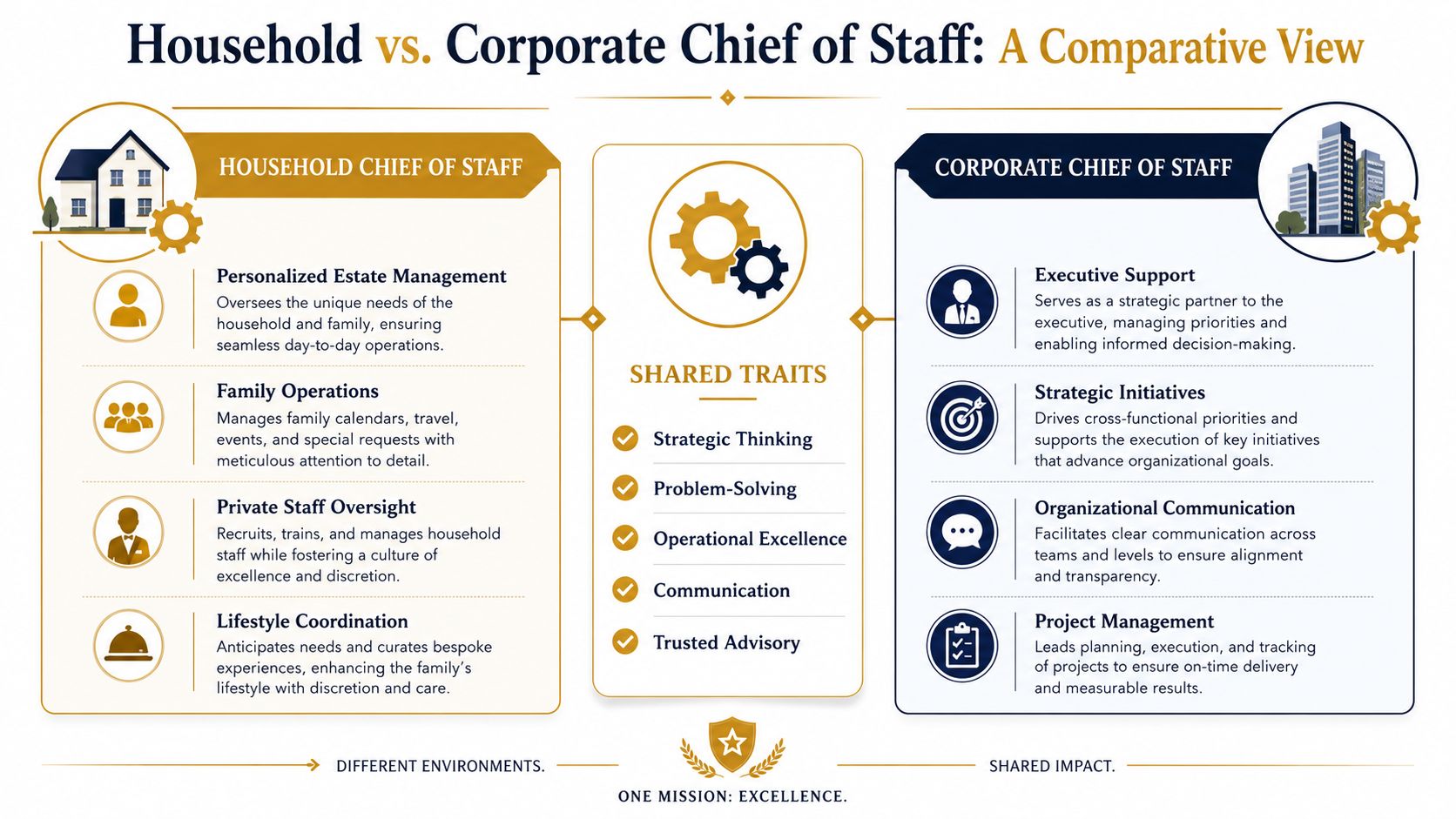
The title is the same. The operating reality is not. In a company, the role usually supports an executive inside a defined hierarchy, with formal authority, clear reporting lines, and commercial objectives. In an elite household, the Chief of Staff works inside a private system where family dynamics, staff management, personal preferences, reputation, security, and timing all collide.
That changes the job at its core.
A household Chief of Staff must handle influence without theatrics, enforce standards without making the home feel corporate, and protect the Principal's time without blocking access in the wrong moments. They may need to coordinate a driver, a housekeeper, a nanny, a property consultant, a family office adviser, and a last-minute guest request before lunch. A corporate operator who is used to board papers and departmental meetings often underestimates that level of complexity.
| Dimension | Household Chief of Staff | Corporate Chief of Staff |
|---|---|---|
| Primary objective | Family continuity, discretion, operational harmony | Strategic execution, internal alignment, business performance |
| Stakeholders | Principals, children, staff, vendors, advisors, guests | CEO, leadership team, departments, board |
| Operating environment | Private, intimate, reputation-sensitive | Formal, structured, commercially visible |
| Risk profile | Confidentiality breaches, household disruption, trust erosion | Strategic drift, communication gaps, project delays |
| Typical remit | Estate operations, staff leadership, lifestyle logistics, Principal support | Meetings, planning cadence, cross-functional business initiatives |
The brief for this role is now a hybrid one. Families are not hiring a glorified executive assistant, and they are not looking for a corporate strategist who treats the household like a business unit. They need a disciplined operator who can connect private service, household leadership, and strategic oversight in one post.
That is why generic corporate job descriptions fail. They miss domestic fluency, service judgment, and the ability to run a private environment with calm authority. If you are also reviewing reporting lines and service standards across the home, this guide on managing household staff effectively in elite family settings is a useful companion piece.
For households with a formal private office structure, the strategic side of the role still matters. strategy execution for Chiefs of Staff gives a useful view of planning cadence and accountability. Use that framework selectively. Then adapt it to the pressures of a private home, where trust, discretion, and personal judgment decide whether the hire succeeds.
A corporate Chief of Staff can excel in a boardroom and still fail in a private residence because the household role depends on discretion, domestic fluency, and emotional accuracy under pressure.
Core Responsibilities in a Private Household Setting
A strong job description Chief of Staff for a private household should define authority, scope, and judgment with precision. In an elite family environment, this role sits at the centre of competing pressures. Privacy, service standards, property logistics, family preferences, security concerns, and staff performance all meet here. If the remit is vague, the household starts running on personality and habit instead of leadership.
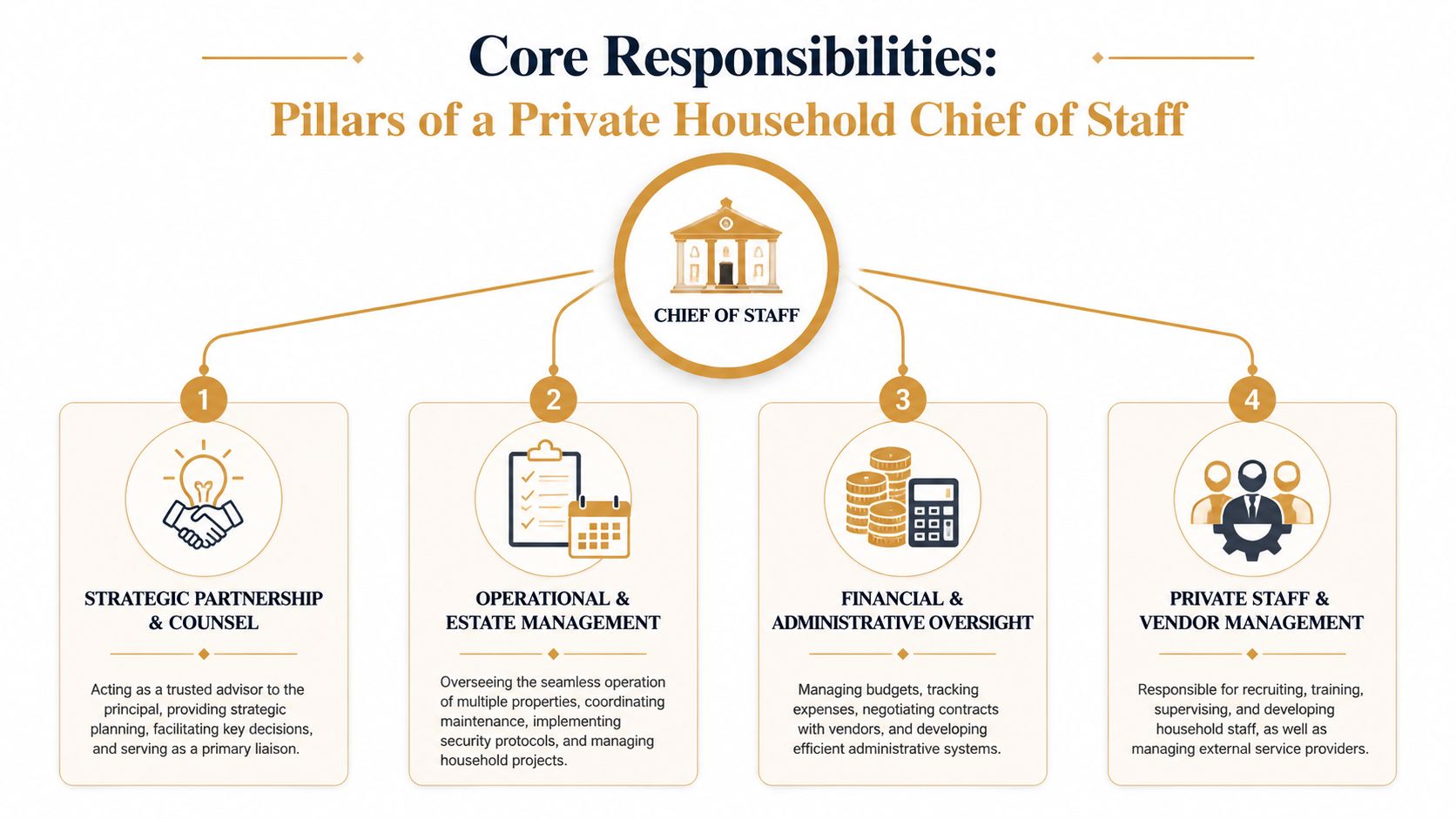
Strategic partnership and Principal support
At the top end of private service, the Chief of Staff protects the Principal's time, attention, and decision quality. That means far more than managing a schedule.
The role should cover:
- Priority management across household, personal, and family office matters
- Decision support through short, well-prepared briefs with clear options
- Execution oversight on instructions involving multiple staff members or advisers
- Sensitive communication between the Principal and senior household staff when tone and timing matter
Weak candidates pass messages. Strong ones reduce noise, organise action, and keep the Principal out of avoidable friction.
Operational and estate management
Here, private household Chief of Staff roles break away from corporate templates. The work is physical, service-led, and constant. Residences must be ready. Standards must hold across properties. Vendors must perform. Problems must be handled before they become visible to the family.
Your specification should assign responsibility for:
- Multi-property operations including maintenance planning, readiness checks, vendor scheduling, and service consistency
- Security coordination with household leadership, external providers, and any family office stakeholders
- Travel and event logistics where staffing, privacy, transport, and timing need central control
- Incident response for urgent issues involving property, staffing, guest management, or schedule disruption
A corporate operator may know process. A household Chief of Staff must also understand pace, presentation, and discretion inside a lived-in private environment.
Staff leadership and vendor management
Households rarely struggle because no one is working. They struggle because no senior operator is setting standards, correcting drift, and making departments work together.
A well-written brief should include responsibility for:
- Leading senior domestic staff through clear expectations, reporting lines, and accountability
- Recruitment and onboarding oversight for key hires across the residence
- Performance management before frustration turns into resignations or household politics
- Vendor control covering contracts, service reviews, conduct, and reliability
If you are refining service structure at the same time, this guide on how to manage household staff effectively in elite homes is a practical reference.
What to state plainly: “This role holds responsibility for operational alignment across household departments, senior staff, and external service providers.”
Financial and administrative oversight
The household Chief of Staff should not replace your accountant or lawyer. They should make sure operational spending, approvals, reporting, and records stay controlled and intelligible.
Include duties such as:
- Budget tracking across departments, properties, and recurring household costs
- Contract administration with support from legal or family office advisers where needed
- Reporting systems for approvals, updates, issue logs, and recurring reviews
- Confidential information handling across documents, access, communications, and internal records
This area also touches hiring risk. If the role includes recruitment oversight, compliance checks, or staff access to sensitive environments, mastering employee vetting for compliance is worth reviewing before you finalise the remit.
If your draft reads like a polished assistant role, it is too small. A private household Chief of Staff is there to impose order, protect standards, and keep an intricate family world running properly.
Essential Qualifications and Competencies to Demand
Families often overpay for polish and under-hire for judgment. In a private household, that mistake is expensive.
A strong household Chief of Staff does not need to impress you with corporate vocabulary or a glamorous CV. You need someone who can protect privacy, impose order, read family dynamics accurately, and run a complex personal environment without creating noise. This is a private-world leadership role. The standard should be higher than it is in many companies because the work reaches into your home, your children, your staff culture, your travel, and your reputation.
Essential Competencies
Start with the person, then assess the pedigree. I advise clients to demand these qualities first:
Discretion without performance
The right candidate handles confidential information carefully, speaks with restraint, and never signals their access for status.Calm authority
They can direct senior household staff, external suppliers, and advisers without becoming abrasive or theatrical.Sound judgment under pressure
They know what needs immediate escalation, what can be resolved quietly, and what should never reach the Principal as avoidable drama.Emotional control and social awareness
Private households are shaped by personalities, routines, family sensitivities, and unspoken hierarchies. Your Chief of Staff must read all of that accurately and stay steady.Operational breadth
They should be capable across staffing, residences, travel logistics, event oversight, reporting, and standards enforcement.Respect for service culture
A candidate who cannot treat housekeepers, nannies, drivers, and chefs with professional respect will destabilise the entire operation.
Experience that translates well
The best candidates usually come from environments where confidentiality, standards, and complexity already matter. That may include private office support, estate or house management, luxury hospitality, military service, family office operations, or senior executive support.
What matters is transferability. A candidate may have an impressive background and still be wrong for a household setting if they are rigid, ego-driven, or careless with boundaries. If you are also defining adjacent senior roles, this house manager job description for private households helps clarify where house management ends and Chief of Staff leadership begins.
What to test beyond the CV
Interview charm proves very little in this market. Private service requires discipline, verification, and consistency.
Ask how the candidate has handled sensitive staff exits, conflicting instructions from family members, and failures by trusted suppliers. Probe their approach to references, documentation, and access control. If they seem casual about screening or vague about process, take that as a warning sign.
For households building a serious screening process, this resource on mastering employee vetting for compliance is a useful complement to a confidential recruitment workflow.
Credentials that help
Advanced education can strengthen a profile. So can formal training in operations, hospitality, project management, or security-conscious environments. None of it rescues weak instincts.
Hire the candidate who makes your household feel more controlled, more protected, and easier to lead. Reject the one who looks impressive on paper but creates doubt the moment you picture them inside your private world.
Crafting Your Job Description A Complete Template
Most families overcomplicate the wrong parts of the brief and stay vague on the parts that matter. A strong job description Chief of Staff should be specific enough to filter candidates and flexible enough to reflect the reality of your household.
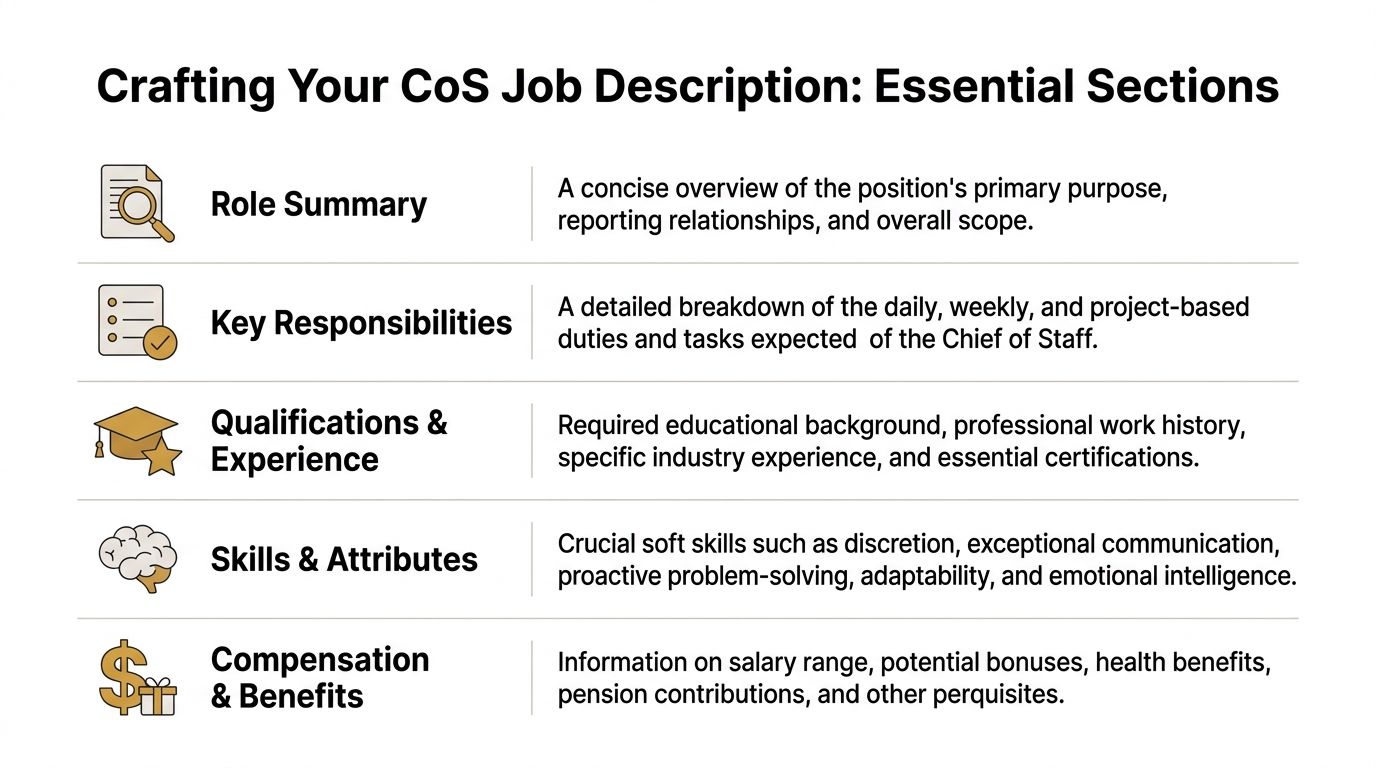
Start with a sharp role summary
Use plain English. State who they support, what they oversee, and what success looks like.
Example role summary
We are seeking an experienced Chief of Staff to provide strategic and operational leadership across a private household environment. The role supports the Principal by overseeing household operations, aligning senior staff, coordinating cross-functional projects, and ensuring the smooth running of residences, travel, service standards, and confidential matters. This position requires exceptional discretion, sound judgment, and the ability to lead in a high-trust, high-expectation setting.
Build responsibilities around real scope
Don't copy and paste generic executive support bullets. Tailor responsibilities to the life you run.
Template sections to include
Principal support and decision management
Include strategic briefings, issue escalation, and implementation tracking.Household and estate operations
Specify number of residences, major service lines, and whether there is an existing house manager or estate manager.Staff leadership
Clarify whether the Chief of Staff directly supervises senior staff, influences hiring, or owns performance reviews.Travel, events, and special projects
Add this if your household moves internationally or hosts often.Confidential administration
Include document handling, information flow, and policy discipline where relevant.
If you want a useful benchmark for structuring responsibilities, this house manager job description example for private households helps clarify where the house manager remit ends and the Chief of Staff remit should begin.
Write the qualifications section like a filter
Many briefs result in losing strong candidates and attracting unsuitable ones. Keep it firm, but relevant.
Suggested wording
Required experience
Significant senior-level experience in private household leadership, executive operations, family office support, or comparable environments.Demonstrated competencies
Discretion, diplomacy, staff leadership, project ownership, and calm decision-making under pressure.Practical requirements
Flexibility for travel, varied hours when necessary, and comfort operating across formal and informal settings.
Hiring standard: If a requirement doesn't help you assess trust, leadership, or fit, remove it.
Be honest about the package
Top candidates read compensation language as a signal of seriousness. If the package is vague, they'll assume the scope is vague too.
State salary range, benefits, reporting line, and whether accommodation, travel expectations, bonus potential, or pension support apply. Precision attracts adults.
UK Salary Benchmarks and Compensation Packages for 2026
Compensation for a household Chief of Staff should be treated as a strategic investment. If you want executive judgment, private service fluency, and operational authority in one person, the package has to reflect that.
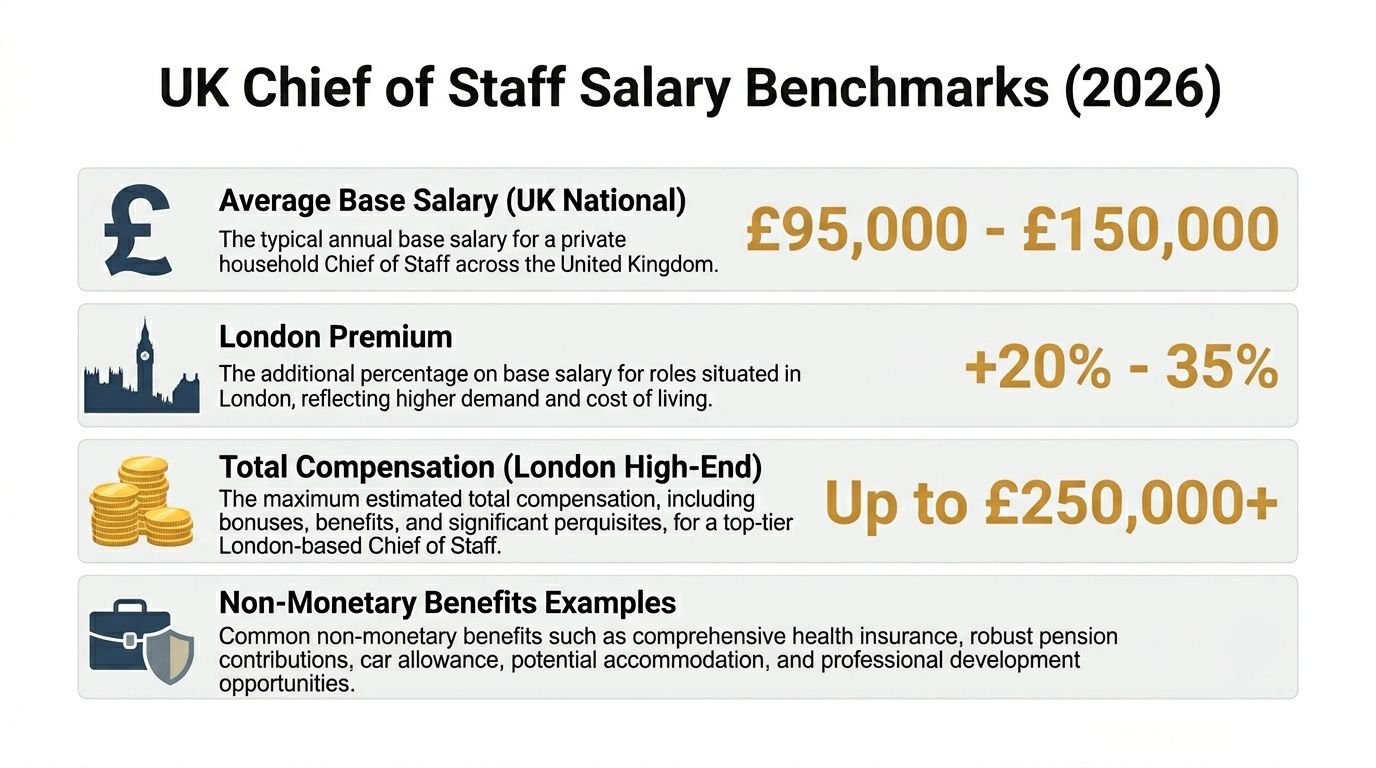
The clearest benchmark available is this. The average annual salary for a Chief of Staff in the UK is approximately £85,000 to £110,000, with senior practitioners in London reaching upwards of £140,000, reflecting a 25% premium over the national average due to the concentration of UHNW clients, based on independent industry reports on UK Chief of Staff salaries.
What a competitive package should include
Base salary is only one part of the offer. At this level, strong candidates usually assess the full shape of the role:
- Base pay aligned to scope, household complexity, travel, and reporting burden
- Bonus structure where performance expectations are clear
- Pension and healthcare suitable for a senior leadership hire
- Practical benefits such as travel support, accommodation where relevant, or professional development
- Authority clarity which isn't monetary, but often matters as much as cash
The real cost problem
Families often think they're saving money by holding the salary down. Usually they're just increasing search time, turnover risk, and operational drag.
A fair package does two things. It attracts serious candidates. It also signals that the household understands the level of leadership it's asking for.
Interview Questions That Reveal True Potential
A polished CV won't tell you how a candidate behaves when two Principals disagree, a security issue lands at midnight, or a senior nanny and house manager are undermining each other. Your interview must test judgment.
The market itself is telling you what matters. A 2025 analysis found that 82% of Chief of Staff job descriptions in UK elite households now require archetype fit, such as Consigliere or Catalyst, and 58% include OKR process ownership as a deliverable, according to the National Household Employers Association's 2025 UK Domestic Sector Job Description Analysis. That means you should interview for style of influence, not just competence.
Questions worth asking
Tell me about a time you had to manage conflicting instructions from two senior stakeholders. How did you proceed?
Look for diplomacy, structured communication, and respect for hierarchy without paralysis.Describe a situation where sensitive information was mishandled by a team member. What did you do first?
A strong answer shows containment, documentation, discretion, and prevention.How do you establish authority with experienced private staff who didn't hire you and may not welcome change?
The best candidates talk about listening first, observing patterns, then setting standards clearly.What kind of Chief of Staff are you at your best? Adviser, driver, integrator, fixer?
This helps reveal archetype fit. Self-awareness matters.How have you used reporting, goals, or tracking systems to keep multiple departments aligned?
You're testing whether they can create operating rhythm, not just react to noise.
Ask for examples. Then ask what they would do differently now. Reflection is often the clearest sign of seniority.
What to avoid
Don't waste time on generic questions about strengths and weaknesses. They reward rehearsal. Scenario questions reveal operating style, emotional control, and discretion far more reliably.
Conclusion Secure the Leader Your Household Deserves
A household Chief of Staff is not a luxury title for a polished assistant. It is a serious leadership hire for a serious private operation.
If your life includes multiple residences, senior domestic staff, family office coordination, frequent travel, or too many moving parts resting on your personal attention, then the job description Chief of Staff you use will determine the quality of the search. Get the brief wrong and you'll attract capable people for the wrong job. Get it right and you'll find someone who brings order, judgment, and calm to the centre of your world.
Write the role with honesty. Define authority clearly. Demand discretion, maturity, and operational fluency. Pay properly. Interview for fit, not charm.
Frequently Asked Questions
What should a private household Chief of Staff job description include?
It should include a role summary, reporting line, operational scope, key responsibilities, required experience, essential competencies, and a clear compensation outline. For private households, the strongest briefs also define household complexity, number of residences, staff leadership expectations, travel requirements, and confidentiality standards.
Is a household Chief of Staff the same as a house manager?
No. A house manager usually focuses on daily household operations and service delivery. A Chief of Staff sits at a more strategic level, often aligning departments, advising the Principal, managing cross-functional priorities, and overseeing senior staff or special projects that affect the whole household.
How senior should a household Chief of Staff be?
Senior enough to lead without needing constant instruction. In practice, that usually means someone with substantial executive-level or equivalent private service experience, strong judgment, and the maturity to operate inside a high-trust environment. The role shouldn't be treated as a development post.
Should a Chief of Staff in a private home manage household staff directly?
Often, yes. It depends on the structure. In many households, the Chief of Staff directly manages senior staff and coordinates across childcare, security, property operations, and external providers. The key is to define authority clearly so there's no confusion with the Executive Assistant, house manager, or estate manager.
How do I know if I need a Chief of Staff instead of another assistant?
If your problem is complexity rather than volume, you likely need a Chief of Staff. An assistant helps you cope with tasks. A Chief of Staff helps your private operation run with better judgment, coordination, and structure.
If you want discreet guidance on hiring a household Chief of Staff or any other senior private staff professional, contact Superstar Nannies for a confidential consultation.