


When people decide to hire a personal assistant, it's rarely because life is busy in a general sense. It's because details have started to spill into places they shouldn't. Travel changes are being handled from the back of a car. Household decisions are sitting in unread messages. Confidential matters are moving through too many hands. The cost is no longer inconvenience. It's distraction, exposure, and preventable friction.
For a UHNW household, a personal assistant isn't an extra pair of hands. The right hire becomes a control point. One person who understands how the household runs, who knows what must never be repeated, and who can absorb complexity before it reaches the principal. The wrong hire does the opposite. They create noise, dependence, and risk.
That's why the process has to be more exacting than standard recruitment. Skills matter, of course. But in private service, security, discretion, judgement, and cultural fit matter just as much. If you're planning to hire a personal assistant for yourself or your household, the objective isn't speed. It's long-term fit under real-world pressure.
Hiring a PA Is a Strategic Investment in Your Life
A typical turning point looks like this. The principal already has capable people around them. There may be a family office, a housekeeper, a nanny, a driver, perhaps a chief of staff on the business side. Yet simple matters are still bottlenecked because no one owns the personal layer. Appointments are booked, then moved. Guests are arriving, but preferences haven't been briefed. A child's school matter, a villa repair, a passport renewal, and a quiet dinner reservation all land in the same afternoon.
At that point, hiring help is no longer about convenience. It's about regaining control.
A strong private PA reduces decision fatigue in ways often underestimated. They filter what reaches you. They create order around diaries, communication, travel, household follow-through, and personal administration. Equally significant, they protect your time by stopping low-value interruptions from becoming high-stakes problems.
For UHNW households, that protection has another layer. Privacy is a live issue every day. Your assistant may see travel patterns, medical appointments, family routines, security preferences, spending habits, or sensitive interpersonal dynamics. That's why a personal assistant hire must be approached with the same seriousness as any other trusted household placement through private household staffing support.
Practical rule: If your life requires constant chasing, reminding, and double-checking, you don't need more effort. You need cleaner delegation.
The families who get this right rarely describe the result as “help”. They describe relief. Fewer loose ends. Better household rhythm. More privacy. More headspace. That's the actual return.
Defining the Modern UHNW Personal Assistant
A UHNW personal assistant isn't a generic admin professional dropped into a private home. The role sits somewhere between lifestyle management, executive support, household coordination, and private service. That's why poor briefs produce poor hires. If the role is vague, candidates will fill in the gaps with their own assumptions.
What this role is and is not
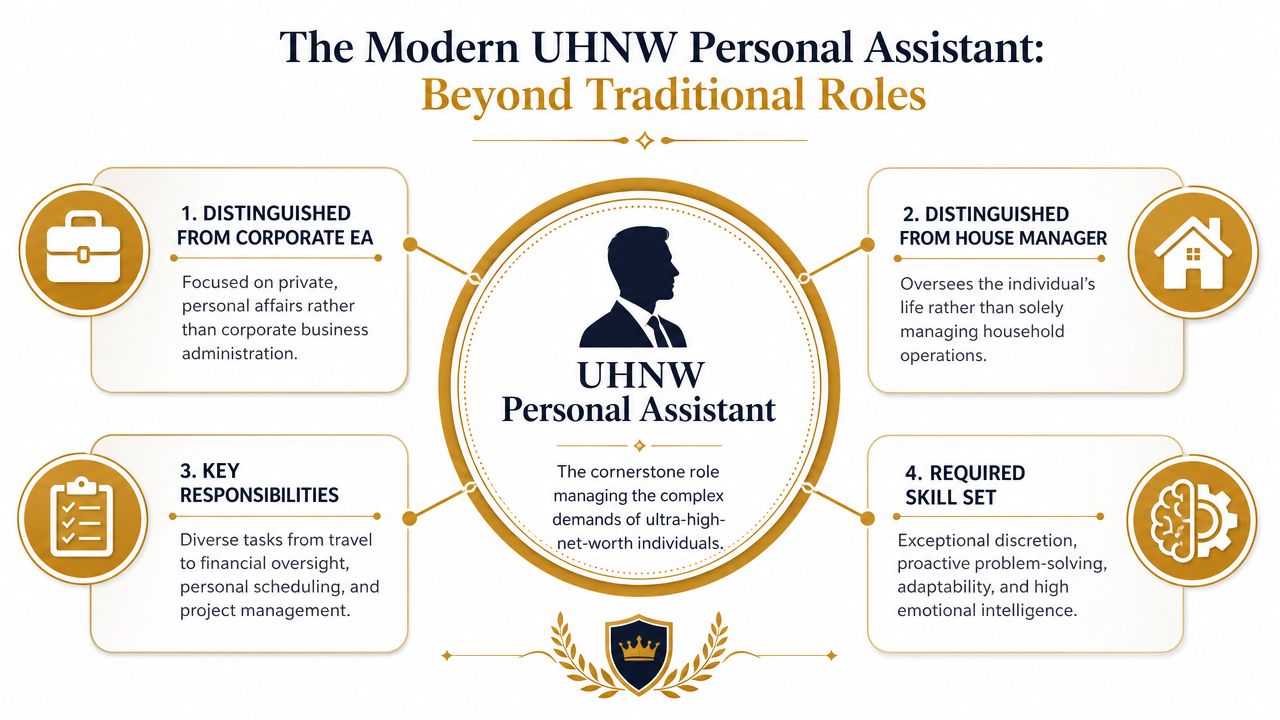
A private PA is not just a corporate EA working from a residence. A corporate EA usually works inside a business structure with clearer office systems, team support, and business-led priorities. A UHNW PA often moves across personal, family, household, and lifestyle matters in the same day.
They're also not a house manager, although there can be overlap. A house manager focuses on the operation of the property and staff. A PA stays closer to the principal's life, preferences, schedule, and personal follow-through. Nor should the role drift into nanny territory unless that crossover is intentional and explicitly defined.
If you need a sharper picture of typical scope, this breakdown of personal assistant duties in a private household is a useful starting point.
Start with a workload audit
The best role specifications come from observation, not aspiration. Track your own week. Note every task that interrupts your focus, requires follow-up, or gets delayed because nobody clearly owns it.
That list usually falls into a few clusters:
- Diary and scheduling control. Appointment management, holding space around travel, wellness bookings, family logistics.
- Travel and movement. Flights, ground transport, packing coordination, last-minute adjustments, discreet itineraries.
- Household administration. Vendor liaison, invoices, service bookings, maintenance follow-up, document organisation.
- Personal logistics. Gifts, reservations, wardrobe support, returns, renewals, errands, research.
- Trusted coordination. Keeping the nanny, housekeeper, chauffeur, security, and office-side contacts aligned where needed.
The phrase “I need someone who can do everything” usually signals that the role hasn't been thought through properly. Elite candidates don't avoid complexity. They avoid ambiguity.
Understand the talent market you are hiring from
In the UK, the available PA market sits inside a broad administrative talent pool. The Office for National Statistics' Annual Population Survey shows that around 1.3 million people work in administrative and secretarial occupations across the UK, and personal assistants are typically sourced from that wider market, which affects availability, competition, and pay expectations. The same labour-market picture also shows that the vast majority of these roles are held by women, which is relevant when employers think about shortlist building and candidate availability in private staffing (UK administrative and secretarial workforce context).
That large pool is helpful, but it can mislead. It means there are many administratively capable people. It does not mean there are many people suited to a highly private household. The shortlist should get narrower, not wider, once discretion, resilience, social fluency, and service instinct are factored in.
Structuring the Role for Your Household
Once the scope is clear, the next decision is structural. Many households make avoidable mistakes at this stage. They focus on what the PA will do, but not on how the role should sit inside the rhythm of the home, travel patterns, and privacy boundaries.
Live-in or live-out
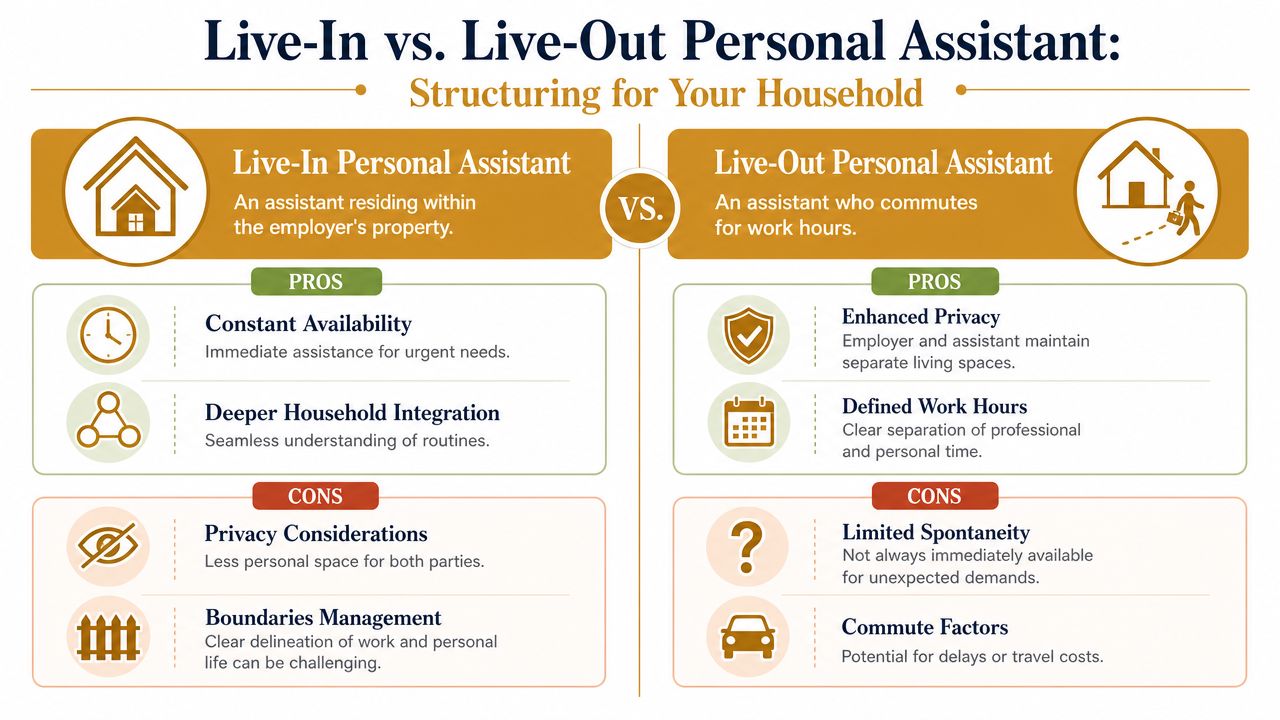
A live-in PA usually suits households with fluid hours, frequent travel, or properties that operate at a high tempo. It can work very well when responsiveness matters and the principal values continuity. It also creates practical challenges. Boundaries can blur. The assistant may feel permanently on call unless hours and private space are properly defined. The principal can start relying on availability instead of good systems.
A live-out PA generally creates cleaner professional separation. That often improves longevity. The assistant has clearer down time, and the household retains more privacy within the residence itself. The trade-off is obvious. You won't have instant support at every unpredictable moment, so systems and forward planning need to be stronger.
A simple comparison helps.
| Structure | Often works well when | Main pressure point |
|---|---|---|
| Live-in | Travel-heavy lifestyles, irregular schedules, multiple residences | Privacy and boundaries |
| Live-out | Principals who want defined working patterns and separation at home | Less spontaneity and immediate availability |
The right structure isn't the one with the most access. It's the one that produces dependable support without eroding trust or stamina.
Full-time, part-time, or hybrid support
Not every principal needs a full-time assistant. Some need concentrated support during business travel, school terms, or event-heavy periods. Others need daily control of diaries, household administration, and personal logistics, which usually points to a full-time arrangement.
Consider the pattern, not the title:
- Part-time can work when the workload is predictable and tightly scoped.
- Full-time is usually necessary when priorities change daily and the assistant must hold many moving pieces.
- Hybrid or flexible scheduling suits principals with alternating quiet and intense periods, but only if expectations are written down clearly.
The mistake is under-hiring for a role that is structurally full-time, then wondering why responsiveness slips.
Costing the role properly
In the UK, compensation starts with compliance, not preference. The National Living Wage was introduced in April 2016, and for April 2025 the UK government set it at £12.21 per hour for eligible workers aged 21 and over, which directly affects the base cost of hiring a PA, especially in live-in or part-time structures (UK pay floor for personal assistant hiring).
That figure is only a floor. It is not a market shortcut for a high-trust private hire. A compliant package also means thinking through working hours, holiday pay, payroll, pension obligations where applicable, and what “availability” means in practice. In private households, confusion around hours is one of the fastest ways to damage an otherwise good placement.
Sourcing and Vetting Candidates with Utmost Discretion
There are only two serious routes for most UHNW households. You either hire through a specialist private staffing agency, or you rely on your private network. Referrals can be helpful, but they're often mistaken for vetting. They are not the same thing.

Why informal referrals often fail
A friend may recommend someone who was “wonderful” for their family. That tells you very little about fit for yours. The principal may travel differently. The household may be more formal. The privacy threshold may be far higher. The role may require calm under social pressure, not just efficiency.
Private referrals also create awkwardness if things go wrong. Concerns become harder to raise, and exits become harder to manage cleanly.
Agency hiring is not infallible, but for sensitive placements it is usually the more defensible route because the process is designed to test for risk before the candidate enters your world. A specialist process such as an uncompromising private staffing vetting framework thus has practical value. It gives the household a formal structure for evaluating trust, consistency, and real-world suitability.
What proper vetting should include
Basic CV screening is nowhere near enough for a PA entering a high-value household. A stronger process should examine pattern, behaviour, and judgement.
Look for depth in these areas:
- Reference verification. Not just obtaining references, but checking consistency in dates, reporting lines, duties, and reasons for leaving.
- Written communication. Emails, messages, and briefing notes reveal judgement faster than rehearsed interview answers do.
- Digital footprint review. Social media behaviour, oversharing tendencies, and poor boundaries often surface here.
- Career logic. A candidate doesn't need a perfect linear background, but their story should make sense.
- Service temperament. The best private PAs are calm, anticipatory, and discreet. They don't need to be the centre of the room.
One factual check matters here. Industry guidance recommends a staged hiring process that starts with defining delegable tasks, moves into a detailed role specification, and then uses a paid trial period of 2 to 4 weeks to evaluate learning speed, discretion, and adaptability before making a permanent offer (staged PA hiring and trial guidance).
Use the trial to test reality
A trial period shouldn't be a vague probation in miniature. It should be structured.
Assign a realistic mix of work, such as:
- A diary exercise with competing priorities.
- A travel change that requires calm rebooking and follow-up.
- A household task involving more than one staff member.
- A written briefing note to assess clarity and judgement.
What works: testing how someone handles ambiguity with grace.
What does not: giving only easy errands, then assuming they can manage real complexity later.
During trial, watch for pace, confidentiality, tone, and recovery after a mistake. Those are usually better predictors of long-term fit than charm in interview.
The Interview Assessing Skill Discretion and Cultural Fit
A private PA interview should feel less like a standard competency exercise and more like a controlled pressure test. CVs can confirm exposure. They can't confirm judgement. In a private household, judgement is what protects the principal when plans shift, information is sensitive, or emotions are running high.
Ask scenario questions, not generic ones
Most weak interviews rely on broad prompts such as “tell me about yourself” or “what are your strengths”. Those produce polished but low-value answers.
Use scenarios that reveal how the candidate thinks:
- Confidentiality under social pressure
“You are asked about your principal by a supplier who is friendly and persistent. How do you respond without creating offence or disclosing anything useful?” - Competing priorities
“A travel change, a household staffing issue, and a family appointment clash arrive within the same hour. How do you decide what moves first?” - Independent judgement
“Your principal is unreachable. A decision needs to be made quickly. What do you act on alone, and what do you hold?” - Professional boundaries
“How do you handle a role where availability matters, but you also need sustainable boundaries?”
Listen for method. Strong candidates explain their thinking in a calm sequence. Weak candidates either freeze or speak in vague generalities.
Test for fit with your household culture
A very capable PA can still be wrong for the household. Formal homes need polished restraint. More relaxed homes still need discretion, but may prefer a warmer style. International households may expect cultural fluency, comfort around travel, and ease with different service environments.
Use interview time to test alignment with matters such as:
| What to assess | What a good answer sounds like |
|---|---|
| Household formality | Candidate adapts tone without becoming stiff or performative |
| Privacy instinct | Candidate defaults to minimal disclosure and careful language |
| Service orientation | Candidate takes satisfaction from making life smoother, not from status |
| Communication style | Candidate is concise, tactful, and unflustered |
A candidate who speaks too freely about former employers is showing you exactly how they may handle your information later.
Red flags that should shorten the process
Some warning signs are subtle. Others are not.
Be cautious if the candidate:
- Name-drops former principals instead of protecting their privacy.
- Shows little curiosity about how your household operates.
- Overstates availability in a way that sounds unsustainable.
- Responds defensively to feedback or correction during interview.
- Writes poorly when the role depends on precise communication.
The best interviews leave you with a clear sense of temperament. You should know whether this person creates calm, or merely performs competence.
Contracts and Compensation Creating a Secure Offer
By the time you make an offer, the strategic work should already be done. The contract's job is to turn that thinking into a durable working relationship. In private staffing, this matters far more than many households assume. A vague offer letter creates confusion. A properly drafted agreement protects privacy, clarifies expectations, and reduces the chance of preventable disputes later.
Build the offer around the real job
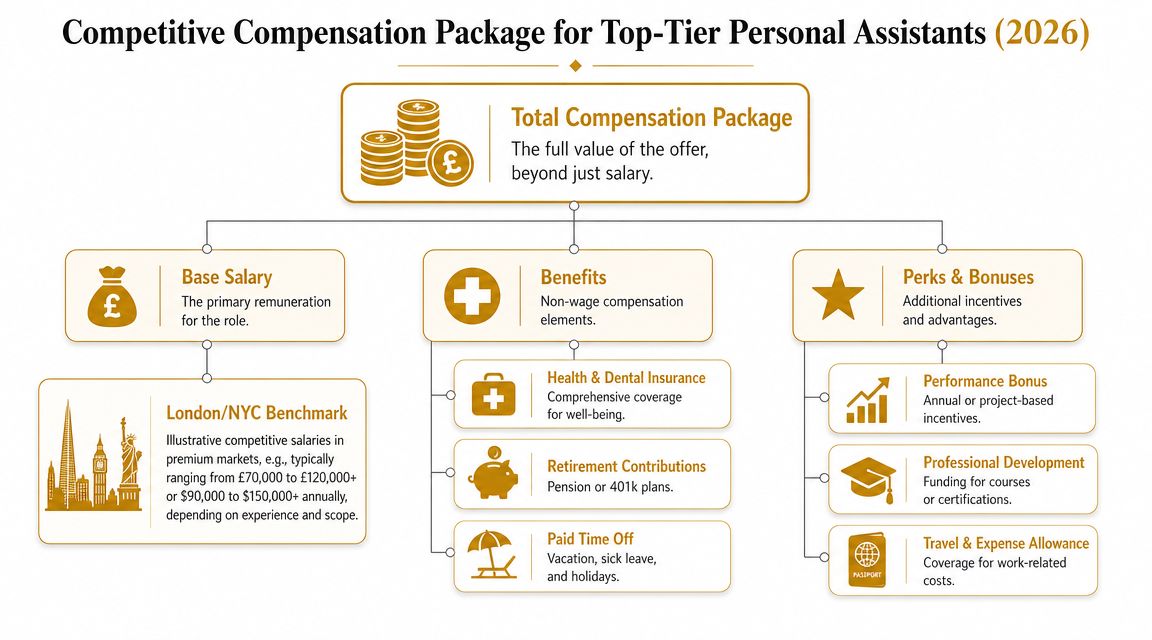
Compensation has to reflect scope, schedule, trust level, and the operational demands of the household. If the role involves complex travel, liaison with family office contacts, personal errands of a highly sensitive nature, and fast-changing priorities, the package should reflect that broader burden.
A sound offer usually addresses:
- Base pay tied to actual scope and expected availability
- Working pattern including whether hours are fixed, flexible, or travel-dependent
- Paid leave and rest periods so the arrangement remains sustainable
- Expenses and reimbursement for purchases, travel, and household-related outlay
- Review structure covering performance, discretion, and scope changes over time
For families comparing private staffing costs, this 2026 private staff salary guide can help frame the wider package components, even though the final figure should always be role-specific.
Employment status is not a technical side issue
A major UK risk area is employment status. Government and specialist guidance are clear that the actual working relationship matters more than the label used in the paperwork. If you hire a PA for regular, supervised work, you may create employer obligations even if the arrangement is part-time or presented informally.
The key legal distinction is whether the PA is a worker, employee, or self-employed contractor, because that affects tax, National Insurance, pension obligations, and employment rights (UK personal assistant employment status risk).
Households frequently encounter difficulties. They call someone self-employed because it sounds simpler, but the day-to-day reality says otherwise. If you set the hours, direct the work closely, expect ongoing personal service, and integrate the PA into the household's operating structure, the legal position may be very different from the label.
Your confidentiality protections must be bespoke
An NDA should never be treated as a generic download. In a UHNW environment, confidentiality clauses should reflect the actual risks of the role.
At minimum, the paperwork should address:
- Private information including family routines, travel, addresses, guest lists, spending, health matters, and internal communications
- Digital confidentiality covering phones, messaging apps, images, cloud files, calendars, and passwords
- Media and social restrictions so there is no ambiguity around posting, discussing, or referencing the household
- Post-employment obligations because confidentiality doesn't end when the role does
Secure hiring principle: the contract should define behaviour before there is ever a problem to solve.
A secure offer is not the most complicated one. It is the one that matches the reality of the role and leaves very little open to interpretation.
Your Next Steps to Hiring with Confidence
To hire a personal assistant well, think like an operator, not a shopper. Start with the actual pressure points in your life. Define the role with precision. Choose a structure that fits your household. Vet for discretion and resilience, not only polish. Then document the relationship properly so expectations, boundaries, and confidentiality are protected from day one.
That approach tends to produce a very different result. The PA doesn't become another moving part to manage. They become the person who removes friction from your day and protects the private ecosystem around your family.
If you're ready to move carefully and confidentially, the next step is a focused hiring conversation. Superstar Nannies can support UHNW households with discreet private staffing searches, role scoping, and vetted introductions suited to the realities of high-trust homes.
Frequently Asked Questions
| Question | Answer |
|---|---|
| What's the difference between a personal assistant and an executive assistant in a private household? | A personal assistant in a private household usually handles life administration, family logistics, travel, personal scheduling, and coordination across the home. An executive assistant is generally anchored more heavily in business support. Some candidates can do both, but the distinction should be explicit before the search starts. |
| Should I hire a live-in or live-out personal assistant? | That depends on your lifestyle, not just preference. Live-in can suit travel-heavy or highly fluid households where responsiveness matters. Live-out often creates healthier boundaries and stronger privacy within the residence. The right answer is the arrangement that can be sustained professionally over time. |
| How do I know if a candidate is genuinely discreet? | Don't rely on claims of confidentiality. Test behaviour. Ask scenario questions, review how they speak about former employers, and assess whether they naturally protect information in conversation. Discretion is usually visible in tone, restraint, and judgement long before it appears in a reference. |
| Is a trial period worth doing for a senior PA hire? | Yes, provided it's structured and paid. A trial lets you see how the candidate handles real priorities, communication, and household dynamics. It is one of the few ways to test adaptability and fit in practice rather than relying only on interview performance. |
| Can I hire a personal assistant as self-employed? | Sometimes, but many households assume this too quickly. If the work is regular, supervised, and integrated into your day-to-day household operations, employer obligations may arise regardless of the label used. Employment status should be assessed carefully before the contract is issued. |
If you're planning to hire a personal assistant and want discreet support with role scoping, candidate vetting, and confidential introductions, contact Superstar Nannies for a private consultation.