

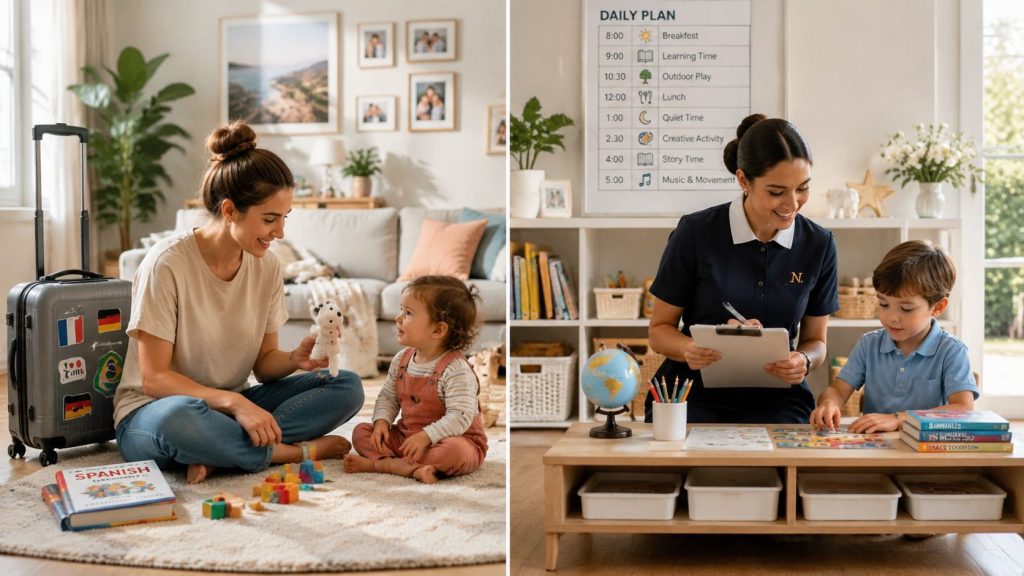
You're likely in the middle of the same conversation many parents have behind closed doors. You need reliable childcare, your schedule may already feel overfull, and two options keep coming up: au pair or nanny. On paper, both seem to offer in-home help. In real life, the difference between an au pair and nanny is far more significant than most families first realise.
For some households, the distinction is mostly about lifestyle. For others, especially homes with demanding careers, frequent travel, security concerns, or multiple staff members, it shapes everything from legal exposure to household harmony. A poor fit doesn't just create inconvenience. It affects your children's routine, your privacy, and the overall rhythm of your home.

The confusion is understandable. Families often use the terms loosely, and some online guides blur the line even further. But these roles are not interchangeable. One is built around a temporary cultural arrangement with light childcare support. The other is a professional childcare role with defined responsibilities, employment obligations, and a very different level of expertise.
Before looking at personalities, schedules, or household preferences, it helps to see the split clearly.
| Factor | Au pair | Nanny |
|---|---|---|
| Core model | Cultural exchange | Professional childcare career |
| Living arrangement | Typically live-in | Live-in or live-out |
| Typical profile | Usually a younger adult | No age limit, career caregiver |
| Legal status in the UK | Not usually treated like a standard employee arrangement | Normally employed under UK employment law |
| Main purpose | Childcare support within a host-family setting | Dedicated, structured childcare provision |
| Household fit | Best for lighter support and family integration | Best for professional, accountable childcare |
Introduction Decoding Your Childcare Choices
Parents rarely make this decision in ideal conditions. Usually, there's a new baby on the way, a return to work approaching, or a family schedule that has outgrown informal help. What looks like a simple childcare search quickly becomes a deeper question: do you want someone joining your family experience, or do you need a trained professional stepping into a defined role?
That's where the difference between au pair and nanny becomes decisive. Families often start with cost or availability, but the better starting point is structure. What kind of support does your household need on a Monday morning, during school holidays, on a travel week, or when a child is ill and routines fall apart?
The right hire isn't the person who sounds warmest in interview. It's the person whose role matches the reality of your household.
In private homes, titles matter because expectations follow them. If you bring in an au pair but expect the judgement, stamina, and self-direction of a career nanny, frustration usually appears quickly. If you hire a nanny when what you really wanted was a lighter, more informal cultural exchange arrangement, the relationship can feel too formal for what you had in mind.
For discerning families, the choice is rarely about which option is “better” in the abstract. It's about which arrangement suits your children's ages, your appetite for structure, your home environment, and the level of professionalism your life requires.
The Fundamental Difference Cultural Exchange vs Professional Career
The most important distinction is this: an au pair arrangement is not a cheaper version of a nanny role. In the UK, the legal distinction is that an au pair is treated as a cultural-exchange arrangement, while a nanny is a paid employee under UK employment law, which means contract, pay, tax, and employment-rights obligations usually apply to the nanny arrangement in a way they do not for an au pair placement, as outlined by AuPairWorld's explanation of the legal difference.
Practical rule: If you need a professional whose central job is childcare, you're looking for a nanny, not an au pair.
What an au pair arrangement is really designed for
An au pair typically joins a host family for a temporary stay that combines living in the home with lighter childcare support and day-to-day cultural immersion. The arrangement tends to suit families who are comfortable hosting a younger adult and who value language exposure, shared routines, and a more informal household dynamic.
That model can work beautifully when expectations stay within the spirit of the arrangement. It usually works less well when families need high-level childcare judgement, independent planning, or continuous coverage in a tightly run household.
What a nanny role is built to do
A nanny is engaged as a childcare professional. The family is not hosting a participant in a cultural exchange. They are hiring someone whose job is to safeguard, nurture, organise, and support the children consistently and professionally.
That difference affects everything else:
- Authority and accountability sit differently in a nanny role.
- Boundaries and reporting lines are clearer.
- Performance expectations can be formalised.
- Continuity of care is easier to build around a professional framework.
Families seeking a particularly high standard often gravitate towards candidates trained to exceptional levels. If you're comparing elite benchmarks in childcare, the Norland standard in elite childcare is a useful reference point.
Why this distinction changes the whole household dynamic
An au pair often becomes part of the family environment. A nanny becomes part of the childcare infrastructure of the home.
That sounds subtle, but it isn't. In practice, one arrangement asks your household to absorb and support a young person living within your family culture. The other asks a professional to support your children within the standards and systems you set.
A Detailed Comparison of Duties Hours and Responsibilities
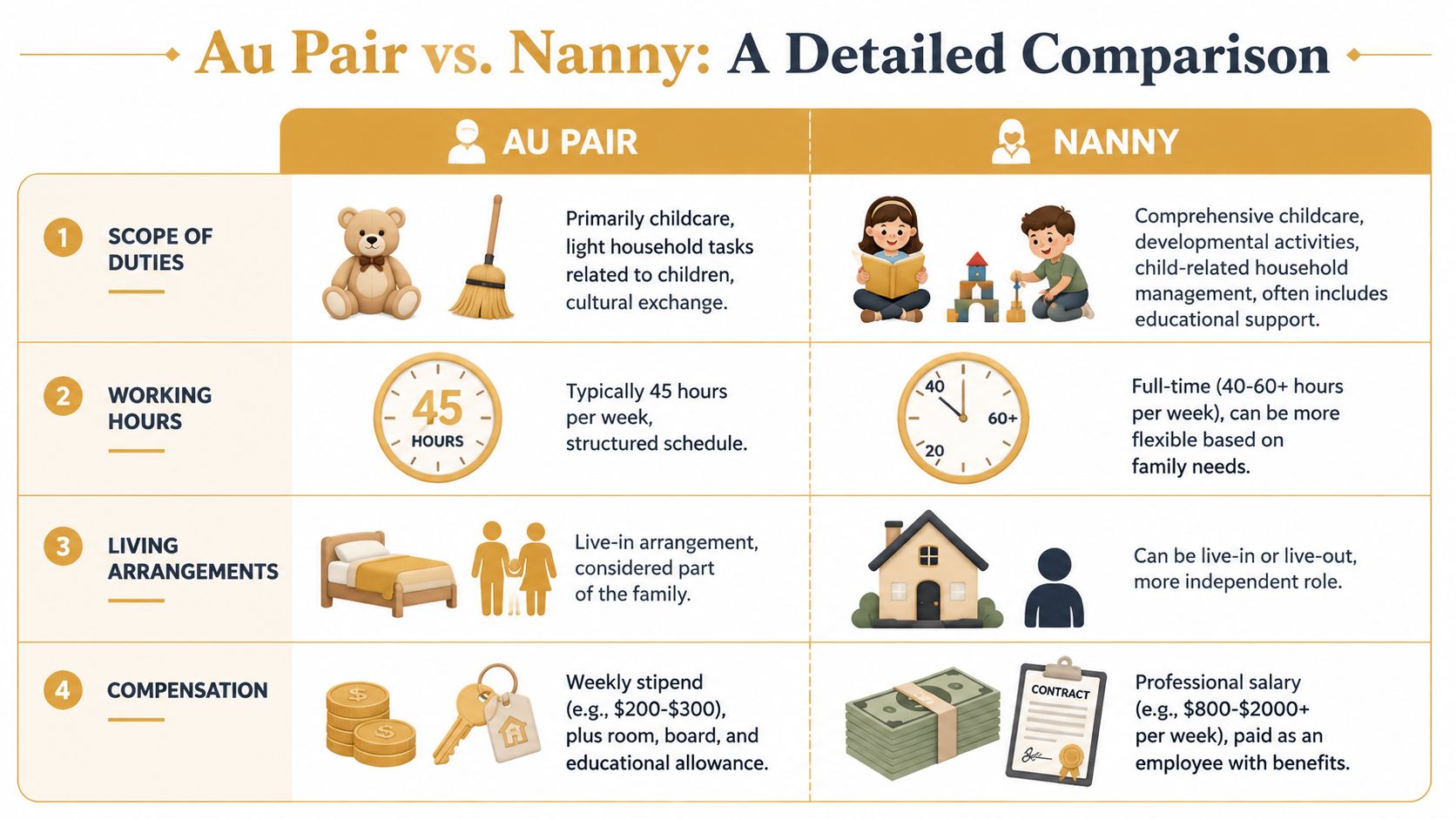
Day-to-day life reveals the difference between au pair and nanny faster than any job title ever will. The broad pattern is well recognised: au pairs are usually live-in and younger, with the arrangement focused on childcare plus light household help, while nannies can be live-in or live-out and are generally expected to bring more formal childcare experience and a broader professional skill set, as described in this practical comparison from The Bump.
Scope of duties
A nanny's remit is usually much broader and more structured. Depending on the role, a nanny may oversee routines, prepare children's meals, support developmental play, manage nursery or school readiness, coordinate activities, supervise homework, maintain children's wardrobes, liaise with tutors, and keep child-related areas organised.
An au pair arrangement is lighter by design. Childcare remains part of the exchange, but not as a full professional portfolio. Families generally do best with an au pair when they need support rather than complete ownership.
A simple test helps here. Ask yourself who should be setting the standard.
- Choose an au pair arrangement if you're happy to direct closely and keep duties light.
- Choose a nanny role if you need someone who can take charge of childcare operations with confidence.
For a fuller picture of professional childcare scope, what nannies do in daily practice gives a useful operational view.
Working hours and flexibility
Hours are where many families misjudge the role before they've even started. A nanny is engaged to meet a defined schedule and, where agreed, can provide early starts, later finishes, travel support, overnight cover, or rota-style flexibility. The role can be adapted to the actual rhythm of the household.
An au pair arrangement tends to suit a more predictable setup. If your week changes at short notice, your home runs across multiple residences, or childcare cover must stretch around assistants, chauffeurs, tutors, and security protocols, an informal support structure usually becomes strained.
Families with complex diaries often don't need “help with the children”. They need dependable coverage that still works when the diary changes at noon.
Household responsibilities
This area needs precision. A nanny may take on a range of child-related household responsibilities, and in some homes that can extend into a nanny-housekeeper or nanny-household-manager brief if it is clearly defined and appropriate to the role.
An au pair, by contrast, is usually better suited to:
- Light child-related tidying such as toys, bedrooms, or simple meal clean-up
- Routine supervision including school runs or playtime support
- Basic family participation where the arrangement is woven into household life
What doesn't work is treating an au pair as an all-purpose domestic solution. Families often run into difficulty when they expect a hybrid of nanny, housekeeper, and family assistant from someone whose placement was never designed for that.
Living arrangements and boundaries
Because au pairs are typically live-in, the relationship can feel warmer and more integrated. That can be a genuine advantage in some homes. It can also blur lines if the family hasn't thought carefully about privacy, downtime, and authority.
Nannies offer more choice. A live-out nanny preserves household privacy. A live-in nanny can deliver convenience while still operating within a professional framework. In staffed homes, that distinction often matters. The more complex the residence, the more helpful formal boundaries become.
Qualifications Vetting and Professional Standards
Parents often ask about personality first. Experienced households ask about judgement. Warmth matters, but it isn't enough on its own, especially when the role involves infants, travel, confidentiality, educational support, or integration with a wider domestic team.
Training signals capability
A nanny may arrive with formal childcare education, paediatric first aid, newborn experience, strong references, and years of practical exposure across different ages and temperaments. In higher-level appointments, families also look for bilingual fluency, tutoring strength, confidence with international travel, and experience in fully staffed homes.
An au pair may have childcare experience and a genuine affinity with children, but the role isn't built around the same professional threshold. That doesn't make the arrangement inferior in every case. It means the family must be honest about how much expertise the home needs.
If you are evaluating childcare hires through a risk-management lens, proper screening should never be optional. A structured nanny background check process is one of the clearest indicators that a family is treating the role with the seriousness it deserves.
Vetting matters more in complex households
In VIP and UHNW homes, vetting goes beyond basic identity checks. Families often need to understand how a candidate handles privacy, hierarchy, travel pressure, last-minute changes, media sensitivity, and proximity to high-profile individuals.
That's why references need to be interrogated rather than collected. A polished CV tells you very little about discretion under pressure. A detailed conversation with former principals, estate managers, or family office representatives tells you much more.
- Look for consistency across references, dates, and responsibilities.
- Test judgement with real-world scenarios, not generic interview questions.
- Assess fit with structure if the home already has chefs, housekeepers, security staff, or PAs.
Safeguarding is broader than childcare alone
The best households treat safeguarding as an ecosystem, not a single check-box exercise. That includes digital awareness, clear behavioural standards, reporting lines, and age-appropriate communication. Schools have moved in the same direction. For a useful example outside the nanny world, Queens Online School's approach to online student well-being shows how modern safeguarding now extends beyond physical presence to the wider environment surrounding a child.
A polished manner can impress in interview. Professional standards show up later, in punctuality, judgement, confidentiality, and the ability to stay calm when family life becomes complicated.
Navigating Legal Status Visas and Costs
The legal side of the difference between au pair and nanny is where many families realise they are not choosing between two versions of the same role. They are choosing between two entirely different frameworks. In the UK, the split is rooted in worker status: Home Office guidance treats au pairs as participants in a cultural exchange rather than ordinary employees, while a nanny is normally employed under UK employment law, meaning wages, tax, National Insurance, and workplace rights apply in a way that does not typically apply to an au pair arrangement, as explained in Care's guide to the UK distinction.

Hiring a nanny means becoming an employer
This is the part families can't afford to treat casually. If you hire a nanny, you are normally creating a formal employment relationship. That means thinking properly about:
- Written terms covering duties, hours, confidentiality, leave, and notice
- Payroll obligations including tax and National Insurance
- Employment rights such as lawful pay and workplace protections
- Role clarity so expectations are fair and enforceable
A well-run nanny arrangement feels smoother precisely because it is more formal. Clarity reduces resentment. It also protects both sides if the role evolves.
Families comparing the financial commitment often find it helpful to review the broader costs of employing a nanny before focusing only on headline salary.
Hosting an au pair is a different kind of commitment
An au pair arrangement tends to be more temporary and culturally oriented. The host family usually provides accommodation and integrates the au pair into family life. That can be attractive for households that have space, want a live-in presence, and are comfortable with a less conventional support model.
But informal does not mean consequence-free. The arrangement still needs boundaries, written expectations, privacy rules, and a realistic understanding of what the placement is for. Problems often start when families assume a lighter legal framework means they can improvise.
Cost is not just financial
Many parents initially compare monthly outlay. The smarter comparison is operational cost.
A nanny usually carries higher employment responsibility, but often reduces hidden friction because the role is clearer. An au pair may seem simpler at first, yet can create more supervision demands inside the home. If the family must train extensively, monitor closely, and absorb mismatched expectations, the “cheaper” option may become more expensive in attention, energy, and household disruption.
Visa and residency practicalities
International households need to think beyond the label and consider practical mobility. Can the caregiver travel with the family easily? Can they relocate between residences? Are there immigration, tax, or jurisdictional issues when the principal residence shifts between countries?
Those questions are often manageable with a professional nanny role because the relationship is formal and the expectations are contractual. With an au pair arrangement, cross-border complexity can become harder to manage because the underlying premise is different.
For globally mobile families, legal structure is not paperwork on the edge of the decision. It is the decision.
Why UHNW and VIP Families Choose a Professional Nanny
In elite households, childcare rarely exists in isolation. It sits alongside travel planning, household staffing, schooling strategy, security protocols, public visibility, and often multiple residences. That is why standard online comparisons usually miss the point for UHNW and VIP families. The question isn't merely who can watch the children. It's who can operate at the level the household requires.
Discretion is not a bonus
For public figures, principals with security concerns, and families known socially or commercially, confidentiality is paramount. A professional nanny understands that private homes run on judgement. What is seen, heard, or inferred inside the residence stays there.
An au pair may be kind, enthusiastic, and well-meaning. But highly visible households usually need someone already accustomed to professional confidentiality, layered protocols, and a clear chain of command.
In a VIP home, discretion isn't a soft skill. It's part of the job description.
Professionalism protects the household
A professional nanny can usually integrate into a staffed environment without needing the family to explain basic household etiquette. They understand punctual handovers, diary discipline, discretion with guests, coordination with housekeepers and chefs, and the difference between warmth with children and over-familiarity with principals.
That matters because children in these homes often live within structured systems. Their caregiver may need to coordinate with tutors, travel managers, maternity nurses, security teams, or household managers. An informal arrangement struggles under that level of operational demand.
Specialist capability matters
Many high-level families need more than standard childcare. They may require:
- Bilingual or multilingual support for internationally educated children
- Travel-readiness across changing locations and time zones
- Educational confidence with homework routines or tutor liaison
- Infant or newborn knowledge where parents need calm, experienced support
- Adaptability inside formal residences and fully staffed homes
A professional nanny can be selected for those exact capabilities. That precision is often the deciding factor.
Stability is part of the luxury
The highest-value childcare is often the least visible. It is the calm, consistent presence who keeps children regulated, routines intact, and parents reassured even when the wider household is moving at speed. That level of steadiness usually comes from experience, professional identity, and long-term commitment.
For homes with high standards, the professional nanny model is not just preferable. In many cases, it is the only arrangement that aligns with the household's reality.
Making the Right Choice and Partnering with Experts
The right decision becomes clearer when you strip away labels and focus on fit.
Choose an au pair if your household wants a cultural exchange arrangement, has room for a live-in setup, and needs lighter childcare support within a more family-integrated model. This option tends to suit homes that are happy to host, guide, and keep expectations modest and clearly bounded.
Choose a nanny if you need dedicated childcare delivered with professionalism, accountability, and consistency. That applies especially if you have younger children, complex schedules, a preference for formal boundaries, or a household where privacy and discretion matter every day.
A simple decision filter can help:
- Go with an au pair if cultural exchange is central and childcare support is lighter.
- Go with a nanny if childcare is a critical function of the household.
- Pause and reassess if you're drawn to the lower-structure model but expect high-level professional output.
For many discerning families, the actual challenge isn't deciding in theory. It's executing well. Strong childcare appointments depend on accurate role scoping, serious vetting, clear terms, and careful matching between family culture and candidate temperament. That is where expert guidance changes the outcome.
FAQs
Is an au pair the same as a live-in nanny
No. An au pair is generally part of a cultural exchange arrangement and is usually live-in, while a nanny is a professional childcare employee who may be live-in or live-out. The live-in aspect can look similar from the outside, but the purpose, expectations, and legal framework are different.
Which is better for babies, an au pair or a nanny
For babies, most families are better served by a nanny because infant care usually requires more skill, judgement, and consistency. A professional nanny is also better suited if you want support with feeding routines, sleep structure, developmental milestones, and close communication with parents.
Can an au pair do housework like a nanny
Not in the way many families assume. An au pair arrangement is generally centred on childcare and light help around the children, not broad household management. If you need someone to take full ownership of child-related logistics or wider domestic support, a nanny is usually the more appropriate hire.
Is hiring a nanny more formal than hosting an au pair
Yes. In the UK, a nanny is normally employed under employment law, which means there are clearer obligations around pay, tax, National Insurance, and employment rights. That formality often makes the arrangement more professional and easier to manage properly over time.
Why do VIP families usually prefer nannies
VIP families often need discretion, advanced childcare capability, flexibility, and the ability to work within a staffed home. Those needs align more naturally with a professional nanny role than with an au pair arrangement, which is temporary and culturally focused by design.
If your family needs discreet, high-level childcare support, Superstar Nannies provides confidential guidance and bespoke placements for exceptional households worldwide. Contact the team for a private consultation and find the calibre of nanny your home, schedule, and children deserve.