


The phrase 'private household staff' might bring to mind old-fashioned, storybook images. But in 2026, hiring professionals for your home is a modern, strategic move to manage your life with greater efficiency and reclaim your most valuable asset: time. This guide will walk you through how to build a highly skilled team whose purpose is to make your household run flawlessly.
The Modern Approach to Private Household Staff

Today, staffing a home is less about tradition and more about applying sound business principles to your private life. The goal is to create a bespoke support system that perfectly aligns with your family’s unique demands and lifestyle. Think of yourself as the CEO of your household; appointing a team of specialists to handle specific domestic operations is simply smart management.
Assembling Your Home's Professional Team
A well-chosen household team operates like a world-class orchestra. Each professional has mastered their role, and under the direction of a leader, they create harmony in your daily life. The key is recognising that these roles are highly specialised. You wouldn't ask a concert violinist to play the tuba, just as you wouldn't expect a Nanny to manage a complex portfolio of properties.
- The Expert Nanny: For many families, this is the most critical role. A professional Nanny is dedicated to your children's development, education, and well-being, creating a safe and stimulating environment for them to flourish.
- The Meticulous House Manager: This is your "conductor." A great House Manager oversees the entire operation, managing other staff, coordinating calendars, and ensuring every detail of your home is handled flawlessly.
- The Culinary Private Chef: Imagine restaurant-quality dining, completely personalised to your family's tastes and dietary requirements. A Private Chef manages everything from menu planning and shopping to preparation and kitchen hygiene.
- The Discreet Chauffeur: So much more than a driver. A professional chauffeur provides safe, punctual, and comfortable transport, while also managing vehicle maintenance and logistics.
This modern framework is built on expertise and efficiency. It’s all about creating a perfectly managed home that adapts to your needs.
The Value of Professional Coordination
The true magic happens when these individual experts work in concert. A Nanny can liaise with the Private Chef about the children's meal schedule, while the House Manager ensures the Chauffeur's availability aligns with the family’s appointments. It is this synergy that elevates a group of employees into a cohesive, high-performing team.
When you view private household staff through this professional lens, you see the immense value it creates. This isn't about extravagance; it's about building a robust support system that secures your peace of mind and brings order and harmony to your home.
Defining the Key Roles on Your Household Team
Building the right support structure starts with knowing who you’re looking for. It's easy to get bogged down in job titles, but the key is to understand the distinct skills each professional brings. Think of it less like filling a vacancy and more like casting the perfect ensemble for your life. The world of private household staff is far broader and more professional than many realise, with diverse roles recognized by official bodies in the UK.
The Childcare Specialist: The Nanny
For any family with children, a Nanny is often the heart of the home. A true professional Nanny is a childcare expert, completely dedicated to your children’s well-being, growth, and happiness. Their days are a thoughtful mix of education, creative play, and consistent routine. A typical day might start with preparing a healthy breakfast, followed by an enriching trip to a museum or a structured phonics lesson, juggling school runs, and patiently guiding them through homework.
To suit different family dynamics, Nannies often work in specific arrangements:
- Live-in Nanny: By residing in your home, they offer incredible flexibility and become a stable, integrated presence in your family’s life.
- Rota Nanny: Working on a rotational schedule, often ‘two weeks on, two weeks off’, they provide seamless, 24/7 coverage. This model is perfect for families with demanding travel schedules.
- Bilingual Nanny: This specialist provides all the expected care while immersing your children in a second language—an invaluable gift in our modern world.
Many exceptional nannies have trained at world-renowned institutions like Norland College, signaling a deep professional commitment and high standards of care.
The Household Conductor: The House Manager
If the Nanny is the heart, the House Manager is the operational brain. This individual serves as the central command post for your residence, ensuring every aspect of the household runs with flawless efficiency. Their focus isn't on the small tasks, but on the big picture: managing budgets, liaising with vendors, and supervising the entire domestic team.
A House Manager’s role is incredibly dynamic, from leading team briefings and interviewing new staff to overseeing event setup. They are master problem-solvers and organisers, acting as the single point of contact for the family. You can explore our detailed guide on the role of a House Manager to fully grasp what this pivotal position entails.
A truly exceptional House Manager doesn't just manage tasks; they anticipate needs. They have the foresight to schedule seasonal maintenance before a problem arises and the diplomacy to lead a diverse team with respect and clarity.
Bespoke Hospitality Professionals
Beyond childcare and overall management, a number of specialist roles exist to cater to specific lifestyle requirements. These professionals elevate a residence into a sanctuary of personal service.
- Private Chef: A culinary artist who designs your entire dining experience, from menu planning based on precise dietary needs to sourcing the finest ingredients and maintaining professional kitchen standards.
- Butler: A master of personal service and formal etiquette. Duties range from meticulous table service and wardrobe management to greeting guests with absolute discretion.
- Chauffeur: Your guarantee of safe, punctual, and comfortable travel. They are responsible for immaculate vehicle maintenance, strategic route planning, and upholding the highest standards of security and confidentiality.
- Estate Manager: For larger properties or multiple residences, the Estate Manager oversees the entire portfolio, managing grounds, outbuildings, staff, and large-scale projects.
Understanding these distinctions allows you to build a team that works in perfect harmony with your life.
Structuring Your Household for Flawless Operation
Once you’ve handpicked the professionals for your home, the next step is designing a structure that lets them work in perfect sync. It’s one thing to assemble a team of private household staff; it’s another thing entirely to define how they collaborate. A well-designed structure prevents roles from blurring, clarifies ownership, and establishes a clear chain of command, which is essential for smooth day-to-day management.
Establishing a Clear Chain of Command
In any professional setting, ambiguity breeds inefficiency. A clear chain of command ensures every team member knows who to report to and who provides direction. For most substantial households, the House Manager or Estate Manager is the linchpin. They act as the general manager of your home, orchestrating the team and serving as the main point of contact, freeing you from minor daily decisions.
This diagram shows a classic hierarchical structure you might find in a large estate, illustrating how roles are organised for peak efficiency.
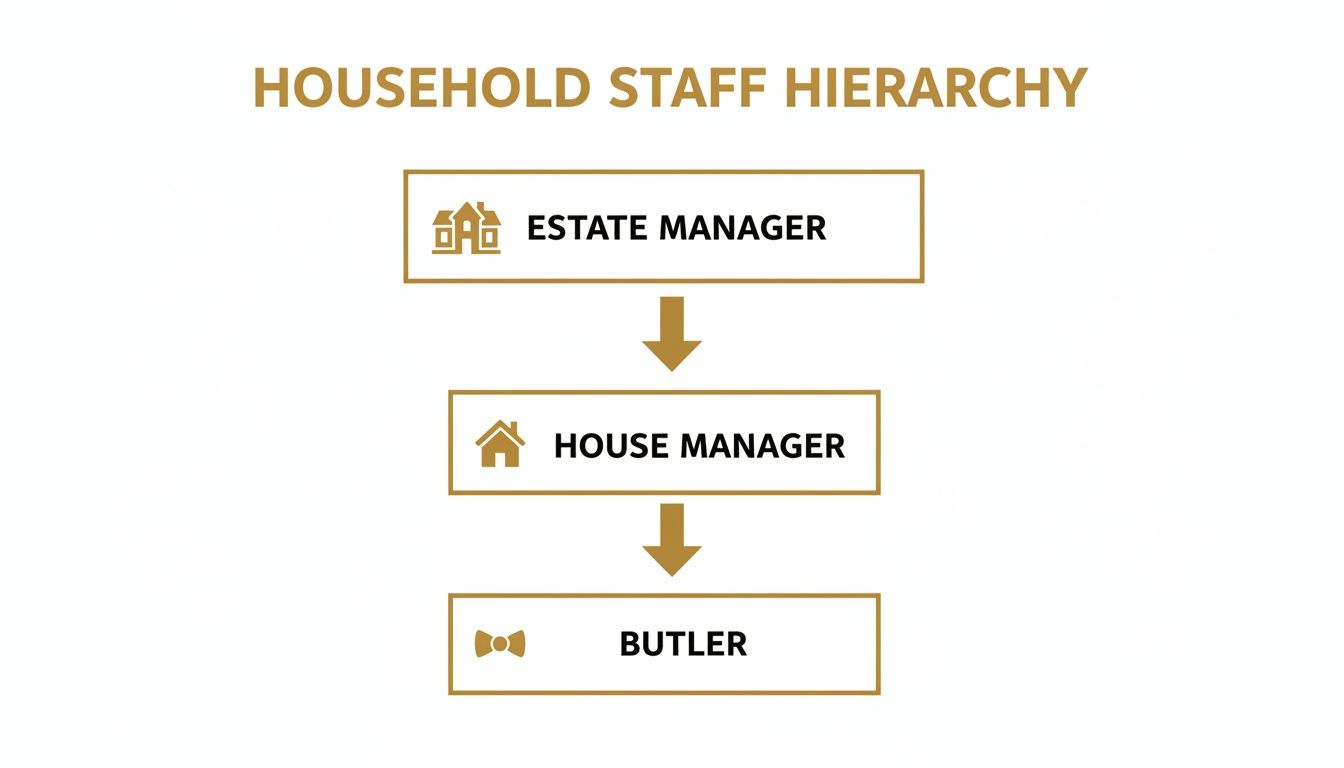
This top-down flow of command is crucial when you’re managing a larger team or juggling the demands of multiple properties.
From City Apartments to Country Estates
The ideal staffing model isn't one-size-fits-all. The operational rhythm of a sprawling country estate is worlds away from that of a chic city penthouse, and your staffing structure must reflect that reality. The key is to scale your team to fit your environment, ensuring you have the right level of support without unnecessary complexity.
Sample Household Staffing Structures
| Household Type | Core Staffing Model | Key Roles | Management Structure |
|---|---|---|---|
| City Apartment | Lean & Multiskilled | Housekeeper-Cook, Part-time Nanny | Collaborative: Staff report directly to the Principal. Communication is often informal and direct. |
| Suburban Family Home | Family-Focused Team | Full-time Nanny, Housekeeper, Part-time Gardener | Hybrid: A lead staff member (e.g., experienced Nanny) may coordinate daily tasks, reporting to the Principal. |
| Large Townhouse | Formal & Departmentalised | House Manager, Chef, Chauffeur, Housekeepers | Hierarchical: Led by a House Manager who supervises all other staff and manages household operations. |
| Country Estate | Comprehensive & Managed | Estate Manager, House Manager, Full Domestic Team | Tiered Hierarchy: The Estate Manager oversees the entire property, while the House Manager runs the main residence. |
These models provide a starting point, but the best structure is built around your unique lifestyle. A thoughtful structure, supported by modern communication tools, transforms a group of employees into a cohesive, high-performing team.
Your Guide to Hiring and Vetting Private Household Staff

Finding the right people to bring into your home is the most critical part of this journey. A thoughtful, professional hiring process isn't just about filling a vacancy; it's about protecting your family, safeguarding your privacy, and laying the groundwork for a relationship built on trust. Hiring private household staff demands a level of diligence that goes far beyond a typical office job, as you are inviting someone into your most personal space.
Crafting the Blueprint for Your Ideal Candidate
Before you can find the perfect person, you must know exactly who you're looking for. Create a detailed and compelling job description—your blueprint for the search. A vague outline will only attract unsuitable applicants.
Your job description needs to be a crystal-clear reflection of the role:
- Day-to-Day Responsibilities: Be specific. Instead of "housekeeping," detail expected standards, from daily tidying to the special care required for antiques.
- Must-Have Skills and Qualifications: List your non-negotiables, such as a clean driving licence or specific culinary skills.
- The Atmosphere of Your Home: Describe the cultural fit you're seeking—formal and traditional, or relaxed and informal?
A great job description acts as your first vetting tool, setting clear expectations and attracting high-calibre candidates.
The Multi-Stage Interview Process
A multi-stage interview process is the only way to properly assess candidates for such an important role.
- The Initial Screening: A quick phone or video call to confirm basics like salary expectations and key qualifications.
- The In-Depth Interview: A formal conversation focused on their professional background. Ask behavioural questions like, "Tell me about a time you had to handle a last-minute change of plans."
- The Practical Trial: For roles like a Chef or a Housekeeper, a paid trial day is invaluable to see their skills in action.
- The Final "Fit" Interview: An informal chat to ensure personalities and values align, potentially including other key family or staff members.
A Word of Advice: Never cut corners on vetting. It is the bedrock of safety and trust in your home. Every single step, from checking references to practical trials, is essential.
The Non-Negotiable: Background and Reference Checks
This final stage is your ultimate safety net. Comprehensive background checks are not optional. In the UK, this means running an enhanced DBS (Disclosure and Barring Service) check, which is vital for anyone working with children or in a position of significant trust.
Equally critical is the thorough verification of references. You must personally speak with previous employers to ask direct questions about their reliability, integrity, and performance. This is an area where reputable domestic staffing agencies truly shine, as they handle this meticulous vetting for you. Once you’ve made your choice, a structured onboarding checklist for new employees helps integrate them seamlessly.
Getting to Grips with UK Employment and Legal Rules
When you hire your first member of private household staff, you’re no longer just a householder; you’re officially an employer. This shift brings a set of legal and financial duties you can’t ignore in the UK. Getting this right protects you from legal headaches and builds a foundation of respect with your new employee.
Your First Step: A Formal Employment Contract
A handshake deal is a recipe for confusion. The only way to start a professional relationship is with a formal, written employment contract. This document is the cornerstone of the arrangement, offering clarity and legal protection for both you and your staff.
A properly drafted contract should leave no room for ambiguity. Make sure it covers:
- Detailed Job Duties: A specific list of all responsibilities.
- Working Hours and Schedule: Stated hours, days off, and overtime policies.
- Salary and Payment Schedule: The agreed gross salary, payment frequency, and method.
- Confidentiality and Privacy Clauses: A non-disclosure agreement (NDA) is essential.
- Notice Periods: The required notice from either side to end employment.
- Holiday and Sick Pay Entitlements: Details on holiday allowance and sickness reporting procedures.
For highly specialised roles, like security, a comprehensive guide to a security guard for home protection can help outline precise responsibilities.
Understanding Your Duties as an Employer
Being an employer in the UK means you have several mandatory financial responsibilities. Getting them wrong can lead to serious penalties from HMRC.
Key Takeaway: As the employer, the responsibility for managing tax and national insurance for your staff falls squarely on your shoulders.
Here’s what you’ll need to manage:
- PAYE (Pay As You Earn) Registration: You must register as an employer with HMRC and operate a payroll to collect Income Tax and National Insurance contributions.
- National Insurance Contributions (NICs): You are responsible for paying employer’s NICs, an extra cost on top of the gross salary.
- Pension Auto-Enrolment: By law, you must enrol eligible staff into a workplace pension scheme and make contributions.
- Statutory Pay: This involves providing Statutory Sick Pay (SSP) and ensuring staff receive their paid holiday entitlement (5.6 weeks per year for full-time work).
To understand how these deductions work, read our article explaining the difference between gross and net pay. While you can manage payroll yourself, many clients prefer to use a specialist service.
Budgeting for and Keeping Your Top Household Talent
Finding exceptional people is just the start. The real art lies in creating an environment where they want to build a career. Getting the budget right for your private household staff and putting thoughtful retention strategies in place are key to long-term success and a harmonious home.
Getting the Salaries Right in the UK Market
A fair, competitive salary is the first signal that you value a professional’s expertise. In the UK, compensation depends on the role's demands, the candidate's experience, location (London salaries are higher), and whether the role is live-in or live-out.
As we move through 2026, we see high demand across the board. An experienced housekeeper can command £35,000–£45,000, while a versatile live-in domestic couple can earn up to £100,000. Talented private chefs can expect salaries up to £75,000. For more industry trends, you can explore detailed salary survey findings here.
To budget properly, you need the complete financial picture. Our Private Staff Salary Guide for 2026 offers a full breakdown of these costs.
Building a Culture That Inspires Loyalty
While salary is vital, a positive, respectful working environment is what truly anchors staff. People who feel valued, listened to, and appreciated are far more likely to stay committed.
Key Insight: Genuine loyalty is built on a foundation of mutual respect. The single most powerful retention strategy is to view your staff as the valued professionals they are.
Practical Steps for Long-Term Retention
Investing in your staff's happiness and growth pays back tenfold in performance and loyalty.
- Communicate Clearly and Often: Set up regular check-ins to offer feedback and catch small concerns early.
- Invest in Their Growth: Sponsor a new course for your chef or advanced first-aid training for your nanny to show you’re invested in their career.
- Recognise and Review Performance: Hold annual reviews to celebrate achievements and set goals. Acknowledge a job well done with a 'thank you', a small bonus, or an extra day off.
- Respect Their Personal Time: Honour scheduled days off. A well-rested team member is more effective. Always compensate any overtime fairly.
Pairing a competitive salary with a culture of respect ensures your home benefits from dedicated expertise for years to come.
Conclusion: Building Your Perfect Household Team
Hiring private household staff is a strategic decision to enhance your quality of life by creating a seamless, supportive, and professionally managed home environment. By clearly defining roles, establishing a solid structure, and committing to a fair and respectful hiring process, you can build a team that operates in perfect harmony. The key is to view your staff not just as employees, but as trusted professionals dedicated to the well-being of your family and home.
Ready to find the perfect professionals for your household? Contact Superstar Nannies today for a consultation and let our experts guide you through every step of the process.
Frequently Asked Questions (FAQs)
How long does it take to hire private household staff?
A thorough, professional search to hire the right private household staff typically takes between four to eight weeks. This timeframe allows for a detailed consultation to understand your unique needs, targeted candidate sourcing, multi-stage interviews, practical trials, and comprehensive background and reference checks. Rushing the process is a mistake; this investment of time ensures a successful, long-term placement that fits perfectly with your family's lifestyle.
What is the difference between a House Manager and an Estate Manager?
The key difference lies in the scale of responsibility. A House Manager oversees the day-to-day operations of a single residence, managing interior staff, coordinating schedules, and ensuring the home runs flawlessly. An Estate Manager has a much broader scope, acting as the CEO for an entire property portfolio. This includes multiple residences, extensive grounds, and a more complex ecosystem of staff, vendors, and assets.
Should I use an agency or hire directly?
While hiring directly is possible, partnering with a specialist agency like Superstar Nannies offers significant advantages. You gain immediate access to a network of pre-vetted, high-calibre professionals, saving you countless hours. More importantly, a reputable agency acts as your expert advisor, handling the complexities of recruitment, contract negotiation, and legal compliance, which dramatically reduces your risk and administrative burden.
What are the standard working hours for live-in staff?
For most live-in roles, a standard working week is typically 40-50 hours over five days. However, this is just a baseline. The schedule must be tailored to the specific role and your family’s unique lifestyle. It is crucial that the exact working hours, scheduled days off, and policies for overtime are clearly defined and agreed upon in the employment contract to foster a fair and respectful working relationship.