


You've likely seen the same pattern already. One site quotes a “maternity nurse salary” as if it were a standard annual wage. Another mixes hospital midwives with private newborn specialists. A third gives a headline number that tells you nothing about night cover, twins, travel, or whether the role is live-in.
For high-net-worth families, that approach is useless.
Private postnatal support is a specialist market. The right hire can protect maternal recovery, stabilise the home in the first weeks, and bring calm to a period that otherwise becomes fragmented and exhausting. The wrong hire, or the wrong budget assumption, creates confusion before the baby has even arrived.
Navigating Your Postnatal Support Options
At 34 weeks, a family often comes to us with a spreadsheet full of “maternity nurse salary” figures and very little clarity. One number assumes a temporary live-in maternity nurse, another reflects a night-only booking, and a third has nothing to do with private postnatal care at all. By that stage, the key question is no longer price alone. It is which form of support will protect the mother's recovery, fit the household, and hold up under the practical demands of the first weeks.
Private postnatal care does not follow a standard salary model. In this market, fees are usually structured by day, night, week, or rotation, because assignments are short-term, client-specific, and often built around live-in cover, intensive nights, travel, or complex family logistics. Families who budget as though they are hiring into a fixed payroll category usually misread the market early.
The right starting point is a precise brief. A consultant will want to know how the baby is expected to be fed, whether there are older children in the house, how much overnight cover is required, whether discretion is a priority, and who else already supports the residence. A principal recovering from a difficult birth needs a different professional from a family seeking polished night cover and light routine guidance.
That difference affects cost quickly.
Clear role definition usually produces a stronger shortlist and a narrower, more credible fee range. It also reduces the risk of hiring someone excellent on paper but wrong for the household. Families who want a fuller explanation of service models can review this guide to maternity nurse services and elite postnatal support.
Private newborn care becomes more expensive when the brief calls for unusual stamina, refined judgment, strict confidentiality, and the ability to integrate smoothly into a high-functioning home from day one.
Maternity Nurse, NCS, or Night Nanny Understanding the Roles
Before discussing compensation, the role itself needs to be precise. Many articles collapse everything into one label, which leads families to compare unlike with unlike.
Most content on this topic mixes up NHS midwives, postnatal ward nurses, and private maternity nurses, even though private rates are negotiated separately and depend on live-in or rota arrangements rather than a published scale, as outlined in this discussion of how salary content often confuses UK maternity roles. That distinction is the foundation of any serious budget conversation.
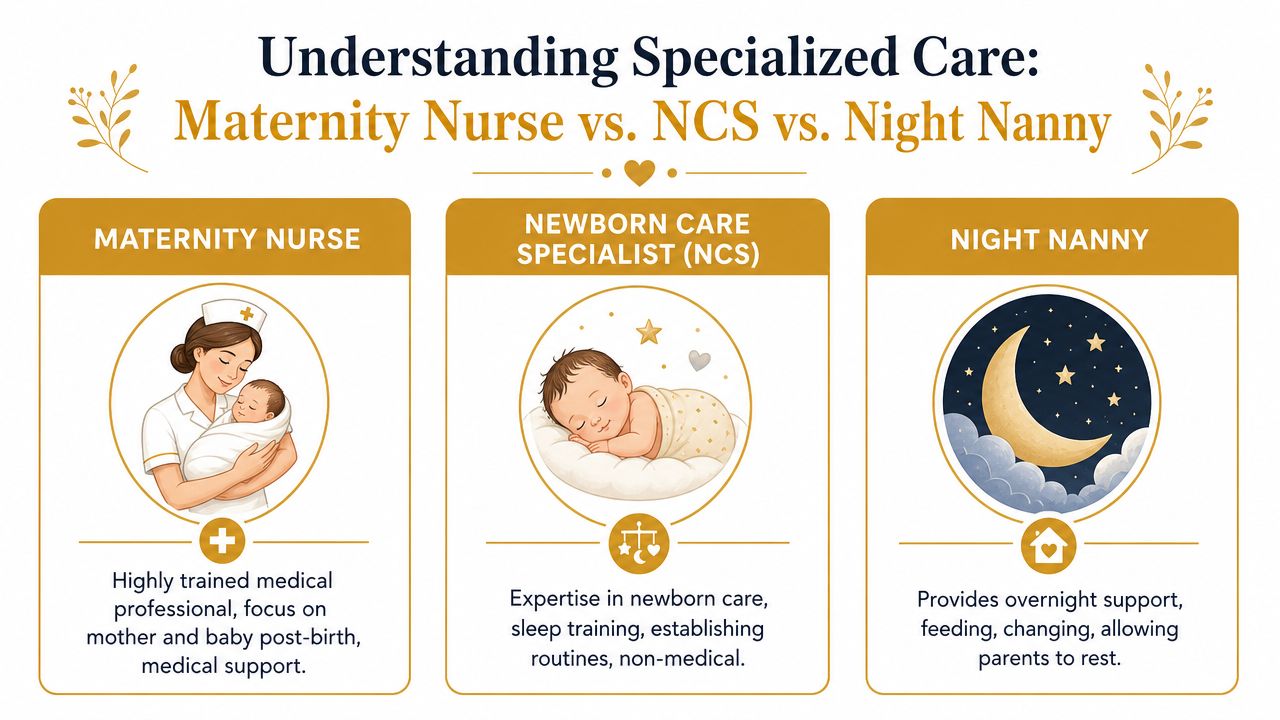
What a maternity nurse usually does
In private households, a maternity nurse is typically brought in during the immediate postnatal period. The remit is broad but focused. Newborn feeding support, settling, routine establishment, nappy care, sterilising, nursery organisation, and informed maternal guidance all fall within scope.
In more formal households, the maternity nurse may also coordinate closely with the principal's assistant, house manager, chef, or security team so the home functions smoothly around the baby's schedule. That's especially relevant when privacy, protocol, and discretion matter as much as infant care.
This role is often the closest thing to an all-around early-postpartum specialist.
How an NCS differs
A Newborn Care Specialist, or NCS, is usually more infant-centred and less medically framed in title, even when highly experienced. Families often choose an NCS when the priority is structured newborn care, sleep foundations, feeding rhythms, and consistency across shifts.
An NCS can be ideal where the household already has strong maternal medical support from consultants, doulas, or lactation professionals, and wants a specialist whose focus stays tightly on the baby's daily care patterns.
Where a night nanny fits
A night nanny is the most clearly defined of the three. The household needs overnight relief. Feeding, burping, changing, settling, and handing the baby back in a calm morning state are the core functions.
That sounds simple, but in practice night work is exacting. The best night professionals are quiet, observant, and excellent at maintaining sleep hygiene for the whole household. They don't overstep. They don't create dependency. They preserve rest.
A fuller role-by-role comparison is available in this guide on maternity nurse vs nanny for elite parents.
A practical way to choose
If you're deciding between the three, start with the outcome you want:
- Postnatal household stabilisation: choose a maternity nurse.
- Infant routine and specialist newborn care: an NCS may fit better.
- Protected sleep for parents: hire a night nanny.
- Complex recovery, multiples, or high-touch support: ask for a candidate with deeper neonatal or medically adjacent experience.
Global Salary Benchmarks for Elite Maternity Nurses
A maternity nurse salary is rarely a single annual figure. In the private market, the more useful benchmark is what the household pays for a defined pattern of cover.
In the UK, the Office for National Statistics reported median weekly pay of £728 for full-time employees in April 2024, and specialist maternity nurse rates for night or 24-hour cover often sit significantly above that national median because the work is intensive, unsociable, and highly specialised, according to this UK pay benchmark for specialist nursing-related roles. That comparison is useful because it frames private newborn care as a premium service category rather than ordinary childcare.
What families should compare
Families usually compare one of three structures:
- Night-only support, often booked for consistent overnight rest
- Live-in intensive cover, usually for the early weeks after birth
- Rota cover, where continuity is maintained across a more demanding schedule
The challenge is that many online figures flatten these into a single “salary” line. They shouldn't be flattened. A night booking and a rota placement solve different household problems and attract different professionals.
| Estimated Gross Weekly Rates for Maternity Nurses (2026) | |||
|---|---|---|---|
| Location | Night Nanny (10-12hr nights) | Live-In (24/5 or 24/6) | Rota (24/7, per nurse) |
| London | Premium private market. Usually quoted by shift or week | Premium private market. Often quoted by day or week | Highest-tier structure, typically negotiated individually |
| New York | Premium private market. Usually negotiated by schedule and profile | Premium private market. Live-in terms vary by household expectations | Rota placements are highly bespoke |
| Miami | Strong demand for night support and travel flexibility | Live-in rates vary with seasonality and scope | Rota arrangements tend to be lifestyle-led |
| Dubai | Premium market with strong demand for live-in support | Often shaped by residence setup, discretion, and travel | Rota terms usually reflect service intensity and household protocol |
This table is deliberately qualitative because location alone doesn't produce a reliable figure. The primary driver is the service model attached to that location.
Why direct comparisons fail
A family looking at London and Dubai may see similarly senior profiles but entirely different pricing logic once travel, privacy, staffing layers, and accommodation expectations enter the picture.
That's also why it helps to review adjacent market guidance when trying to determine a night nanny's pay. It sharpens the distinction between shift-based overnight support and broader maternity nurse coverage, which are often incorrectly bundled together.
For wider household budgeting, this private staffing reference on the salary guide for UHNW families is often the more practical tool than any generic “nurse salary” article.
If a quoted rate doesn't specify the working pattern, it isn't a useful rate.
Key Factors That Influence a Maternity Nurse Salary
Two candidates can look similar on paper and price very differently. The reason is service intensity.
In private placements, compensation is priced to that intensity. Overnight care, rota length, twins, prematurity, and complex infant medical needs all widen the rate range beyond standard hourly employment, as explained in this overview of how service intensity affects private nurse compensation. That principle is far more useful than asking whether someone has only worked “for many years”.
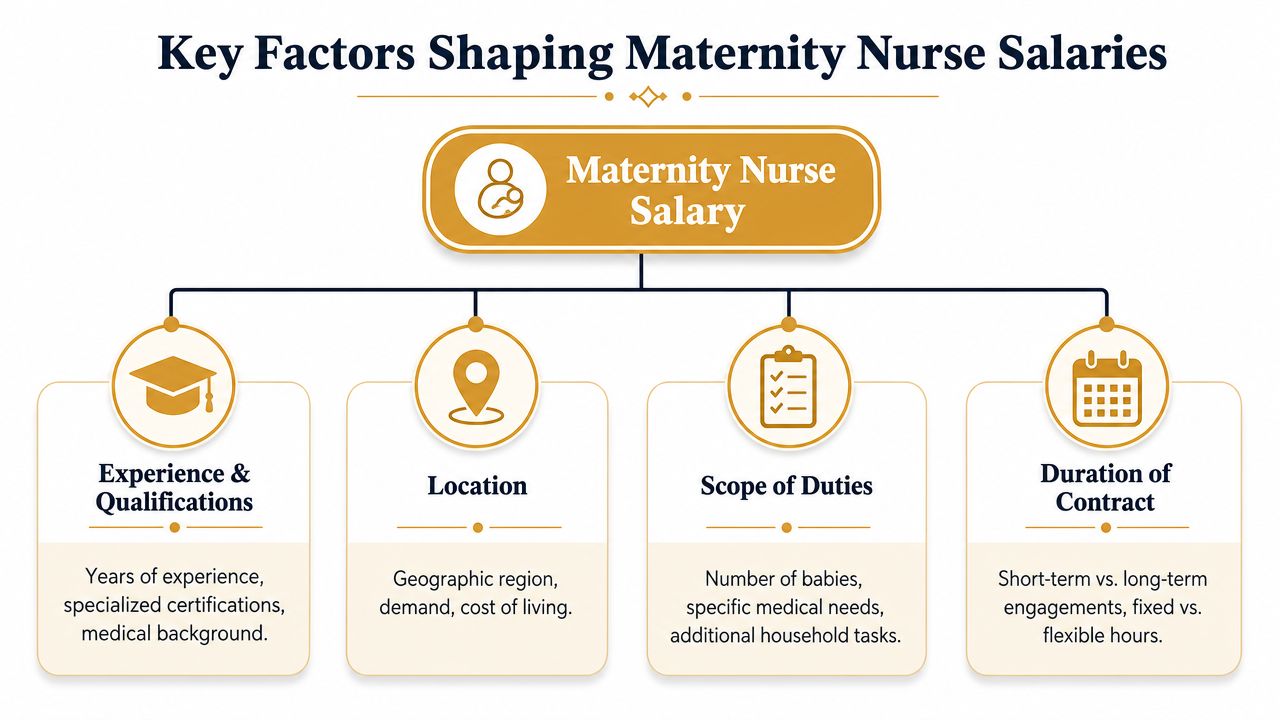
The premium drivers families feel first
Some factors affect price immediately because they change the stress level of the assignment.
- Multiples: Twins and triplets increase workload, fatigue risk, bottle management, logging, and night complexity.
- Prematurity or reflux: Families need someone calm, technically competent, and confident around more delicate routines.
- Night-heavy schedules: Unsociable hours narrow the candidate pool quickly.
- Rota continuity: The household isn't just buying labour. It's buying handover quality and consistency.
A family may think they need “help with the baby”, but the fee rises when it actually entails “continuous expert cover with no learning curve”.
The premium drivers families miss
In UHNW homes, the less obvious features often push the maternity nurse salary higher than expected.
Consider these examples:
- Travel expectations: The role may involve flights, packing protocols, time-zone changes, and work in unfamiliar residences.
- Operational polish: Some homes need a professional who can slot into a staffed environment without friction.
- Confidentiality standards: Public-facing families place a premium on discretion and low-drama professionalism.
- Specialist add-ons: Lactation knowledge, sleep shaping, reflux experience, or bottle refusal troubleshooting can all matter.
Practical rule: The rate should reflect what would be difficult to replace at short notice, not just what appears in the job title.
Families sometimes compare this role with mainstream nursing salary discussions, but that's a poor guide. A better contrast is to look at adjacent senior healthcare compensation, such as charge nurse pay trends, and then recognise that private newborn work adds domestic, emotional, and logistical demands that formal hospital pay structures don't capture.
Understanding the Full Financial Commitment
The quoted maternity nurse salary is only one line in the budget. The actual cost sits in the hiring route, compliance burden, and what happens if the placement fails.
Families who hire directly often focus on the headline rate and underestimate the administrative work that follows. Families who hire through an agency pay more overall, but they shift risk and due diligence away from the household.
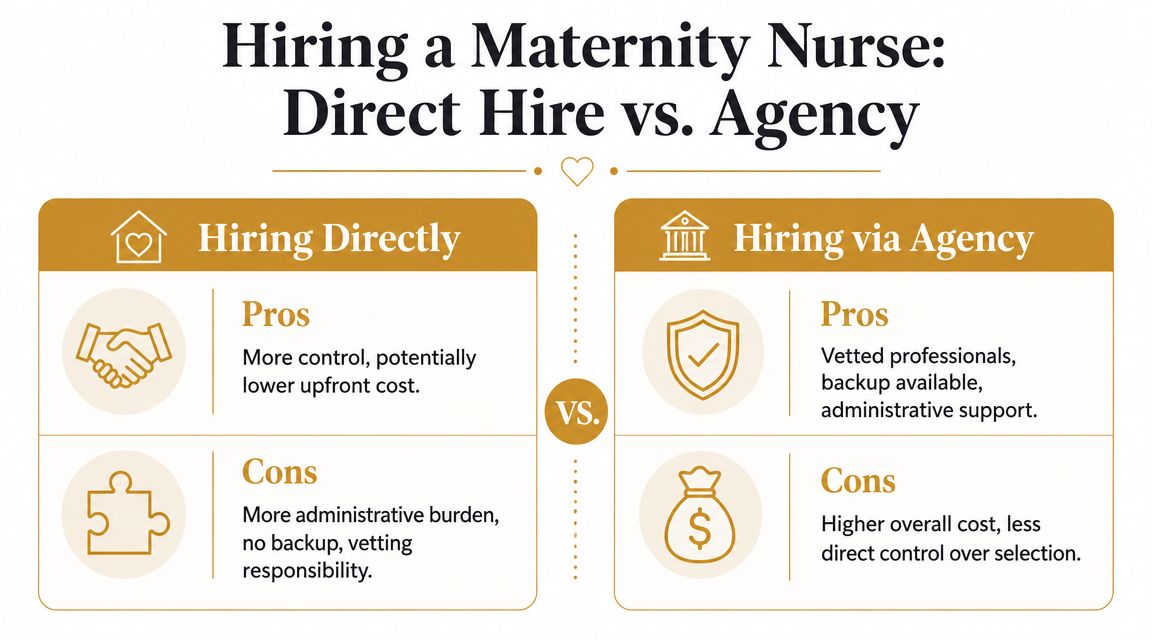
Direct hire versus agency placement
| Hiring route | What works well | What tends to go wrong |
|---|---|---|
| Direct hire | More control over sourcing and direct communication | Vetting burden, contract drafting, payroll questions, and no easy replacement if the fit is wrong |
| Agency placement | Structured screening, reference checking, faster shortlist quality, support if the booking changes | Higher total spend and less appetite for informal arrangements |
For some experienced employers, direct hire is entirely workable. For first-time parents or highly exposed households, it often becomes a false economy.
Costs families often overlook
The family's real outlay may include more than the agreed professional fee:
- Tax and employment status: Whether the arrangement is structured as employment or self-employment affects administration and comparisons.
- Pension and statutory obligations: These matter when the role falls within an employed model.
- Travel and accommodation: Particularly relevant for live-in, international, or moving households.
- On-duty practicalities: Meals, transport, and room setup are small individually but important in aggregate.
- Gap risk: If a direct hire pulls out close to the due date, urgency changes the market immediately.
One practical route is using an agency that handles specialist postnatal placements and clarifies fee structure early. For example, this guide to maternity nurse cost per week outlines the categories families should budget for beyond base pay.
The cheapest route on paper is often the most expensive route once urgency, replacement risk, and your own time are priced properly.
Structuring the Contract and Negotiating Rates
A polished contract makes the placement calmer from day one. It sets expectations before sleep deprivation and household emotion begin to blur what was verbally agreed.
Elite candidates also expect this. The stronger the professional, the less likely they are to accept vague terms.

Clauses that should be explicit
The contract should define the role in operational terms, not broad intentions.
Include:
Working pattern
State whether the booking is nights, live-in, or rota. Spell out start and end times, on-call expectations, and how breaks work in practice.Duties
Specify infant care tasks, nursery duties, feeding support, diary logging, bottle prep, laundry for the baby, and any boundaries around siblings or household errands.Accommodation and travel terms
If the role includes travel, detail cabin expectations, private room standards, time off while away, and who covers transport.Confidentiality
In VIP homes, this isn't boilerplate. It should be strong and clear.
How to negotiate without damaging the relationship
The best negotiations aren't aggressive. They're precise.
A useful structure is to agree:
- a base rate for the normal weekly pattern
- a separate rate for additional nights or extra rota cover
- a clear approach to public holidays
- a policy for overrun if the birth timing shifts
- any premium attached to travel, multiples, or medical complexity
Good negotiations reduce resentment later. Bad negotiations simply postpone it.
A practical template mindset
Think in layers rather than one number. Ask: what is the fee for the defined pattern, what triggers an uplift, and what expenses are reimbursable?
That's especially important in households where plans may change quickly. If the baby arrives earlier than expected, if grandparents visit, or if the family relocates between residences, the contract should already show how those changes are handled.
Investing in Your Family's Wellbeing
The question isn't whether a maternity nurse salary looks high in isolation. The question is whether the professional you appoint creates order, recovery, and confidence when your household needs it most.
A strong maternity nurse protects sleep, supports feeding decisions without drama, and reduces the friction that often appears in the first stretch after birth. In a well-run placement, the home feels calmer within days. Parents can recover, bond, and make decisions with a clearer head.
That value doesn't come from the title alone. It comes from fit. The right level of seniority, the right style of support, the right contract model, and the right briefing all matter more than chasing the lowest fee.
Families who approach this as a specialist appointment, rather than a generic childcare purchase, usually end up with a better experience and fewer expensive surprises.
Frequently Asked Questions About Maternity Nurse Pay
Is a maternity nurse salary usually quoted annually in the UK
In the UK private household market, maternity nurse pay is usually quoted as a daily or weekly rate, not an annual salary. That reflects how these appointments are booked. Most are fixed-term placements tied to the postnatal period, with hours, nights, and duration agreed in advance.
For a family comparing proposals, an annualised figure often obscures the actual cost. The meaningful question is how the booking is structured, how many nights or 24-hour periods are covered, and what is included in that rate.
Why can one maternity nurse cost far more than another
Fees rise with complexity. A maternity nurse who can step into a household with twins, feeding complications, prematurity, staff coordination, travel requirements, or strict confidentiality protocols is not priced the same way as someone taking on a more standard booking.
In high-net-worth homes, the premium usually reflects judgement as much as childcare. Families are paying for someone who settles quickly, reads the room, protects routine, and needs very little direction.
Is a rota maternity nurse always better than one live-in maternity nurse
A rota model suits households that want continuous cover over a longer stretch and are comfortable running a more formal staffing arrangement. A single live-in maternity nurse often suits families who value consistency with one professional and want a shorter, contained period of support.
Neither option is better. The right choice depends on recovery needs, overnight expectations, privacy, available space, and how the parents want the home to feel in those first weeks.
Should families negotiate hard on rate
Clear negotiation is sensible. Aggressive negotiation usually costs more in the end because it narrows the field, weakens goodwill, and can push stronger candidates toward households offering cleaner terms.
The best outcomes usually come from a well-defined brief. If the family wants flexibility around dates, travel, multiple residences, or frequent schedule changes, the rate needs to reflect that from the outset.
What's the biggest budgeting mistake families make
Focusing only on the headline pay figure.
The full commitment often includes agency fees, travel, accommodation, extra nights, payroll administration where relevant, and contingency planning if the baby arrives earlier or later than expected. In VIP and international households, those secondary costs can shape the budget just as much as the base rate.
If you're assessing postnatal support and want a discreet, structured shortlist for your household, Superstar Nannies can help you define the role properly, compare suitable contract models, and appoint a maternity nurse, NCS, or night professional with the right level of experience for your family.