


Sickness absence reached an average of 9.4 days per employee in 2025, compared with 7.8 days in 2023 and 5.8 days before the pandemic, according to the CIPD's UK sickness absence data. For a private household, one absent nanny can disrupt school runs, travel plans, newborn routines, and the family's basic privacy.
A clear set of sick leave policies protects both sides. It gives staff a fair route to report illness and receive the correct statutory payment, while giving parents and household managers a reliable process for cover, records, confidentiality, and return-to-work planning.
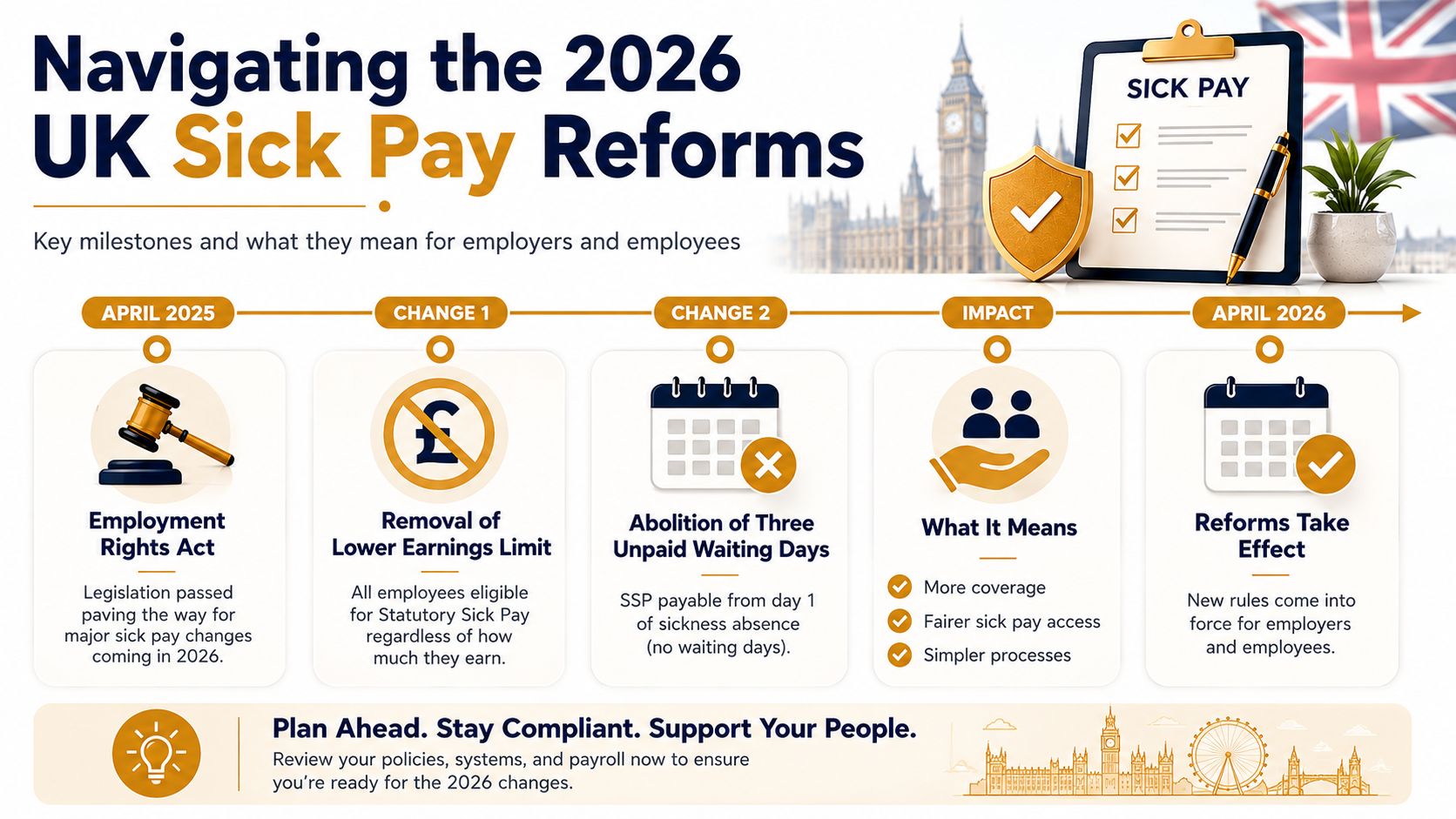
Navigating the 2026 UK Sick Pay Reforms
The UK's sick pay framework changed substantially on 6 April 2026. The reform removed the Lower Earnings Limit and the previous four-day qualifying rule, so eligible employees no longer need to earn at least £125 per week or be absent for four consecutive days before SSP can apply, as explained by ACAS guidance on Statutory Sick Pay.
SSP is now payable from the first full day of sickness absence for eligible employees. The three unpaid waiting days were removed, and the current rate is £123.25 per week or 80% of average weekly earnings, whichever is lower, for up to 28 weeks, according to GOV.UK employer rates and thresholds for 2026 to 2027.
What household employers must change
The reform matters most for part-time nannies, weekend staff, domestic couples, and workers with irregular schedules. A low-paid employee may now qualify where they previously fell outside SSP because of the earnings rule. A one-day absence also needs proper treatment, rather than being ignored because it ends before the former waiting period.
Update the payroll workflow before the next absence. Your records should identify:
- The first full day of sickness: Record the date reported and the working pattern that applies to that employee.
- Average weekly earnings: Ensure payroll can calculate 80% of normal earnings and compare it with the statutory cap.
- Eligibility: Remove outdated references to the Lower Earnings Limit and waiting days from contracts, handbooks, and payroll notes.
- Payment duration: Track the absence against the maximum SSP period rather than relying on memory or informal household records.
A household employer who continues applying the old rules risks an underpayment dispute. The risk is higher where a nanny works variable hours, because managers may assume that a short shift or low weekly wage automatically excludes the employee. It doesn't under the 2026 framework if the employee meets the remaining eligibility requirements.
Payroll rule: Treat day-one sickness reporting as a payroll event, not as a courtesy message that can wait until the employee returns.
Your sick leave policies should also sit alongside accurate tax and payroll administration. Keep the sick pay clause consistent with the wider obligations described in this UK nanny tax obligations guide, then ask your payroll adviser to test the calculation against both a regular salaried nanny and an irregular-hours employee.
Drafting a Robust Household Sick Leave Policy
A household policy shouldn't be copied from a corporate handbook. It needs to reflect private service, close contact with children, changing schedules, family travel, and the fact that the employer and employee may share the same home.
Start with a plain definition of sickness. State that sickness absence means the employee is unable to perform agreed duties because of illness or injury. Separate that from a family emergency, a childcare disruption affecting the employee's own family, medical appointments, and planned leave. Each category may need a different approval and payment process.

Build the policy around practical decisions
Use this drafting sequence:
Set the reporting route. Name the person to contact, the accepted method, and the point in the shift by which notice should normally be given. Permit a phone call where the employee is too unwell to write a detailed message.
Explain self-certification. Employees absent for 7 days or less don't need a fit note or other healthcare proof. They can self-certify when they return, with the employer and employee agreeing how that record is provided, as set out in GOV.UK guidance on taking sick leave.
Set the documentation trigger. The policy should explain that a fit note is required after more than 7 consecutive days of illness. Don't demand medical details that the household doesn't need.
State the payment terms. Your contract should confirm the statutory minimum and clearly identify any Occupational Sick Pay offered above it. GOV.UK's SSP payment guidance confirms the current payment is £123.25 per week or 80% of normal weekly earnings, whichever is lower, for up to 28 weeks.
Cover enhanced benefits. If the family offers additional paid sick days, state whether they sit separately from SSP, how they interact with a probationary period, and whether unused days expire. Don't promise a benefit verbally and leave the contract silent.
Add household-specific terms. Travel nannies need clauses covering illness overseas, notification while travelling, medical assistance, insurance, and safe arrangements for returning home. Staff working across jurisdictions need advice on which country's employment rules apply.
The nanny contract templates from Superstar Nannies can help a family organise the relevant employment terms, but a solicitor or qualified payroll adviser should review the final wording where the arrangement is complex.
A strong policy doesn't treat staff as a risk to control. It sets boundaries while acknowledging that illness is part of working life. Explain the policy during onboarding, give the employee a copy, and ask them to confirm they understand the reporting process.
Managing Live-In Versus Live-Out Staff Requirements
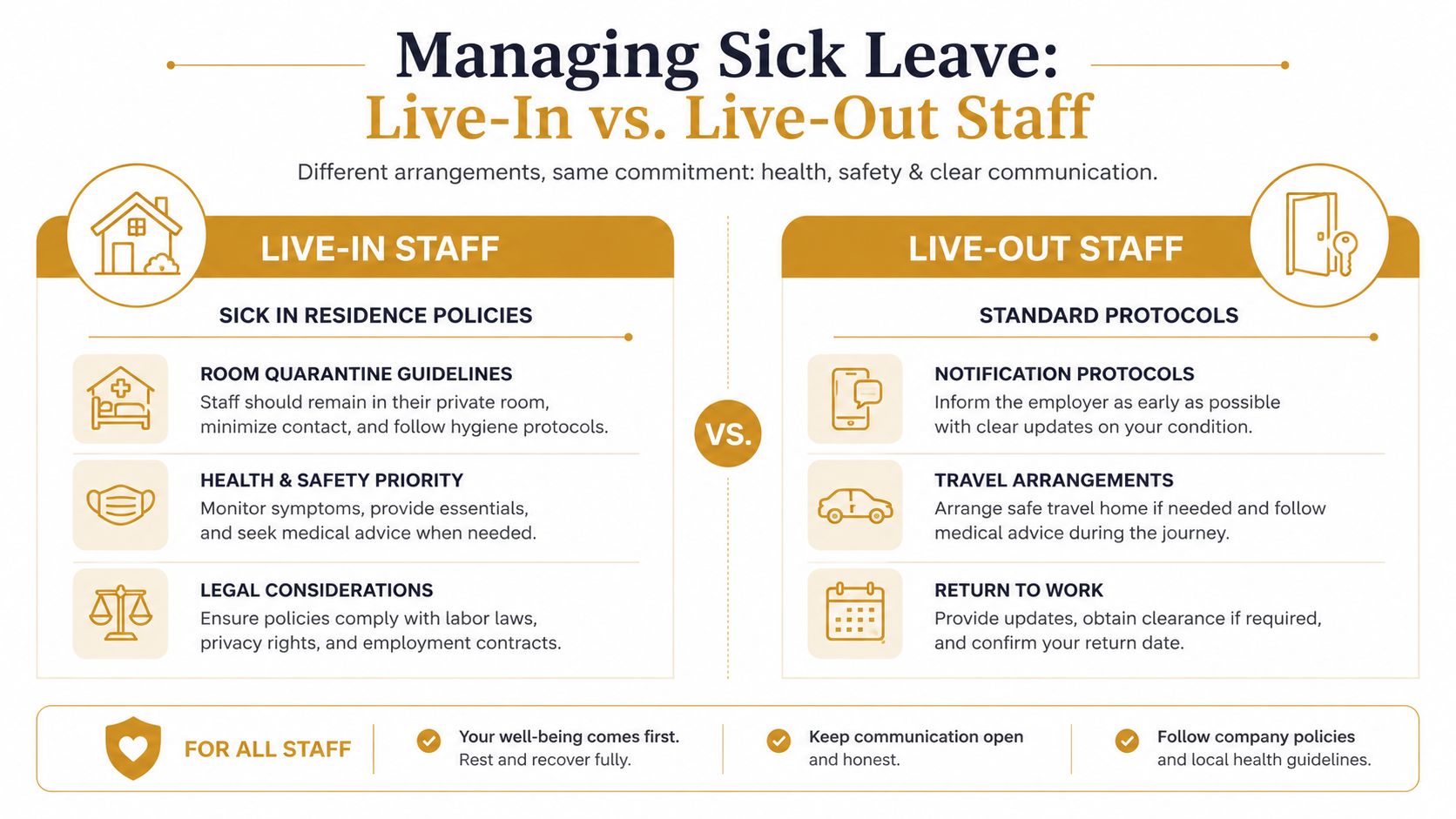
Living arrangements change the practical response to illness, but they don't remove the need for a fair employment process. A live-in nanny who stays in their room is still absent if they aren't available to perform childcare duties. A live-out nanny may leave the home immediately, but the family must still protect children, parents, and replacement staff from infection.
| Issue | Live-in staff | Live-out staff |
|---|---|---|
| Immediate safety | Agree whether the employee can remain safely in their room and which facilities they may use. | Confirm whether the employee should travel home and whether transport creates an infection risk. |
| Household access | Define which areas are private and whether meals, medication, or supplies can be delivered. | Keep communication remote where possible and avoid unnecessary visits. |
| Cover | Arrange replacement care without treating the employee as available because they are physically present. | Activate agency or relief cover according to the agreed rota. |
| Travel | Establish who coordinates medical care and accommodation if illness occurs abroad. | Confirm whether the employee can safely return home or needs support at the destination. |
The live-in question is about duties, not proximity
A nanny isn't “at work” because they remain under the family's roof. The policy should state whether the employee is fully relieved from duties, how rest periods are protected, and who handles children, meals, and household communication while they recover. Don't ask a sick employee to supervise from bed, monitor a baby, or remain on standby.
For contagious illness, agree a room-quarantine protocol in advance. It should cover bathroom access, food delivery, laundry, ventilation, and the point at which the employee may re-enter shared areas. The family should also check its insurance arrangements before international travel, particularly where a staff member needs medical attention or repatriation.
Live-out staff create a different operational challenge. The family needs a dependable notification protocol, an emergency cover list, and a clear rule that the nanny shouldn't attend merely because no replacement has been found. A payroll provider can also help coordinate absence records and payments. This HR and payroll guide from HireAccountants is a useful reference when household administration has outgrown informal spreadsheets.
For a fuller employment comparison, review live-in versus live-out nanny arrangements. The right structure depends on the duties, accommodation, schedule, and travel expectations, not on convenience alone.
Record-Keeping and Compliance Workflows
A reliable absence record protects the household from two costly errors: incorrect SSP payments and inconsistent treatment of staff whose hours vary. Use one shared record for payroll and household management. It can be a secure spreadsheet or simple HR system, provided it is accurate, current, and access-controlled.
GOV.UK's Statutory Sick Pay guidance states that SSP can be paid for up to 28 weeks, at £123.25 per week or 80% of average weekly earnings, whichever is lower, once the employee has been sick for at least one full working day.
Create one absence record per employee
Record these details whenever sickness is reported:
- Date and time reported: Note when the employee contacted the designated person.
- Absence dates: Record the first full sick day, expected duration, and actual return date.
- Working pattern: List affected shifts or working days, including irregular rota hours.
- Evidence received: Note whether the employee self-certified or supplied a fit note after more than 7 consecutive days.
- Payment decision: Record the SSP calculation, any Occupational Sick Pay, and the payroll period in which payment was made.
- Review dates: Set reminders for ongoing absence and agreed medical or return-to-work reviews.
Retain SSP records for at least 3 years after the end of the tax year they relate to, as specified in the employer guidance linked above. Store medical documents separately from payroll notes, limit access to authorised people, and record only information needed for the employment decision. “Unfit for work” is usually sufficient; a diagnosis is not.
Use a measured return-to-work conversation
Keep the return-to-work form practical:
- What date did you return?
- Are you fit to resume your normal duties?
- Do you need any temporary adjustment?
- Is there a workplace issue the family should address?
- Should the household schedule a further review?
Use the meeting to confirm safe working arrangements, not to demand private medical details or accuse the employee of misuse. Review absence patterns by dates, duties, and rota type, then apply the same process consistently to live-in and live-out staff.
Keep right-to-work checks separate from sickness administration. If employment documents require review, use a structured right-to-work verification process and record that check in its own file.
Set the payroll calendar to flag every absence before wages are finalised. Irregular shifts make this particularly important. A Monday-to-Friday assumption can produce the wrong payment, misstate the first sick day, and leave the household without a clear audit trail. Review the record before payroll closes and correct discrepancies promptly.
Handling Long-Term Illness and Contagious Conditions
Long-term illness and contagious conditions require separate decisions. A nanny who cannot safely manage the nursery run needs a work-capacity assessment. A nanny who reports vomiting before arriving at a home with a newborn needs an immediate infection-control response.
For long-term illness, keep contact respectful, purposeful, and documented. Confirm the next review point, request a fit note when the relevant absence threshold is reached, and consider occupational health advice if the condition affects duties or the likely return date. Ask functional questions rather than seeking unnecessary medical detail: can the nanny lift a child, drive, work nights, or manage stairs? Those answers determine safe duties, cover, and any temporary adjustment.
A supported return is safer than a rushed return
A phased return may involve limited childcare, shorter shifts, or no driving until the employee can safely resume those tasks. Put the arrangement in writing, set a review date, and account for the child's routine. Live-in staff may need a temporary change to sleeping arrangements or shared-space access, while live-out staff may need revised start times or a different rota. If an employee cannot perform a required duty, arrange alternative cover instead of transferring the risk to another member of staff.
Long-term conditions require a consistent process. Rigid attendance rules do not resolve reduced capacity or uncertain recovery. Set a clear referral route, consider reasonable adjustments, and review the arrangement at agreed intervals. Apply the same standard to irregular hours and overnight work, while assessing the actual duties performed.
Contagious illness requires an immediate safety decision
A nanny with symptoms that could spread should not begin the shift or enter the household until the manager has assessed the risk and followed current medical advice. In a home with an infant, pregnant family member, or immunocompromised person, arrange cover promptly and use a conservative threshold for attendance.
Use this response:
- Stop exposure: Tell the employee not to enter shared areas or start work.
- Protect privacy: Share only the information needed to organise safety and cover.
- Arrange continuity: Contact a relief nanny, agency, or approved household staff member.
- Review travel: If illness occurs overseas, consult the travel insurer and establish a safe medical or repatriation plan.
- Document the decision: Record the notification, action taken, and return conditions, without unnecessary diagnosis details.
Household welfare principle: A supportive policy can still prohibit attendance when a child or vulnerable family member may be exposed.
Final Policy Checklist and Implementation
A sick leave policy becomes useful only when the contract, payroll file, rota, and household team follow the same rules. Audit the documents together rather than updating one clause and leaving the old process in place.
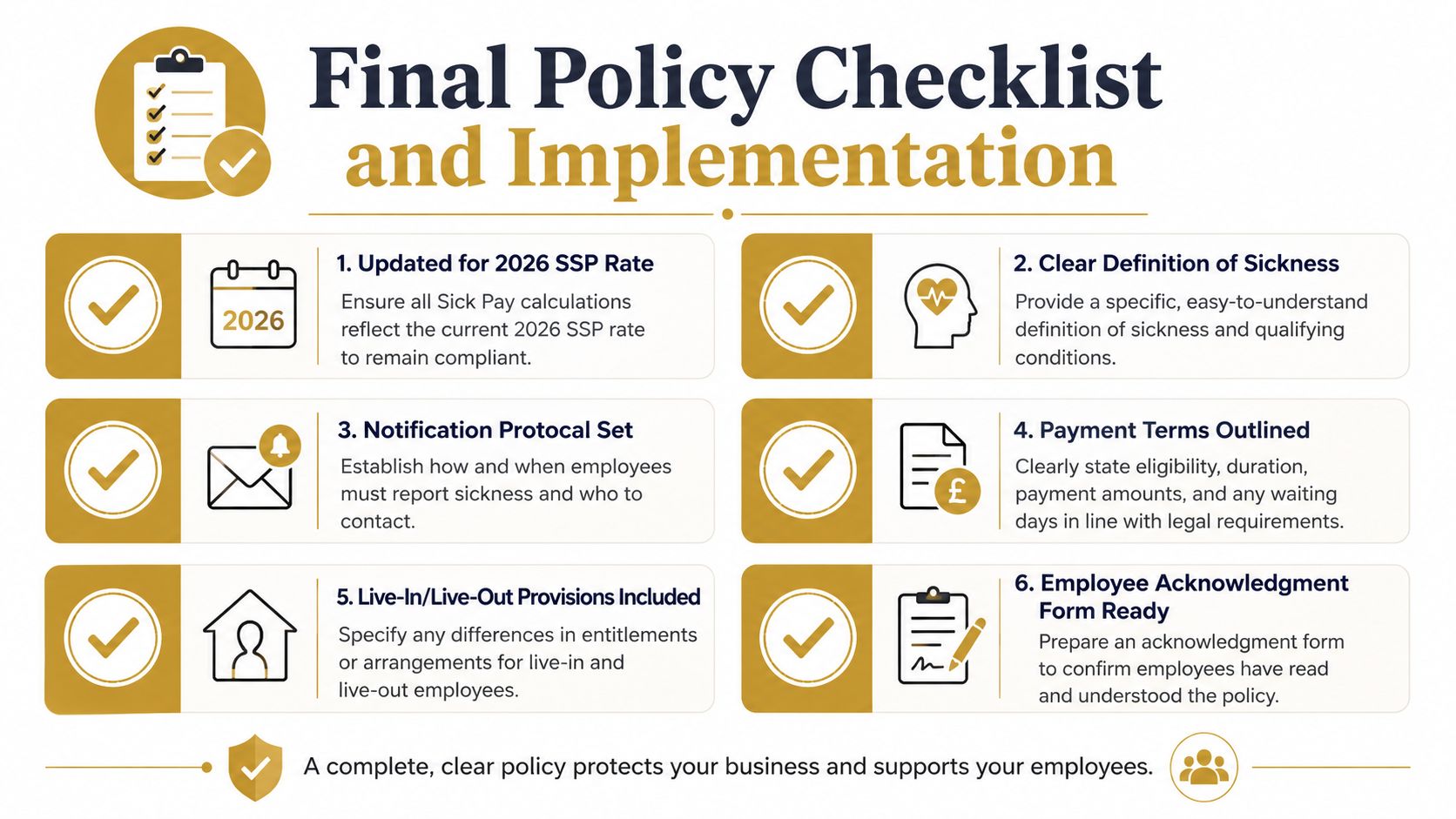
Use this final checklist:
- 2026 SSP rate: Confirm the payroll calculation reflects the current statutory rate and earnings formula.
- Definition of sickness: Separate sickness absence from family emergencies, appointments, and planned leave.
- Notification protocol: Name the contact, communication method, and expected timing.
- Payment terms: State SSP, any enhanced sick pay, and the process for irregular hours.
- Living and travel arrangements: Include separate provisions for live-in, live-out, overseas, and contagious-illness situations.
- Employee acknowledgement: Give every employee the updated policy and retain confirmation that they received it.
Tell existing staff what has changed before the revised policy is applied. Explain the day-one SSP rule, show how absence reporting works, and invite practical questions about cover and privacy. Clear communication protects morale because employees understand that the family is enforcing a consistent process rather than reacting personally to illness.
Keep the policy with the employment contract, payroll records, emergency contacts, and rota instructions. Review it whenever statutory guidance, household staffing arrangements, or international travel expectations change.
Superstar Nannies can help families recruit and organise bespoke live-in, live-out, rota, travel, and newborn childcare arrangements with clear employment expectations. Visit Superstar Nannies to discuss staffing support that reflects your household's sick leave procedures, privacy requirements, and continuity-of-care needs.