


You're coordinating three school runs across different time zones, preparing for a new baby, and moving one household to another country. The problem isn't a lack of childcare options. It's that every option solves only one part of a much larger family operation.
Custom family support treats the household as a connected system. The right nanny, maternity nurse, governess, tutor, house manager, and wider domestic team should fit the family's rhythms, culture, travel schedule, privacy expectations, and highest-stakes needs. That approach also reflects a wider UK movement towards coordinated support. England's Supporting Families programme recorded 858,179 successful family outcomes from April 2012 to March 2025, including 104,761 in 2024–25, measured against an annual target of 130,054 outcomes. The public-policy model and private household model serve different markets, but they share an important principle: support works best when it responds to the whole family rather than one isolated problem. England's National Supporting Families Outcome Framework sets out that multi-domain approach clearly.
What Tailored Family Support Means in a Private Household
A principal may leave for an early flight while one child needs a school transfer meeting, another has a language lesson, and a newborn has unsettled nights. The family may also be managing a relocation, a second residence, visiting relatives, and staff handovers between properties. A generic placement can fill a vacancy. It won't necessarily make the household function.
In a private setting, personalized family support means designing the staffing structure around the way the family lives. That can mean a rota built around travel dates, a bilingual nanny who supports heritage language goals, or a house manager who absorbs operational noise before it reaches the principal. It can also mean a specialist nanny for a child with additional requirements, a governess who coordinates education across countries, or a maternity nurse whose experience matches the family's preferred approach to newborn care.

Bespoke means designed, not merely selected
An agency promise that someone is “suitable” usually describes a candidate's experience. A bespoke process goes further and asks whether that person can operate within your family's unspoken rules.
The brief should identify:
- Daily rhythm: School times, meals, sleep routines, activities, and preferred communication.
- Geography: Primary residence, additional properties, travel expectations, and relocation plans.
- Family identity: Languages, faith, cultural customs, dietary preferences, and family traditions.
- Risk profile: Privacy, security, health requirements, safeguarding, and media exposure.
- Authority lines: Who makes decisions, who manages staff, and when the principal expects updates.
This is why personalized family support matters more in private staffing than in standardised childcare. A regulated setting can provide a defined service within fixed hours, but it can't promise that one trusted adult will understand your family's travel patterns, household etiquette, and developmental priorities.
Working definition: Tailored family support matches people, duties, schedules, and safeguards to the way a specific household lives.
That definition also leaves room for emotional and developmental needs. If a child is experiencing anxiety during a move, separation, or school transition, the family may need specialist clinical guidance alongside a carefully chosen caregiver. Uptown Psychology's child anxiety care resource can help parents understand when a child may need support beyond ordinary nanny care. For the wider staffing architecture, this guide to structuring an elite household offers a useful framework for separating childcare, household management, and family-office responsibilities.
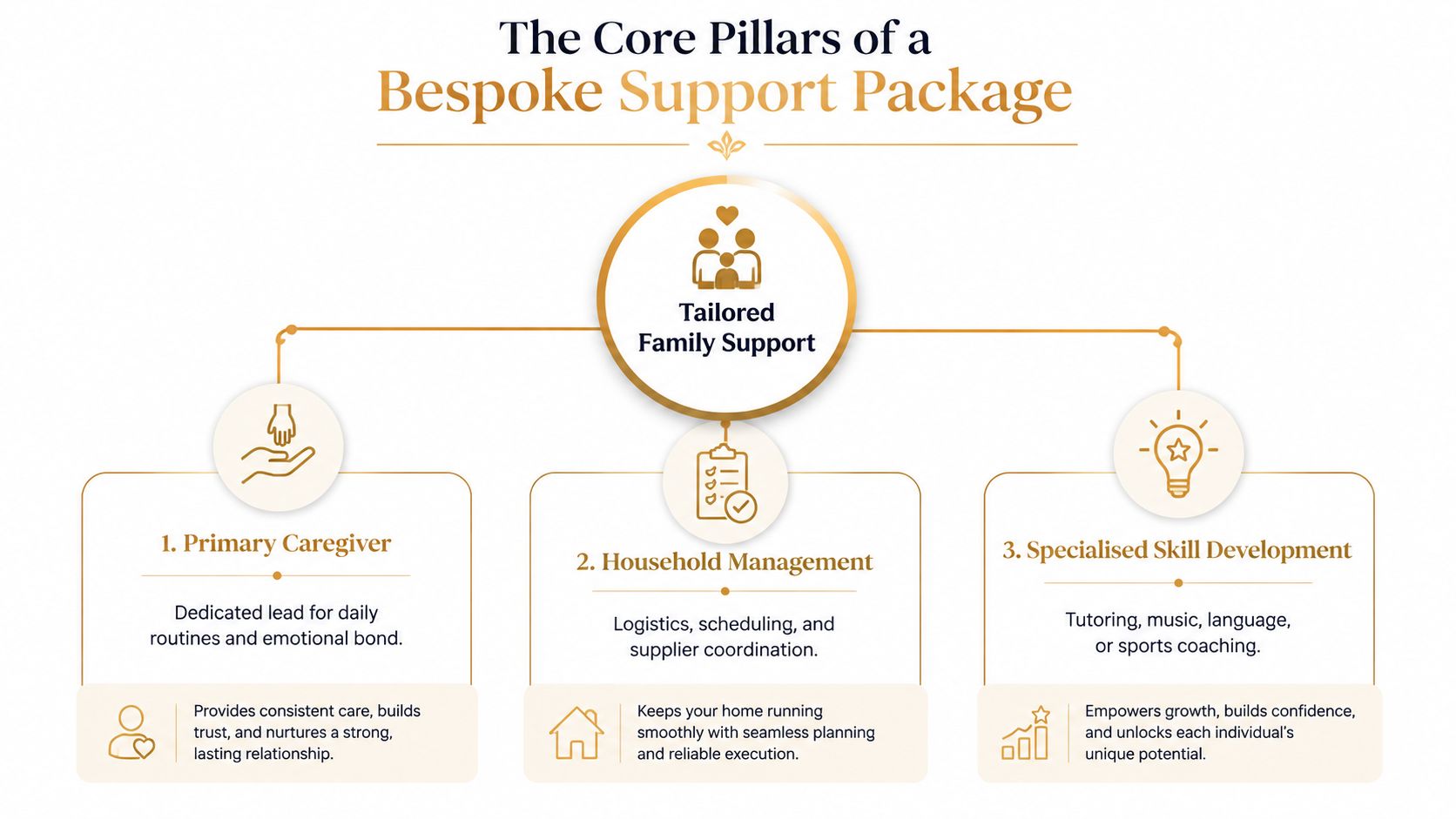
The Core Pillars of a Bespoke Support Package
A fully staffed residence isn't defined by the number of employees on a payroll. It's defined by whether each person owns a clear function and whether the functions work together without creating duplication or confusion.
Childcare and attachment
The primary caregiver protects the children's routines and emotional continuity. Depending on the household, that could be a Norland-trained nanny, a bilingual nanny, a live-in nanny, a live-out nanny, or a rota team.
A returning expatriate family may want a Mandarin-speaking nanny who can use the language naturally during play, meals, and daily conversation. Another family may need a travel nanny who can maintain sleep, nutrition, and school routines while moving between residences. The important point is that language and travel experience must appear in the job design, not as an afterthought added to a standard nanny search.
Newborn and maternal care
Newborn support has a different intensity and skill requirement from ordinary childcare. A maternity nurse, newborn care specialist, or night nanny may be appropriate when parents need experienced guidance through feeding, sleep, settling, nursery organisation, and the transition into a new routine.
A household welcoming a baby may bring in a maternity nurse during the early postnatal period, then adjust the structure as the parents gain confidence and the baby's needs change. The right plan respects the mother's recovery, the baby's care, and the existing children's need for attention.
Education and development
A governess or private tutor can provide educational continuity when school arrangements are international, changing, or unusually demanding. The role may include homework supervision, homeschooling support, language development, music, sport, travel learning, or coordination with schools and external teachers.
Household infrastructure
The wider team keeps the family's environment usable. House managers coordinate people, suppliers, maintenance, calendars, and handovers. Housekeepers, butlers, chefs, chauffeurs, gardeners, estate managers, and domestic couples each contribute to the operation, but accountability must remain clear.
A multi-property family often benefits from one house manager who can brief the principal, coordinate local teams, and prepare each residence before arrival. For a detailed division of responsibilities, see the household manager responsibilities checklist. Families also need to consider the relationship between household access and wider protection. Guidance on how concierge security elevates your brand is relevant when reception, access control, guest handling, and service standards overlap.
Matching the Rota to the Way Your Family Actually Lives
The rota decision affects attachment, privacy, cost, resilience, and the amount of management the family must provide. Don't choose a model because it worked for a friend. Choose it because it fits your residence, travel load, children's ages, and tolerance for handovers.
Live-in nanny
A live-in nanny suits a family that values proximity and continuity in one main residence. The arrangement can work well where children benefit from a stable caregiver who understands the home's routines and can respond to early starts, late finishes, or occasional changes.
The trade-off is privacy. A live-in arrangement requires excellent accommodation, clear boundaries, and a disciplined understanding of when the nanny is working and when they're off duty. Without that structure, the family may feel watched and the nanny may feel permanently available.
Live-out nanny
A live-out nanny gives the household a stronger physical boundary between work and home. This can suit families with predictable local routines, strong backup arrangements, or a preference for keeping staff quarters separate from family space.
The risk is fragility around traffic, travel delays, early flights, and unexpected schedule changes. A live-out plan needs contingency cover. It shouldn't depend on one person arriving perfectly every morning.
Rota nannies
A rota team usually suits principals who travel heavily, operate multiple residences, host frequent events, or need sustained coverage without asking one individual to remain permanently on call. A common structure is two weeks on and two weeks off, but the precise pattern must reflect the family calendar.
The main advantage is resilience. The main trade-off is handover quality. Children need to know who is arriving, what will remain consistent, and how information moves between outgoing and incoming staff.
| Criterion | Live-In Nanny | Live-Out Nanny | Rota Nannies |
|---|---|---|---|
| Best fit | One principal residence and strong need for proximity | Local, predictable routines and firm privacy boundaries | Frequent travel, multiple homes, or extended coverage |
| Continuity | One familiar caregiver can anchor daily life | Strong during contracted hours, with more dependence on backup | Consistent team approach, but handovers must be precise |
| Privacy | Requires explicit living and working boundaries | Clearer separation between employment and home life | Depends on accommodation and team structure |
| Resilience | Vulnerable if the nanny is unavailable | Needs reliable contingency cover | Built around planned coverage and succession |
| Management demand | Moderate, provided expectations are written | Higher when schedules change suddenly | High at the start, then reduced by strong systems |
| Typical concern | Staff availability can blur boundaries | Commuting can disrupt early or late coverage | Poor handovers can unsettle children and parents |
Hybrids often produce the strongest result. A live-in nanny may handle daily care, a part-time tutor may manage academic work, and a night nanny may support a newborn after the early weeks. The staffing plan should be reviewed whenever the family moves, travels, adds a property, or changes school arrangements.
Why Cultural Fit and Language Matter More Than a CV
A technically impressive CV can still conceal a poor placement. Private staffing happens inside the family's most intimate spaces, so a candidate must understand not only what to do, but how the household expects it to be done.
Consider a French family in London. The nanny may have excellent childcare references and strong early-years knowledge, yet struggle with long Sunday lunches, multi-generational meals, and the family's expectation that children remain part of adult social life. The issue isn't competence. It's cultural fluency.
A Gulf-based family may need someone who speaks Arabic and English, understands female-only spaces, respects fasting periods, and knows how to welcome visiting elders. Those details shape daily trust. They also affect whether a child sees the caregiver as a natural part of family life or as an efficient outsider.
Build the family charter before the search
Write a one-page family charter before interviewing. Keep it practical, not aspirational.
Include:
- Languages in use: Which language belongs to play, education, discipline, meals, and formal occasions?
- Religious and cultural practice: Which periods, gatherings, foods, and household areas require particular respect?
- Family hierarchy: Who gives instructions, and how should staff handle conflicting requests?
- Social expectations: How should the caregiver behave around guests, relatives, principals, and security staff?
- Child-development priorities: Is the focus independence, academic performance, emotional regulation, language, sport, or a combination?
Language should also be treated as a developmental tool. A bilingual nanny may support identity, family connection, and confidence, not merely translate instructions.
WorkSignal's hiring insight on cultural fit assessment is useful for sharpening interview questions beyond qualifications. In practice, ask candidates to describe how they handled unfamiliar customs, disagreement with a principal, and a child who behaved differently at home from school. For deeper preparation, cultural sensitivity training for household staff can help an established team work respectfully across backgrounds.
Practical rule: If a candidate understands your family's values but lacks one teachable technical skill, that may be fixable. The reverse is rarely true.
Vetting, Trials, and the First Ninety Days
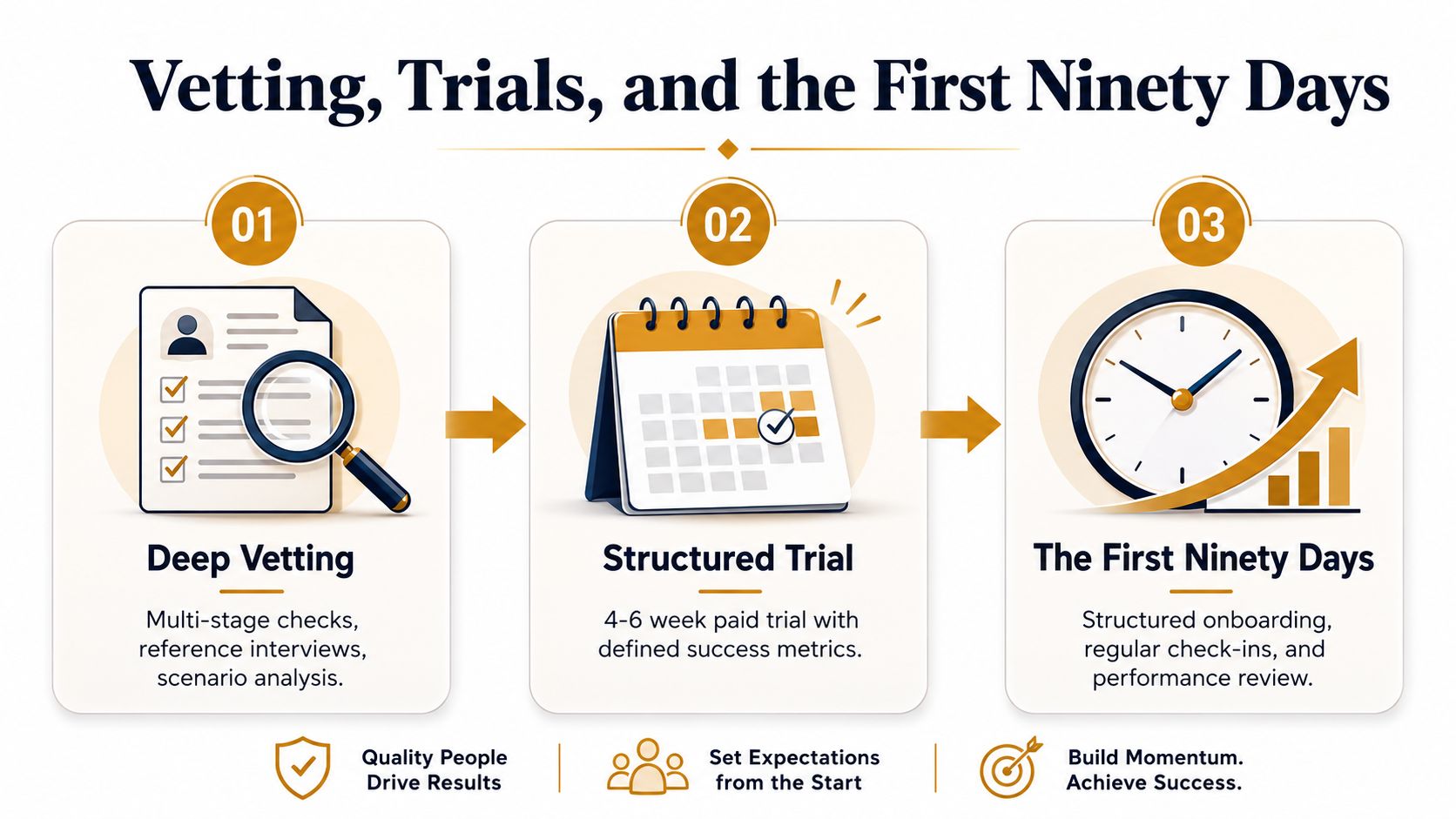
The most expensive staffing mistake is retaining someone who was never right for the household. A thorough process reduces that risk by testing judgement, discretion, communication, and cultural fit before the placement becomes emotionally or operationally difficult to unwind.
Begin with a brief that describes the job. “Nanny for two children” is inadequate if the role includes international travel, school liaison, staff coordination, language development, formal entertaining, or care across multiple homes.
Deep vetting
Enhanced background checks are only the starting point. References should be triangulated through detailed conversations, not limited to confirming dates and job titles. Ask former employers how the candidate behaved under pressure, handled confidentiality, received correction, and managed transitions.
Use scenario questions during interviews:
- Travel disruption: A flight changes and a child's medication is in another residence. What does the candidate do first?
- Privacy concern: A guest asks for family information. How does the candidate respond?
- Staff disagreement: Two employees give conflicting instructions. How does the candidate establish authority?
- Child distress: A child refuses school after a move. How does the candidate support the child while keeping the day on track?
Structured trial
An all-day interview can make a candidate appear polished without showing how they work over time. A paid trial inside the home gives the family a better view of punctuality, initiative, warmth, boundaries, and practical judgement.
The trial should have written objectives. Observe how the candidate enters the household, speaks to children, handles a change in plan, records information, and hands over at the end of the day.
The first ninety days
Probation should be written into the employment contract, with review points and a clear route for either party to exit cleanly. The family should assess the placement against agreed outcomes, not vague impressions.
Senior roles often require four to ten weeks for a focused search, while multi-staff builds can take longer. That timeframe allows the brief to be tested, candidates to be interviewed properly, references to be explored, and travel or notice arrangements to be managed. Superstar Nannies' nanny vetting process guide provides a useful reference for families formalising this stage.
Continuity, Confidentiality, and What Actually Changes in the Home
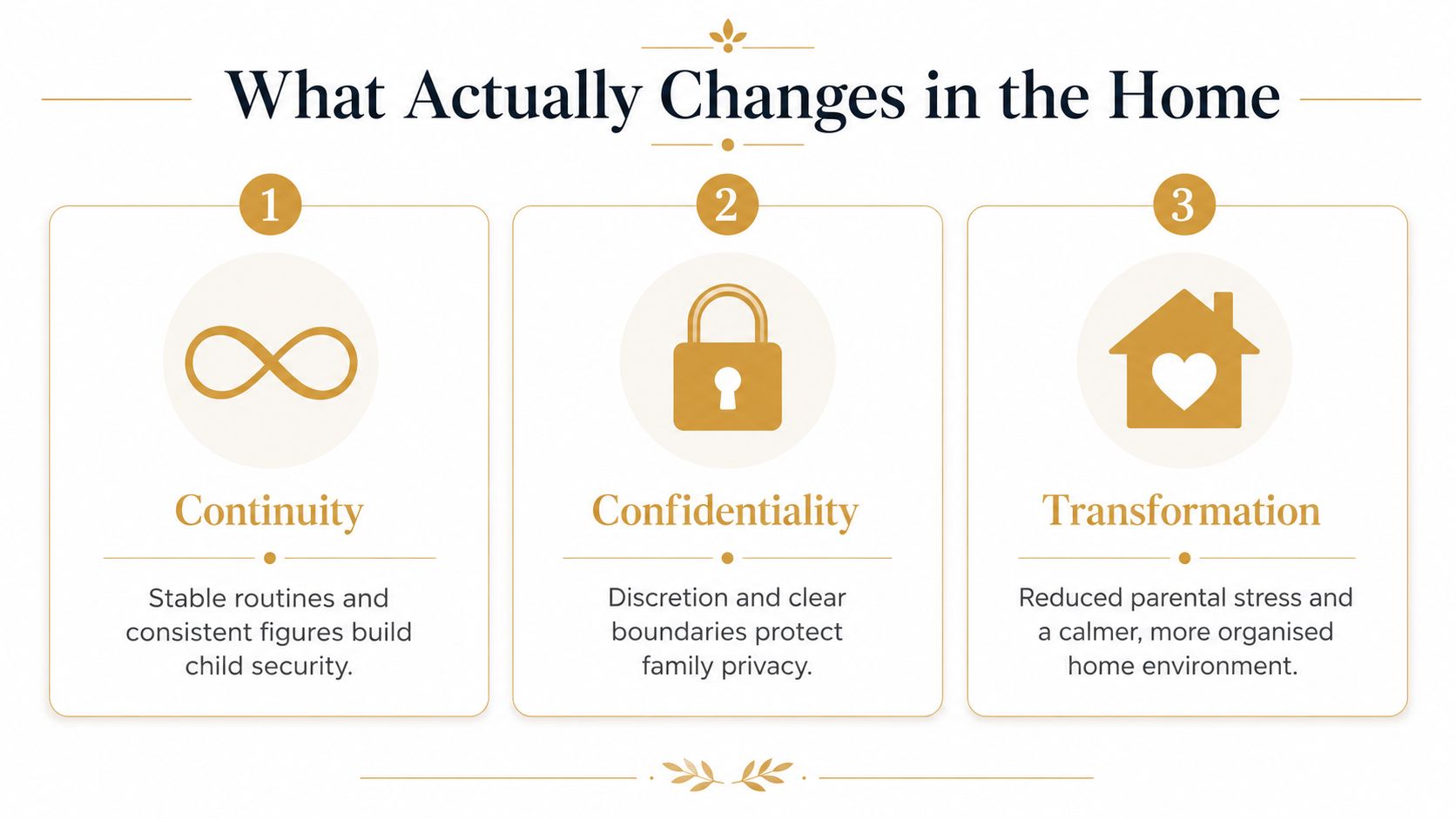
A placement succeeds when the household feels different months after the start date. The children know what to expect, the principal receives fewer avoidable interruptions, and staff understand who owns each decision.
Start with a controlled handover
A practical workflow begins with a confidential family briefing, followed by a written role profile and a map of household responsibilities. Candidates are then assessed against the family charter, interviewed around real scenarios, checked through references, and introduced through a paid trial.
Once appointed, the family should provide a structured handover. That may cover school contacts, medical information, travel documents, preferred suppliers, emergency procedures, children's routines, and communication protocols. Each employee needs access only to the information required for their role.
Continuity creates operational calm
Continuity means the same trusted caregiver understands the child's cues, the same house manager knows the principal's preferences, and the same team can prepare a residence before arrival. It reduces the need for parents to repeat instructions and gives children a more stable experience during travel, relocation, or family change.
Confidentiality needs more than good intentions. Use written confidentiality obligations, clear device and photography rules, controlled access to family information, and a defined escalation route for concerns. A single accountable manager can prevent sensitive details from circulating across an unnecessarily large staff network.
Private staffing fills gaps public provision can't
England's funded early-years baseline is defined as 570 hours over at least 38 weeks for each eligible child, equivalent to 15 hours per week when spread across the year, according to official early education and childcare guidance. Eligible working families may also receive 30 hours for 38 weeks a year, beginning from the term after a child turns 9 months and continuing until school age, with official guidance stating an average saving of £8,000 a year per child through that offer. Working Families childcare guidance explains the mechanics.
Those entitlements can reduce cost, but they don't provide a bilingual travel nanny, overnight continuity, multi-property coverage, or one trusted adult at every school run. Tax-Free Childcare can complement a private plan, adding £2 for every £8 paid into the account, up to £2,000 per child each year or £4,000 per disabled child, as explained in the government's childcare guidance. Personalised family support costs more because it delivers coordination, discretion, flexibility, and accountability that fixed-hour provision isn't designed to provide.
Superstar Nannies matches UHNW and VIP families with discreet nannies, maternity nurses, newborn specialists, governesses, tutors, and wider household professionals. Visit Superstar Nannies to discuss a staffing structure built around your family's routines, culture, travel schedule, and standards.