

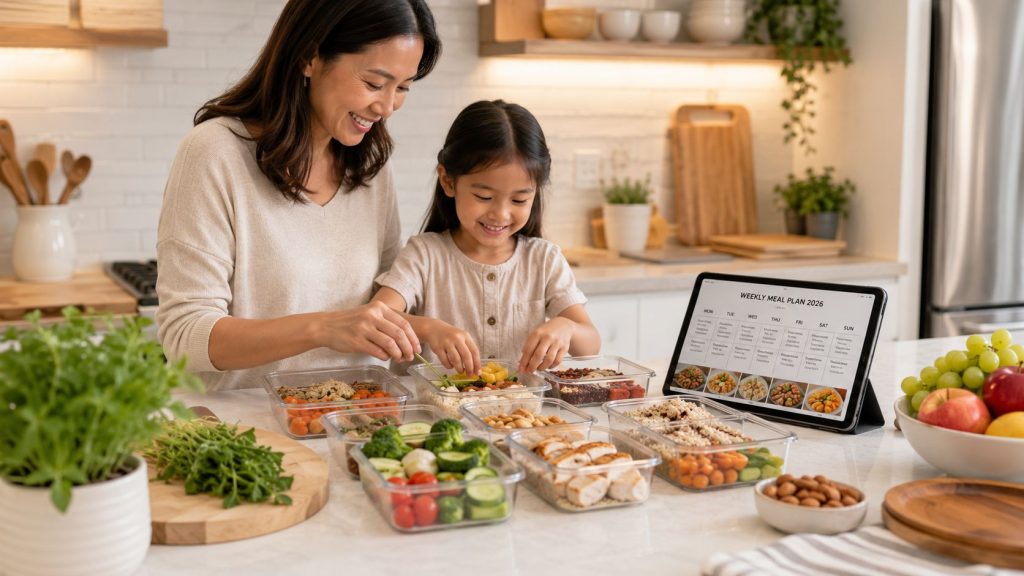
Most family meal-planning advice starts with the same instruction: choose seven dinners, shop for all of them, and follow the menu exactly. That sounds organised, but it breaks down quickly when a child refuses dinner, a meeting runs late, or the fresh ingredients you carefully bought sit untouched in the fridge. Meal planning for families works better as a flexible household system than as a rigid weekly timetable.
A practical UK approach is to plan three to five days ahead, begin with the food you already have, and leave room for changed appetites and disrupted schedules. That method protects the food budget, reduces decision fatigue, and gives parents, nannies, housekeepers, and private chefs a shared routine that can survive real life.
Why Rigid Weekly Menus Fail Families
The popular seven-day menu assumes that every evening has the same shape. Families know that isn't true. School events, commuting, travel, childcare changes, unexpected guests, and children's unpredictable appetites can turn a carefully planned Thursday dinner into a takeaway, leaving the ingredients for Thursday to wait another day.
That rigidity creates a second problem. A plan can look efficient on paper while being wasteful in practice. The Richmond food-waste guide recommends checking cupboards and fridges first, planning four to five meals, making a list, and cooking extra portions to freeze rather than committing every meal in advance. Richmond's household food-waste guidance also reflects an important operational truth: the plan has to respond to what needs eating soon.
Decision fatigue is a planning problem
The pressure to create a perfect menu can make dinner harder before cooking even begins. In the 2026 Good Food Nation survey, 76% of people reported experiencing decision fatigue when planning meals, while 80% said speed matters when choosing recipes. The Good Food Nation survey also found that 42% plan meals in advance to save money, showing that families are using planning as a financial tool, not merely an organisational hobby.
A full week of choices asks parents to make too many decisions at once. It also encourages overbuying because each recipe requires its own ingredients. The result can be a fridge full of disconnected items rather than a small set of foods that work across several meals.
Practical rule: Plan enough to remove tonight's uncertainty, but not so much that next week's schedule has to behave perfectly.
Why flexibility beats menu perfection
A flexible plan uses anchor meals, reusable ingredients, and one open slot for leftovers or change. For example, a family might prepare a vegetable-rich pasta sauce, roast chicken, and cooked grains, then use them in different combinations. If Wednesday disappears into a late workday, the planned meal moves forward rather than becoming waste.
This approach also answers the concern reported by 17% of respondents, who feared that meal planning might create more waste. Planning itself doesn't guarantee savings. The household must check dates, use vulnerable ingredients early, store food correctly, and accept that the menu may change.
Building a Flexible 3 to 5 Day Meal Plan
The most reliable meal planning for families starts with an inventory, not a recipe search. Before anyone writes a shopping list, check the fridge, freezer, fruit bowl, bread bin, and cupboards. Look for foods that are close to their use-by dates, opened packets, cooked leftovers, and ingredients that can anchor more than one meal.
The aim isn't to use every item immediately. It's to identify what needs priority and then buy only the missing pieces.
Use an inventory-first sequence
-
Start with perishables. Note vegetables, dairy, meat, fish, cooked food, and opened products that need attention first.
-
Choose a use-first meal. Build the earliest dinner around the most time-sensitive ingredients. Wilted greens might go into a frittata, while ripe tomatoes can become a sauce or salad.
-
Select four or five meals. Use the existing ingredients as the base, then choose meals that share components. A roast chicken can become dinner one night and a filling for wraps or soup later.
-
Leave one flexible space. That space can become a leftovers night, a freezer meal, or an easy option when the family schedule changes.
-
Write the gap-only shopping list. Buy what the plan needs, not what each recipe would traditionally require in isolation.
-
Freeze deliberately. Freeze bread before it goes stale and label surplus portions with the dish and date. Freezing should protect food you're likely to eat, not hide food you've already lost interest in.
The method aligns with UK local authority advice to plan several days ahead, check existing supplies, and cook extra portions for later use. Families can also browse menu planning tips for further ideas, but the core discipline remains the same: inventory first, shopping second.
Build around change
Suppose a four-day plan includes fish with vegetables, lentil pasta, chicken wraps, and a freezer portion. If a child's activity runs late, the fish can move to the next evening and the freezer portion can fill the gap. If the family eats fewer wraps than expected, their fillings can become a lunch or fridge-clear meal.
For households using a private chef or nanny, the same approach can be recorded in a shared kitchen note. A useful template includes the planned meal, ingredients to use first, prepared components, freezer items, allergy notes, and the person responsible for each task. Families interested in a more formal culinary setup can explore private chef services as part of their wider household routine.
Meeting Nutritional Needs Across Different Ages
A child-friendly meal isn't automatically a nutritionally adequate meal. Many families understandably repeat foods that young children accept, but a menu built almost entirely around refined carbohydrates, processed snacks, or narrow “safe foods” can miss important nutrients.
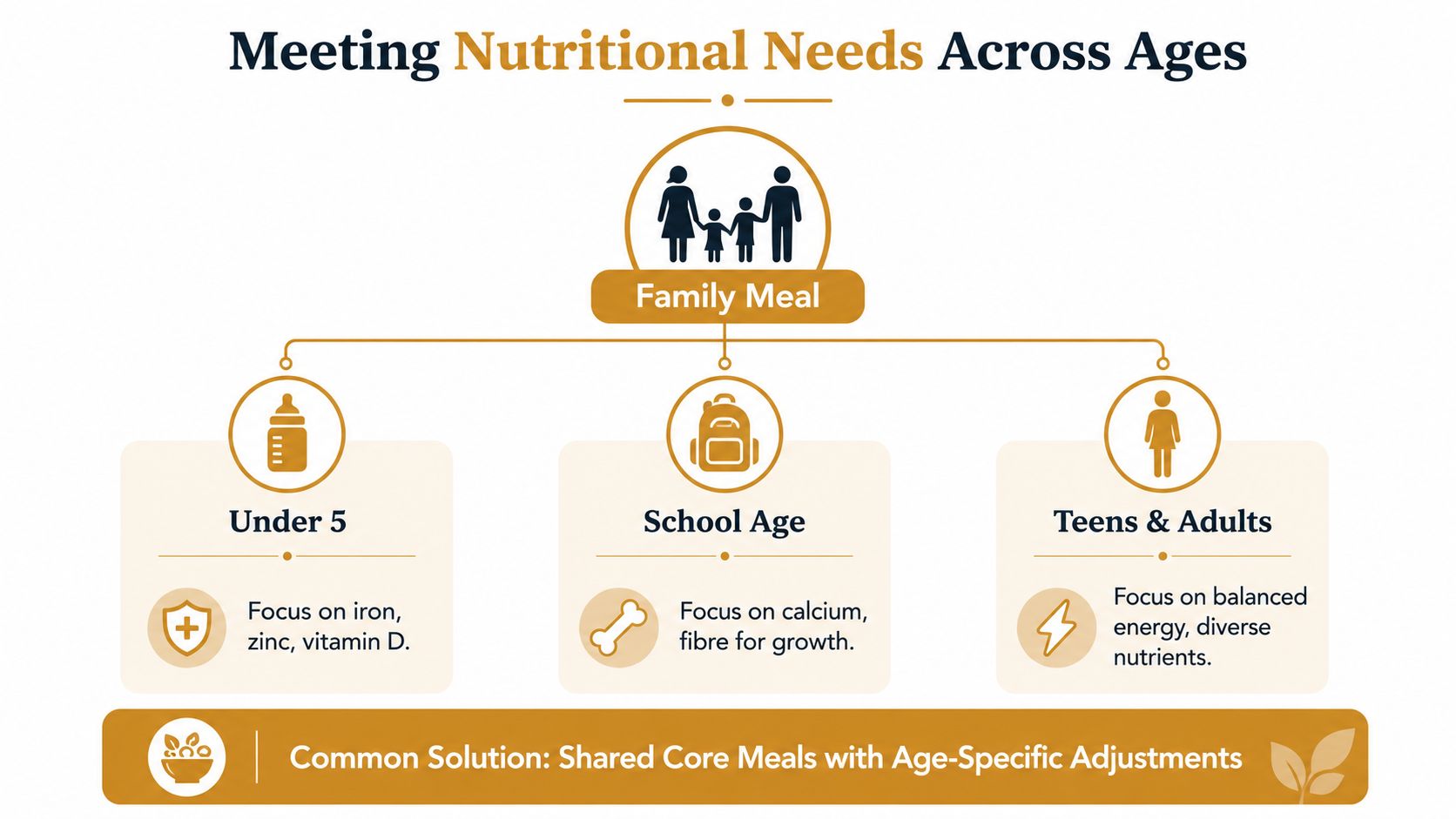
The Scientific Advisory Committee on Nutrition report on feeding young children aged 1 to 5 states that diets for UK children in this age range aren't aligned with government recommendations. The report identifies excessive intakes of energy, protein, saturated fat, and free sugars, alongside fibre intake that's too low. It also notes that more than 5% to 10% of under-fives in some age groups may have inadequate intakes of iron, zinc, vitamin A, and vitamin D.
Recent UK food-intake data gives the issue practical context. Among children aged 18 months to 3 years, free sugars were around 9.7% of energy, while fibre intake was 12.5g per day against a 15g per day target. Only 27% met free-sugar guidance and 22% met fibre guidance. Those figures are reported in the same government evidence base and show why “the children ate something” isn't a sufficient measure of a successful plan.
Use one shared meal with sensible adjustments
The answer doesn't have to be separate cooking for every person. Start with a shared core meal, then adjust texture, portion, seasoning, and presentation.
-
For toddlers and preschoolers, offer soft, manageable textures and smaller portions, while building in iron- and zinc-containing foods such as meat, fish, eggs, beans, or lentils where suitable.
-
For older children, keep the meal recognisable but add variety through vegetables, fruit, wholegrain options, and calcium-containing foods.
-
For adults and teenagers, serve the same components with portions and additions that match appetite and activity.
The NHS Eatwell Guide and food-label guidance provides the official UK framework for balanced meals. Use it as the reference point rather than relying on internet food rules or assuming that a child's favourite meal covers every nutritional need.
A successful family meal can look different on each plate while still coming from the same kitchen preparation.
Rotate nutrients without creating extra work
Across a three-to-five-day cycle, rotate the main protein sources, vegetables, fruit, and carbohydrate bases. Add lentils to a familiar tomato sauce, blend vegetables into soup, serve yoghurt or another suitable calcium-containing food alongside breakfast, and keep iron-rich options visible rather than treating them as occasional extras.
Texture matters as much as flavour for younger children. Keep some ingredients separate when mixed dishes cause resistance, and offer a familiar component beside a less familiar one. You're widening the meal gradually, not demanding that a child accept an entirely new plate.
Families who employ culinary staff can also clarify food preferences, allergies, textures, and age-specific needs in writing. Guidance on qualifications for private chefs can help families assess the skills needed when cooking forms part of a broader childcare or household role.
Batch Cooking and Prep Schedules That Work
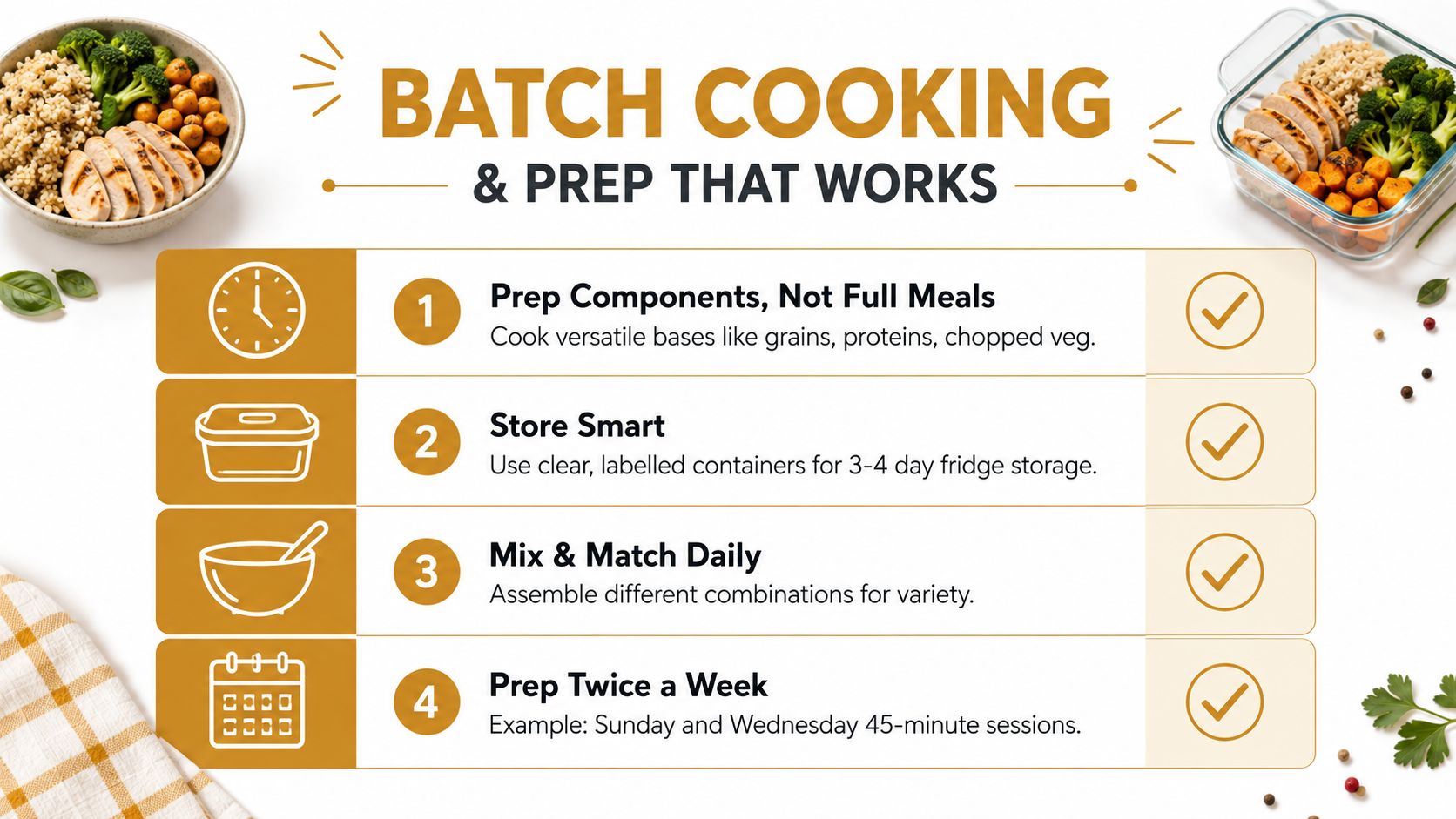
Batch cooking fails when it becomes a weekend marathon producing identical meals that nobody wants by the end of the week. A better system prepares components, not a row of matching containers. Components preserve variety and allow the cook to adjust meals for children, adults, appetites, and changing plans.
A useful prep session might include a cooked grain, roasted vegetables, a protein, a sauce, washed fruit, and chopped ingredients. Those items can become bowls, wraps, pasta, soup, omelettes, or side dishes without forcing the family to eat the same dinner repeatedly.
A practical prep rhythm
Use the planning horizon to decide what deserves preparation.
At the first session, prepare the ingredients needed for the earliest meals and one flexible component. Store food in clear, labelled containers so everyone can see what's available. Keep the fridge organised by priority, with “use first” items at the front.
At the second session, reassess what remains. Refresh vegetables, cook another component if necessary, and move suitable portions to the freezer. The aim is to support the next few meals, not to predict the entire week.
A focused 90-minute preparation session can cover several meals when tasks overlap, but the exact duration will depend on the household, equipment, recipe choices, and number of people. Don't measure success by how much food was cooked. Measure it by whether the next dinner requires fewer decisions.
Make the freezer part of the plan
Freezing works best when it's specific. Label portions with the food name and date, freeze bread in usable amounts, and avoid filling the freezer with unidentified containers. A portion that can't be found or recognised won't protect the budget.
Household staff can maintain this system with a short handover note:
- Prepared components: Record what was cooked and how it can be used.
- Priority foods: List items that need eating soon.
- Freezer stock: Note portions available for quick dinners.
- Child adjustments: Include texture, serving, and allergy instructions.
- Next decision: State which meal should be chosen first if plans change.
This turns batch cooking into a shared process rather than a task that depends on one parent remembering everything.
Coordinating Household Staff and Managing Disruptions
A meal plan becomes much more reliable when the family treats it as a communication tool. Parents, nannies, housekeepers, and private chefs need access to the same information, especially when one person shops, another prepares food, and someone else serves the children.
A shared digital note can work, but only if it's kept current. Some households prefer a printed kitchen sheet because staff can update it during food preparation. The format matters less than the handover: everyone should know what needs using, what has been prepared, what can be frozen, and what changes require approval.
Give each person a defined responsibility
The parent might approve the four or five meals and identify schedule constraints. A nanny or household assistant might check supplies and report children's preferences. A housekeeper might monitor storage and labels, while a private chef prepares the core meal and records leftovers.
For families refining their staffing structure, this guide to managing household staff offers useful context for defining responsibilities and communication. Meal planning should sit within that wider household protocol, not operate as an informal favour that disappears when someone is away.
Prepare for the usual disruptions
When a child refuses the meal, keep one familiar component available without creating an entirely separate dinner. The child can eat the plain grain, vegetable, bread, or other suitable element while the rest of the family eats the shared meal.
When an allergy concern appears, stop improvising and follow the family's documented allergy protocol. Staff should know approved substitutions before they begin cooking, and they shouldn't rely on memory when labels or ingredients are unclear.
When guests arrive, add a flexible meal that can stretch, such as a soup, pasta sauce, grain bowl, or tray of suitable components. Avoid consuming the ingredients reserved for the use-first meal unless the plan is updated immediately.
When travel changes the week, freeze what won't be eaten and move the menu forward. Don't leave fresh food in the fridge because it was assigned to a particular day.
A weekly fridge-clear night provides a controlled place for leftovers, opened ingredients, and small portions. It can be a build-your-own plate, soup, omelette, pasta, or shared platter, with adults and children choosing from the same prepared components.
Reducing Waste and Protecting Your Food Budget
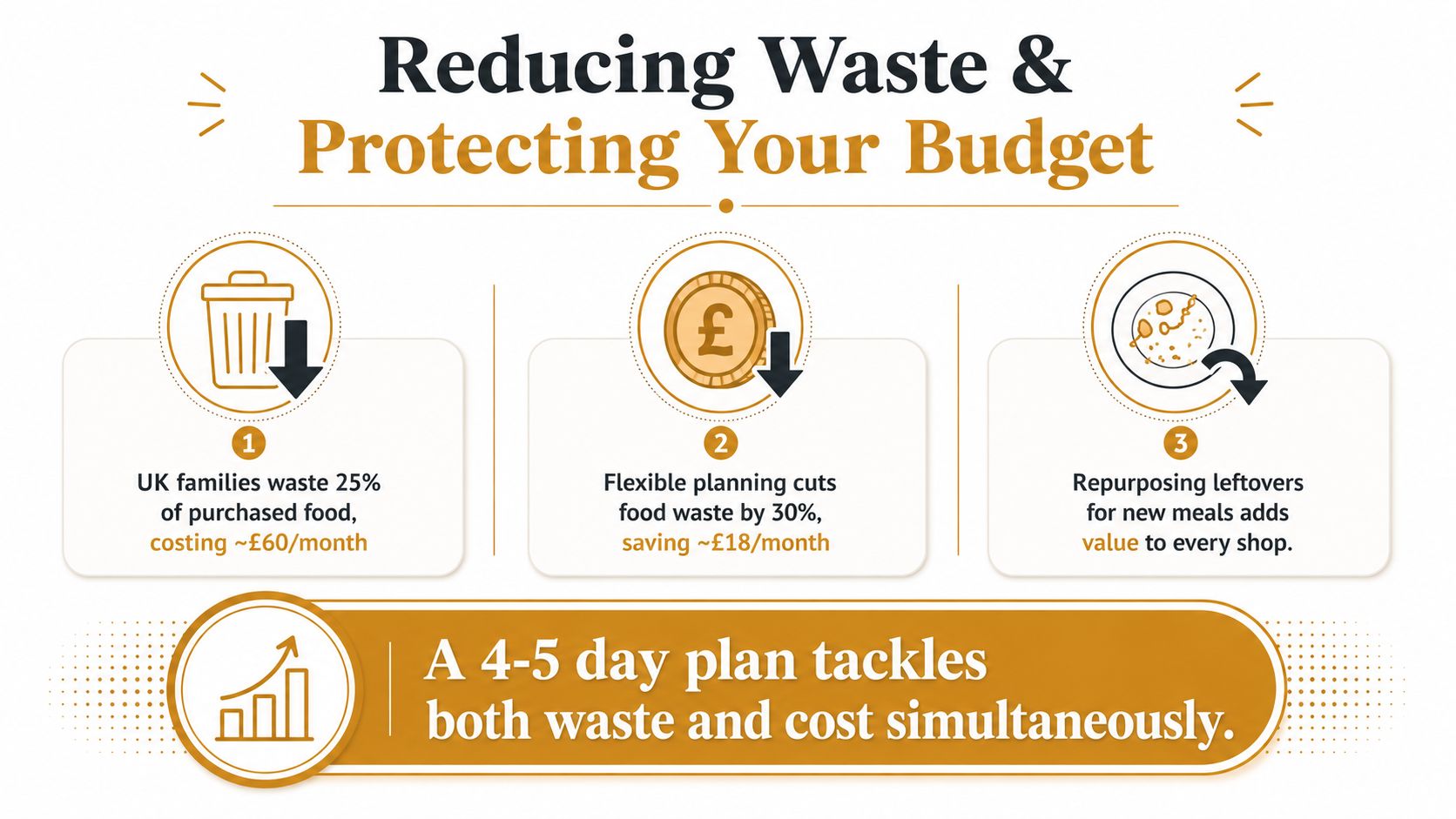
The financial case for meal planning for families is strongest when it focuses on food that would otherwise be bought and never eaten. WRAP states that the average UK family of four wastes around £1,000 a year on food, while its UK household food-waste report records 6.0 million tonnes wasted in 2022, including 4.4 million tonnes of edible food. WRAP's household food-waste report identifies the scale of the problem without suggesting that a perfect menu is the only answer.
The practical solution is smaller and more repeatable:
- Check the kitchen before shopping.
- Use vulnerable ingredients in an early anchor meal.
- Plan four or five meals rather than forcing seven.
- Cook useful extra portions and freeze them.
- Schedule a fridge-clear night.
- Keep one flexible slot for disruption.
This protects the budget more effectively than buying ingredients for ambitious recipes that depend on every evening going to plan. The DBakerAid™ cost-cutting tool may also be useful for households reviewing kitchen routines and trying to reduce unnecessary spending.
The same principle applies when comparing household support options. Families considering culinary assistance can review private chef costs alongside the value of shopping, preparation, allergy management, and reduced evening pressure.
Start with your next four-day cycle, not an idealised month. Inventory the food you already have, choose one use-first dinner, add three flexible anchor meals, and write the shopping list only after those decisions are made.
Superstar Nannies can help families coordinate nannies, household staff, and private chefs around dependable routines such as grocery shopping, meal preparation, allergy-aware cooking, and flexible family schedules. Visit Superstar Nannies to discuss staffing support shaped to the way your household lives.