


The chef stands in the kitchen before breakfast is finished, the housekeeper has already set out the children's plates, one child won't touch dairy, another wants plain food only, and the principal is expecting a tasting menu that evening. In a private household, what qualifications do chefs need isn't a neat academic question, it's a hiring test. Families want proof that the person can cook, stay discreet, work safely, and fit the rhythm of the house without creating friction.
That is why the answer has two parts. There's the formal layer, meaning culinary courses, apprenticeships, and recognised certificates, and there's the practical layer, meaning verifiable kitchen competence, food-safety literacy, and references that hold up under scrutiny. If you want a useful outside comparison, the guide to hiring chefs in independent pubs shows how employers often weigh training against service history in a high-pressure kitchen.
For a private home, that split matters even more than it does in restaurants. A polished diploma can open the door, but it won't save a chef who can't handle school-night dinners, allergy protocols, or a principal's changing schedule. If you're hiring, or trying to move into elite household work, the key question is simple: which qualification proves you can do the job in that exact kitchen, with those exact people, under those exact conditions? For a closer look at the role itself, see what a private chef does.
The Real Answer Behind Chef Qualifications
A private household never hires a certificate. It hires a person who can cook calmly, think ahead, and protect the family's trust. That's why the strongest answer to what qualifications do chefs need is not “one diploma” or “one course”, it's a combination of route, competence, and proof.
What families actually buy
In a restaurant, a chef can sometimes hide behind brigade structure, service pace, and a large team. In a home, there's no place to disappear. The chef is exposed to the family's routines, the children's preferences, the housekeeper's standards, and the principal's expectation that dinner, lunch, and breakfast all feel effortless. A qualification matters only if it supports that reality.
Practical rule: if a candidate cannot explain how their training shows up in a real private kitchen, the paper isn't enough.
That's why I'd treat qualifications as evidence, not as the hire itself. A culinary diploma can show structured training. An apprenticeship can show repetition under supervision. Food hygiene paperwork can show baseline safety. But none of those replace discretion, menu judgement, or the ability to adapt when a household changes plans at short notice.
The private-household filter
UHNW families should judge chef qualifications through four filters. First, can the chef cook at the level the household expects. Second, can they work cleanly and safely. Third, can they handle special diets without drama. Fourth, can they be trusted around a home that runs on privacy.
A career-changer should read that the other way round. Your training matters, but only as proof that you can operate in someone else's house without learning on the job in front of the principal. That is why a short, relevant reference trail often carries more weight than a long, unrelated qualification list.
The Four Main Routes Into a Chef Career
The UK doesn't force chefs down one path. The National Careers Service says you can enter chef roles through university, college, apprenticeship, or working toward the role through kitchen jobs, and it also notes that apprenticeship routes usually take 1 to 2 years while food safety certificate training typically lasts 1 to 2 days. The BBC adds a fifth route that many overviews miss, chef training through the armed forces. The National Careers Service chef profile is useful because it shows how open the profession is.
Chef Qualification Routes at a Glance
| Route | Entry Requirements | Typical Duration | Best Fit For |
|---|---|---|---|
| University | Varies by course | Longer-form study | Candidates who want broader academic training and time to build technique |
| College course | Varies by course | Course-based | School leavers and career-changers who want structured practical learning |
| Apprenticeship | Foundation routes need no specific qualifications, intermediate usually asks for some GCSEs including English and maths, advanced typically needs 5 GCSEs at grades 9 to 4, higher or degree routes usually need 4 or 5 GCSEs plus A levels or equivalent | 1 to 2 years for apprenticeship routes | Hands-on learners who want paid, supervised progression |
| Working toward the role | No formal single route | Ongoing | Kitchen assistants and trainee commis chefs building experience first |
A lot of people get trapped arguing about which route is “proper”. That's the wrong debate. The key question is whether the route fits the target kitchen. A fine-dining hotel may reward formal culinary schooling more than a domestic setting does. A private home may care more about evidence of service discipline and special-diet handling than about the name of the course.
The smartest route is usually the shortest one that still gives you credible technique, safety training, and real service exposure.
For someone moving into private work, the working-up route can be perfectly respectable if the references are strong and the candidate has been exposed to service pressure. For a new entrant, an apprenticeship or college route can be the fastest way to turn enthusiasm into usable kitchen habits. If you're mapping this to a household hire, the relevant companion piece is private chef jobs in the UK.
Decoding the Qualifications That Appear on a CV
CVs in this field can look more impressive than they are. The letters matter, but only if you know what they signal. The plain-English version is this: some qualifications show structured learning, others show progression, and the best CVs show both. The CPD Online UK chef guide puts the ladder in concrete terms, with Level 2/3 courses usually expecting four or five GCSEs at grades 9 to 4, and Level 4/5 courses usually needing one or two A levels, a Level 3 diploma, or relevant experience.
What the common labels mean
BTEC Hospitality and Catering tells you the candidate has studied practical hospitality basics in a structured setting. NVQ or Diploma in Cookery signals vocational training, from Level 1 food preparation and cookery through to Level 2 professional cookery. A foundation degree or HND suggests more advanced training and a stronger academic layer, often better suited to candidates moving toward more complex roles or broader food-service environments.
That said, employers do not buy the title alone. Indeed's UK guidance is blunt on the point, qualifications are useful, but up-to-date food hygiene training is still a critical requirement for all kitchen staff. In private households, that means a CV should be read as a map of capability, not a guarantee of taste, judgement, or calm under pressure.
What I'd look for on paper
- Basic vocational training: enough to show kitchen literacy, not just enthusiasm.
- Progression evidence: a clear step-up from entry-level work to more demanding service.
- Recent relevance: qualifications that connect to the work the household needs.
- Service exposure: signs the chef has worked in real kitchens, not just classrooms.

A private household should read those acronyms like a recruiter, not like a student. If the candidate has a respectable qualification but no evidence of service discipline, the paper is only half the story. If they have strong experience and modest formal training, that can still be enough, especially when the household values discretion and consistency over culinary branding.
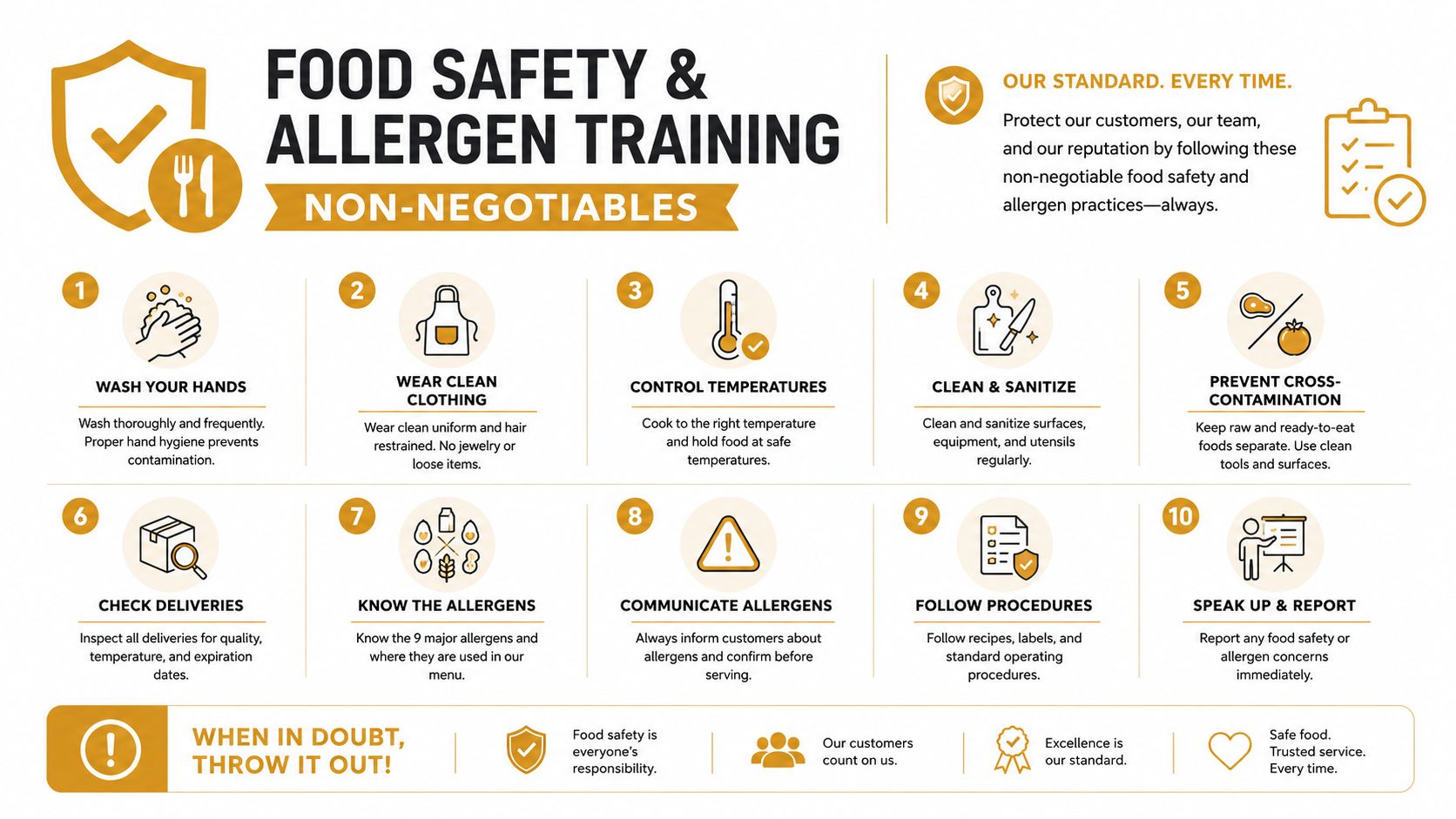
Food Safety and Allergen Training Non-Negotiables
A private chef can be brilliant and still be a bad hire if the food-safety side is weak. That's not dramatic, it's just reality. The National Careers Service says food safety certificate training usually lasts 1 to 2 days, which tells you everything about how short the course is and how essential the outcome should be. The same guidance also points to food safety as part of the role, and Indeed's UK advice treats up-to-date food hygiene training as critical for all kitchen staff.
The minimum paperwork to ask for
You want current proof of food hygiene training, not a vague promise that “it's all in hand”. You also want clear allergen awareness, because in a family kitchen the margin for error is tiny and the consequences land on the household, not on a restaurant manager.
- Food hygiene certificate: confirms the chef understands safe storage, handling, and cleaning.
- Allergen awareness training: shows the chef can manage ingredient risk, not guess.
- Refresh date: matters because stale training is a warning sign, even if the certificate once looked impressive.
- Presentation of records: a chef who can't produce paperwork quickly often isn't organised enough for private service.
Why private homes should be stricter than restaurants
A restaurant has systems around a chef. A household often doesn't. The chef may be working around school lunches, guest arrivals, and last-minute changes to the evening meal. That means food safety has to be instinctive, not theoretical.
For managers who want the operational side laid out in plain English, the food service managers' guide is a useful companion read. In the home, I'd be even stricter than in a managed venue. If a candidate can't show current hygiene training and a sensible approach to allergens, don't rationalise it away. Move on.
Specialisms That Matter in Private Households
A private chef CV should never read like a generic restaurant template. The work is too specific for that. One household wants school-night simplicity, another wants polished entertaining, another needs a chef who can handle low-FODMAP lunches for one child and halal dinners for a grandparent. Qualification only matters if it matches the actual job.
A multi-generational Knightsbridge household, for example, doesn't just need technique. It needs a chef who can move between light breakfasts, child-friendly suppers, and formal evening service without switching personality every hour. A chef trained in haute cuisine might be ideal for a state dinner, but that same chef may be clumsy in a home where discretion and adaptability matter more than plating drama.
A different family may need a chef fluent in plant-based cooking, intolerances, or paediatric nutrition. In that case, the right signal on the CV isn't a glossy school name, it's documented special-diet work and references from households with similar needs. Travel and yacht chefs also need a separate kind of proof, because mobility, compact kitchens, and guest-facing polish change the job completely.
Useful test: ask whether the candidate has cooked for a household like yours, not just for a venue that sounds impressive.
That's where dietary fluency becomes a real qualification. The chef who can cook confidently for allergies, low-FODMAP plans, kosher kitchens, or elder-friendly menus is more useful than someone with a prestigious diploma and no lived experience in special diets. For UHNW families, the correct hire often comes down to one question, can this person cook safely and elegantly for the people who live in the house?
References, Trials and Verification Beyond Paperwork
Paperwork gets a chef shortlisted. It does not get them trusted. In private service, the hire often turns on what happens after the CV looks good. A strong referee, a well-run trial, and a clean background check tell you far more than another line on a diploma list.
A referee is not just someone who “knows them”. You want named people who supervised the chef recently and can speak to actual service, pace, and conduct. A trial service is even more revealing, because it shows how the chef moves through a real kitchen, handles timing, and reacts when the household changes the plan. That's where charm disappears and competence shows up.
What verification should cover
- Reference quality: recent, specific, and from comparable settings.
- Background screening: enhanced checks where appropriate, plus international equivalents when relevant.
- Trial standards: a tasting or working service that reflects the household's rhythm.
- Discretion signals: how the chef speaks about former employers, staff, and routines.
This is also where agencies earn their keep. A firm like Superstar Nannies can vet a chef's recent employment, references, and suitability for a private household without turning the process into theatre. That matters because the best hire is usually the one who fits the family's way of living, not the one with the loudest CV.
The soft skills are not soft at all. Cultural sensitivity, calendar awareness, and a calm tone with household staff are part of the job. A chef who respects the principal's schedule and the housekeeper's workflow is easier to keep long term than a more talented cook who treats the home like a stage.
Action Plan for Candidates and Families
A chef career and a chef hire both need a plan. If you're building a private-household career, your first job is to make your profile easy to trust. If you're hiring, your first job is to define what the house needs, then test for it properly.
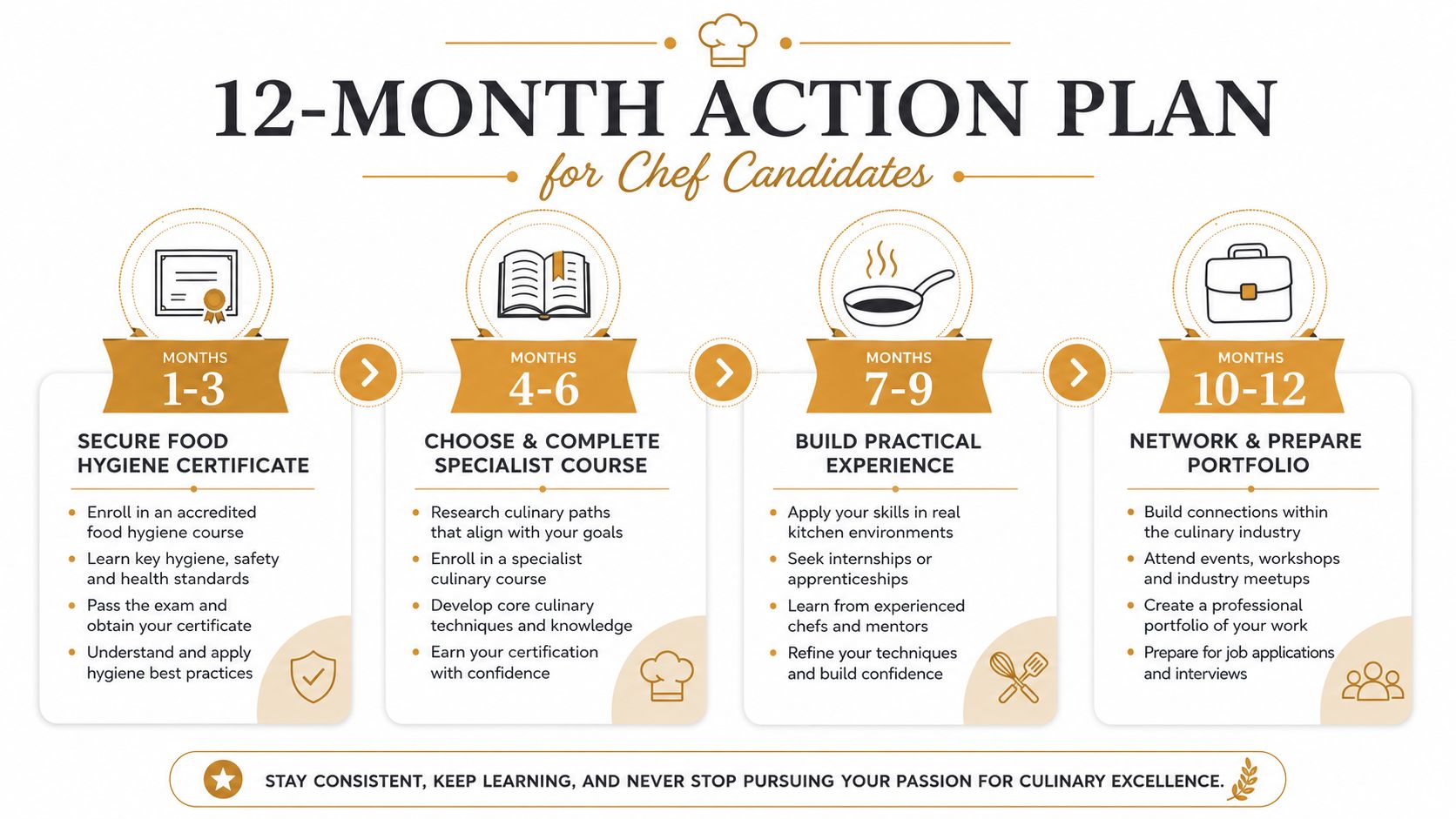
For candidates, the route is straightforward. Get a current food hygiene certificate, choose the training path that suits your budget and timeline, and collect proof of real service. Then build a portfolio that shows special-diet work, formal or informal, and line up referees who can talk about recent performance, not nostalgia.
For families, the checklist should be sharper than the CV review. Define the household rhythm, decide whether the role is live-in or live-out, ask for food safety and allergen paperwork, and run a tasting that reflects the actual brief. If the chef needs to cook for children, elderly relatives, or guests with complex dietary rules, test for that specifically.
Hiring rule: if the trial doesn't match the household, the hire won't either.
A few practical steps make the decision easier:
- State the brief clearly. Breakfasts, school nights, entertaining, travel, and special diets all change the profile.
- Request current certificates. Do not assume food hygiene and allergen training are up to date.
- Check the references properly. Compare the candidate's story with the referee's.
- Taste the actual food. Beautiful language on a CV means nothing if the plates don't work in your home.
If you want a cost benchmark before you brief a search, see the cost of a private chef. For candidates, the smartest move is to treat qualifications as the entry ticket and reputation as the primary currency. For families, the smartest move is to hire for trust first, then for technique.
Frequently Asked Questions About Chef Qualifications
Can someone become a private chef without formal culinary training? Yes, if they can prove real kitchen competence, current food safety training, and strong references. Formal training helps, but in private households the decisive factor is whether the chef can deliver safely, discreetly, and consistently in your home.
Do international qualifications count in the UK? They can, but they need translating into UK hiring terms. Agencies commonly map overseas chef training against UK levels, then check whether the candidate also has current hygiene credentials and relevant service experience.
Is a trial more useful than a diploma? Often, yes. A paid tasting or short working trial shows how the chef performs under household conditions. A diploma proves learning, a trial proves fit.
Do top private chefs need constant retraining? Not constantly, but they do need certificates to stay current and they need ongoing professional development in practice. The labour market remains active, with the U.S. Bureau of Labor Statistics projecting 7% growth for chefs and head cooks from 2024 to 2034, which reinforces the value of staying sharp and relevant.
If you're hiring a private chef, or you're a chef aiming to work in elite households, speak with Superstar Nannies for discreet guidance on qualifications, references, and vetted placements that fit the way your home runs.