
You can have a warm, capable nanny, a polished house manager, and a family that values politeness, yet one small misunderstanding about greetings, food, prayer time, or discipline can make the whole house feel tense. In private households, cultural sensitivity training is not abstract theory, it's the difference between staff who “mean well” and staff who know how to work in a family's real rhythm.
I've seen that difference decide whether a placement settles in or slowly unravels. The strongest homes don't treat cultural competence as a box to tick, they build it into daily practice, so staff can communicate clearly, respect boundaries, and adapt without losing professionalism.
Why Cultural Sensitivity Matters in Private Households
A house can look calm on the surface while cultural friction builds underneath it. A nanny may think she's being helpful by serving food a certain way, while a parent sees it as ignoring a religious rule. A house manager may give direct feedback in a style that works in one country but feels rude in another. These moments don't usually start with bad intent, they start with different assumptions.
Private households are more delicate than corporate settings because the work is personal. Live-in staff share kitchens, corridors, routines, and often family milestones, so minor misunderstandings have more chances to repeat. In international placements, especially across London, Dubai, and New York, I've found that success depends less on whether someone knows a cultural fact and more on whether they can adjust their behaviour in real time.

Families also notice when staff handle differences with ease. That tends to build trust faster than polished CVs do. It's one reason many agencies now treat cultural sensitivity training as part of placement readiness, not a nice extra.
Practical rule: if a family has to explain the same boundary more than once, the issue usually isn't effort, it's training.
When staff understand communication styles, holiday routines, dietary preferences, and the family's expectations around children, the home runs more smoothly. That doesn't erase differences. It gives people a framework for managing them without embarrassment or defensiveness.
For families hiring internationally, the value is straightforward. Better cultural awareness reduces avoidable conflict, supports retention, and protects the trust that private service depends on. It also makes onboarding faster, because the team spends less time decoding basic misunderstandings and more time doing the work well. For a practical recruitment approach that starts before placement, see inclusive recruitment practices.
Core Learning Objectives and Curriculum Design
A strong cultural sensitivity training programme for household staff starts with clear learning goals. The point is not to memorise a long list of customs. The point is to help staff notice differences, ask better questions, and respond appropriately when routines, beliefs, or family expectations don't match their own.
In private households, that means training has to translate into daily behaviour. A nanny may need to read a parent's preference without making the child feel caught in the middle. A house manager may need to confirm a request from one family member while keeping the tone respectful for another. A driver or housekeeper may need to recognise when silence signals discomfort, not agreement.
What staff need to be able to do
A useful curriculum gives a nanny, governess, house manager, or driver the ability to:
- Recognise cultural cues in speech, silence, eye contact, and feedback style.
- Adjust communication when a family prefers directness, deference, or softer language.
- Respect religious observances that affect meals, schedules, and children's activities.
- Work around dietary restrictions without making the home feel complicated.
- Support children's routines in a way that fits the parents' child-rearing philosophy.
- Use interpreters well when language barriers affect safety or care.
These are practical household skills, not abstract values. A curriculum works best when each module ends with a household scenario, because theory alone rarely changes what staff do at 7 a.m. in a busy kitchen or during a rushed school handoff.
What to include in the programme
The strongest programmes usually mix short teaching blocks with role-play, reflection, and real examples from domestic work. A cultural genogram can help staff map their own background and assumptions, which makes it easier to see where misunderstandings come from. Scenario work matters too. A house manager might practise how to respond when a parent's instructions conflict with a grandparent's expectations. A nanny might practise how to explain a child's behaviour in a way that respects the family's values.
The curriculum should also cover non-verbal communication, holiday observances, and disciplinary approaches. Those are the areas where good intentions often fail inside a private home. For a practical example of how agencies frame this work for domestic teams, see household staff training. Published training literature supports this practical focus, because structured programmes have been associated with gains in knowledge, attitude, and skills, not just awareness (systematic review of cultural competence training).
The training format also shapes how much staff carry into the home. One remote pilot in nursing education used four weekly sessions of about 90 minutes each with 16 students, and it reported significant pre-post gains in knowledge and self-efficacy, plus 94% compliance and high satisfaction (remote training pilot). That kind of structure translates well to household staff when schedules are tight and the learning needs to stay focused.
For families who want the material shaped around the actual rhythms of the home, the best curriculum is built around live scenarios, brief practice, and clear expectations rather than a generic classroom syllabus.
Choosing the Right Delivery Method for Your Staff
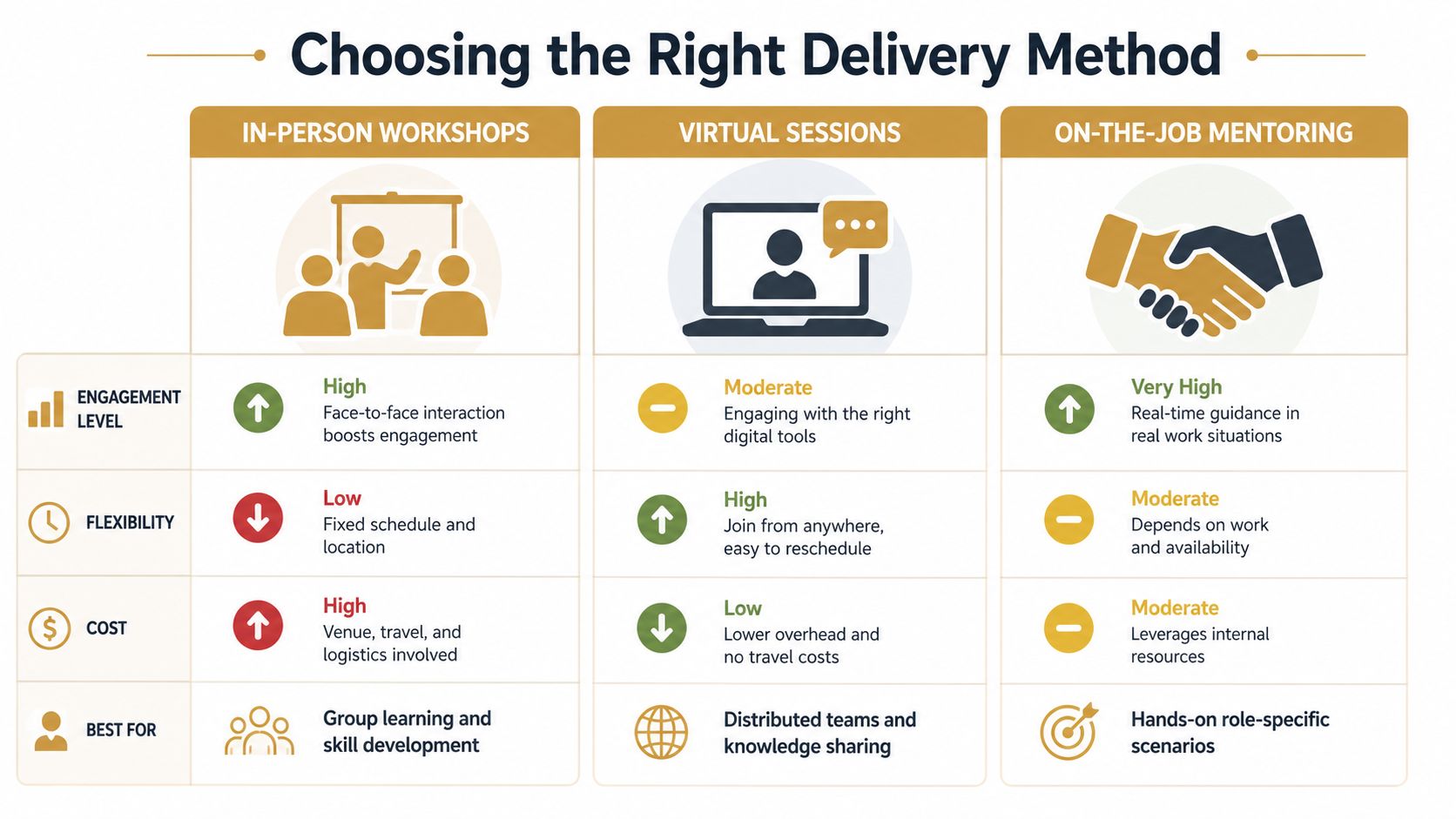
A nanny who lives in the home, hears the family's routines every day, and manages children through small but constant cultural moments usually needs training delivered in context. A part-time housekeeper may absorb the same material better in a shorter session with a clear agenda and fewer moving parts. A family that splits time across countries often needs remote delivery so everyone hears the same expectations, even if they are not in the same city.
In-person workshops
In-person sessions work well when the household needs shared language quickly. They suit new teams, family offices, and homes where several staff members need to agree on the same standards before the work becomes messy. The main strength is live discussion. Staff can ask awkward questions, test wording, and hear how others read the same situation.
The weakness is inconsistency. If the workshop stays too broad, people leave with notes and no change in habit. The older workshop literature shows why format matters. One evaluation of training for 350 nursing students used exercises on dimensions of difference, names, early memories, and a cultural genogram, and participants described the space as safe and useful (workshop evaluation). That matters because the setting can lower defensiveness, but the exercises still need to connect to what staff do in a kitchen, nursery, or shared living area.
Virtual sessions
Virtual delivery is often the easiest fit for international households. It works well when staff are based in different countries, when privacy matters, or when the employer wants a short, tightly managed session instead of a full day off-site. It also suits families that need everyone to hear the same guidance without bringing the whole household together in one room.
Virtual training has limits. It can feel polite and detached if the facilitator leans too hard on slides and never gets into real household examples. A remote training pilot in nursing education showed that online sessions can still hold attention and support learning when they are structured, interactive, and paced carefully (remote training pilot).
On-the-job mentoring
This is the format that changes behaviour most reliably in domestic settings, because the staff member gets coached in the same environment where the issue appears. If a child refuses a meal, if a parent's instructions change without warning, or if a visiting relative has a different expectation, mentoring turns the moment into practice.
Training that never reaches the corridor, kitchen, or nursery rarely survives first contact with family life.
For many households, the practical answer is a blend. Short virtual theory, then a focused in-person session, then mentoring during the first weeks of placement. That sequence respects schedule pressure and gives staff a chance to practise before mistakes become habits. Families that want the human side of this work often pair that follow-through with emotional intelligence training, because cultural sensitivity in a private home is rarely just about facts. It is about tone, timing, and reading the room without turning every correction into a formal conversation.
Measuring What Actually Changes After Training
Too many programmes stop at attendance and a short quiz. That tells you who showed up and who remembered a few facts, but it doesn't show whether the nanny spoke differently to the child, whether the house manager handled a cultural misunderstanding better, or whether the family experienced less tension at home.
Use evidence that reaches behaviour
The training literature is useful here because it draws a line between knowledge and practice. A systematic review of cultural competence training found gains in knowledge, attitudes, and skills across many studies, with benefit reported in the studies it reviewed. That doesn't mean every programme works equally well, but it does show that skill-based design matters.
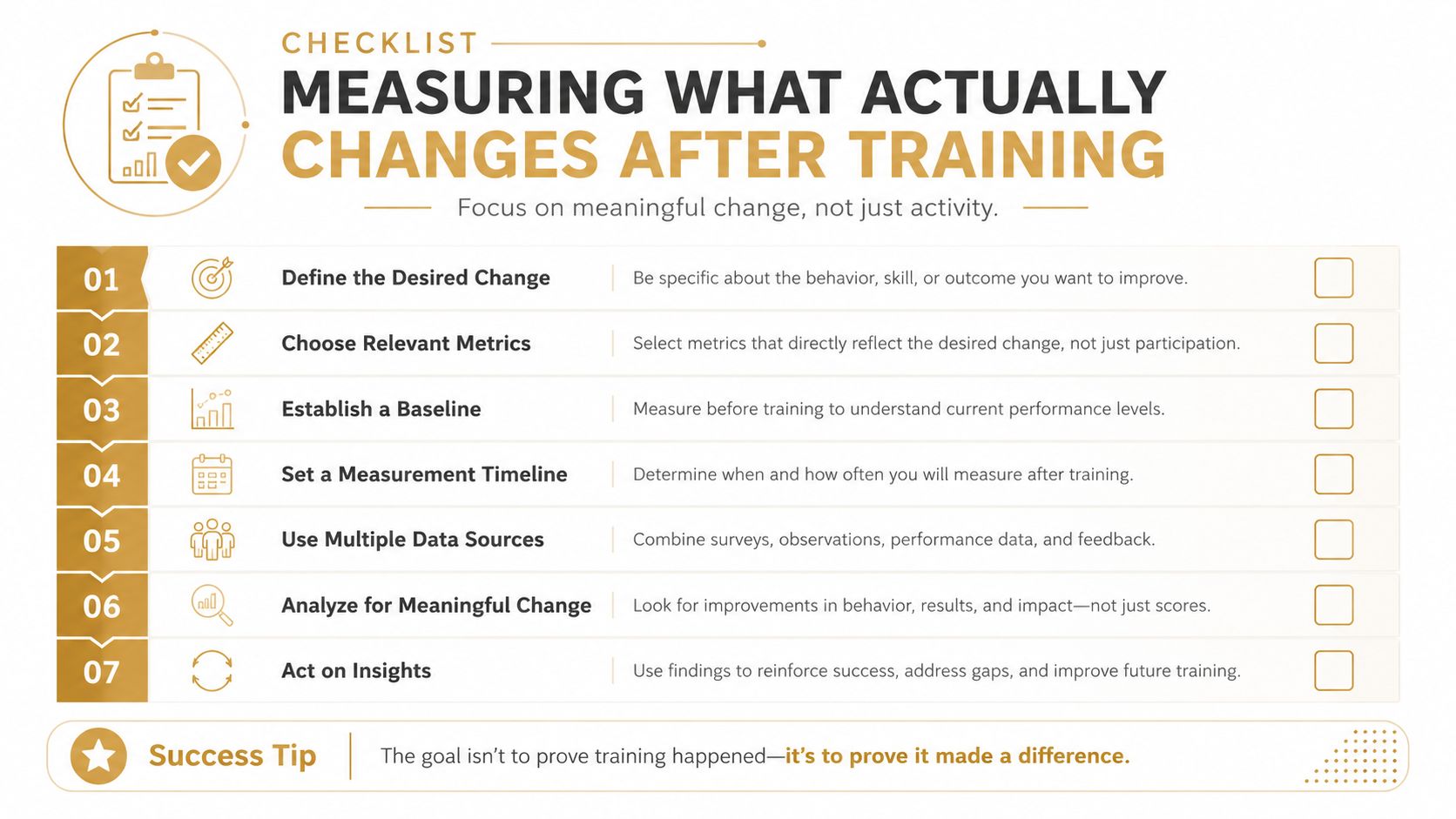
A practical household evaluation should include:
- Pre- and post-training reflection, to capture what staff think they know before and after.
- Observed interactions, especially in greetings, meal handling, correction, and conflict moments.
- Family feedback, gathered carefully so it feels constructive, not punitive.
- Follow-up reviews, because short-term enthusiasm can fade quickly without reinforcement.
- Scenario re-checks, where staff respond to the same type of issue later in the placement.
What not to rely on
Knowledge tests matter, but they're not enough. A staff member can score well and still default to old habits under pressure. That mismatch is familiar in household work. A nanny may know the family's expectations around religious observance or language use, then miss them in a rushed morning routine. A house manager may understand the policy and still handle a guest's comment in a way that creates friction.
Use a simple observation checklist built around real household moments. Keep it behavioural and specific. Instead of asking whether someone “understands diversity,” ask whether they asks clarifying questions before acting, whether they respects family instructions, and whether they adjusts communication when language or faith needs come up. For a practical template, A checklist infographic titled Measuring What Actually Changes After Training with seven steps for training evaluation. is a useful prompt for what to watch, document, and revisit.
The review literature also shows the limits of some programmes. One controlled study reported no statistically significant short-term improvement in cultural awareness scores, with F(1, 31) = 2.27, p = .17 and effect size = .06 (sensitivity training summary). That is a useful reminder that timing, format, and follow-up all matter.
For households working with agencies, staff performance metrics should be tied to the behaviours the family values. If the metric doesn't change decisions in the home, it's probably just paperwork.
Adapting Training for Regional and Cultural Contexts
A family in Dubai, a townhouse in London, and a pied-à-terre in New York can all need the same standard of discretion, but the cultural context around that standard won't be identical. A programme that relies on stereotypes, tidy cultural checklists, or broad “dos and don'ts” tends to fail fast in private service. Staff need principles they can apply, not scripts that break the first time a family's habits differ from the norm.
The most useful adjustment is to separate universal respect from local practice. Universal respect covers listening, confidentiality, consent, and professional tone. Local practice covers meal timing, holiday routines, prayer space, children's formal address, or how much eye contact feels appropriate. That distinction keeps training flexible without becoming vague.
Multilingual households need extra care. Staff may work with bilingual children, overseas grandparents, or parents who switch languages mid-instruction. In those homes, language support should be practical, not theatrical. Simple written routines, clear handover notes, and consistent phrasing matter more than trying to impress anyone with fluency. For families and agencies looking at how language adaptation works in a service setting, ScanStay localizes welcome books gives a useful example of how content can be adapted without losing meaning.
Strong rule of thumb: teach staff to ask, not assume. Curiosity is safer than confidence when the family structure is mixed, international, or changing.
This matters even more when disability access intersects with culture. A household may need to balance mobility needs, faith practices, and privacy concerns at the same time. The best trainers make space for that complexity instead of flattening it into a single cultural explanation.
A blended workforce also needs room for staff to bring their own backgrounds into the conversation. Cultural humility usually matters more than cultural expertise, because no one can memorise every household norm in advance. That's why the strongest programmes use adaptable scenarios, not fixed cultural profiles.
Protecting Privacy While Building Cultural Competence
Cultural training in a private household only works if confidentiality is built into the design. Staff often learn about family routines, faith practices, children's medical needs, or personal boundaries that should never travel outside the home. If training encourages casual sharing, it undermines the trust that makes domestic service possible in the first place.
The safest approach is to anonymise every case study. Change the names, the location, the family structure, and any detail that could identify the household. Staff can still learn from the situation without being asked to expose a real employer. That is especially important in live-in homes, where the line between “interesting story” and breach of trust can blur quickly.
I also advise families to make the privacy rules explicit during onboarding. Staff should know what they can discuss in supervision, what must stay inside the household, and how to ask questions without naming a family. That protects both sides. It also creates psychological safety, which helps staff raise concerns before they turn into mistakes.
For a clear example of how policies can be framed around confidentiality, find the privacy practices is a useful reference point for the discipline of protecting sensitive information. The detail matters because cultural sensitivity without privacy can become gossip, and gossip is poison in a household.
The strongest homes treat discretion as part of professionalism, not a separate issue. That means staff are trained to respect the family's culture, but also to protect the family's private life from unnecessary exposure. When those two things sit together, trust gets stronger instead of thinner.
If you want household staff who can handle cultural differences with calm, discretion, and real-world judgement, visit Superstar Nannies to discuss placements and training support. The team works with families who need more than a standard hire, they need staff who fit the home, the routines, and the values from day one.