

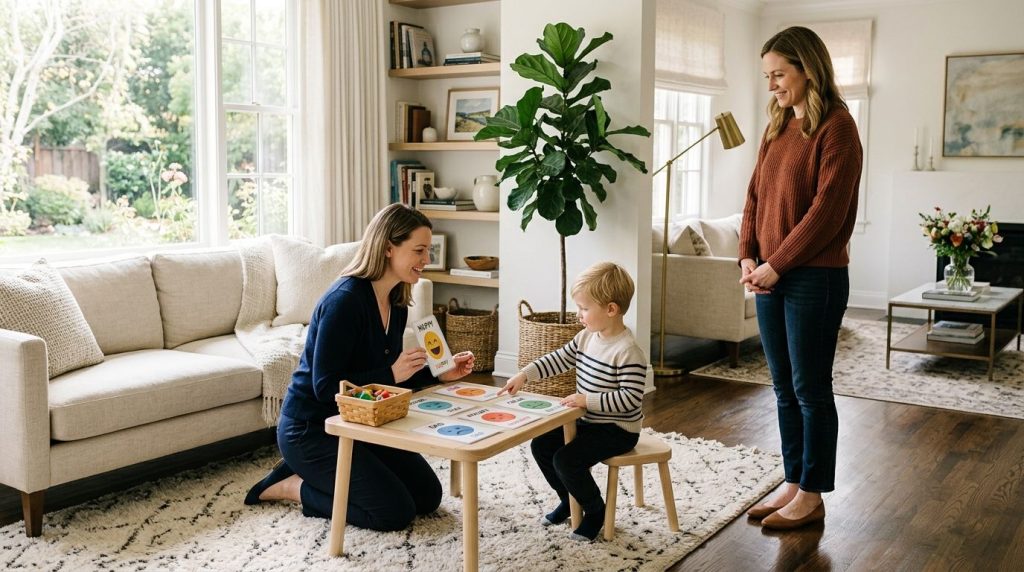
A child is overtired after a long school day. The parent arrives home late, the handover is rushed, and a perfectly capable nanny says something accurate but poorly timed. Nobody has done anything outrageous. Still, the atmosphere changes. Trust dips. The child feels it first.
That is usually where emotional intelligence training proves its value. In high-functioning households, technical childcare skills are expected. What separates smooth, reassuring care from low-grade friction is emotional attunement. It is the ability to read stress early, respond without escalation, and protect the tone of the home.
For families with exacting standards, this isn't remedial training. It is a strategic investment in household harmony, staff retention, and the emotional climate surrounding the children. It also supports the kind of staff culture that prevents avoidable resentment and miscommunication, which is why practical guidance on how to improve staff morale often sits alongside stronger emotional skills in well-run homes.
Introduction
Parents in private households rarely struggle to identify technical competence. You can see punctuality, organisation, child development knowledge, and polished presentation almost immediately. What takes longer to spot is whether a nanny or household staff member can absorb pressure without passing it on to the family.
That is the hidden differentiator. A professional may be excellent on paper and still unsettle the home if they miss tone, react defensively, or fail to recognise when a child's behaviour is really anxiety, jealousy, or exhaustion. In a household with travel, rotating schedules, multiple staff, and high privacy expectations, that gap becomes expensive very quickly.
Emotional intelligence training closes that gap by turning soft skills into observable professional habits. It helps staff communicate with more judgement, regulate their own stress, and support children in a calmer, more consistent way. For discerning families, that is what creates a home that feels contained, respectful, and emotionally safe.
Why Emotional Intelligence is Non-Negotiable in Modern Childcare

A nanny in a modern household does far more than supervise routines. She manages transitions, reads family dynamics, handles stress in real time, and often protects the emotional rhythm of the day. That work requires more than warmth. It requires skill.
A UK-specific survey found that 75% of employers consider emotional intelligence a critical hiring criterion for early childhood staff, making it a decisive factor in recruitment for roles like nannies and early years educators (LSIB course page citing the survey). Families may phrase it differently, but the expectation is the same. They want someone who can be calm, perceptive, and trustworthy under pressure.
The skill behind reading the room
In private childcare, emotional intelligence shows up in ordinary moments:
- During disrupted plans: A travel delay, a cancelled activity, or an overtired child can destabilise the whole day. High-EI staff adjust their tone first, then the schedule.
- During sensitive handovers: They know when to raise a concern immediately and when to wait until the child is settled and the parent can absorb the information.
- During family stress: They don't make themselves the centre of the moment. They contain, observe, and communicate clearly.
The practical value is that emotionally intelligent staff can often anticipate needs before anyone states them directly. That doesn't mean mind-reading. It means noticing pace, mood, and pressure, then responding appropriately. Parents who value discretion and maturity usually recognise this instinctively. It is one of the reasons top skills every superstar nanny must have in 2025 now extends far beyond nursery experience and first aid.
Practical rule: In elite households, the best childcare professionals don't just solve problems. They prevent emotional spillover.
The five teachable skills that matter most
A strong training programme should teach five concrete capabilities. The accepted framework adapted by Brackett and Rivers from Mayer and Salovey identifies these mechanics as recognising emotions, understanding causes and consequences, labelling emotions accurately, expressing emotions appropriately for time, place, and culture, and regulating emotions (NAEYC overview of teachable emotional intelligence skills).
In household terms, that means a nanny can:
- Spot emotional shifts early
- Interpret what is driving them
- Name feelings clearly for children
- Communicate in a measured way
- Stay regulated while helping others regulate
This matters in settings where domestic life is closely managed, privacy is paramount, and children are highly sensitive to adult tone. Even practical life moments can require tact. If a family is navigating bereavement, for instance, staff may need help with emotionally appropriate language. A concise resource such as this guide for writing condolence messages can be surprisingly useful because it models restraint, empathy, and judgement, all of which are central to emotionally intelligent communication.
The Five Pillars of Emotional Intelligence for Nannies
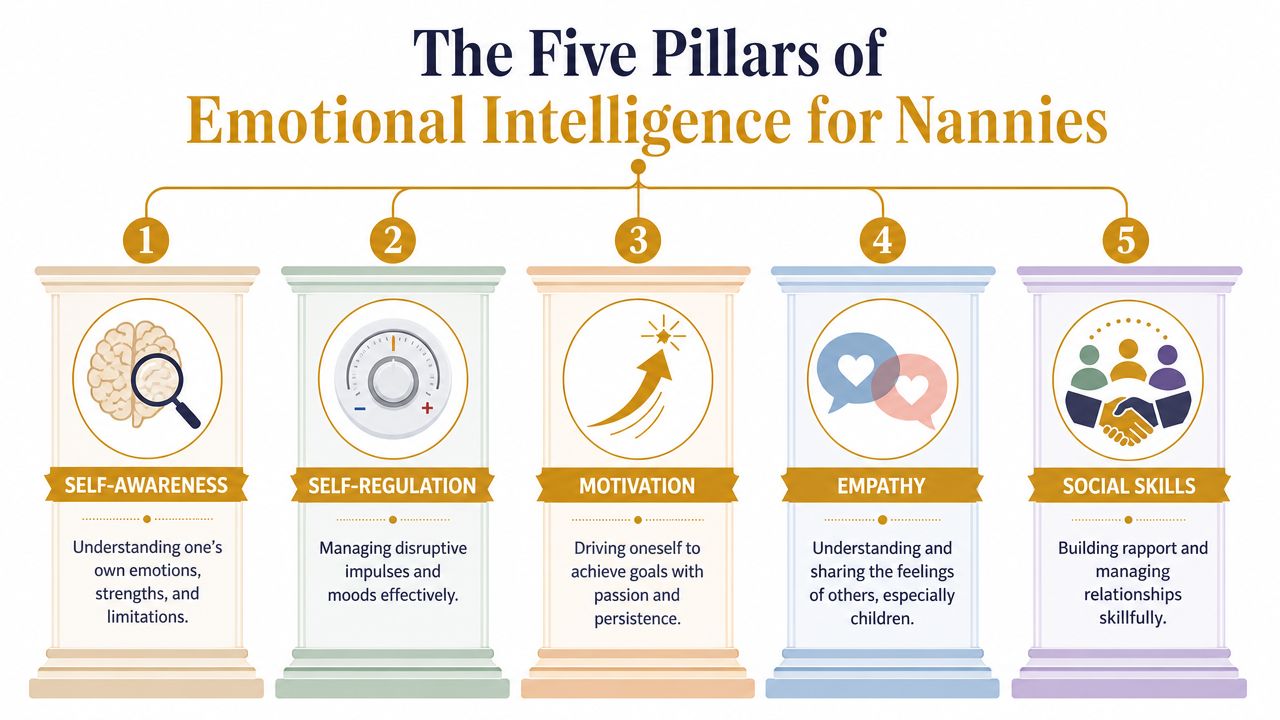
A broad label like emotional intelligence only becomes useful when it is broken into behaviours that can be taught, observed, and refined. In childcare, the framework needs translating into daily practice. The most reliable programmes do exactly that.
Recognising emotions
This is the first filter. A nanny must notice what is happening emotionally before she can respond well.
Recognition includes her own state, the child's state, and the parent's state. A professional who notices that a child has gone quiet after a playdate, or that a parent's brief tone reflects stress rather than criticism, avoids many unnecessary misunderstandings. It also supports cleaner communication with parents, because the exchange starts from accurate observation rather than assumption.
Understanding emotions
Recognising a feeling is not enough. Staff must also understand what is likely causing it and what may follow if it is ignored.
A child's “defiance” may be embarrassment. A parent's abrupt instruction may be driven by time pressure. A nanny's own irritation may signal fatigue rather than a genuine problem with the family. Such interpretation protects the relationship.
Staff who confuse behaviour with intention usually overreact. Staff who understand the emotion beneath the behaviour respond with more precision.
Labelling emotions
Children need language for inner states. Without it, they act feelings out physically, indirectly, or repeatedly.
A skilled nanny doesn't force emotional vocabulary into every conversation. She offers it when useful. “You seem disappointed that the plan changed.” “You wanted more time with Mum.” “It looks like you felt left out.” That kind of language lowers confusion and helps children organise their experience.
Expressing emotions
This pillar concerns delivery. Emotions can be valid and still expressed poorly.
In a household setting, staff must communicate with proportionality. A concern about a child's behaviour may be correct, but it should be raised calmly, privately, and with context. That is one reason reflective listening matters so much. This explanation of understanding coaching communication levels is useful because it shows how listening depth changes the quality of the response.
Regulating emotions
Regulation is where training earns its keep. It is easy to sound emotionally aware when the day is calm. It is harder when a toddler is screaming, a parent is delayed, dinner is running late, and another staff member has dropped the ball.
Regulation means pausing before reacting. It means keeping one's voice even, holding boundaries without sharpness, and helping a child borrow that steadiness. In practical terms, this is often the difference between a rough patch and a ruined evening.
A serious emotional intelligence training programme for nannies should make each pillar visible through examples, rehearsal, and feedback. Theory alone won't hold under pressure.
Designing a Bespoke Training Programme Module by Module
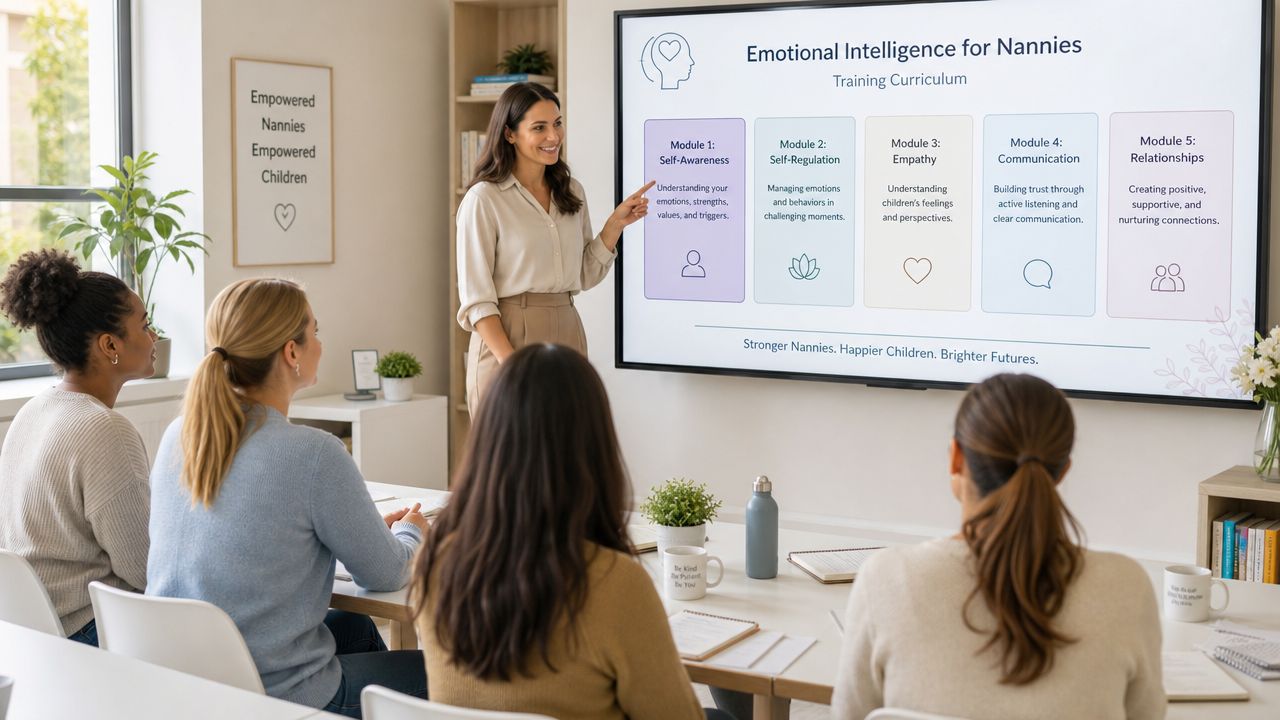
A generic workshop rarely changes behaviour in a serious household. Staff need a structured programme that reflects the reality of private service. That means specific modules, realistic scenarios, and enough repetition for new habits to stick.
A UK-based empirical study found that a structured EI training protocol of four weekly 2.5-hour sessions plus homework significantly improved trait emotional intelligence metrics, which supports a formal modular approach rather than a single motivational session (British Psychological Society summary).
Module one to four
A sensible programme often starts with EI fundamentals. Staff learn the core mechanics, identify their own triggers, and practise distinguishing observation from interpretation. Without that foundation, later coaching tends to stay superficial.
Then comes advanced communication and active listening. These skills address real household friction. A nanny may need to tell a parent that a child's behaviour changed after a family event, or clarify a boundary issue without sounding defensive. If you are planning formal staff development, a practical LearnStream guide to training needs can help shape what should be assessed before the programme begins.
The third module should focus on conflict resolution and problem-solving. In a fully staffed home, tension may arise between nanny and housekeeper, nanny and tutor, or two caregivers with different styles. Training should rehearse how to handle disagreement early, privately, and without creating factions.
The fourth module is resilience and stress management. This is not wellness language. It is job protection. Staff in high-pressure homes need methods for recovering quickly, managing emotional load, and avoiding cumulative resentment.
Adjustments for the high-net-worth household
Private households require content that corporate EI courses usually ignore. The environment is more intimate, more hierarchical, and less forgiving of loose judgement.
Training should address:
- Confidentiality under pressure: Staff must learn how to respond when children disclose private family matters or when other adults ask intrusive questions.
- Professional boundaries: Warmth must never become over-familiarity. Families want closeness with structure.
- Complex family systems: Divorced parents, international travel, blended households, principals with demanding public roles, and changing routines all require emotional discipline.
A common scenario illustrates this well. A parent returns from a difficult trip and is noticeably short-tempered. An untrained nanny may withdraw, over-explain, or mirror the stress. A trained nanny gives the child stability first, keeps the handover clean, and chooses the right moment for any non-urgent discussion.
That is what bespoke training should produce. Not a more polished personality, but better judgement under live conditions.
Practical Training Exercises and Role-Playing Scenarios
The fastest way to tell whether emotional intelligence training is working is to watch what happens in rehearsal. Staff either become more measured and perceptive under simulated pressure, or they stay theoretical. In childcare, role-play is not a gimmick. It is where emotional habits become visible.
Scenarios worth practising
Use role-play situations that mirror domestic reality, not office culture.
- Late parent, anxious child: The parent is delayed and unreachable for a short period. The child becomes restless and asks repeatedly when Mum or Dad is coming. The nanny must regulate her own frustration, reassure without overpromising, and keep the atmosphere steady.
- Sensitive disclosure: A child shares private family information during play. The nanny must respond respectfully, avoid probing, and preserve confidentiality.
- Competing instructions: One parent gives a direction that clashes with the normal routine. The nanny must adapt in the moment and clarify later without sounding oppositional.
- Staff tension in front of children: A disagreement with another staff member starts to surface near the child. The exercise is to pause, contain it, and move the conversation to an appropriate setting.
Coaching drills that build daily habits
Short exercises often work better than long seminars when households want practical improvement.
- Emotional weather report: At handover, staff describe the child's emotional tone in a few calm, accurate words rather than launching into a stream of events.
- Pause, label, choose: Before responding to a difficult moment, the staff member identifies what they are feeling, names the child's likely feeling, then chooses the response deliberately.
- Replay with alternatives: After a tense incident, the staff member walks through what happened and generates two better responses.
For homes already working on behavior management techniques, these drills are especially useful because they distinguish discipline from emotional containment. The most effective carers do both.
A child rarely remembers the exact wording of a correction. The child remembers whether the adult felt safe to be with.
To make role-play useful, keep feedback narrow. Don't critique everything at once. Focus on timing, tone, word choice, and whether the staff member stayed regulated. That is where the return on training starts to show.
Measuring Success and Ensuring Lasting Change
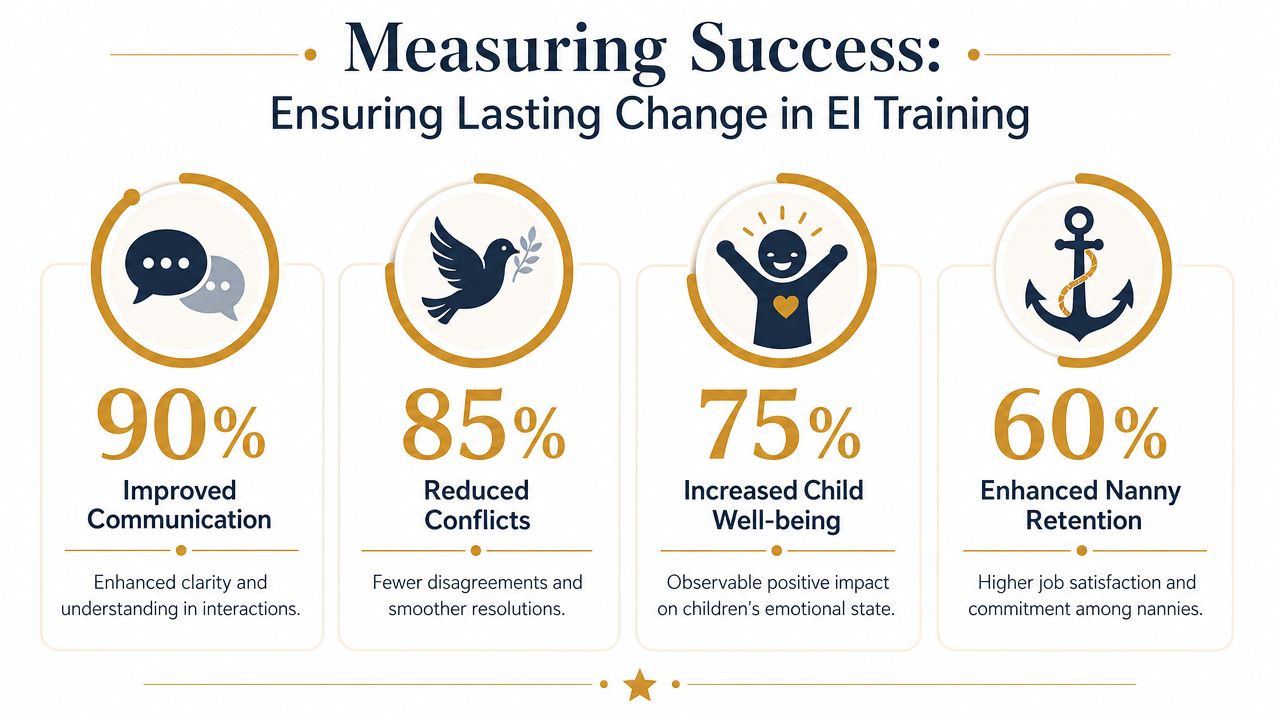
Families often ask the right question. How do you know emotional intelligence training is working if the goal is something as nuanced as harmony?
Start with behaviour, not sentiment. In roles with high interpersonal demands, employees with higher emotional intelligence are 10.6 times more likely to be high performers, and teams with high EI perform 46% better (SIY Global). In a household, that doesn't mean tracking abstract scores. It means looking for specific shifts in how people operate.
What to observe after training
Look for changes that are visible within ordinary routines:
| Area | Early sign of progress | Stronger sign of lasting change |
|---|---|---|
| Handover quality | Updates become clearer and calmer | Sensitive issues are raised with judgement |
| Child responses | Fewer escalations during transitions | Children recover more quickly from upset |
| Staff conduct | Less defensiveness when corrected | More proactive problem-solving |
| Household tone | Fewer misunderstandings | More consistency across busy or stressful days |
These are practical indicators because they show whether learning has transferred into daily conduct.
How to reinforce progress
One-off training helps, but reinforcement is what protects the investment.
- Use short review points: A brief fortnightly check-in often reveals more than a formal annual review.
- Ask for examples: “Tell me about a moment this week when you had to regulate before responding.”
- Track patterns, not perfection: Improvement should look steadier over time, not flawless performance.
- Include self-reflection: Staff should be able to identify where they handled pressure well and where they would respond differently next time.
A useful long-term marker is whether the home feels more predictable under pressure. Not quieter all the time, but more contained. The child senses that. The parents sense it. Other staff sense it too.
Household benchmark: Lasting change is present when emotional steadiness remains intact on difficult days, not just easy ones.
If you are assessing a trainer or programme, ask one direct question. How will you measure behavioural change after the course ends? If the answer is vague, the training probably is too.
Finding and Vetting the Right Professional EI Trainer
The market has no shortage of people offering emotional intelligence workshops. The challenge is finding someone who can work credibly inside the reality of private households. That requires more than charisma and a slide deck.
In the UK, 72% of managers report that emotional skills should be a top priority, yet most are not receiving the emotional intelligence training they want, which highlights a clear gap between demand and the availability of qualified trainers (HR Magazine). For families, that means selection needs to be careful.
What to look for
A suitable trainer should meet several tests:
- Private household understanding: Corporate experience alone isn't enough. They should understand confidentiality, hierarchy, discretion, and the intimacy of in-home roles.
- Relevant developmental knowledge: A background in child development, psychology, or closely related practice matters because childcare settings are not standard workplaces.
- Experiential methods: Choose trainers who use role-play, observation, feedback, and coached repetition. Pure theory rarely changes conduct.
- Strong references: References should speak to judgement, discretion, and behaviour change, not just presentation style.
Questions worth asking before you hire
Use direct questions. They save time.
- How do you adapt training for nannies, rota teams, or fully staffed residences?
- What household scenarios do you rehearse?
- How do you measure whether behaviour has changed after training?
- How do you handle confidentiality during coaching and feedback?
A serious trainer should answer without resorting to vague leadership language. Families need someone who understands that the objective is not merely better communication. It is a calmer home, more resilient staff, and children who are cared for by adults with sound emotional judgement.
Conclusion
For private families, emotional intelligence training is one of the clearest ways to improve the lived quality of childcare. It sharpens communication, supports steadier behaviour under pressure, and helps staff protect the emotional atmosphere of the home. That matters not only for efficiency, but for the child's sense of safety and trust.
To learn more about sourcing or training childcare professionals with exceptional emotional intelligence, contact Superstar Nannies today for a confidential consultation.
Frequently Asked Questions
Is emotional intelligence training only useful for staff who are struggling?
No. In the best households, it is used to refine already strong professionals. The aim is not to “fix” someone. It is to improve judgement, timing, regulation, and communication in a setting where small missteps can affect the whole home. Strong staff usually benefit the most because they can apply the training quickly and consistently.
How long does emotional intelligence training take to show results?
Some changes appear early, especially in handovers, conflict handling, and how staff respond during tense moments. Deeper change takes reinforcement. The strongest results usually come when training is followed by check-ins, role-play, and feedback based on live household situations. A one-off session can help, but practice is what makes the change hold.
Can emotional intelligence training help with staff retention?
It often can, particularly where household stress, unclear communication, or emotional overload are driving tension. Staff tend to stay longer when expectations are clearer, difficult moments are handled well, and they feel equipped to manage pressure professionally. Families also benefit because fewer misunderstandings mean less avoidable strain in the working relationship.
Should parents be included in the training process?
Often, yes. Not always in every session, but certainly in the design and reinforcement of the programme. If parents and staff use very different communication styles, even a good training course can lose momentum. A short alignment session on handovers, feedback, boundaries, and emotional tone can make the training more effective and more durable.
What is the difference between emotional intelligence training and general childcare training?
General childcare training covers safety, development, routines, and practical care. Emotional intelligence training focuses on how the professional notices, interprets, expresses, and regulates emotion in themselves and others. In a private home, that affects everything from how a nanny manages a child's distress to how she handles a difficult conversation with calm and discretion.
If you're looking for exceptional childcare or household professionals who can support a calm, discreet, and emotionally intelligent home environment, Superstar Nannies offers confidential guidance for discerning families worldwide.