

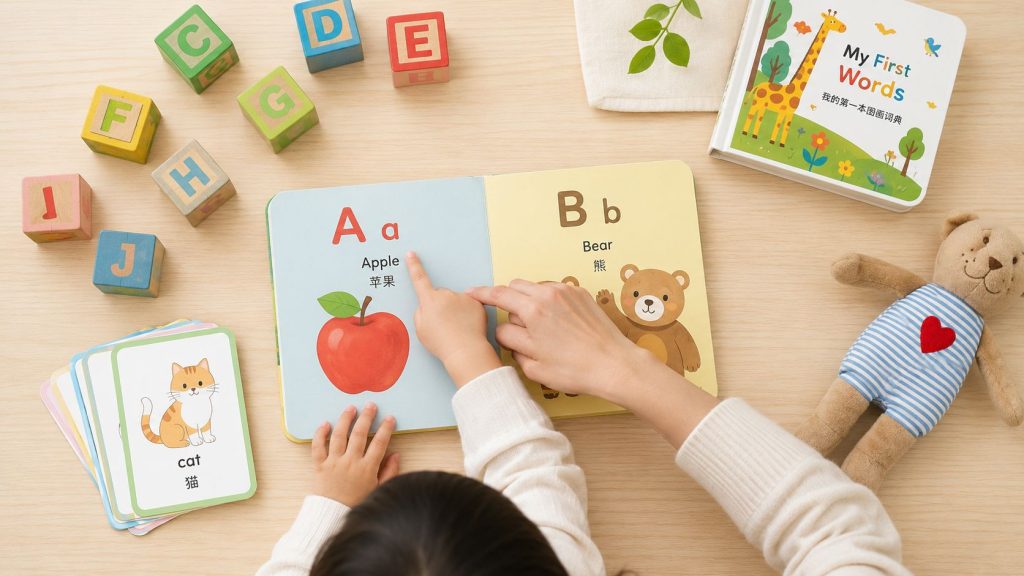
What happens when a child has plenty of toys, books, and screens, but still doesn't get enough real conversation? For language development activities to work, the quality of interaction matters far more than just keeping a child busy. In elite households, that means nannies and parents need routines that are intentional, repeatable, and easy to weave into the day.
The strongest early years guidance in England points to a rapid vocabulary trajectory, with children typically recognising about 50 words by age 1, 1,000 words by age 3, and 10,000 words by age 5. That makes the first years a critical window for shared reading, talk, song, and play-based interaction, not as extras, but as core inputs for communication growth, as the Department for Education's guidance explains in its language overview (England's early language milestones). For families who want practical, high-impact routines, the best approach is simple. Use everyday moments well, repeat language often, and choose activities that fit the child's age and the household's pace.
1. Narration During Daily Routines
Narration turns ordinary moments into language development activities without adding pressure to the day. Breakfast, dressing, bath time, and the school run all become chances to name objects, actions, colours, feelings, and simple sequences. This works because children learn language most easily when words are tied to what they can see, touch, and do.
A nanny might say, “You're eating a warm croissant. The strawberries are red and sweet,” or “We're buttoning your blue jumper, one, two, three.” For babies, the same principle applies in a simpler form. “The water is warm,” or “You hear the engine,” gives language to sensory experience without overwhelming the child.
Practical rule: say less, but say it often. Short, accurate narration repeated across the day beats one long teaching moment.
The home learning environment matters here too. UK research found that the number of books available, frequency of library visits, parents teaching a range of activities, and number of toys available were all important predictors of expressive vocabulary at age 2 years, while increased television exposure was linked with lower scores at school entry (Department for Education research PDF). That doesn't mean every child needs more stuff. It means children need more active adult language around the things already in front of them.
For busy, high-standard homes, narration is one of the easiest habits to sustain. It works in London townhouses, on travel days, and during nanny handovers because it asks for consistency, not special equipment. It also gives the caregiver a calm, natural way to extend a child's words. If a toddler says “dog,” the adult can answer, “Yes, a big brown dog is running fast.”
For a developmental reference that helps match narration to age, see this child language development stages guide.
2. Interactive Read-Aloud Sessions
A good read-aloud is not passive listening. It's a conversation with a book in the middle of it. Children notice pictures, predict what happens next, and answer questions that stretch vocabulary and thinking at the same time.
The difference between reading at a child and reading with a child is easy to hear. “What do you think the caterpillar will eat next?” invites a response. So does, “How do you think Max feels here?” or “Can you find the red apple?” The child learns that books are interactive, not static, and that language has a purpose beyond naming objects.
Here's where elite-family routines can work in the child's favour. A daily 10-minute read with the same caregiver builds predictability, attention, and shared reference points. Repeated books are especially useful because children can begin to join in, anticipate language, and feel confident correcting or completing familiar phrases.
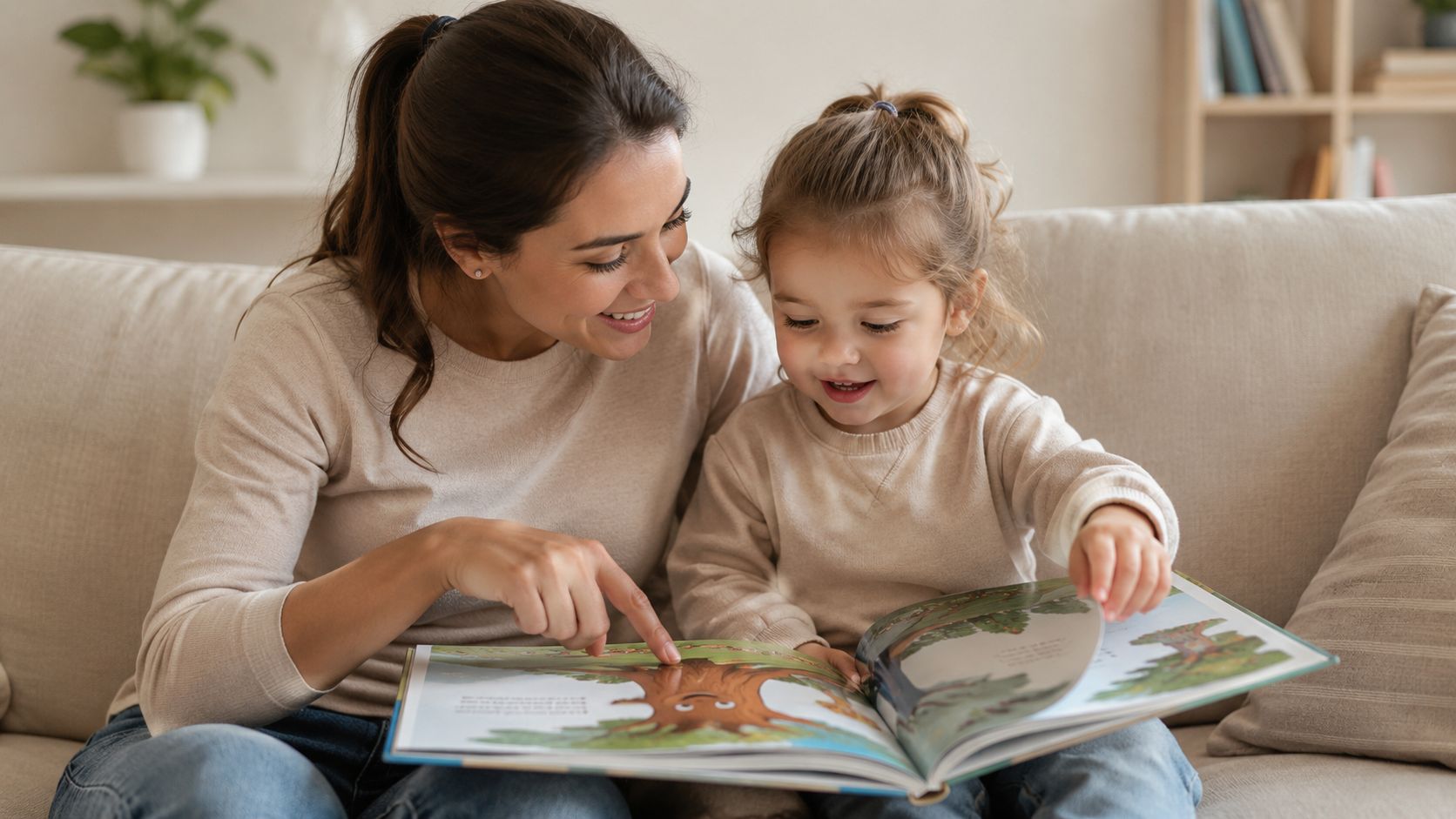
A few habits make read-alouds far more effective:
- Choose visually rich books: Strong illustrations give children something concrete to talk about.
- Pause on purpose: Wait for answers instead of filling every silence.
- Revisit favourites: Familiar stories build comprehension and confidence.
- Let children handle the book: Turning pages and pointing keeps them engaged.
- Talk about real life connections: Link the story to the child's own experiences.
Children in multilingual homes often benefit from books that can be discussed in more than one language. A bilingual nanny can use familiar stories to connect vocabulary across languages, which is especially useful when one caregiver speaks a language the other doesn't. For families exploring that route, bilingual nanny support can make reading time more consistent across the week.
3. Singing and Music-Based Language Activities
Singing is one of the most efficient language development activities because it bundles repetition, rhythm, pronunciation, and memory into something children enjoy. Nursery rhymes and simple songs help children hear patterns in speech, and they often say words more clearly when those words sit inside melody and movement.
Songs about body parts, routines, emotions, and animals work especially well because the language is concrete. “Head, Shoulders, Knees and Toes” supports body vocabulary. “If You're Happy and You Know It” gives emotional language and action verbs. “Old MacDonald Had a Farm” reinforces animal names and sounds. Even a made-up routine song, like “We're putting on our shoes, our shoes, our shoes,” can be useful when a child needs the same words every morning.
Singing slowly often works better than singing beautifully. Children need clear mouth movements and repeated words, not performance.
The UK early years system treats talking, singing, and play as core language inputs because the first five years move so quickly, from early recognition to much larger receptive vocabularies. That makes music a practical part of daily learning, not a filler activity. In multilingual households, songs also give children repeated exposure to sounds and structures in more than one language.
A nanny can use music during transitions, which is where many families struggle. A short song before shoes, bath, or tidy-up gives the child a predictable cue and reduces resistance. That matters in travel routines too. A familiar song can settle a toddler in a hotel room, in the car, or on an airplane when everything else feels unfamiliar.
For families interested in bilingual development, the benefits of raising a bilingual child can help shape how songs are shared across languages. The key is to keep it light, repeated, and joyful. If the child starts adding words, pauses, or hand movements, the activity is working.
4. Pretend Play and Role-Playing Scenarios
Pretend play gives children a reason to use language for a real social purpose. They need to negotiate roles, give instructions, ask for help, and explain what is happening in the story they are building. That makes role-play useful for pragmatic language, not just vocabulary.
A restaurant game can bring in polite requests, food names, and turn-taking. A doctor's office opens the door to body parts, feelings, and simple problem-solving. A shop scenario adds colours, counting language, and social phrases. The adult's job is not to take over. It is to add enough language to keep the play moving while the child stays in charge.
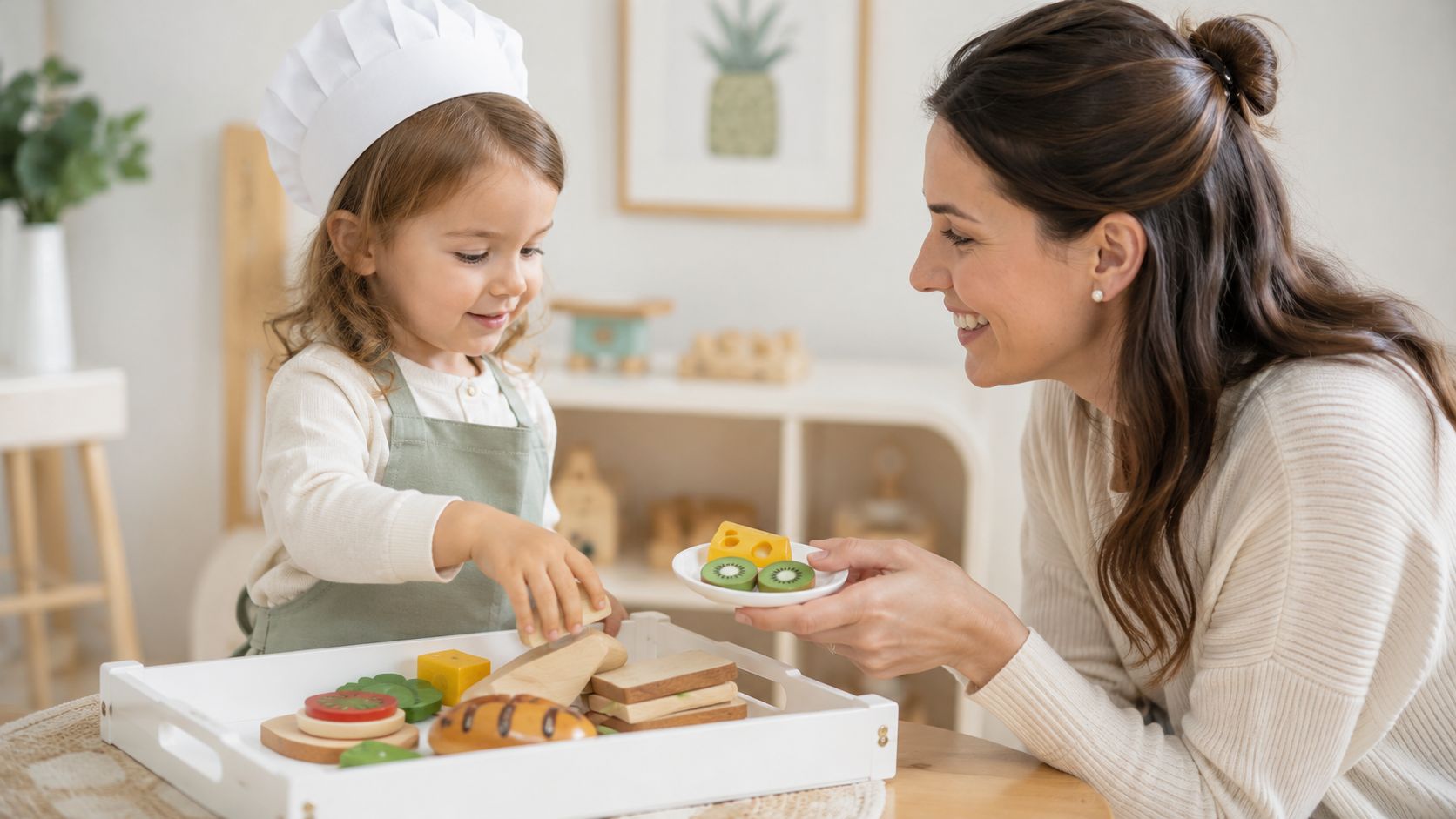
In a UHNW household, this kind of play can look polished without being complicated. Toy kitchens, dress-up clothes, miniature furniture, or travel-friendly props can support many variations, including hotel-room setups and quiet play between scheduled commitments. The value does not come from expensive materials. It comes from the language the adult models while following the child's lead. For a clear overview of what makes this kind of play effective, the Playz guide on pretend play gives a useful overview, and these nursery activity ideas show how pretend play fits into broader developmental routines.
A few useful lines during pretend play sound like this:
- “I'd like the pasta, please.” This models complete sentences in a natural way.
- “The doctor is checking your temperature.” This adds vocabulary inside the story.
- “Tell me about your magical castle.” This invites narrative language.
- “What happens next?” This keeps the child in charge of the plot.
Households that already use a nanny for structured play often find role-play easiest to build in after school or before dinner, when children need a bridge between activity and calm. In a home-based routine, the same approach works with a few fixed props kept in an easy-to-reach basket, so the adult can start quickly and the child can revisit familiar scenarios without a long setup.
5. Word Games and Rhyming Activities
Rhyming games train children to hear the sounds inside words, which supports early reading and speech awareness. They're playful, fast, and ideal for commutes, waiting rooms, and in-between moments when a child can't sit through a full activity. For families who value efficiency, this is one of the best low-prep tools available.
A child who can hear that cat rhymes with hat is already learning that words can be broken into sound parts. That's why games like I Spy, rhyming chains, and simple nonsense rhymes are so useful. They build sensitivity to sound patterns without feeling like lessons.
The What Works Clearinghouse practice guide recommends choosing 3–5 unique words per week, then returning to them across daily activities so children hear and use them often (WWC vocabulary guidance). That narrow, repeated approach fits rhyming work well. A nanny might focus on one sound family, then revisit it in a book, a song, and a short game over several days.
Useful habit: if a child gets the answer wrong, keep the rhythm going and model the sound again. Confidence matters more than perfection at this stage.
You don't need worksheets for this. In the car, you can say, “I spy something that starts with B.” At the breakfast table, you can ask, “What rhymes with spoon?” On a walk, you can try, “Can you think of a word that sounds like tree?” These tiny moments add up because they are repeated in real life, not isolated from it.
For families with strong literacy goals, rhyming and word play can be folded into bedtime, travel, or sibling interaction. The format can stay simple while the language challenge gradually increases.
6. Picture Sorting and Naming Activities
Sorting pictures or objects by category gives children a concrete way to organise language. They're not only learning words, they're learning how words belong together. That's a major step in vocabulary growth, especially for toddlers who are beginning to notice patterns.
A child might group farm animals, fruit, vehicles, or clothing, then name each item as it's placed. “This is a cow. This is a horse. Both are farm animals.” That kind of repetition strengthens both recognition and recall. It also supports concept building, which matters when children later need to describe, compare, and explain.
This activity is especially practical in multilingual homes because the same categories can be named in more than one language. A nanny can sort everyday household items, laundry, or toy collections without needing specialist materials. The point is not to create an academic exercise. It's to make language visible through organising.
The Victorian Government's early-childhood literacy toolkit recommends using language in every interaction, turning normal situations into discussion, and repeating and rewarding each attempt at a word with attention and affection (Victorian early-childhood literacy toolkit). That approach fits sorting beautifully. Every item becomes a chance to name, compare, and notice detail.
A simple routine might include:
- Colour sorting: “Red blocks, red balls, red buttons.”
- Food sorting: “Apples and oranges are fruits.”
- Clothing sorting: “These are socks. These are shoes.”
- Household sorting: “Where should this go?”
In elite households, this kind of activity works well in playrooms, nursery spaces, or even during tidying up. It helps children see that language can organise the world, not just describe it.
7. Scrapbooking and Photo Narrative Activities
Photo-based storytelling helps children talk about what already happened, which is a different skill from naming what they can see right now. It builds memory, sequencing, and descriptive language all at once. That makes it especially valuable for children who travel often or have rich family routines worth revisiting.
A simple scrapbook might include holiday photos, cooking pictures, weekend outings, or seasonal changes in the garden. The adult and child can look at each image and build a story together. “We flew on an airplane. We saw the ocean. We built sandcastles.” Those short lines give children a structure for past tense, sequence words, and detail.
This activity also gives shy children something solid to talk about. The photo does part of the work. They can point, name, and remember before they have to explain. That makes it easier to stretch language without pressure.
The best scrapbooks are revisited often. A child who has heard the same holiday story several times begins to retell it with more confidence and more words. For families with packed schedules, a digital version can be just as useful as a printed one because it's easy to open during downtime, travel, or a nanny shift change.
Best use case: treat photos as conversation starters, not finished captions. The adult's questions should pull the child into the story.
Questions like “What happened first?” or “What did we hear there?” help children organise their thoughts. Describing the same event in multiple ways also strengthens language. “We travelled,” “We explored,” and “We discovered” each add a different shade of meaning.
For families who want to preserve memorable experiences while supporting speech development, this activity is both practical and personal. It keeps language tied to the child's own life, which makes it easier to remember and reuse.
8. Outdoor Exploration and Nature-Based Language Learning
Outdoor time offers a rich stream of language without needing to manufacture a lesson. Plants, insects, weather, textures, sounds, and colours all give children real words attached to real sensations. That's why nature walks and garden exploration are so valuable for vocabulary growth.
A nanny can slow the pace and narrate what the child notices. “Look at the red roses. They smell beautiful.” “That bird is singing.” “The sand feels warm.” These observations help children connect sensory experience to descriptive language, which is especially useful for early expressive speech.
This is also one of the easiest activities to adapt for families with access to gardens, estates, parks, or travel destinations. A beach, a city park, and a country path each bring different vocabulary. The child learns that language changes with place, not just with books and toys.
The strongest outings are the ones where the adult doesn't rush. Ask the child what they hear, what they smell, or what they can find that is soft or rough. Return to the same place later and compare what has changed. That repetition gives children a stronger sense of time, sequence, and observation.
For households that travel, this becomes a useful continuity tool. The same child can talk about leaves in London, shells on the coast, or flowers abroad, and the adult can keep the language style consistent. Outdoor exploration doesn't need a formal curriculum. It needs attention, patience, and a willingness to let the child lead the noticing.
9. Conversation Coaching and Questioning Techniques
Some of the most effective language development activities are adult habits in everyday conversation. The way a nanny asks, pauses, listens, and expands on a child's answer can noticeably shape how much language the child uses across the day.
Open-ended questions usually draw out more speech than questions with one clear answer. “Tell me about the park” invites more language than “Did you have fun?” If a child says “car,” the adult can respond, “Yes, a fast red car,” instead of moving on too quickly. That small expansion gives the child a richer model without turning the exchange into a correction.
The South Australian Department of Education's language guide offers practical mechanics that fit this approach, including “word of the day” teaching, category games, “Simon says” with 2 or 3 instructions at a time, and noun wrapping, where a noun is expanded with an adjective or phrase (language development activity guide). Those tools are useful because they show exactly how to shape language, not just how to speak more. For adults who want help writing natural back-and-forth exchanges, you can find dialogue tips for authors, then adapt the same rhythm for child-led conversation.
A strong caregiver also knows when to pause. Wait time matters. Children often need a few seconds to organise a response, especially when the question is open-ended or the setting is busy. The best conversations feel unhurried even when they are brief, because the child has room to think and answer.
For elite households, coaching can make a real difference across meals, play, and transitions. A nanny who knows how to extend speech, ask sharper questions, and keep the child talking brings consistency to the day. That consistency often matters more than adding more toys or structured materials.
The goal is not to interrogate the child. It is to keep the exchange open long enough for real language to emerge.
9 Language Development Activities Comparison
| Activity | Implementation complexity | Resource requirements | Expected outcomes | Ideal use cases | Key advantages |
|---|---|---|---|---|---|
| Narration During Daily Routines | Low, integrate into existing routines; needs caregiver consistency | Minimal, none beyond caregiver language ability | Vocabulary growth, sentence structure, listening comprehension | Busy or multilingual households; birth–5 years | Seamless, zero cost, constant natural exposure |
| Interactive Read-Aloud Sessions | Moderate, requires book selection and active engagement | Books, quiet time, caregiver preparation | Comprehension, narrative skills, enriched vocabulary | Structured bonding time; 6 months–8 years; pre-literacy focus | High language gains; builds love of reading and critical thinking |
| Singing and Music-Based Language Activities | Low, easy to add but benefits from repetition | Songs/recordings, optional simple instruments | Phonological awareness, memory, rhythm, vocabulary recall | Short transitions, multilingual homes; birth–6 years | Highly engaging, multisensory, supports phonics and recall |
| Pretend Play and Role-Playing Scenarios | Moderate, caregiver scaffolding boosts effectiveness | Toys/props, play space, active adult participation | Pragmatic language, narrative development, social skills | Social skill development; 2–8 years; group or one-on-one play | Motivating, encourages complex language and social interaction |
| Word Games and Rhyming Activities | Low, portable and easy to implement anywhere | Minimal, voice prompts or simple cards | Phonological awareness, sound discrimination, early literacy | Transitions, car rides, 2–7 years | Portable, strongly predictive of reading success, playful |
| Picture Sorting and Naming Activities | Low–Moderate, some prep for materials | Picture cards or household items | Vocabulary, categorisation, visual discrimination | Toddlers and preschoolers; concrete learners; 12 months–6 years | Concrete visuals, easy differentiation, obvious progress |
| Scrapbooking and Photo Narrative Activities | Moderate, time for collecting and assembling materials | Photos (digital or print), craft or digital tools | Narrative skills, temporal language, memory encoding | Families who travel or document events; 18 months–8 years | Highly personalized, revisitable, builds sophisticated narratives |
| Outdoor Exploration and Nature-Based Language Learning | Moderate, planning, supervision and seasonal factors | Access to outdoor spaces, caregiver nature knowledge | Rich vocabulary, observation skills, sensory language | Energetic children; garden/estate/park access; 12 months–8 years | Multisensory, health benefits, highly motivating context |
| Conversation Coaching and Questioning Techniques | Moderate–High, requires caregiver training and habit change | Training/coaching time; no special materials | Increased language production, conversational competence, richer utterances | Households seeking sustained language gains; birth–8 years | Strong evidence base, improves quality of all interactions, cost-effective |
Your Next Step in Five-Star Childcare
The strongest language growth happens when adults turn everyday life into repeated, meaningful conversation. Shared reading, songs, role-play, sorting, outdoor observation, and responsive questioning all work because they give children many chances to hear, use, and enjoy language in context.
For busy families, the practical challenge is consistency. A child may have beautiful toys, excellent schools, and a full calendar, but still need a caregiver who knows how to speak, listen, and respond in ways that build vocabulary every day. That's why the right nanny matters so much. A well-matched professional doesn't just supervise. They notice teachable moments, shape routines, and keep language development active from morning to bedtime.
Superstar Nannies places experienced childcare professionals who understand these routines and know how to adapt them to family life, travel schedules, and different ages. If you want support that feels discreet, thoughtful, and developmentally informed, contact Superstar Nannies for a customized placement conversation. They can help you find a nanny whose style fits your home and supports your child's communication growth.
If you want a nanny who can build language development activities into real family routines, visit Superstar Nannies to explore placements and expert childcare support. Their team works with families who value discreet, development-focused care, and they can help match you with a professional who supports your child's language growth in daily life.