
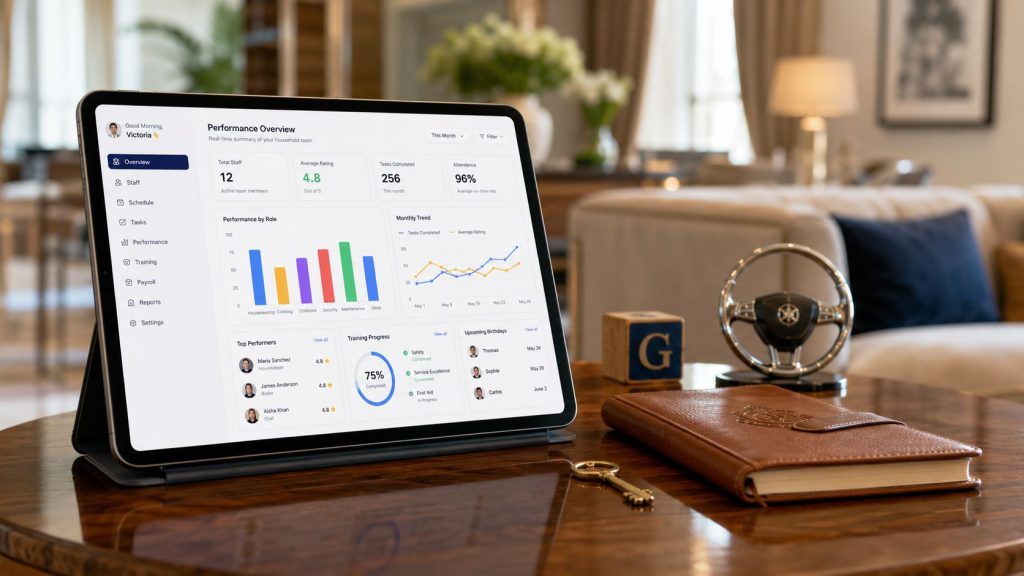
A household often reaches for staff performance metrics at the same moment it feels a little off balance. Standards are high, everyone is busy, and yet the question remains: why do some days run beautifully while others feel reactive?
In a private home, the right system brings calm. Good staff performance metrics don't turn a household into a corporation. They give families and staff a shared language for excellence, discretion, and consistency.
Moving Beyond the Checklist to Meaningful Metrics
A checklist tells you whether a task was completed. Meaningful staff performance metrics tell you whether the household is functioning at the standard you intended.
That distinction matters more than most families expect. A nanny can arrive on time, prepare meals, and follow the schedule, yet still miss the deeper outcome: a child who feels secure, stimulated, and settled. A housekeeper can finish every room on the rota, but if wardrobes aren't reset properly before travel or supplies run out before guests arrive, the result still feels below standard.

A 2023 report from the UK Department for Business and Trade found that 72% of British households employing domestic staff now use formal performance metrics, and households using structured systems saw a 35% reduction in staff turnover and a 28% increase in overall service quality.
Checklist completion versus household outcomes
The first mistake is measuring only what is easy to count. Completed laundry loads, driven journeys, stocked fridges, and attended appointments matter. They just don't tell the whole story.
Useful household metrics usually sit in three layers:
- Foundational standards. Punctuality, reliability, hygiene, presentation, and adherence to agreed routines.
- Outcome measures. Is the home calmer? Are children progressing? Are guest visits smoother? Are mistakes reducing?
- Leading indicators. Did the staff member anticipate a problem before it affected the family?
Leading indicators are what separate competent service from excellent service. A butler who notices an upcoming dinner and confirms glassware, flowers, and dietary notes in advance is creating ease before anyone asks. A nanny who flags sleep disruption early and adjusts the day thoughtfully is managing the actual outcome, not merely the timetable.
Practical rule: If a metric only proves that someone was busy, it's too weak. If it shows whether the household experience improved, it's worth tracking.
Start with the family's values
Generic HR systems fail in private homes because homes run on trust, rhythm, and judgement. The standard isn't just “done”. It's “done in a way that protects the family's privacy, supports the children, and keeps the home harmonious”.
Before setting targets, define what excellence looks like in your household:
- Name the essential standards. Privacy, calm communication, child safety, wardrobe care, guest readiness, punctual travel, or discretion.
- Identify pressure points. School mornings, travel packing, handovers between shifts, vendor coordination, or weekend entertaining.
- Translate values into observable behaviours. “Discreet” becomes no casual discussion of family matters. “Proactive” becomes flagging diary clashes before they become disruptions.
Families managing a larger team often benefit from pairing role expectations with a clear estate structure, especially when responsibilities overlap between childcare and operations. A practical reference point is this guide to household manager responsibilities for UHNW estates.
What works and what does not
What works is a compact scorecard with a few metrics that staff can understand and influence. What doesn't work is a long spreadsheet full of vague labels such as “attitude” or “professionalism” with no explanation.
A good metric in a private home is clear, respectful, and tied to lived reality. It should help staff succeed, not leave them guessing what “better” means.
Tailored KPIs for Every Household Role
Once the household standard is clear, each role needs its own measures. Many families err by using one review form for everyone, then wonder why it feels unfair.
A nanny's performance can't be judged like a driver's. A housekeeper's excellence won't look like a house manager's. Staff performance metrics only work when they reflect the actual role, the level of autonomy, and the pace of the home.
The clearest example is childcare. According to the UK Homecare Association, the top three UK performance metrics for nannies are child development progress, parental satisfaction ratings, and staff reliability. The same report notes that 94% of UK domestic staffing agencies now include performance metric training in their onboarding programs.
Sample KPIs by household role
| Role | Core Responsibility KPI | Proactive/Initiative KPI | Qualitative KPI |
|---|---|---|---|
| Nanny | Child development progress aligned with family goals and age stage | Anticipates routine changes, travel needs, or developmental concerns early | Warmth, judgement, calm communication with parents and children |
| Housekeeper | Standards of cleanliness and household presentation by zone | Notices stock shortages, fabric care issues, or maintenance concerns before they escalate | Care, consistency, discretion in occupied spaces |
| Butler or House Manager | Smooth delivery of household operations, diary flow, and vendor coordination | Prevents service failures through planning, confirmation, and follow-through | Composure, confidentiality, authority without friction |
| Private Driver | Safe, punctual, well-planned transport | Monitors routes, timing, vehicle readiness, and contingency planning | Professional presence, discretion, adaptability |
Nanny metrics that reflect real childcare quality
For nannies, broad labels aren't enough. “Good with children” is not a metric. Better measures include progress in routines, support for developmental milestones, communication with parents, and reliability during handovers.
A strong nanny review usually considers:
- Developmental support. Is the child being engaged in age-appropriate play, reading, language, and routine building?
- Parent communication. Are updates concise, useful, and reassuring rather than excessive or vague?
- Reliability under pressure. Does the nanny stay steady during illness, travel, or changing family schedules?
For households with a broader leadership structure, it also helps to distinguish where nanny accountability ends and where operational accountability begins. This is especially important when a nanny reports into a principal, a chief of staff, or a house manager. A useful reference is this overview of the chief of staff role in private households.
The best nanny KPIs protect the child first. They don't reward performative busyness. They reward attentive, safe, developmentally sound care.
Housekeeping, management, and driving
Housekeeping metrics should be zone-specific. A formal drawing room, a nursery, and a principal dressing area do not carry the same standard or urgency. The useful question is whether the room is consistently maintained to the expected level, not whether the staff member looked occupied.
For house managers and butlers, the strongest KPIs usually sit around operational control. Budget discipline, vendor follow-through, successful event preparation, stock oversight, and diary coordination are all fair measures. So is the ability to keep issues from reaching the family at all.
Drivers need a similarly practical framework. Driving skill matters, but household confidence often rests on route planning, readiness, timing, presentation, and discretion. A driver who never needs chasing and always has a sensible contingency plan is delivering real value.
Gathering Information with Trust and Technology
The fastest way to ruin staff performance metrics is to make them feel like surveillance. In a private home, that damage happens unobtrusively. Staff become cautious, principals stop hearing the truth, and every tool starts to feel punitive.
A better system gathers information in a way that is visible, proportionate, and useful. The point is not to watch people constantly. It's to create reliable records of standards, communication, and follow-through.
Use more than one input
No single method gives a fair picture. Soft skills are especially difficult to measure. The UK Recruitment & Employment Confederation reported in a 2025 survey that 74% of domestic staffing agencies struggle to quantify soft skills, often relying on gut feeling rather than structured metrics.
That's why I prefer a blended approach:
- Self-assessment. Ask the staff member what went well, what was difficult, and what support would improve performance.
- Manager observation. Short notes after major events, travel periods, or busy weekends are often more useful than memory at review time.
- Household records. Shared calendars, maintenance logs, stock sheets, and handover notes create objective evidence.
- Targeted family feedback. Keep it specific. “Morning routine has become calmer” is useful. “We just love her” is kind, but not measurable.
Low-tech can be excellent
Not every household needs software. A simple handover book, a printed room-check standard, or a weekly review sheet can work beautifully when the home is smaller or the team is stable.
In larger residences, digital tools help because they make responsibilities visible across shifts and departments. Families and managers often use Trello for project boards, Asana for recurring workflows, and shared calendars for logistics. None of these tools should hold intimate family details unless access is controlled and the purpose is legitimate.
If a note wouldn't be fair to discuss openly in a review, it shouldn't be sitting in a shared system.
For childcare roles, the same principle applies during vetting and onboarding. Keep records organised, limited to what is needed, and easy to review. Households that want to tighten process early often benefit from a more disciplined look at nanny background checks, because weak hiring records often become weak performance records later.
Measure invisible performance carefully
Empathy, discretion, adaptability, and emotional steadiness matter enormously in domestic roles. They just need anchors. Instead of asking whether someone is “warm”, ask whether they de-escalate stress, communicate calmly, and read the room well during difficult moments.
That shifts the conversation from personality judgement to observed behaviour. Staff can improve observed behaviour. They can't improve against a vague label that changes with mood.
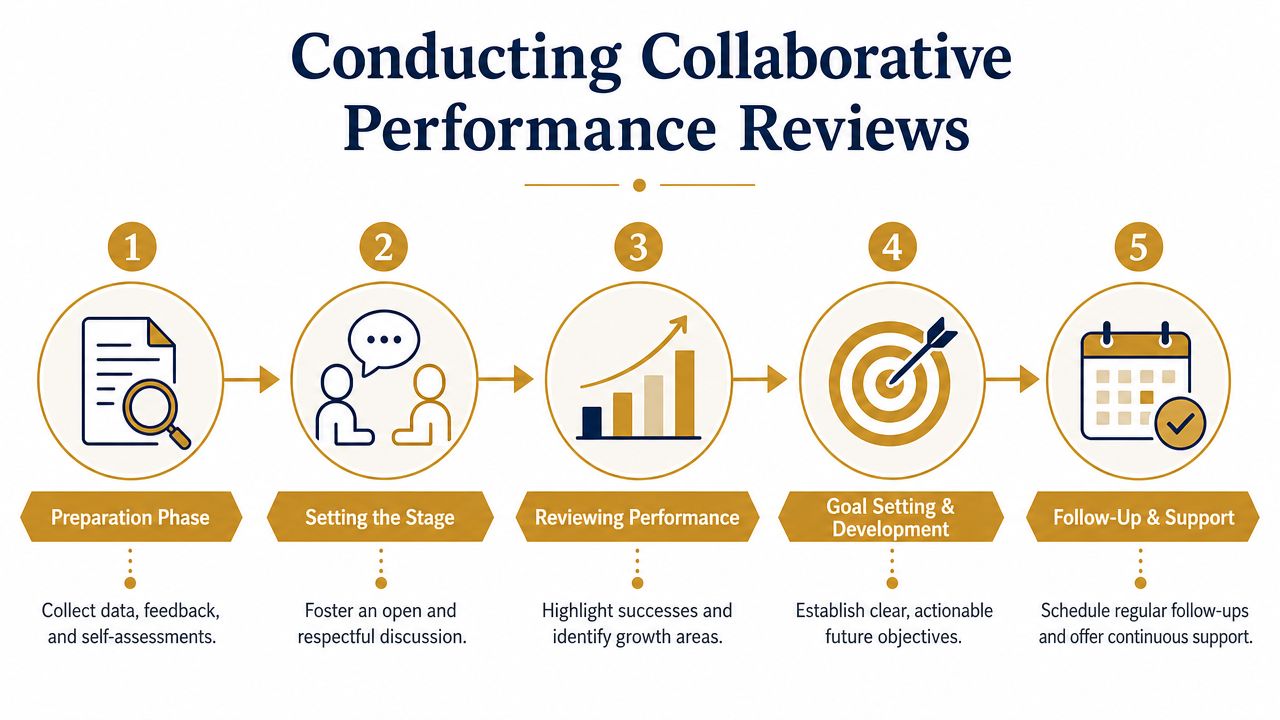
Conducting Collaborative Performance Reviews
A review should never feel like a trap. If it does, the household has already lost half its value.
The strongest reviews are developmental. They protect standards, yes, but they also preserve dignity. That matters in a private household where trust, longevity, and daily closeness all carry unusual weight.
Prepare properly before the meeting
A poor review starts with vague recollection. A good one starts with evidence gathered over time. Bring notes, examples, completed objectives, and any self-assessment the staff member has provided.
Keep the review file balanced. If the folder only contains mistakes, the process will feel loaded. Record successes with the same discipline you record concerns.
A simple preparation checklist helps:
- Review prior goals. Which were met, partly met, or overtaken by household changes?
- Gather examples. Use concrete situations, not general impressions.
- Ask for reflection. Let the staff member submit comments in advance.
- Choose the setting carefully. Private, calm, uninterrupted.
Structure the conversation as a dialogue
Start with outcomes and strengths. That isn't softness. It creates accuracy. People listen better when they know you've seen their effort as well as their errors.
Then address gaps directly. Avoid loaded language. “You are careless” invites defensiveness. “The wardrobe reset was incomplete before departure, which caused avoidable stress on the morning of travel” gives the person something they can understand and correct.
Review principle: Critique the behaviour, define the impact, agree the next standard.
A useful rhythm is:
- What worked well
- What fell below standard
- What support or clarification is needed
- What success looks like by the next review point
This is also the right moment to ask what the household may be doing poorly. Unclear reporting lines, last-minute instructions, and conflicting preferences often sit behind underperformance. The review should uncover those patterns, not hide them.
End with agreed actions
Every review should produce written next steps. Keep them specific and realistic. “Improve communication” is too loose. “Send a concise update by 6 pm on school days and flag any routine changes before collection” is workable.
Development should be visible after the meeting, not left as a pleasant intention. Households that want a stronger long-term approach often formalise training, shadowing, and role progression through structured professional development for household staff.
When a review ends with clarity, fairness, and practical support, staff usually rise to it. When it ends with ambiguity, resentment tends to fill the gap.
UK Legal and Confidentiality Frameworks
Many families assume they can easily borrow corporate appraisal forms and adapt them lightly. In private homes, that approach often creates risk.
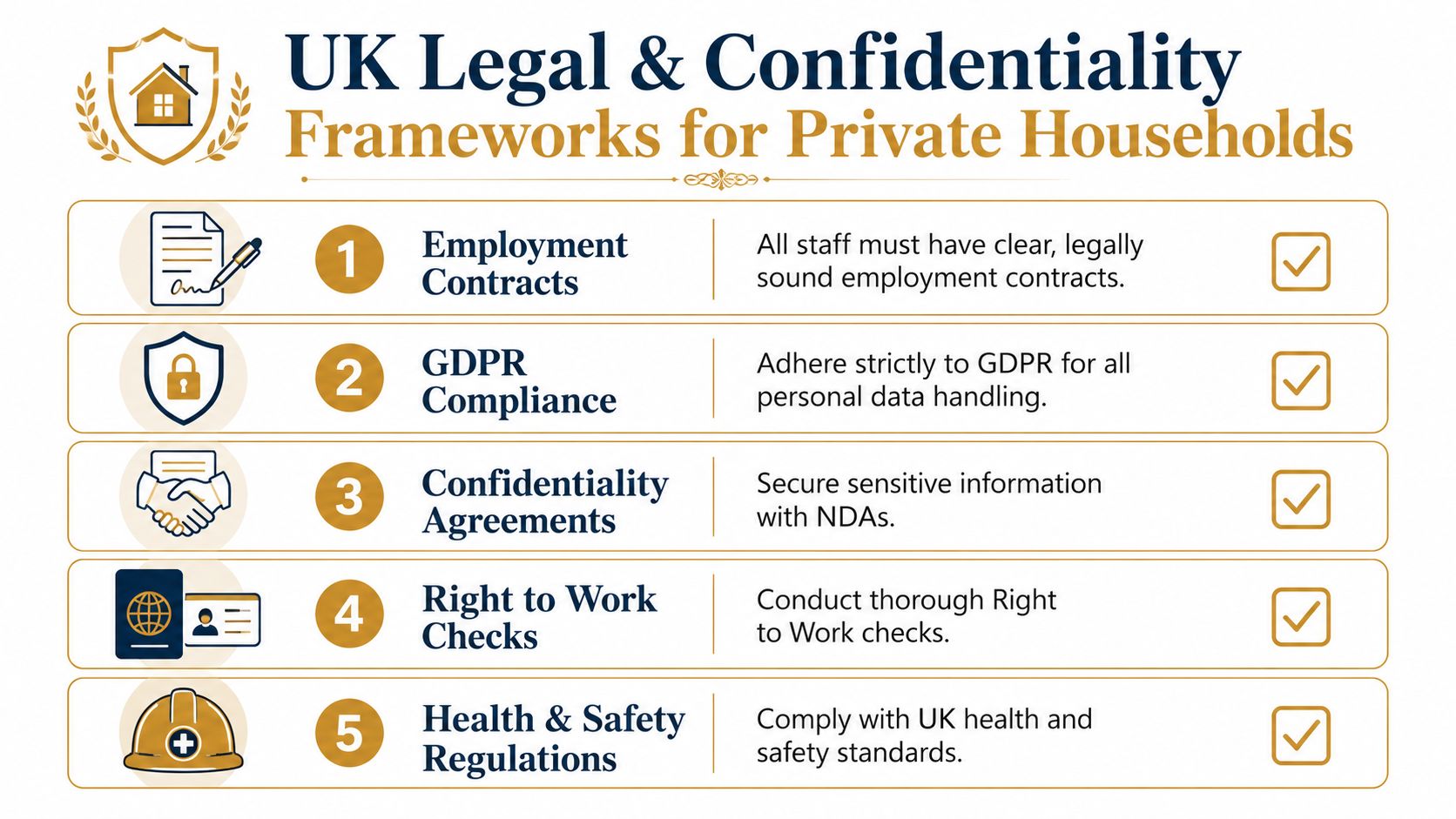
Domestic employment in the UK sits inside a more delicate environment. The workplace is also a residence. The employer holds unusual levels of personal information. The staff member may be caring for children, entering private rooms, handling schedules, and hearing confidential conversations. Staff performance metrics must reflect that setting.
A 2025 NIESR study found that 68% of UK domestic employers consider standard performance metrics misaligned with their needs, and noted that many guides ignore compliance with the Domestic Workers' Rights Charter (2023) and the UK's 2024 Modern Slavery Act amendments.
What private households must handle differently
Confidentiality is not just cultural. It needs structure. If you collect review notes, schedule data, household logs, or incident records, you're handling personal data within a domestic employment relationship. That means your process should be limited, relevant, secure, and clearly explained to staff.
At minimum, households should ensure:
- Employment terms are clear. Staff should understand duties, reporting lines, and how performance is assessed.
- Data handling is proportionate. Keep only what is necessary for legitimate management purposes.
- Confidentiality expectations run both ways. Staff protect family privacy, and employers protect staff records and dignity.
- Review processes are fair. Concerns should be raised consistently, documented properly, and discussed with the employee.
GDPR and the home setting
Families often forget that informal notes can still become problematic if they are excessive, intrusive, or carelessly shared. A private WhatsApp message thread full of subjective complaints is not a strong performance management system. A secure, relevant, and limited record is.
If you use shared apps, smart home systems, or digital logs, be especially careful. Not every available data point should become a metric. Just because technology can collect something doesn't mean it should.
A lawful household process is usually a restrained one. Collect less, define purpose clearly, and avoid anything that feels like covert monitoring.
Rights, compliance, and practical protection
The Domestic Workers' Rights Charter and modern labour compliance standards point in the same direction: private households need structure without exploitation, and standards without arbitrariness.
That means performance measures should never become a backdoor for unreasonable control. Metrics should not pressure staff into unpaid availability, unsafe pace, or blurred off-duty boundaries. They should clarify what good work looks like during paid employment and support a fair path to improvement where needed.
Handled well, this protects both sides. Families gain documented consistency. Staff gain clarity, process, and respect.
Frequently Asked Questions
How often should private household staff be reviewed?
For most households, a light-touch monthly check-in works better than waiting for one large annual conversation. Formal reviews can then sit at agreed intervals, with written goals and follow-up notes. The key is consistency. If feedback only appears when something has gone wrong, staff will naturally associate staff performance metrics with criticism rather than growth.
What's the best way to measure soft skills without making the process subjective?
Anchor soft skills to observable behaviours. Don't score “empathy” in the abstract. Score whether the nanny settles transitions calmly, whether the house manager handles pressure without creating friction, or whether the driver adjusts smoothly when plans change. That keeps the discussion grounded in conduct rather than personality.
Which digital tools are appropriate in a private household?
Choose tools that improve coordination, not surveillance. Shared calendars, task boards such as Trello or Asana, stock trackers, and secure document storage are usually enough for most homes. If you're exploring more advanced systems, it helps to first get answers on creating AI experts so you understand where automation can support workflow without crossing privacy boundaries.
How should underperformance be addressed?
Start early and stay calm. Name the issue, give a specific example, explain the impact on the household, and agree what must change. Then document the discussion and set a date to review progress. What doesn't work is storing frustration for months and unloading it all in one conversation. In domestic employment, delayed feedback usually creates confusion, not improvement.
Can performance metrics be linked to pay rises or bonuses?
Yes, but only if the system is clear, consistent, and fair. Staff should know which outcomes matter, how they are assessed, and whether household circumstances can affect the result. Avoid opaque decisions. If compensation is linked to performance, the process should be documented and discussed in advance so it supports trust rather than undermining it.
What should never be included in staff performance metrics?
Avoid intrusive monitoring, vague moral judgements, and anything unrelated to the role. Family gossip, personal preferences dressed up as standards, or excessive collection of personal data have no place in a proper review system. The metric should always answer one relevant question: did this help the household function safely, professionally, and well?
If you want discreet guidance on hiring, structuring, or reviewing exceptional household staff, Superstar Nannies can help you build a team that delivers excellence with professionalism, warmth, and trust.