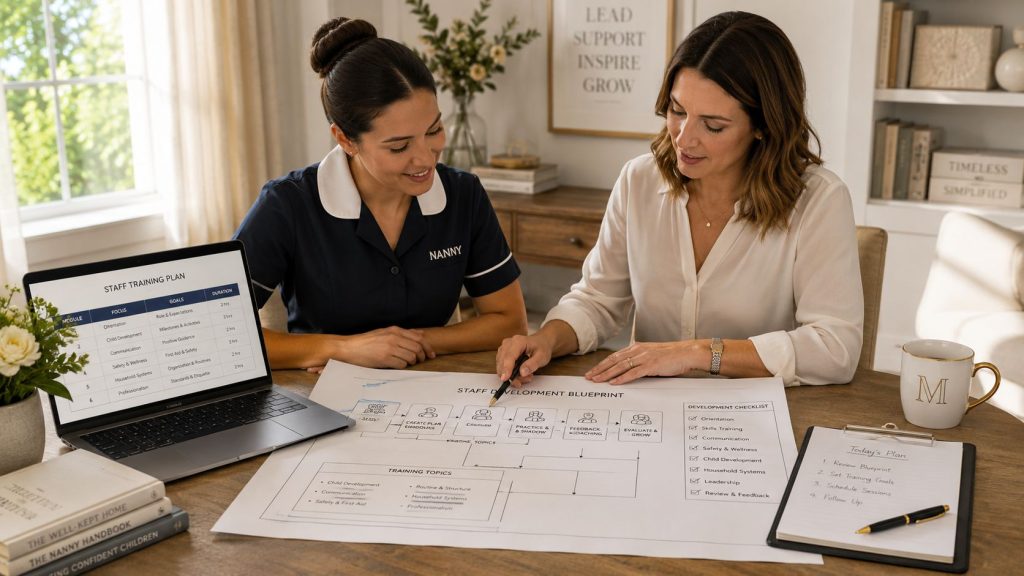
You've likely seen the pattern already. A nanny is warm and capable, but activity planning is inconsistent. A housekeeper is diligent, but standards shift depending on who gave the instruction. A family assistant handles diaries well enough, yet small communication lapses keep turning into avoidable friction. Nothing is disastrous. Everything is slightly off.
That sort of household drift is rarely a hiring problem alone. It's usually a systems problem. Talented people underperform when expectations are vague, training is reactive, and feedback only arrives when something goes wrong. In a private home, that costs more than efficiency. It affects calm, trust, and the atmosphere your family lives in every day.
That's why professional development staff should be treated as a strategic function, not a loose collection of occasional courses. In the wider UK market, 77% of employers view learning and development as central to business strategy, while 62% see it as essential for employee retention according to this labour market overview. A well-run household should think the same way.
If you're building or refining a domestic team, start with a proper operating model, not ad hoc fixes. A strong recruitment process matters, but so does what happens after the hire. Many families make errors at this stage, even after using an excellent search process such as this guide to hiring private household staff.
Investing in Excellence An Introduction
Monday starts well enough. By Wednesday, small faults are stacking up. One housekeeper follows the principal's preferences exactly, another relies on old instructions, and the nanny handles a schedule change differently from the family assistant. Nobody is failing. The household still feels inconsistent.
That inconsistency is expensive in a private home. It creates friction, repeats avoidable mistakes, and wears down good staff who would perform far better inside a clear system.
Treat staff development as an operating discipline. A well-run residence does not send people on occasional courses and hope standards improve. It sets expectations, teaches the house way of working, reviews performance properly, and gives strong people a reason to stay. That is how you protect service quality and retention at the same time.
This matters most after hiring. Even an excellent search process will not compensate for weak onboarding, vague standards, or irregular feedback. Families that want lasting results need a hiring method and a management method. If you are refining both, start with our detailed private household staff hiring process.
Professional development in a residence should be structured with the same discipline a high-performing company applies to its people, then adjusted for the privacy, intimacy, and nuance of domestic life. The aim is simple. Clear standards. Better judgment. Consistent service. Lower turnover.
Good systems also make staff management more measurable. Tools used in corporate environments, including Formbricks' EX management software, show the value of tracking staff experience rather than relying on instinct alone. In a household, the principle is the same. If you want excellence, you need a framework that makes performance visible, coachable, and repeatable.
Laying the Foundation for Staff Growth
Most development plans fail before a single course is booked. The reason is simple. The household has never defined what success looks like.
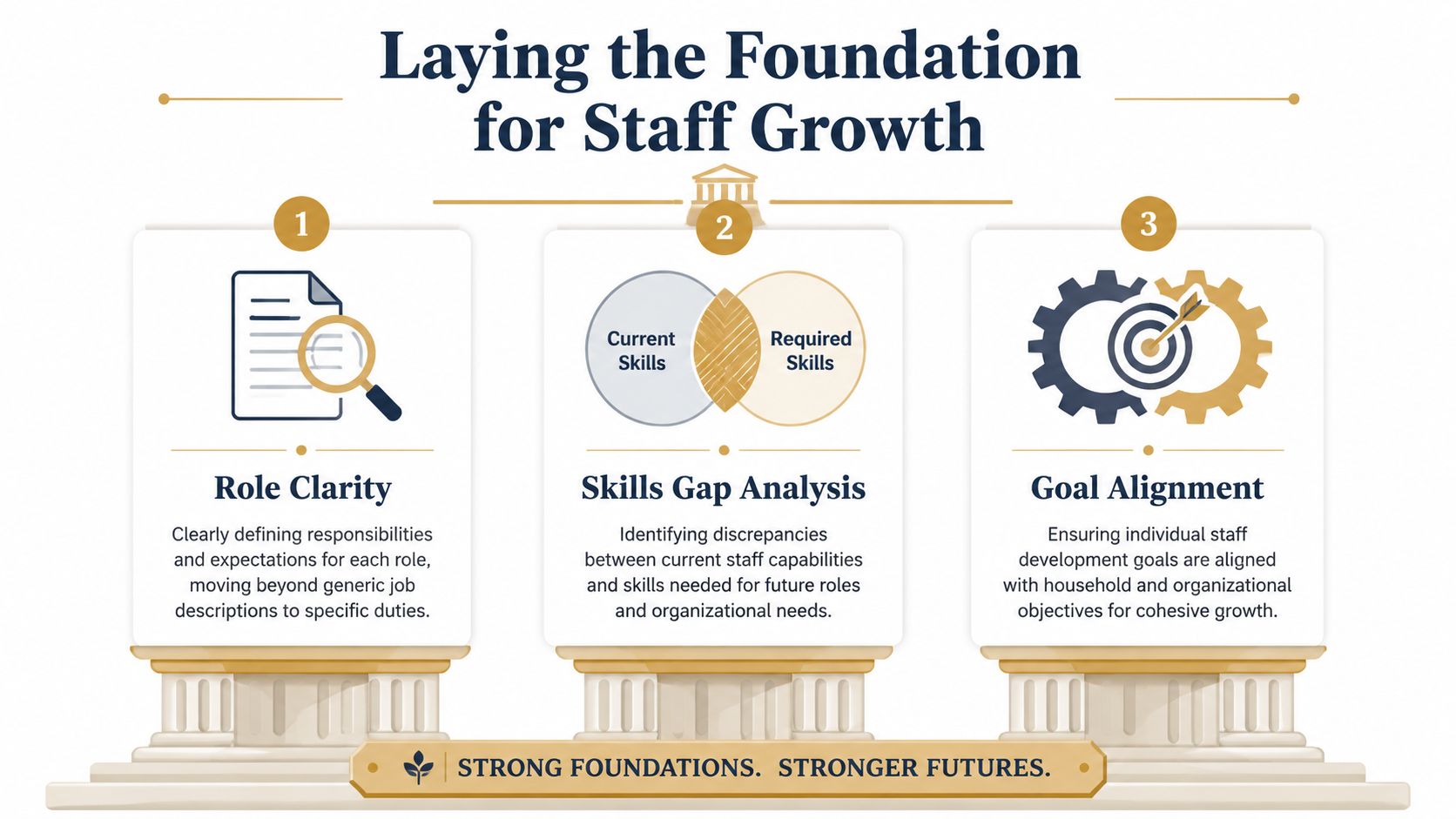
A serious framework rests on three pillars. If any one of them is weak, your training budget gets wasted and your staff default back to habit.
Define the role with precision
Start with the job itself. “Nanny”, “housekeeper”, and “assistant” are labels, not operating instructions. Write a role profile that states responsibilities, decision authority, boundaries, reporting lines, and required standards.
A proper role profile should answer questions like these:
- What does excellent performance look like daily: not in theory, but in your home.
- Which tasks are owned outright: and which require approval.
- How should communication happen: WhatsApp, written handover, in-person briefing, or all three.
- What matters most: discretion, anticipation, warmth with children, formal service, travel readiness, or all of the above.
Families who skip this step often create confusion by accident. One principal wants initiative. Another wants every change approved. Staff can't perform confidently when the household sends mixed signals.
Establish household culture
A well-run home has a culture whether you define it or not. The difference is whether your staff learn it by design or by trial and error.
Write down the household values that shape behaviour. Not generic values. Practical ones. For example:
| Household value | What it should look like in practice |
|---|---|
| Discretion | Staff never discuss family matters outside authorised channels |
| Proactivity | Problems are anticipated and solved before the principal has to ask |
| Calm communication | Concerns are raised clearly and privately, never emotionally in the moment |
| Consistency | Standards do not vary by shift, location, or who is supervising |
If you want a useful model for collecting staff feedback on experience and communication, look at Formbricks' EX management software. Even in a household, the principle is relevant. You need a simple way to understand where expectations are unclear and where staff experience friction.
Commit as the employer
Development only works when the employer behaves like a sponsor, not a bystander. That means giving time for training, making feedback routine, and treating standards as teachable.
Practical rule: Never ask staff to “be more proactive” if you haven't first told them where they have permission to act independently.
This is also why household leadership matters. If your house manager, chief of staff, or principal doesn't model clarity and follow-through, no course will fix the culture. For a broader operating structure, this guide on how to manage household staff effectively is worth reviewing.
Designing a Bespoke Training Curriculum
A new nanny arrives with glowing references. Your chef has worked in Michelin-level kitchens. Your housekeeper has years of private service behind her. Six weeks later, standards still feel uneven. The problem is rarely effort. The problem is the absence of a training system built for your home.
Generic training is poor management. A private residence needs the discipline of a strong business, applied with far more discretion and precision. Your development framework should be built around three things: the role, the person, and the operating standard of the household.
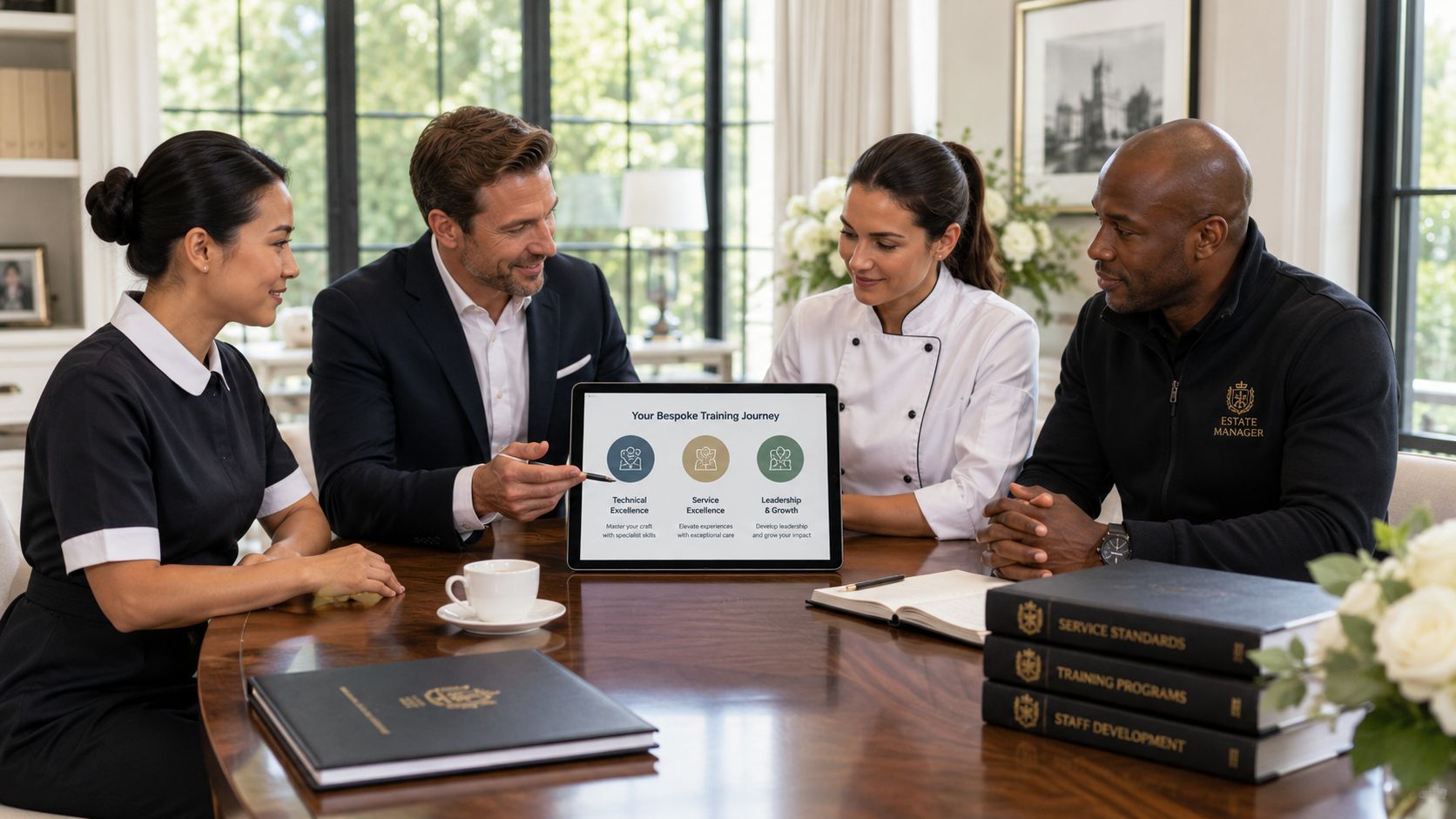
Start with the gap between current performance and the standard you expect. Do not start with a course list.
Start with pre-assessment
Before you approve any training, establish a baseline. Watch the staff member work. Review handovers and recurring mistakes. Test judgement with real household scenarios. Pinpoint where speed, polish, judgement, or confidence fall short.
Without that step, training becomes expensive theatre.
A useful pre-assessment should cover:
- Capability review: what the staff member already handles well
- Standards review: where execution misses household expectations
- Confidence review: where the person hesitates, over-checks, or avoids ownership
- Aspirations review: which responsibilities they want to grow into
This approach gives you something far more useful than generic “development.” It gives you a management tool. You can assign training with purpose, judge whether it worked, and decide who is ready for more responsibility.
Build the curriculum in three layers
I advise clients to separate household training into three layers. That keeps the programme disciplined and prevents the usual mistake of focusing only on compliance while ignoring judgement and polish.
Compliance and risk management
This layer covers the requirements attached to the role. It may include first aid, safeguarding, food hygiene, confidentiality procedures, driving protocols, medication handling, or travel security routines. Keep records current and filed centrally. If a certificate expires, your system should catch it before the risk returns to your doorstep.
Role-specific mastery
Private households either create excellence or settle for adequacy.
A nanny may need sharper developmental planning, better travel routines, or stronger educational structure during school breaks. A chef may need to adapt menus for allergies, formal service, and wellness goals set by the family office. A housekeeper may need advanced wardrobe care, antiques handling, floral upkeep, or tighter reset procedures after guests leave.
For childcare roles, benchmarked training is particularly important. Families aiming for a higher standard often study the elite training model of Norland College because it shows the difference between kind care and disciplined professional childcare.
Professional polish
This layer protects the atmosphere of the home. Staff can be technically capable and still create friction if their communication, presentation, or judgement feels clumsy.
Include training on guest interaction, written updates, diary etiquette, personal presentation, discretion, and calm communication under pressure. These skills shape how the household feels day to day. They also determine whether a principal experiences staff as reassuring or draining.
A business discipline helps here. The logic behind designing leadership programs for ROI applies well to domestic staffing. If a training activity does not improve judgement, consistency, or ownership, remove it from the plan.
Set SMART goals that actually guide performance
A private household does not benefit from vague goals. “Improve communication” is too loose to manage. “Provide an end-of-day nursery handover covering meals, sleep, activities, and supplies in the agreed written format for six weeks” gives you a clear standard and a clear review point.
Use goals such as:
- For a nanny: plan and document a structured weekly activity schedule aligned with the children's developmental stage
- For a housekeeper: maintain room-readiness to the agreed checklist without follow-up prompts
- For a family assistant: reduce diary conflicts by using a standard confirmation process for all appointments
- For a chef: deliver rotating menus that meet dietary preferences and event requirements with fewer last-minute revisions
Specific goals make management cleaner. Staff know what good looks like. You know what to measure. And the household gets a development system that improves retention, protects standards, and treats people as the serious asset they are.
Implementing Mentoring and Appraisals
A travel-heavy week ends badly when the nanny improvises a handover, the chef misses a dietary change, and the housekeeper assumes someone else reset the guest suite. None of this points to poor intent. It points to poor management systems. In a well-run residence, mentoring catches small issues early and appraisals turn those lessons into clearer standards, stronger judgement, and better retention.

Treat this as talent management, not a courtesy exercise. High-performing households run two review rhythms at the same time. Mentoring handles day-to-day judgement and course correction. Appraisals handle accountability, advancement, compensation logic, and development priorities.
Use mentoring to sharpen judgement in real time
Good mentoring is short, specific, and private. Ten minutes after a school run, before staff sign off for the day, or after a family trip is often enough. The point is to improve performance while details are still fresh.
Ask direct questions:
- What went smoothly this week
- Where did timing or communication break down
- What required unnecessary follow-up
- What would help you handle this independently next time
Done properly, mentoring builds confidence without lowering standards. It also reduces the build-up of quiet frustration that later appears as defensiveness, inconsistency, or resignation. For background on the benefits of workplace mentorship, the business case is straightforward. Regular guidance improves performance because people get correction before mistakes become habits.
Use appraisals to formalise standards and next steps
An appraisal should document what changed, what improved, and what comes next. It is a management record. It should never read like a vague conversation summary.
A simple appraisal form should include:
| Review area | What to document |
|---|---|
| Core performance | Delivery against the agreed role profile |
| Household standards | Consistency, discretion, communication, judgement |
| Development progress | Completed training and practical application |
| Next-stage growth | New goals, mentoring needs, added responsibility |
Use appraisals to decide who is ready for more autonomy, who needs closer oversight, and where training money should go. This is how you build a professional development framework that works like a strong business system while respecting the personal nature of a private home.
Fair access matters. Guidance from the de Beaumont Foundation on engaging all employees highlights the need to review who receives development opportunities, since access often varies by role and visibility across an organisation. In a household, that means the polished senior nanny should not receive every investment while the quieter laundress, housekeeper, or driver receives none. Development should fit the role, but access to growth should be managed deliberately.
If you run a larger estate, assign clear ownership for reviews, records, and follow-up. This checklist of household manager responsibilities is a practical reference for defining who should lead that process.
Measuring Success and Tracking Progress
A member of staff returns from excellent training, everyone feels positive for a week, and then the household slips back into old habits. That is what happens when development is treated as an event instead of a management system.
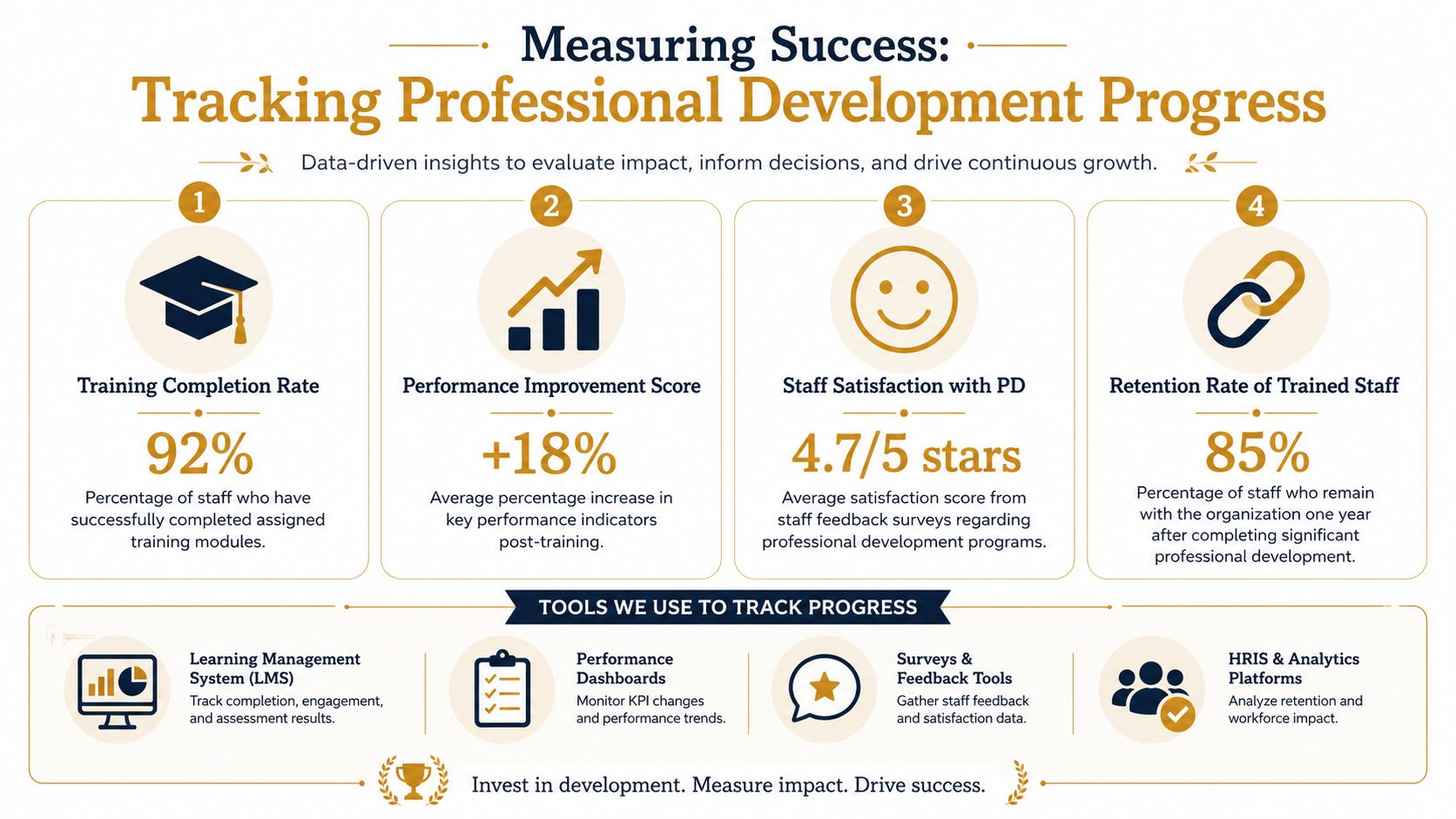
In a private residence, training only has value when it changes day-to-day performance. You are not funding courses to collect certificates. You are building a household team that operates with more judgement, more consistency, and less need for your intervention. Measure that.
Track outcomes that affect the home
A household does not need a corporate scorecard. It needs a tight set of indicators linked to the original purpose of the training and the standards of the home.
Use measures such as:
- Task consistency: are routines carried out to the same standard across shifts, properties, or travel periods
- Autonomy: does the staff member handle routine issues correctly without asking for direction
- Accuracy: are inventories, wardrobes, schedules, logs, or household records kept correctly
- Principal confidence: are fewer corrections, reminders, or rescue interventions needed
- Professional judgement: are decisions made with stronger timing, discretion, and awareness of the household's preferences
These are the signals that tell you whether development is improving the operation of the residence, not just the appearance of professionalism.
Keep a proper record
Every staff member should have a CPD log. Digital is easier to maintain, but paper is acceptable if someone is accountable for updating it.
Record four things:
- What development took place
- What the staff member was expected to apply
- What changed in practice
- What still needs correction or reinforcement
If you record attendance alone, you are tracking administration. You are not tracking growth.
Use a review cycle that is short and disciplined
Do not wait six months to find out whether training worked. Set a review point while the learning is still fresh and observable.
A practical cycle looks like this:
- Define the standard to improve
- Provide the training, coaching, or shadowing
- Observe performance in live household conditions
- Review the evidence after an agreed period
- Decide whether to reinforce, adjust, or raise expectations
This approach works because a private home runs on behaviour, judgement, and repetition. Professional development staff should be managed with the same discipline you would expect in a high-performing business, but with measures that reflect the realities of domestic life.
Ask for evidence you can see
“Much improved” is not a useful conclusion. Look for proof inside the running of the household.
A nanny's weekly planning should become clearer and more reliable. A housekeeper's finishing checks should produce fewer missed details. A family assistant should start anticipating needs earlier, with fewer reactive messages and fewer last-minute scrambles.
Short feedback forms, manager observation notes, and simple pre- and post-training comparisons are usually enough. Heavy software is unnecessary. Consistent follow-through is not. Without it, development becomes a gesture. With it, staff training becomes a repeatable performance system that protects standards, supports retention, and increases the value of every good hire.
Building Long-Term Career Pathways
Top-tier staff do not stay solely because they like the family. They stay because the role remains professional, respectful, and progressive.
That is where many affluent households lose strong people. The employee performs brilliantly for a period, but the job never evolves. Responsibility stays static. Learning stalls. Pay may rise occasionally, but the role itself feels flat. Eventually, the person leaves for a position that offers growth.
The retention risk is real. Recent workforce research shows that 58% of professionals are likely to leave their job if they don't receive development opportunities, according to this report on development and retention. In a private household, that should be read as a warning. If you want loyalty, give people a future.
What a household career path can look like
Career progression in a residence does not need a corporate org chart. It does need visible steps.
Examples include:
- Nanny to senior nanny or head nanny: with greater oversight of routines, travel planning, and mentoring of junior childcare staff
- Housekeeper to head housekeeper: with responsibility for standards, stock systems, and delegation
- Family assistant to house manager support role: with wider control over logistics, vendors, and scheduling
- Chef to lead hospitality role: with input into entertaining, provisioning, and event coordination
Match progression with responsibility
Promotion without changed responsibility is empty. If a staff member is growing, reflect it in what they own. Let them train new starters. Give them authority over a defined area. Ask them to improve a process and report back.
A strong pathway often includes:
| Stage | What changes |
|---|---|
| Skill growth | Better execution and more consistent judgement |
| Scope growth | Ownership of more complex tasks or wider areas |
| Leadership growth | Mentoring, onboarding, or quality control responsibilities |
| Recognition growth | Compensation and title aligned with added value |
A domestic role becomes a career when the staff member can see what comes next and what they must master to earn it.
This is especially important with high-performing nannies, governesses, and house managers. Ambitious professionals want standards, but they also want momentum. Give them both and you create a partnership rather than a revolving-door hire.
Conclusion Your Partner in Household Excellence
A polished household doesn't happen because you hired well once. It happens because you build a system that helps good people become exceptional and stay that way. That's what professional development staff are really for. Clear roles, relevant training, fair feedback, proper measurement, and visible career pathways.
When that framework is in place, your home runs with more consistency, more discretion, and far less friction. Staff feel supported. Standards rise. You gain peace of mind.
Ready to build your five-star household team? Contact Superstar Nannies today for a confidential consultation on creating a bespoke professional development programme for your staff.
Frequently Asked Questions
What does professional development staff mean in a private household
In a household, professional development staff refers to the people and systems responsible for improving how your domestic team performs over time. That may be led by a principal, house manager, family office representative, or external adviser. The key is that development is organised, documented, and tied to household standards, not left to chance.
How often should household staff receive training
Core compliance training should follow the relevant certification or household requirement. Beyond that, staff should have regular development touchpoints throughout the year. In practice, that means brief mentoring check-ins, periodic skills reviews, and formal appraisals on a set schedule. Waiting for problems before offering training is poor management.
Should every staff member receive the same development opportunities
No. Development should be fair, not identical. Different roles require different skills, and some staff will be ready for more advanced responsibilities than others. What matters is that access is not reserved only for the loudest, longest-serving, or most visible employee. Every role should have a credible path to growth.
What is the best way to measure whether training worked
Use a simple before-and-after approach. Start with a clear goal, observe current performance, provide targeted training, then review whether behaviour changed in day-to-day work. Look for improved consistency, better judgement, stronger communication, and less need for supervision. If you only record course completion, you haven't measured impact.
Can a small household still benefit from a development framework
Absolutely. You do not need a large estate for this to matter. In fact, smaller households often feel training gaps more sharply because each person carries more responsibility. Even with one nanny and one housekeeper, a basic framework for expectations, coaching, and growth can transform how smoothly the home runs.
If you want discreet, expert support in building a stronger household team, Superstar Nannies can help you recruit, structure, and retain exceptional staff with the standards a private residence demands.