


A familiar London morning often starts with three calendars colliding at once. A school drop-off in one postcode. A business meeting across town. A medical appointment, fitting, lunch, or airport run threaded somewhere in between. Add security concerns, waiting time, bags, changes of plan, and the need for complete discretion, and standard transport stops feeling convenient very quickly.
That's where a personal driver becomes less of a luxury purchase and more of an operating decision. In practice, clients usually aren't choosing between “driver or no driver”. They're choosing between fragmented, reactive travel and a single reliable person who can support the day properly.
In the London market, the language matters. A personal driver usually suggests a broader, day-structured role built around your routine. A chauffeur often signals a more polished, premium service style, sometimes focused on formal bookings, executive movements, and presentation. In elite households, those lines blur. The right person often needs both: polished enough for diplomatic or business-facing duties, practical enough for school runs, waiting, errands, and household logistics.
Introduction Your Ultimate Guide to Hiring a Personal Driver in London
London generates enough daily movement to explain why this role has become so valuable. Transport for London reports that London residents make 6 million journeys by car per day, including 4.6 million car-driver trips and 1.4 million car-passenger trips. TfL also says nearly six in ten of these journeys are for shopping, leisure, or other non-work purposes. That matters because many of the journeys families need covered aren't single A-to-B business transfers. They're layered, domestic, time-sensitive movements that require patience, route knowledge, and flexibility.

For high-net-worth and ultra-high-net-worth households, the strongest value isn't usually the car itself. It's continuity. One driver who knows the family timetable, understands preferred routes, handles waiting without fuss, and works calmly around household staff can remove a surprising amount of friction from daily life.
What clients are usually deciding
Some households need a full-time retained driver. Others need a day chauffeur several times a week. Others still need someone for peak periods only, such as term-time school logistics, London season events, airport movements, or periods when principals are entertaining heavily.
The better question isn't “Do we need a personal driver in London?” It's this:
A personal driver earns their place when your travel needs involve sequence, waiting, confidentiality, and unpredictability, not just transport.
That's why this hire often sits alongside broader private household staff support. The driver isn't an isolated vendor. In many homes, they become part of the rhythm of the household.
What works and what doesn't
What works: hiring for temperament, discretion, and reliability first, then polishing presentation around that.
What doesn't: choosing on vehicle brand alone, or assuming any premium booking service can replicate the consistency of a properly integrated driver who knows your family, security expectations, and daily pressures.
The Legal Framework Licensing Vetting and Insurance Requirements
If someone is driving for hire in London, compliance isn't optional. It's the baseline. A polished manner and a smart suit don't tell you whether the person is properly licensed, medically fit to drive professionally, or legally eligible to do the work.
In London, a private hire driver must generally hold the appropriate TfL private hire licence. According to London chauffeur licensing guidance summarising TfL requirements, applicants must be at least 21, hold a full driving licence for at least 3 years, have the right to work in the UK, pass an enhanced DBS check, meet DVLA Group 2 medical standards, complete a tax check, and pass TfL assessments covering topographical skills, speaking and listening, and SERU requirements. That's a meaningful filter. It screens for more than driving ability.
What the licensing process actually tells you
A licensed driver has had to demonstrate several things that matter in a private household:
- Legal eligibility: they can lawfully undertake the role.
- Route competence: they've been tested on the practical realities of London movement.
- Communication standards: they can understand instructions and interact appropriately.
- Health suitability: they meet a professional medical standard for driving duties.
- Criminal record scrutiny: an enhanced DBS check forms part of the process.
None of that replaces private household vetting. But it does eliminate a large amount of avoidable risk.
Why this matters in a crowded market
The supply side is substantial. The UK government's taxi and private hire vehicle statistics for England 2024 show that, as at 1 April 2024, England had 313,000 licensed taxi and private-hire vehicles and 381,100 driver licences. The same report says the vehicle total was up 8.2% from 2023 and driver licences were up 10% year on year. It also notes that licensed taxis in London fell by 2.1% in 2024, while private-hire vehicles in England rose by 10.5% to 256,600. In other words, London sits inside a mature, heavily regulated, highly competitive market.
Practical rule: if a candidate or service is vague about licensing, insurance, or check status, stop the conversation there.
Household vetting goes beyond transport compliance
A principal or family office still needs to assess suitability for domestic service. That includes reference integrity, gaps in employment, confidentiality, boundaries, judgment around children, and comfort working in close contact with other household staff.
If you're reviewing screening processes internally, these legal rules for employer background checks are a useful starting point for understanding the broader UK framework around employment checks. In private staffing, legal compliance and role-specific suitability have to sit together.
For elite households, the strongest process mirrors the standards used in specialist high-profile staffing vetting. A driver may have access to children, homes, travel plans, routines, addresses, security habits, and confidential conversations. That makes this a safeguarding hire as much as a transport hire.
Hiring Routes Comparing Agency Placement and Direct Hire
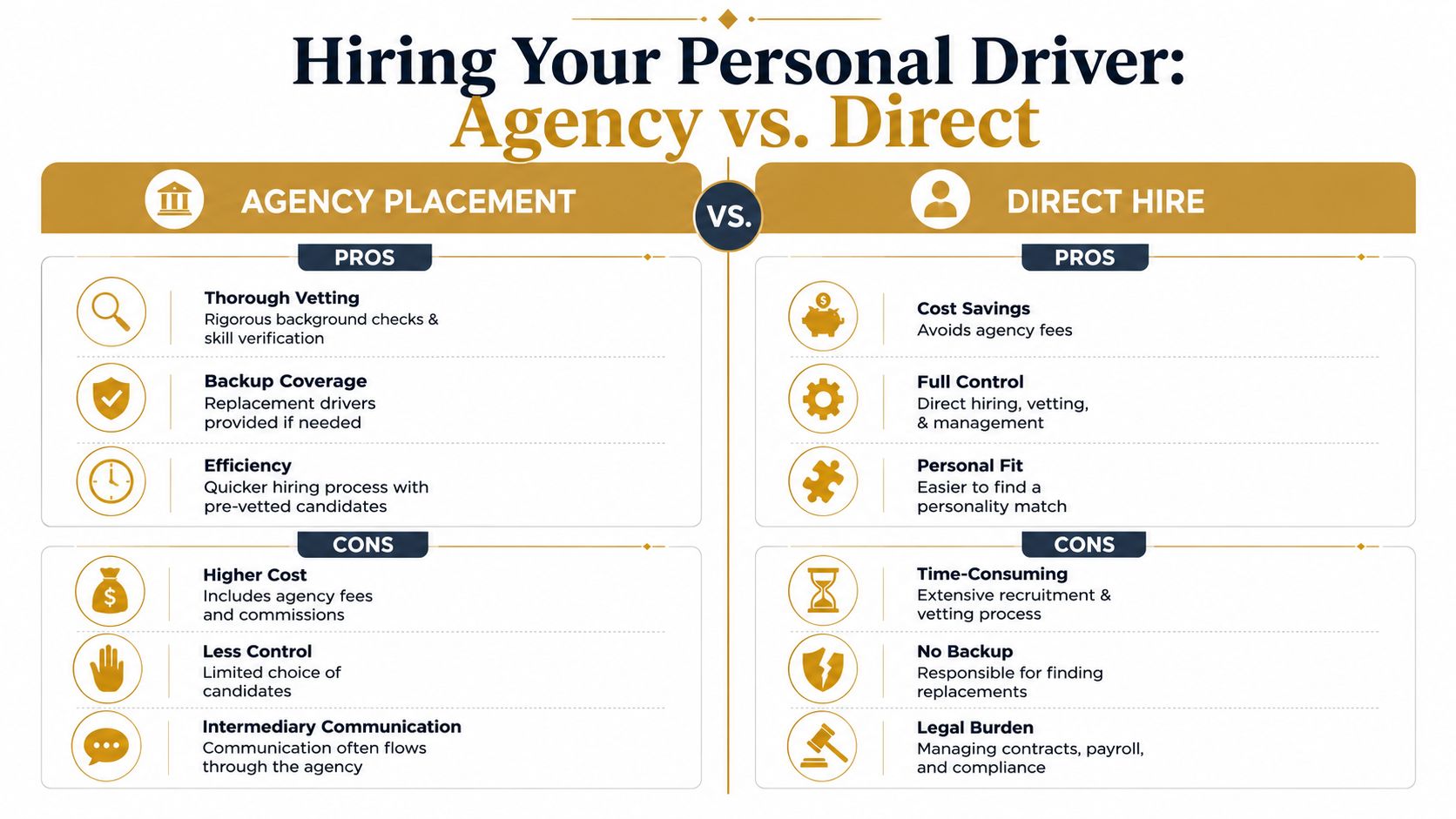
There are two realistic ways to secure a personal driver in London. You either appoint through a specialist agency, or you hire directly and run the process yourself. Neither route is automatically right. The sensible choice depends on how much time, internal support, and risk appetite your household has.
Agency placement
Agency placement suits households that want a curated shortlist, stronger front-end filtering, and help managing confidentiality from the start. In practical terms, it's usually the cleaner route when the role includes family logistics, security sensitivity, or integration with a wider domestic team.
Advantages
- Pre-vetted candidates: an experienced consultant should remove applicants who don't meet the brief before you see them.
- Discretion: a specialist agency can protect principal identity and address details during early-stage recruitment.
- Speed: households avoid sorting through unsuitable CVs and incomplete references.
- Replacement support: if the fit isn't right, there's usually a process for finding another candidate.
Trade-offs
- Higher upfront cost: you're paying for sourcing, screening, and placement expertise.
- Less raw market visibility: you won't see every possible applicant.
- Process discipline: you'll usually need to work within the agency's stages and timelines.
Direct hire
Direct hire can work well for principals or family offices with strong in-house HR support. It can also suit clients who already have a trusted referral and only need help polishing the final checks.
Here's where direct hire often becomes heavier than expected:
| Route | Best for | Main pressure point |
|---|---|---|
| Agency placement | Confidential, urgent, security-aware hires | Fee and process cost |
| Direct hire | Clients with time and internal admin support | Vetting, contracts, and contingency |
Direct hire strengths
- Closer control: you set the brief, shortlist, and interview process yourself.
- Potential cost efficiency: no agency placement fee.
- Personal fit: some principals prefer direct involvement from first contact.
Direct hire weaknesses
- More administration: contracts, references, payroll decisions, and onboarding sit with you.
- No built-in backup: if the driver leaves, falls ill, or proves unsuitable, you start again.
- Screening risk: poor vetting rarely shows up on day one. It shows up later, when routine and trust matter most.
The households that struggle most with direct hire are usually not short of candidates. They're short of time to verify them properly.
For clients weighing both paths, it helps to review how specialist private household staff agencies in the UK structure search, shortlist, and replacement support. The route that feels cheapest at the start isn't always the route that proves most efficient once the role goes live.
Decoding the Costs A Breakdown of Personal Driver Pricing
Cost questions are usually framed too narrowly. Clients ask what a personal driver in London costs, but the question is which pricing model matches the way the household moves. Paying hourly for an all-day, multi-stop schedule often becomes clumsy. Equally, retaining a full-time driver for occasional ad hoc use may not be the smartest deployment.
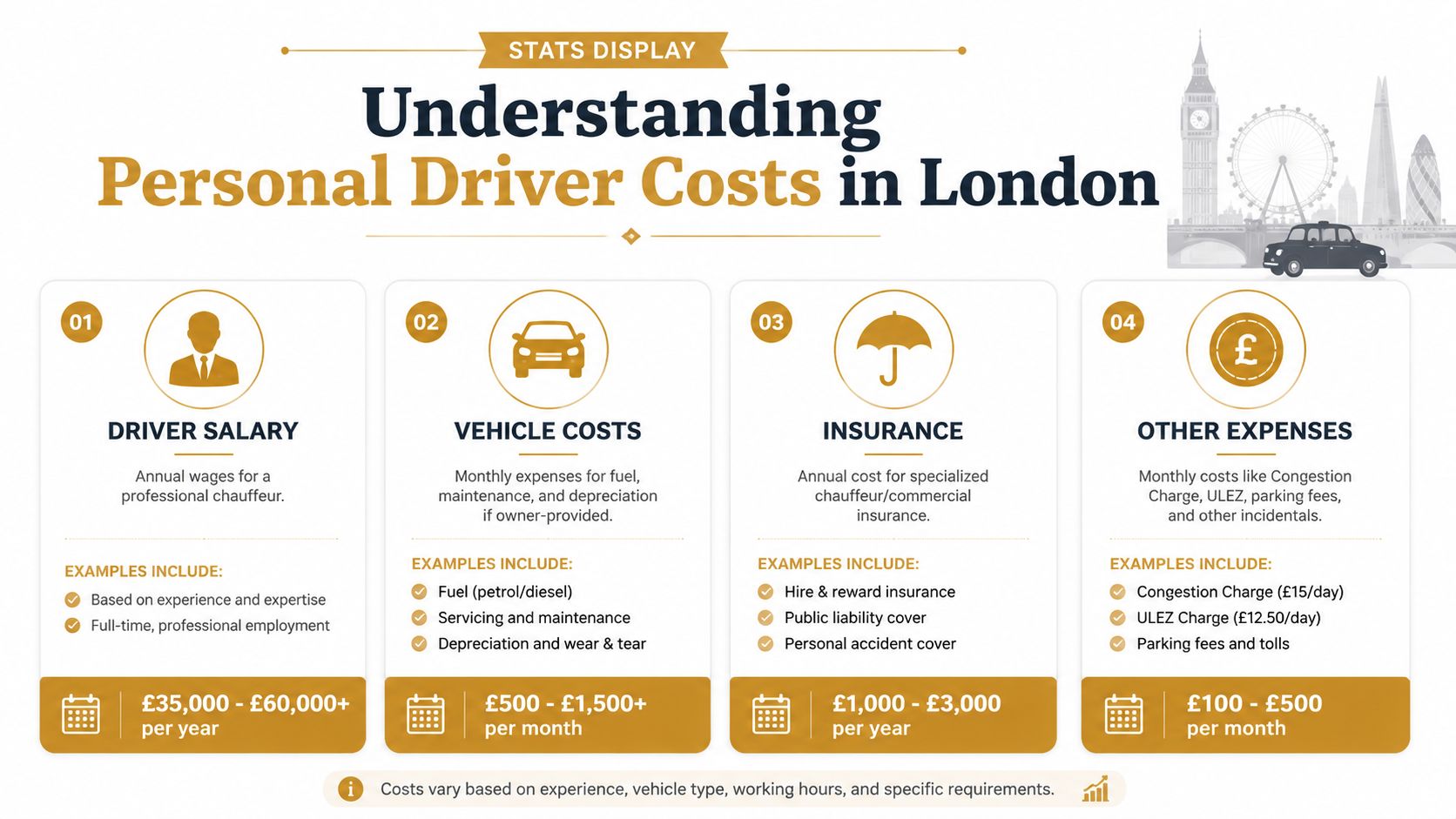
According to UK personal driver pricing benchmarks, personal driver hire typically ranges from £45 to £120 per hour, £300 to £800 per day, and £5,000 to £18,000 per month for a full-time chauffeur, depending on duties, experience, and vehicle requirements.
Which pricing model suits which need
Hourly hire works best when the household needs flexibility without long commitment. Think event transfers, a day of appointments, or short-term cover during travel peaks.
Daily hire tends to suit multi-stop itineraries with waiting time built in. This is often the cleanest structure for shopping, fittings, children's schedules, appointments, and evening movements in one organised block.
Monthly or retained arrangements make sense when transport is part of the household's operating routine. If someone is regularly handling school runs, recurrent appointments, airport duties, and principal availability windows, a retained setup often feels more efficient and more predictable.
What pushes the fee up
Price usually rises for sensible reasons, not arbitrary ones.
- Complex duties: school logistics, confidential errands, or schedule coordination require more than straightforward driving.
- Experience level: some households want candidates with strong formal-service backgrounds or greater security awareness.
- Availability pattern: early starts, late finishes, weekend demands, and on-call flexibility affect cost.
- Vehicle expectations: whether the driver provides the vehicle or the household does so changes the commercial structure.
A useful discipline is to cost the role around usage, not aspiration. If the household needs recurring support, compare ad hoc spend against the practical value of continuity. If the need is occasional, avoid overcommitting.
Clients trying to benchmark offers in more detail can review this guide on how much a personal chauffeur costs. The useful part isn't the headline figure. It's understanding what the quote includes and what it leaves out.
Beyond the Wheel Duties and Service Levels for UHNW Families
A strong household driver doesn't just arrive, drive, and disappear. In the best appointments, the role becomes a quiet logistical function that protects the family's time and lowers daily friction.
That matters most in homes where several things are happening at once. One child needs collecting. Another principal is running late. A parcel has to be collected securely. A guest needs meeting. The route has changed because of an event, protest, or road closure. None of that is dramatic, but all of it requires judgment.
What the role often includes in reality
For UHNW families, the value of the role extends beyond transport. Industry guidance on elite private driver services notes that the strongest value often lies in reliability for multi-stop household logistics such as school runs and errands, absolute discretion with confidential information, and day-structured flexibility. In these settings, luxury branding can matter less than calm execution.
A well-placed driver may handle:
- School and children's logistics: punctual pickups, waiting, communication with household staff, and smooth handovers.
- Errands and collections: documents, shopping, prescriptions, wardrobe items, or guest support.
- Vehicle readiness: cleanliness, fuelling, charging, and general presentation.
- Time protection: structuring movement so the principal isn't solving transport problems all day.
- Discretion: keeping travel patterns, conversations, addresses, and routines confidential.
In elite households, the best driver is often the person everyone relies on and almost never has to think about.
Where service levels really differ
The largest gap between average and exceptional candidates isn't roadcraft alone. It's composure and anticipation.
An average driver waits for instructions. An exceptional one notices that a child is delayed, confirms the revised order of movements, adjusts the route, keeps the car ready, and does it without creating stress. A polished chauffeur presentation is welcome, but in domestic service the deeper skill is operational steadiness.
What tends not to work is hiring someone who only understands formal executive transfer work. That experience can be valuable, but family life is less linear. Plans move. Children overrun. Appointments shift. Household drivers need professional boundaries, but they also need flexibility and common sense.
The Vetting Blueprint Interview Questions and Contract Essentials
Once you've narrowed the shortlist, the hiring decision usually turns on small indicators. The CV may look tidy. The references may sound acceptable. The interview is where you discover whether the person can function inside your household.
Interview for judgment not charm
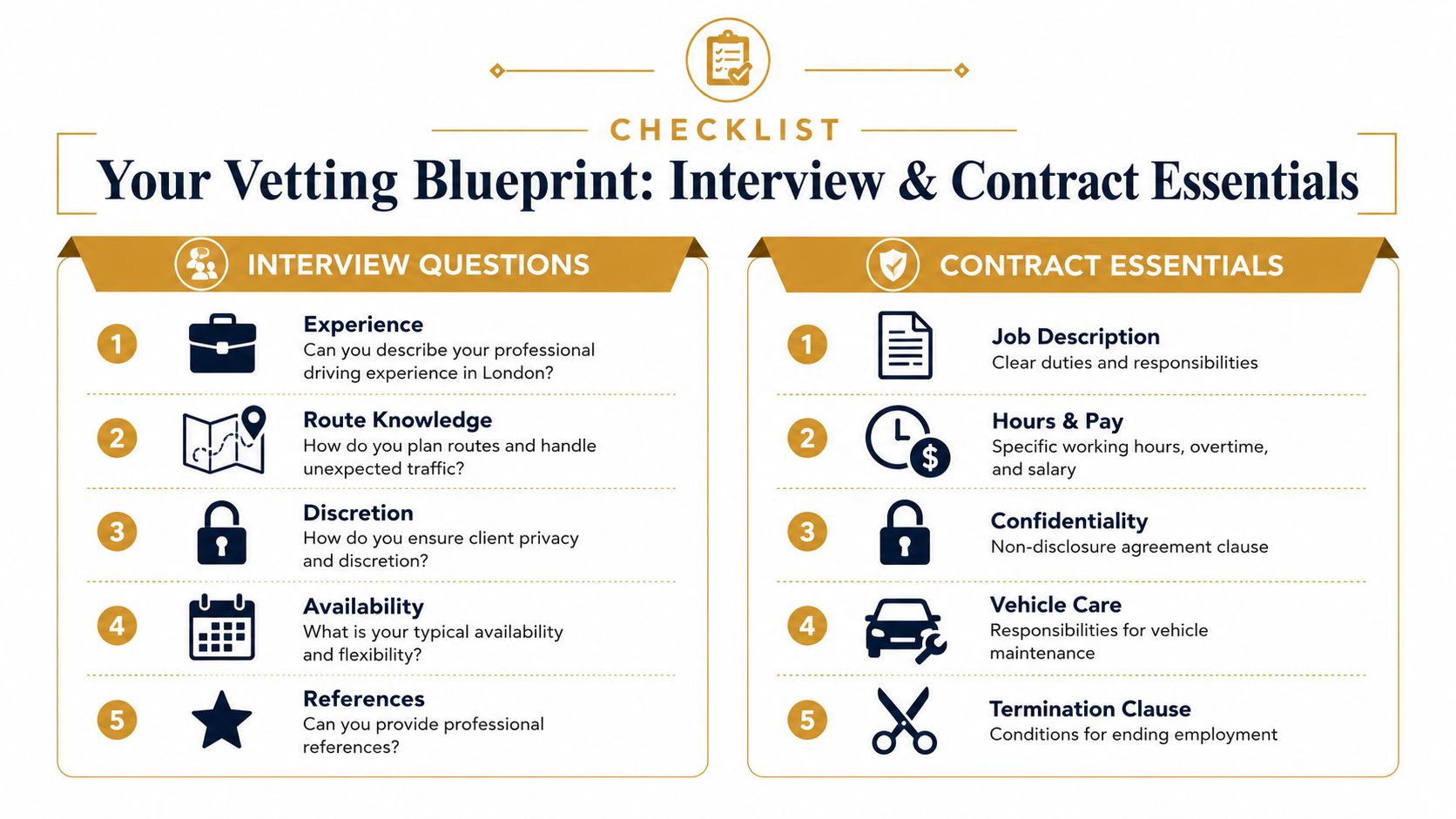
A smooth candidate can interview well and still be wrong for the role. The most useful questions test decision-making, privacy instincts, and resilience.
Consider asking:
- Tell me about a household or principal schedule you've supported that changed frequently. How did you stay organised?
- What do you do when a route collapses because of traffic, closures, or a late-running passenger?
- How do you handle confidential information overheard during the working day?
- Describe your approach to children, family staff, and guest movements.
- What does excellent vehicle presentation mean in your own routine?
Listen for specifics. Good candidates talk about systems, communication, timing, and restraint. Weak candidates stay vague or overstate their adaptability.
Hiring cue: if a driver speaks more about prestige than punctuality, they may be selling an image rather than describing a service mindset.
Check the CV with a sceptical eye
Reviewing a driver's profile requires more than confirming licence status.
Look for:
- Stable service history: frequent short tenures may need explanation.
- Household or principal-facing experience: commercial driving and domestic service aren't identical.
- References you can verify properly: not just glowing comments on paper.
- Consistency: dates, duties, geography, and progression should make sense.
For a broader screening framework, this essential guide for business background checks is useful background reading. Private household hiring has its own sensitivities, but the discipline of checking identity, work history, and references thoroughly still applies.
Contract points that protect both sides
A strong contract prevents confusion later. At minimum, it should cover:
| Contract area | Why it matters |
|---|---|
| Duties | Clarifies whether the role includes children, errands, waiting, guests, or vehicle care |
| Hours and flexibility | Prevents dispute around early starts, overtime, evenings, and weekends |
| Pay structure | Distinguishes salary, day rate, overtime, expenses, and any standby arrangement |
| Confidentiality | Protects addresses, routines, conversations, travel plans, and family information |
| Vehicle rules | Sets responsibility for maintenance, cleaning, use, and reporting issues |
| Termination terms | Gives both sides a clear exit framework |
The best contracts are precise without being theatrical. If the role requires unusual trust, write that trust into the terms clearly.
Conclusion Secure Your Elite Driver with Superstar Nannies
Hiring a personal driver in London isn't just about finding someone who can handle traffic. It's about securing a professional who can operate within the rhythms, standards, and privacy demands of a high-functioning household.
The right hire is properly licensed, thoroughly vetted, contractually clear, and well-suited to the role. They understand London, and they possess an equally strong understanding of service. They know when to speak, when to wait, when to adapt, and when to disappear into the background.
Many of the same principles that apply in other private household hires also show up in practical guides such as HomeProBadge's babysitter hiring advice. The role is different, but the lesson is similar. Reliability, safeguarding, fit, and verification matter more than first impressions.
If you want a discreet, expertly managed search for a driver who can meet elite household standards, Superstar Nannies can help. A confidential consultation can save time, reduce risk, and ensure the shortlist reflects the level of trust this role requires.
FAQs About Hiring a Personal Driver in London
Is a retained personal driver better than a premium ride-hail service?
It depends on how you travel. Blacklane's hourly car service model highlights the key distinction: clients usually choose between a retained personal driver for consistent availability and discretion, or a premium service for ad hoc use. If your movements are irregular and simple, ad hoc can work. If your days involve waiting time, multiple stops, family logistics, and confidentiality, a retained driver is usually the better fit.
Should the driver provide the vehicle or should the household?
Both models exist. Some clients prefer a driver with their own suitable vehicle for flexibility. Others want the household to provide the car so standards, security features, maintenance, and presentation stay fully under their control. The right answer usually depends on how branded, formal, or security-conscious the role is.
Do personal drivers for UHNW families need specialist training?
Sometimes. Not every household needs advanced security credentials or first aid training, but some do. The brief should decide the requirement. A family with children, travel-heavy schedules, or higher-profile principals may want stronger safeguarding awareness, calm incident handling, and experience working around confidential routines.
What's the biggest mistake clients make when hiring?
Hiring on polish alone. Presentation matters, but it won't compensate for weak discretion, poor flexibility, or inconsistent reliability. The best appointments are built around temperament, judgment, references, and a clear understanding of the household's real daily pattern.
If you're looking to hire a personal driver in London with complete discretion, rigorous vetting, and a customized shortlist for your household, contact Superstar Nannies for a confidential consultation.