
Welcome to one of the most magical parts of being a parent: watching your child discover their voice. This guide is here to walk with you through the incredible journey of child language development stages, from the very first coos to those first, full-blown conversations.
Think of it less as a rigid checklist and more as a map to help you connect with and support your child on their own unique path.
Your Child’s Incredible Journey into Words
There’s nothing quite like hearing your child’s first words. It’s a profound moment where simple sounds suddenly blossom into real, meaningful connection. But this journey starts long before that first “mama” or “dada.”
This guide is designed to be your trusted companion on this adventure. It offers clarity on what to expect, reassurance that every child’s timeline is different, and practical, everyday ways you can create a world rich with language. The leap from a baby’s cry to a preschooler’s detailed story is truly one of the most remarkable parts of their growth, and you have a front-row seat.
Why Understanding These Stages Matters
Getting to grips with the key phases of language acquisition helps you tune into your child’s world on a deeper level. It’s about learning to spot the small but mighty steps they take every single day. For instance, a baby’s babbling isn’t just sweet noise; it’s a crucial practice session, the linguistic equivalent of a workout for their mouth as they master syllables and mimic the rhythm of your speech.
Knowing what’s typical for each stage allows you to:
- Celebrate Every Milestone: You’ll truly appreciate the incredible cognitive work behind each achievement, from the first intentional ‘mama’ to a full, complex sentence.
- Provide Age-Appropriate Support: You’ll know how to respond to their coos, expand on their first words, and ask the kinds of questions that spark real back-and-forth conversation.
- Spot Potential Red Flags Early: Understanding what’s expected helps you recognise when a little extra support might be needed, ensuring you can act quickly if concerns arise.
Building a Strong Foundation for Communication
A nurturing environment is the soil in which language skills grow and flourish. Every interaction—every song you sing, every story you read, every simple chat during a nappy change—is laying the foundation for a lifetime of effective communication. This is where both parents and dedicated caregivers, like an experienced nanny, can make a profound difference.
A child’s brain develops faster in the first five years than at any other time in their life. In fact, research shows that a staggering 85% of brain development is completed by age five, making these early interactions fundamentally important for building language and cognitive skills.
We’ll walk you through each stage, offering clear explanations and advice you can actually use. We’ll look at the building blocks laid down in the first two years, the conversational explosion that follows, and how you can turn everyday play into a powerful language lesson.
The Building Blocks of Language From Birth to Two Years
The first two years of a child’s life are an incredible period of transformation. It’s here that the foundations for all future communication are laid, brick by brick. Every gurgle, cry, and coo is a meaningful step on their journey towards language. Your baby moves from being a passive listener to an active participant in the world of words, and understanding these early developmental stages helps you appreciate every single milestone along the way.
This simple timeline shows the natural progression from listening and absorbing sounds to babbling and, eventually, forming those first treasured words.
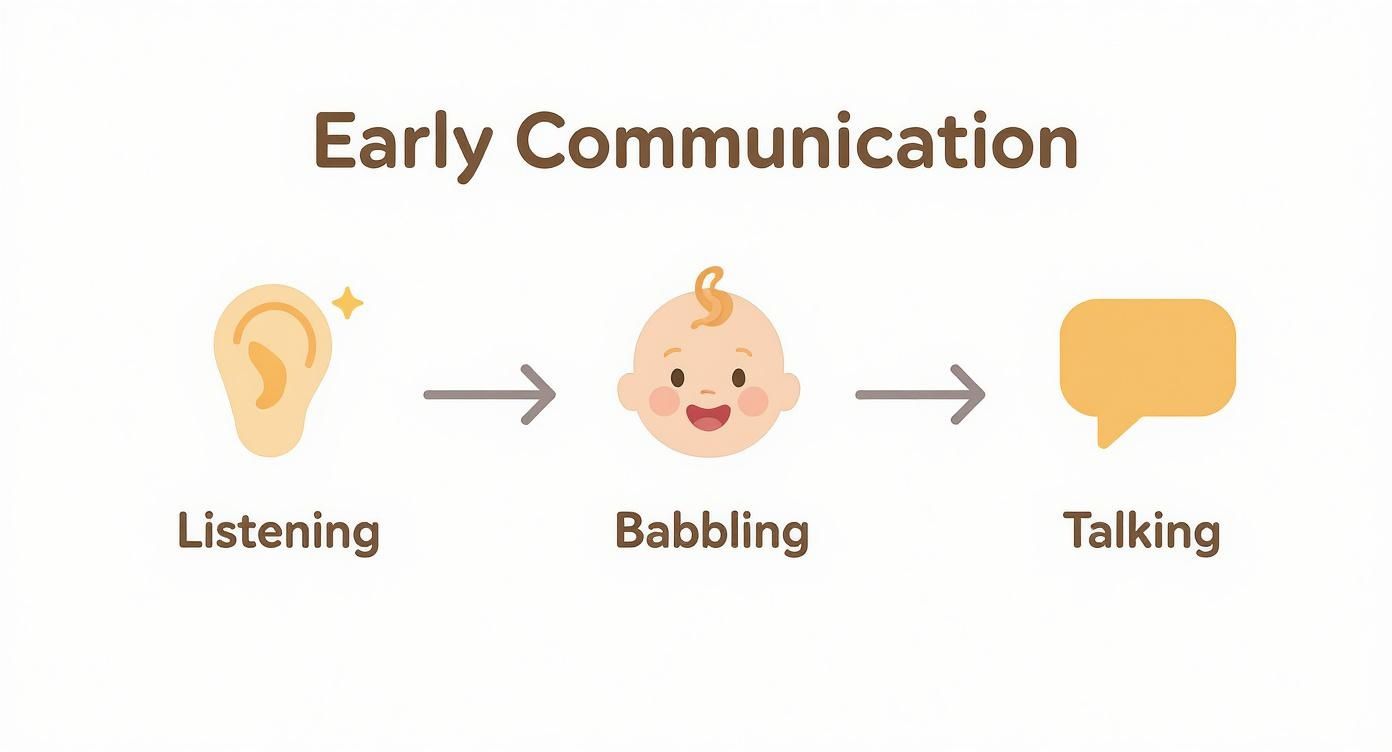
As you can see, each stage builds directly on the last. It’s a great visual reminder of just how vital those early listening skills are for developing spoken language later on.
From Cries to Coos: The First Six Months
In the very beginning (0-6 months), communication is purely instinctual. A baby’s cry is their first and most powerful tool for letting you know they need something, whether it’s hunger, discomfort, or simply a cuddle.
But before long, these urgent cries are joined by softer, more melodic sounds like cooing and gurgling. These delightful noises, often full of “oohs” and “aahs,” are your baby’s first real experiments with their vocal cords. They are literally learning how to control the muscles needed for speech, and when you respond to these sounds, you’re having your very first conversations.
Babbling and First Understanding: Six to Twelve Months
Around the six-month mark, a significant shift happens. The gentle coos evolve into babbling, which starts to sound much more like real speech. You’ll begin to hear clear, repeated consonant-vowel combinations, such as “bababa” or “dadada.” This isn’t just random noise; it’s a critical practice phase.
Your baby is now actively mimicking the rhythms and tones of the language they hear all around them. At the same time, their receptive language—what they understand—is growing by leaps and bounds. They’ll start to recognise their own name, respond to simple requests like “wave bye-bye,” and understand the meaning of “no.”
Every time you engage with your baby’s babbling, you are reinforcing the back-and-forth rhythm of conversation. This turn-taking is the fundamental structure of all human dialogue and is a crucial lesson learned long before the first word is ever spoken.
For a more detailed look at what to expect during this exciting period, have a look at a practical guide to speech development milestones for ages 0-3.
First Words and Simple Phrases: Twelve to Twenty-Four Months
The period between one and two years is often when the real magic happens. Those repeated “mamama” sounds finally connect to a specific person, and suddenly “mama” has real meaning. This stage is marked by the thrilling arrival of first words and, soon after, a rapid explosion of new vocabulary.
By their second birthday, many toddlers can point to pictures in a book when you name them, follow simple two-step instructions, and use around 50 or more single words. They then begin stringing two words together to form mini-sentences like “more juice” or “my ball,” expressing complex ideas in a simple but effective way. This exciting phase truly highlights the importance of early childhood education and interaction in building a strong verbal foundation.
To help you track this incredible progress, we’ve put together a simple checklist of key milestones to watch for.
Language Milestones Checklist From Birth to Two Years
This table gives a clear summary of the key receptive (what they understand) and expressive (what they can say) language milestones for infants and toddlers. It’s a helpful guide to see how your little one is progressing.
| Age Range | Receptive Language Milestones (Understanding) | Expressive Language Milestones (Speaking) |
|---|---|---|
| 0-6 Months | Turns head towards sounds. Responds to changes in your tone of voice. Seems to recognise your voice. | Makes cooing and gurgling sounds. Cries in different ways to express different needs. |
| 6-12 Months | Responds to their own name. Understands simple words and gestures like “no” and “bye-bye.” | Begins babbling with repeated syllables (e.g., “bababa”). Tries to imitate speech sounds. |
| 12-18 Months | Can point to body parts when asked. Follows simple one-step commands (e.g., “Give me the cup”). | Says first words like “mama” or “dada” with meaning. Uses at least 10-20 single words. |
| 18-24 Months | Understands simple questions. Can point to objects in a book when named. | Begins using two-word phrases (e.g., “want milk”). Has a vocabulary of 50+ words. |
Remember, every child develops at their own pace, but this checklist provides a great overview of what you can typically expect during these foundational first two years.
The Conversational Leap From Two to Five Years
If the first two years are all about laying the foundational bricks of language, the preschool years are when your child becomes a true architect, building elaborate structures of thought and expression. This period, from age two to five, is nothing short of breathtaking. Their personality doesn’t just peek through—it starts telling you exactly who they are in full, colourful sentences.
This is a key phase in the child language development stages, where simple words blossom into complex conversations, questions, and the most incredible stories.

The Two-Year-Old Word Explosion
Between two and three, your toddler’s vocabulary expands at a head-spinning pace. It’s often called the ‘word explosion,’ and it truly feels like they learn a new word every time you turn around. They’ll quickly move beyond two-word phrases to stringing together three or four words, like “Me want big car” or “Nanny read book now.”
Their sentences might not be grammatically perfect just yet, but the intent is crystal clear. They are now actively using language not just to name things but to state opinions, make demands, and describe the world as they see it.
This rapid growth is more than just vocabulary; it’s a huge cognitive leap. Your child is starting to grasp the basic rules of grammar, instinctively understanding that the order of words changes their meaning. This is the moment they truly begin to converse, rather than just label.
This is also the time when their speech becomes much clearer to people outside your immediate circle. The physical development of their speech sounds plays a massive part in this newfound clarity.
By age three, about 90% of children have mastered basic consonant sounds like m, b, p, h, and w, alongside all their vowel sounds. By age four, 90% of children can typically produce more complex consonants like k, g, t, d, n, f, and ng. This gradual acquisition is what makes their delightful chatter increasingly understandable. You can explore the full developmental sequence and find more insights about speech sound acquisition on Birth to 5 Matters.
The Age of Endless Questions
From age three to four, you officially enter the famous ‘why?’ phase. I know from experience that it can sometimes test your patience, but this incessant questioning is a brilliant sign of a curious mind hard at work. Each “why?” is a tiny investigation into cause and effect, showing that your child is trying to build a logical framework for how the world works.
During this stage, their language skills become far more sophisticated. They start using connecting words like “because” and “so” and can follow more complex, multi-step directions. They’re not just asking questions; they are also beginning to answer them with more detailed explanations.
- Growing Grammar: They begin to use past and future tenses more accurately (e.g., “We went to the park,” “We will see Grandma tomorrow”).
- Pronoun Progress: Pronouns like ‘I’, ‘you’, ‘he’, and ‘she’ are used much more consistently.
- Engaging in Dialogue: Conversations become genuine back-and-forth exchanges, moving beyond simple question-and-answer routines.
The Emergence of the Storyteller
As your child moves towards age five, they transform into a budding storyteller. This is one of the most magical parts of the preschool language journey. They can now recall past events with surprising detail and narrate them in a logical sequence.
This ability to tell stories signals a massive step in their cognitive and linguistic development. It requires them to organise their thoughts, remember details, and use language to paint a picture for their listener. A simple trip to the zoo can suddenly become an epic tale filled with roaring lions and cheeky monkeys.
Imagine a chat with a four-year-old:
Parent: “What was your favourite part of our trip to the zoo today?”
Child: “I loved the big, big lion! He was sleeping, but then he woke up and did a big ROAR! It was so loud! And then we saw the monkeys eating bananas. One was silly and swinging all the way to the top. I think he was showing off for us.”
This little dialogue reveals so much more than just a memory. It demonstrates:
- Sequencing: Recalling events in the right order (“then we saw the monkeys”).
- Descriptive Language: Using adjectives to add colour (“big, big lion,” “silly monkey”).
- Making Inferences: Guessing the monkey’s motivation (“I think he was showing off”).
- Expressing Feelings: Communicating the emotional impact of the event (“It was so loud!”).
By age five, a child’s language is remarkably complex. They can typically use sentences with five or more words, understand humour and rhymes, and carry on conversations that feel very similar to an adult’s. This period truly sets the stage for the literacy and social skills they will need as they get ready for school and the world beyond.
How To Nurture Language Skills Through Play
Knowing the theory behind your child’s language development is one thing, but putting that knowledge into practice is where the real magic happens. The good news? The best tools for the job are probably already in your home: connection, fun, and everyday play. These simple, joyful interactions are the very foundation of exceptional communication skills.
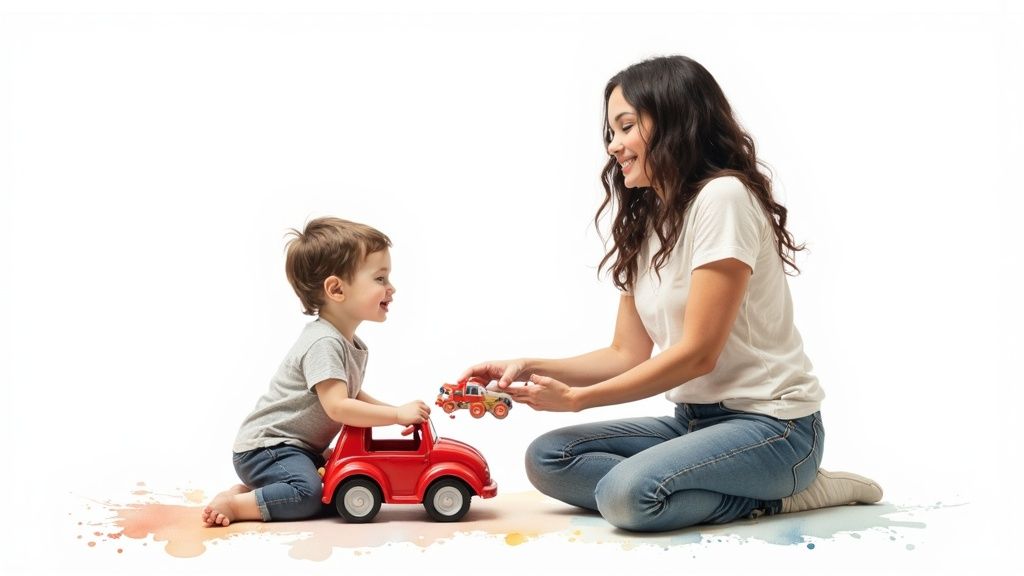
Creating a language-rich environment doesn’t mean you need expensive toys or complicated lesson plans. It’s all about weaving conversation and interaction into the fabric of your daily life, turning even the most routine moments into powerful learning opportunities.
Sparking Language in Infants
For the youngest learners, your voice is the most fascinating sound in their world. The main goal here is simply to be responsive and engaging. You’re teaching them the fundamental back-and-forth rhythm of conversation long before they can say a single word.
- Use ‘Parentese’: This is that high-pitched, sing-song voice adults naturally slip into with babies. It’s not just baby talk; research shows its slow pace and exaggerated vowels actually help infants tune in and learn the distinct sounds of their native language.
- Respond to Coos and Babbles: When your baby makes a sound, make one back. This simple exchange is profound. It teaches them that their voice has power and is a genuine form of communication, validating their very first attempts to talk.
- Narrate Your Day: Talk about what you’re doing, even if it feels a bit silly at first. “I’m washing the dishes now, look at all the bubbles!” or “Let’s find your cosy blue socks.” This surrounds them with vocabulary in a meaningful, real-world context.
Engaging Your Toddler in Conversation
As toddlers begin to use single words, your role evolves from a narrator into a true conversation partner. Now, the focus shifts to encouraging them to talk and helping them expand their budding vocabulary and sentence structure.
The most effective strategy at this stage is expansion. When your toddler says a word, you add to it. This simple act validates their attempt while gently showing them the next step in language, all without direct correction.
For example, if your little one points and says, “Car!” you can expand on that by saying, “Yes, it’s a big, red car! The car is going so fast!” This beautifully models how to build a more complex sentence and introduces new descriptive words.
Another brilliant technique is dialogic reading. Instead of just reading the text on the page, you turn story time into a two-way street. Ask questions like, “What can you see on this page?” or “Where is the fluffy sheep?” This transforms reading from a passive activity into an active, engaging experience.
Fostering Preschoolers’ Growing Minds
Preschoolers have boundless imaginations and an insatiable curiosity, making this the perfect time for more complex language games. Their ability to think more abstractly opens up a whole new world of verbal play.
One of the best approaches is to use open-ended questions—questions that can’t be answered with a simple ‘yes’ or ‘no’.
- Instead of “Did you have fun at the park?” try asking, “What was the most exciting thing you did at the park today?”
- Instead of “Is that a nice drawing?” ask, “Can you tell me all about the picture you’ve drawn?”
These types of questions encourage children to organise their thoughts, use descriptive language, and build their storytelling skills. Rhyming games, singing silly songs, and diving into imaginative pretend play are also fantastic ways to develop their phonological awareness—a critical skill for learning to read. Many of these strategies are similar to those used in top-quality early years settings. For more inspiration, you can find a wealth of ideas about successful activities in nurseries that can be easily adapted for home.
Ultimately, whether these activities are led by a parent or a dedicated professional nanny, it’s these playful, consistent interactions that truly nurture a child’s confidence and competence in communication.
Spotting the Signs: When to Seek a Second Opinion
You know your child better than anyone. You’re attuned to their little quirks, their unique personality, and how they see the world. So, it’s completely natural to wonder now and then if their development is progressing as it should. This isn’t about causing alarm; it’s about giving you the confidence to trust your instincts and know what to look for.
Think of it this way: noticing a potential “red flag” isn’t a diagnosis. It’s just a little nudge to observe more closely and maybe have a chat with a professional. Getting support early can make an incredible difference, and being proactive is one of the best things you can do for your child’s future.
Key Signs to Monitor by Age
While every child hits milestones at their own pace, some skills are generally expected within certain timeframes. If you notice your little one is consistently missing these, it might be time for a conversation with an expert.
Here are a few key signs to keep in mind for different ages:
- By 12 Months: No babbling, not trying to copy sounds, and not using gestures like pointing or waving.
- By 18 Months: Still hasn’t said their first words or relies much more on gestures than sounds to communicate what they want.
- By 24 Months: Isn’t putting simple two-word phrases together (like “daddy go” or “more juice”) and has a vocabulary of fewer than 50 words.
- By 3 Years: Speech is very unclear, even to close family, or they aren’t speaking in sentences.
- At Any Age: A sudden loss of speech or social skills they once had.
Understanding the signs your child might need speech therapy is the first step towards taking positive, informed action.
Taking the First Steps in the UK
If any of this resonates with you, please don’t worry. The path to getting support in the UK is straightforward, and there are wonderful professionals ready to help. You’re not on your own.
Your first port of call is usually your health visitor. They’re a fantastic resource, trained in all aspects of child development. They can offer reassurance, give you some practical advice, and guide you on what to do next.
The power of early intervention cannot be overstated. When a child receives support early on, it can significantly improve their communication skills, boost their confidence, and set them up for greater success in school and in life. It’s a proactive approach that nurtures their potential from the very beginning.
If the health visitor shares your concerns, they or your GP can refer your child for a formal assessment with an NHS Speech and Language Therapist (SLT). This isn’t a scary test; it’s usually a friendly, play-based session where a specialist gets to know your child’s communication strengths and pinpoints areas needing a bit more support. The whole process is about helping, not judging.
The good news is that the vast majority of children are on track. Recent UK statistics show that around 86.6% of children aged two to two-and-a-half are meeting the expected level for communication. While this is encouraging, it also highlights why support systems are so vital for the children who do need that extra help. You can read more about these child development outcomes on GOV.UK.
Ultimately, trust your gut. If something feels off, reaching out for advice is always the right call.
How a Professional Nanny Can Elevate Your Child’s Language Growth
While your voice is the foundation of your child’s world, a professional nanny or maternity nurse adds an incredible layer of focused support, helping to accelerate their journey through the child language development stages. They are far more than an extra pair of hands; they are a trained partner dedicated to nurturing communication skills, turning every interaction into a rich opportunity for learning.
Think of it as building on the strong foundation you’ve already laid. A professional caregiver uses their expertise to enrich your child’s environment, transforming a simple walk in the park into a vibrant vocabulary adventure.
A professional nanny’s greatest asset is their focused, one-to-one time. Unlike in a busy nursery, they can tune into your child’s unique cues and interests, tailoring every conversation, game, and activity to their specific developmental level. This personalised attention is a game-changer for language acquisition.
The Specialist Advantage in Action
A skilled caregiver’s expertise brings real, tangible benefits at every age. A maternity nurse, for example, knows just how vital early auditory stimulation is for a newborn. They use gentle, responsive language, singing, and intentional ‘parentese’ to build those first crucial neural pathways for listening and recognition.
As your child grows, an experienced nanny weaves language lessons into the fabric of the day.
- Meal Times: They move beyond simply feeding, sparking curiosity by talking about the colours, textures, and tastes on the plate. “Shall we try the crunchy, green broccoli?”
- Play Time: They use open-ended questions to encourage imagination and storytelling. “What is your teddy building with those blocks?”
- Outings: A trip to the shops becomes a fun game of categorisation. “Let’s see if we can find all the yellow fruits!”
Unlocking Potential with Bilingual Care
The cognitive benefits of early bilingualism are well-documented, and a bilingual nanny offers the most natural and immersive way to introduce a second language. A young child’s brain is wired to absorb multiple languages at once, without the confusion adults often feel. This early exposure doesn’t just teach new words; it sharpens problem-solving skills and boosts cognitive flexibility.
For parents in London looking to give their child this incredible gift, hiring a native-speaking nanny can be a truly transformative experience. To see how this works in practice, you can learn more about finding a dedicated French nanny in London who can integrate a second language seamlessly into your child’s daily life. This professional support ensures your child gains not just vocabulary, but a deeper understanding of communication and culture right from the start.
Got Questions About Your Child’s Language Development?
As you watch your little one grow, it’s completely normal for questions to pop up about their communication journey. Is this typical? Should they be doing that by now? Let’s tackle some of the most common queries we hear from parents, offering clear, expert-backed answers to give you confidence.
Remember, every child’s path is wonderfully unique. Understanding these common concerns helps you focus on what really matters: supporting your child’s individual progress.
Is It True That Boys Talk Later Than Girls?
You’ve probably heard this one before. While some large-scale studies suggest girls might hit certain language milestones a little earlier on average, the range of what’s considered ‘normal’ is incredibly wide for both boys and girls.
Ultimately, focusing on your child’s personal progress against key milestones is far more helpful than comparing them to others. If you have any concerns about your child’s speech, regardless of their gender, the best step is always to chat with a health professional for personalised advice.
Will Raising My Child Bilingual Cause a Speech Delay?
This is a persistent myth, but the research is crystal clear: bilingualism does not cause confusion or language delays. In fact, it brings a whole host of cognitive benefits, like stronger problem-solving skills and greater mental flexibility.
You might notice a bilingual child mixing words from both languages in the same sentence—this is called ‘code-switching’. Far from being a sign of confusion, it’s a completely normal and rather clever part of their development. A bilingual nanny can be a fantastic way to provide natural, immersive exposure to a second language.
It’s helpful to know the difference between a speech and a language delay. A speech delay relates to the physical act of producing sounds correctly (articulation). A language delay is about understanding words (receptive) or using them to express ideas (expressive). A child can have one, the other, or both.
How Does a Pacifier Affect My Toddler’s Speech?
Frequent pacifier use, especially after 12-18 months, can sometimes get in the way of developing clear speech sounds. It restricts the tongue’s natural movement and can reduce the amount of time a child spends spontaneously babbling and playing with sounds.
The general advice is to limit pacifier use to sleep times as your child gets older and to think about phasing it out entirely between the ages of two and four. Your health visitor can offer guidance that’s just right for your child.
At Superstar Nannies, we provide rigorously vetted, experienced professionals who can support every stage of your child’s development. From maternity nurses who nurture those crucial early auditory skills to bilingual nannies who open up a world of language, we’re here to help.
Discover how our bespoke placements can bring peace of mind and enrichment to your home by visiting us at https://superstarnannies.com.