


You're deciding whether your child needs focused support before mocks, a school move, or a more demanding travel and activity schedule. The important question isn't which subject they're struggling with. It's whether you need a lesson provider for a defined academic problem, or a discreet professional who can become part of the household's working rhythm.
A private tutor can be either. The difference lies in the brief, the vetting, and the agreement around the role. In the UK, tutoring has moved well beyond occasional exam support. The Sutton Trust found that 29% of secondary pupils in England and Wales had received private tutoring at some point, compared with 18% when its series began in 2005, while London stood at 46% in the latest polling (Sutton Trust private tutoring research). For a family considering a full-time or long-term appointment, that makes the recruitment decision a household matter, not a quick purchase.
What a Private Tutor Really Does in a Family Home
A private tutor's visible task is teaching. Their more valuable work is often quieter: identifying why a child is underperforming, creating a dependable study rhythm, and giving parents a clear account of what's happening without turning every supper into a progress meeting.
A strong tutor will usually:
- Diagnose learning gaps: They distinguish a missing concept from weak exam technique, low confidence, poor organisation, or an unsuitable workload.
- Build a structured plan: The plan should reflect the child's curriculum, assessment dates, travel, sport, rest, and existing school commitments.
- Teach transferable technique: The child should learn how to revise, plan an answer, check work, and recover when they're stuck.
- Report in plain English: Parents need concise feedback on attendance, effort, understanding, risks, and next steps.
The role is usually sustained one-to-one academic support, but the timetable must be designed around the child rather than imposed on the household. In-home sessions may suit a child with a crowded week, while online work can be appropriate for an older, self-directed pupil. Technology can also support language development when used carefully, and families exploring this route may find the discussion of benefits of AI for language learners useful alongside professional teaching.
Define the appointment before you define the lessons
A one-term rescue is different from a multi-year placement. A short intervention may focus on a specific paper or entrance assessment. A long-term tutor needs clearer boundaries around availability, confidentiality, communication with parents, interaction with nannies, and what happens during school holidays or family travel.
A tutor teaches. They aren't there to discipline, parent, or take over the governess's responsibilities. If the household expects daily supervision, language exposure, manners, travel support, and academic teaching, the family may need a governess or private educator instead.
Recruiter's recommendation: Write the family's desired outcome in one sentence before reviewing candidates. “Support A-Level chemistry” produces a different shortlist from “provide daily academic structure for a bilingual child travelling between schools”.
Tutor, Governess, and Academic Coach Compared
Hiring the wrong title can create an expensive mismatch. A tutor may teach mathematics brilliantly yet be unsuitable for managing a child's daily routine. A governess may provide broad educational oversight when the family only needs support with three A-Levels. An academic coach may improve study habits without teaching the subject content itself.
| Dimension | Private Tutor | Governess | Academic Coach |
|---|---|---|---|
| Primary purpose | Subject teaching, coursework, revision, and exam preparation | Broad-scope education, routine, manners, languages, and wider development | Organisation, study habits, metacognition, and exam strategy |
| Daily structure | Usually overseen by parents, household managers, or another childcare professional | Usually overseen by the governess within the agreed household routine | Usually remains with parents or the existing childcare team |
| Typical setting | Study, home, school-adjacent location, or online | Family home, residence, school run, and travel | Home, online, or a quiet study environment |
| Living arrangement | Usually live-out, unless part of a bespoke full-time role | Live-in or live-out | Usually live-out or remote |
| Academic profile | Subject degree, teaching qualification, or strong examination experience | Education background with broad child-development and teaching experience | Coaching training combined with relevant academic experience |
| Best fit | A defined subject or examination objective | A family wanting integrated education and daily oversight | A capable pupil who needs structure and independent-learning habits |
A governess can include tutoring within the role, particularly in an internationally mobile household. She may still lack the specialist knowledge required for advanced physics, Latin, or admissions interviews. Separate the educational brief from the job title, then test every candidate against the timetable, travel expectations, and reporting structure.
Families considering that broader appointment should read what a governess does before commissioning a search. The distinction matters contractually. Someone who lives in the home, travels with the family, and oversees daily conduct needs a different agreement, reporting line, privacy arrangement, and safeguarding assessment from a tutor who arrives for planned sessions.
The same principle applies to academic coaches. Coaching suits a capable pupil who understands the subject but needs better planning, revision systems, accountability, or exam technique. It cannot substitute for subject teaching where knowledge gaps are the problem.
The right professional is defined by the work the child needs done, not by the most impressive title attached to the vacancy.
Subjects, Levels, and Qualifications to Look For
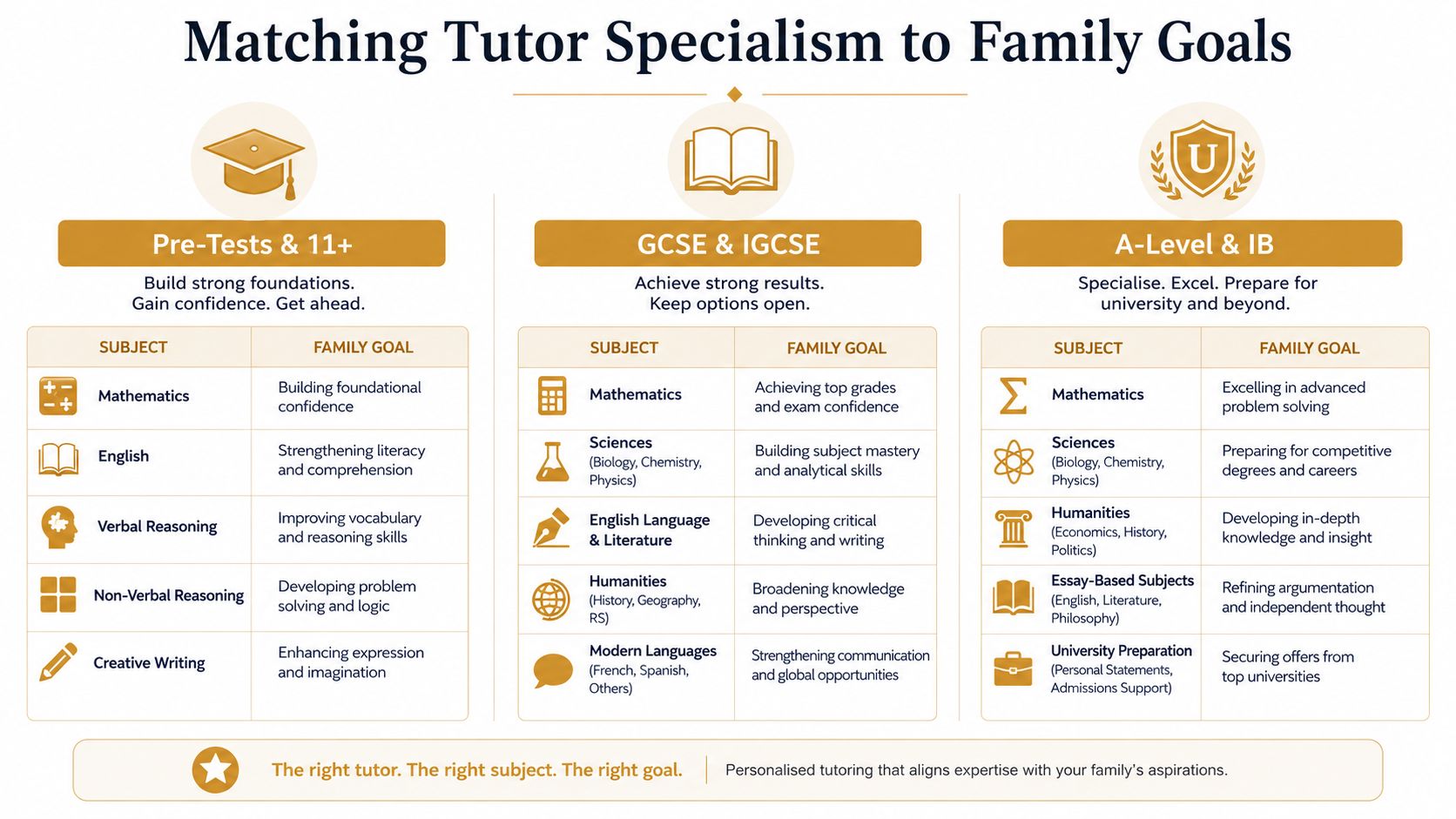
Start with the child's academic destination, not the tutor's school or university branding. A pre-test candidate needs a patient generalist who can build foundations. A GCSE pupil may need a subject specialist who understands the specification and marking demands. An A-Level, IB, or admissions candidate needs deeper technical command and the confidence to challenge advanced work.
The common briefs include:
- Pre-tests and 11-plus: Look for strong primary teaching, reasoning experience, literacy and numeracy depth, and the ability to build confidence without making preparation oppressive.
- GCSE and IGCSE: Prioritise subject-specific teaching evidence, familiarity with the relevant specification, and the ability to mark written work accurately.
- A-Level and IB: Seek a specialist who can teach advanced content, manage independent study, and explain how assessments reward precision.
- University admissions: Oxbridge, medical, and US admissions require a separate profile covering subject interviews, admissions tests, essays, personal statements where relevant, and interview preparation.
- EAL and bilingual learning: The tutor needs both subject competence and the ability to teach academic English or maintain the child's working language without confusing language support with ordinary conversation practice.
For a STEM-focused pupil, a tutor may need a coherent understanding of mathematics, chemistry, and biology or physics, depending on the intended pathway. A humanities candidate may require depth in history, literature, philosophy, or classical languages rather than generic “essay help”.
A first-class degree in the relevant subject is a credible foundation. A PGCE or other teaching qualification adds reassurance, but it isn't a substitute for recent, relevant teaching evidence. For Oxbridge preparation, training and experience connected to rigorous interview and subject discussion work can carry particular weight. Families should also expect agency-level screening to include enhanced DBS evidence where eligible, references, and a sample lesson.
The strongest CV can still be wrong for a shy Year 9 pupil. Watch how the candidate waits, questions, corrects, and encourages. A technically brilliant tutor who makes a child withdraw won't deliver the intended result.
For a fuller review of academic backgrounds, families can consult private tutor qualifications before setting the shortlist criteria.
How to Assess and Fetch an Elite Private Tutor
Treat selection as a staged investigation, not a CV comparison. The family should be able to explain why each candidate has progressed and what evidence supports the decision.
Five checks that deserve time
First, screen credentials against the brief. A degree in a subject is not proof of teaching ability. Ask for recent examples of the level taught, the examination board or curriculum involved, and the type of pupil supported.
Second, triangulate references. Speak directly with previous families and, where relevant, an examination centre or school contact who can verify the tutor's professional conduct. Written praise alone doesn't tell you whether the tutor was discreet, punctual, adaptable, or comfortable working alongside staff.
Third, observe a structured demonstration. Give the candidate a realistic topic and watch for technical accuracy, rapport, questioning, explanation, and the ability to set an appropriate stretch goal. A parent doesn't need to grade the lesson like an inspector. They do need to see whether the child is thinking, speaking, and attempting the work.
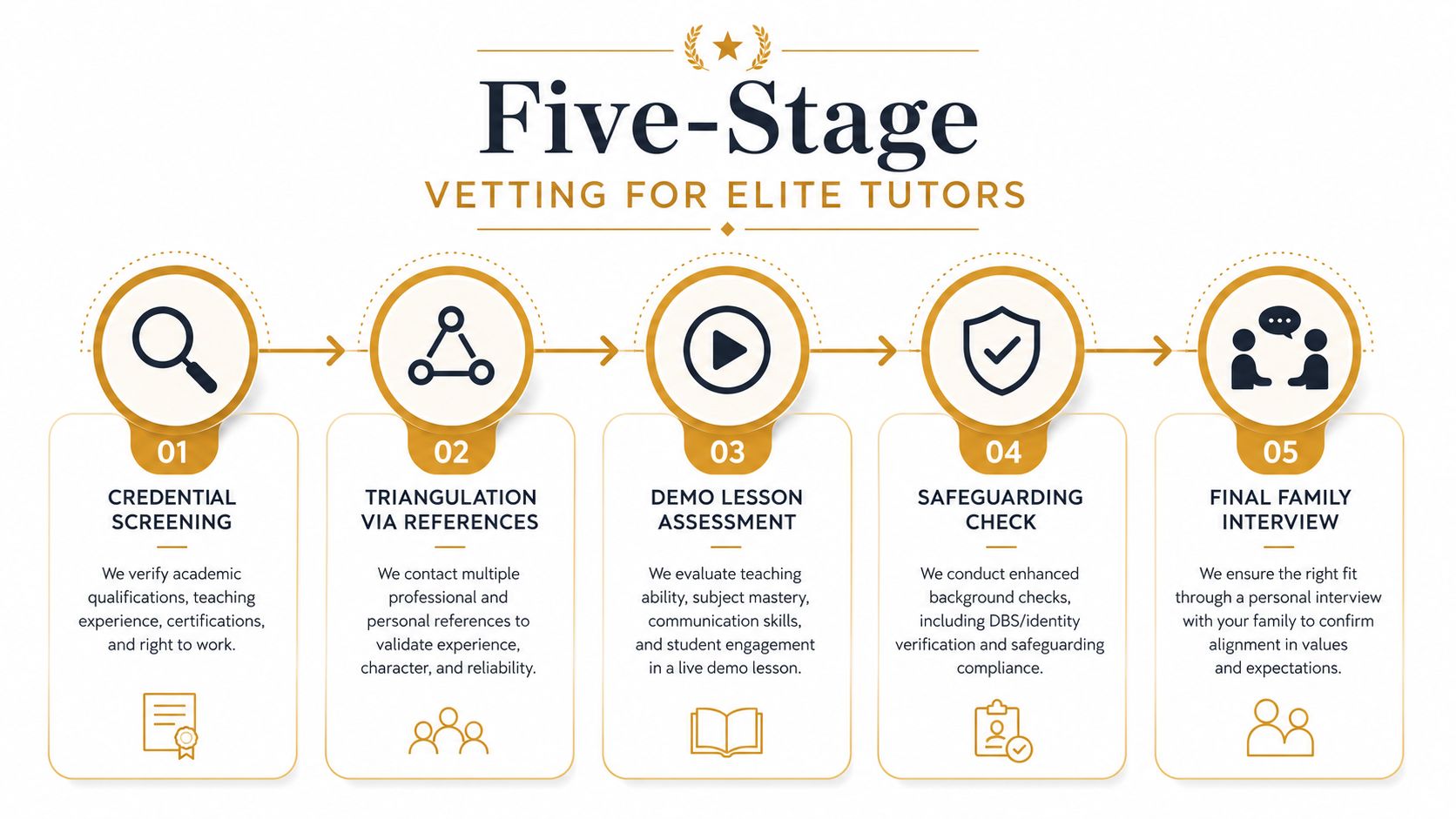
Fourth, complete formal safeguarding checks. In England and Wales, a self-employed tutor can request a basic DBS check personally. An enhanced or enhanced DBS check with barred-list status may be obtained through a DBS umbrella body where an organisation can verify eligibility and identity, as explained in NSPCC guidance for tutors. The route depends on whether the tutor is self-employed, contracted through an agency, or engaged by another organisation.
One-to-one tutoring isn't automatically regulated activity in every arrangement. However, regular unsupervised work directly with children can make the safeguarding position more serious. Guidance identifies tutoring more than 3 days in a 30-day period, or overnight face-to-face access between 2 a.m. and 6 a.m., as thresholds that can trigger regulated-activity considerations and an enhanced DBS check with barred-list inclusion (Leading Tuition safeguarding guidance). Confirm the current position for the role rather than relying on an old certificate or a verbal assurance.
Fifth, use a paid trial before a long commitment. Observe punctuality, discretion, preparation, child rapport, and how the tutor works with nannies, security, drivers, household managers, and parents. An agency can help pre-screen candidates, but the family should retain the final household-fit decision.
Families wanting a related private education search can review private teacher and private tutor services while keeping the brief focused on the child's actual needs.
Bespoke Tutoring Arrangements for Modern Families
The format should follow the household's life. A polished online service won't solve the problem if the child needs a calm adult physically present after school. Equally, an in-home appointment can become wasteful if an older pupil only needs targeted guidance for a particular paper and works independently between sessions.
| Arrangement | Best Fit For | Location | Typical Contract Note |
|---|---|---|---|
| In-home tutoring | Children with busy schedules, specific safeguarding needs, or a need for close routine support | Family residence or agreed study space | Set workspace, arrival protocol, staff boundaries, confidentiality, and communication expectations |
| Online tutoring | Self-directed older pupils, specialist subjects, or families needing wider geographic access | Secure online platform | Define platform, lesson records, recording permissions, technical responsibility, and missed-session terms |
| Travel tutoring | Internationally mobile families following a rolling curriculum | Family residences, hotels, schools, and travel locations | Include itinerary, travel time, accommodation, expenses, availability, and cancellation provisions |
| Bilingual tutoring | Children preparing for international schools or maintaining a heritage language | Home, school, travel, or online | Specify the working languages, academic objective, written reporting language, and cultural expectations |
In-home support
An in-home tutor becomes part of the household's operating environment, even if they don't live there. Agree where lessons take place, whether the tutor joins meals, who may interrupt a session, how devices are handled, and who receives feedback.
Online provision
Online tutoring suits a pupil who can manage materials, remain engaged, and complete work without physical prompting. It's less suitable for a young child whose main difficulty is routine, confidence, or sustained attention.
Travel and bilingual work
Travel tutoring requires more than a passport and academic CV. The family needs a written itinerary, a clear expenses process, and agreement on working hours and rest. Bilingual assignments also require careful sourcing. A fluent speaker isn't necessarily an effective academic teacher, and a subject specialist may not understand the family's language priorities.
Choose the arrangement after assessing the child's temperament, not before. The family's travel calendar, parents' availability, household staffing, and the child's need for independence should all shape the appointment.
Typical Fees and How to Structure the Contract
UK tutoring fees usually rise with academic level, scarcity, and the complexity of the outcome. Verified market data places average rates at about £38 per hour for GCSE and £52 per hour for A-Level tutoring (UK tutoring pricing research). The same source identifies maths and English as representing over 27% of student demand and over 37% of tutor supply, which helps explain why a family should assess the exact subject and level rather than rely on a broad “private tutor” rate.
| Level or specialism | UK benchmark | Common payment structure |
|---|---|---|
| GCSE | About £38 per hour | Hourly invoicing for targeted work, or a termly arrangement for regular sessions |
| A-Level | About £52 per hour | Termly retainer or scheduled hourly sessions, with marking and feedback defined separately |
| Scarce specialist or admissions work | Premium varies by brief | Written proposal covering preparation, lesson time, marking, and parent reporting |
The contract should state the session length, timetable, cancellation notice, illness arrangements, holiday cover, materials, reporting, confidentiality, and termination. For travel work, add itinerary changes, travel expenses, accommodation, per-diem arrangements, and what counts as working time.
Decide who is contracting with whom
A private tutor is often self-employed, but the family must establish whether it's engaging a sole trader, paying through an agency, or becoming an employer. HMRC guidance for tutors indicates that self-employed individuals must register once trading income exceeds £1,000 in a tax year and complete the relevant Self Assessment obligations (UK private tutor tax guide). That doesn't decide the family's employment status for them. Take specialist advice where the arrangement is regular, exclusive, residential, or unusually integrated.
Hourly invoices suit a short intervention. A retainer may suit continuity, guaranteed availability, and a long-term placement, but don't use one to hide unclear duties. Families and tutors who need a simple administrative tool can use a free tutoring invoice generator, while still agreeing the substantive terms in a proper contract.
Measuring Progress and Real Outcomes
A tutor should be able to show what changed, what remains difficult, and what the child can now do without help. “They seem happier” matters, but it isn't enough to manage a long-term academic appointment.
Build the record from the first session
Begin with a baseline that reflects the actual objective. Depending on the brief, that may include marked written work, a diagnostic exercise, a timed paper, reading fluency, language output, or a structured conversation about study habits. Record the starting point without turning it into a judgement about the child.
Set termly targets that are specific enough to review. A target might concern mastering a defined topic, completing a timed response independently, improving revision organisation, or becoming able to explain a method without prompting.
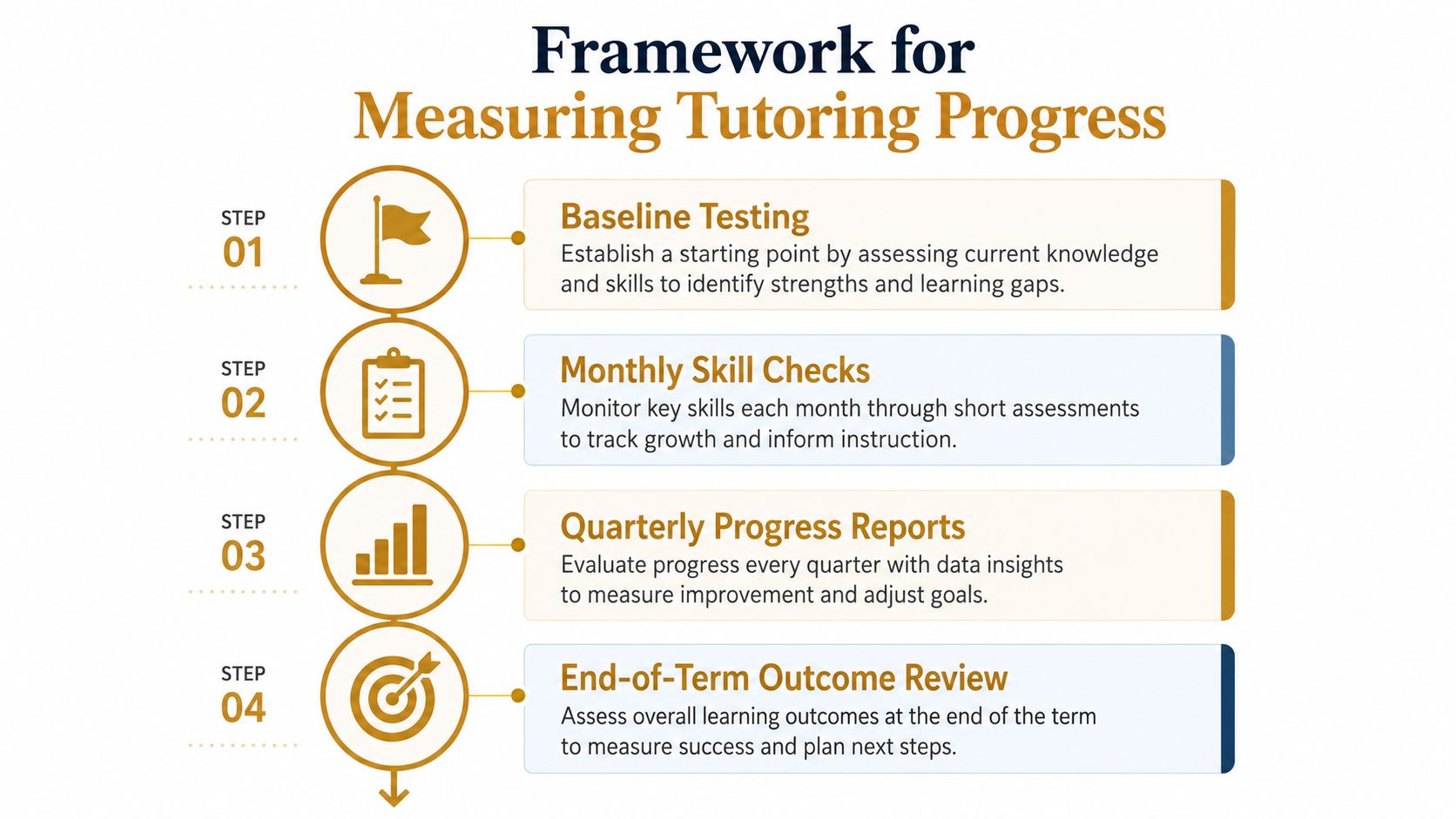
Use four checkpoints:
- Baseline testing: Save the initial work and tutor observations.
- Regular skill checks: Track the concepts, techniques, and habits covered.
- Progress reporting: Ask for concise written feedback tied to the agreed targets.
- End-of-term review: Compare evidence, child confidence, school feedback, and next priorities.
A short review meeting at the end of each half-term should cover lesson logs, written feedback, attendance, the child's confidence, and any change in school performance. Keep it focused. The tutor should identify the next teaching decision, not produce pages of decorative commentary.
Short-term grade movement and long-term independence aren't the same outcome. If a pupil reaches a plateau, change the format or the objective before dismissing the tutor. The answer may be more supervised practice, a subject specialist, a coaching element, or protected time away from lessons.
Families should retain baseline work, reports, mock papers, agreed targets, attendance records, and significant school feedback. Those records make any later handover to another tutor or school far more effective. Families can also review guidance on maximising academic potential through private tutoring as part of their planning.
Family Checklist and Common Questions Before You Hire
A private tutor should pass both an academic test and a household test. Before signing, confirm:
- Safeguarding evidence: Check the appropriate DBS route, identity, references, and any relevant international screening.
- Reference depth: Speak directly to previous families and ask about conduct, reliability, discretion, and outcomes.
- DBS or equivalent check: Confirm who obtained it, when, for what working arrangement, and whether it matches the proposed role.
- Contract clauses: Cover duties, hours, confidentiality, data, travel, cancellation, illness, notice, and termination.
- Fee structure: Separate teaching, marking, preparation, travel, expenses, and additional availability.
- Trial period: Observe the tutor in the household, not only in an interview.
- Exit terms: Make handover, final records, outstanding fees, and return of family property straightforward.
Three questions families ask before signing
How long should the search take? The timeline depends on subject, level, location, travel, language, availability, and the screening standard. A narrow, urgent brief may reduce choice, so start before the academic pressure becomes acute.
Should we use an agency or hire directly? Direct hire can work when the family has time to verify credentials, references, safeguarding, tax structure, and contract terms. A specialist agency is useful when discretion, international sourcing, household integration, or rapid shortlisting matters.
What if the tutor is academically brilliant but a poor household fit? Don't rationalise it. If the tutor undermines routines, disregards confidentiality, or makes the child anxious, academic ability won't rescue the placement. Use the trial and exit provisions, then reassess the brief.
The cheapest option rarely serves a long-term arrangement. Character, discretion, consistency, and the ability to work respectfully beside existing staff matter as much as subject mastery.
Superstar Nannies sources bespoke private tutors and private education professionals for families who need academic expertise alongside careful safeguarding, discretion, and household integration. To discuss a full-time, travelling, bilingual, governess-style, or subject-specific appointment, visit Superstar Nannies and share your family's requirements with the recruitment team.