


Maternity nurse pay in the UK typically starts around £270 per 24 hours for an experienced live-in placement and can reach £550+ per 24 hours at the specialist end of the market. That rate is only the starting point, because your real budget depends on the care model, location, multiples, and how the hire is structured for tax and payroll.
If you're preparing for a new baby, it's easy to get conflicting answers. One listing quotes a day rate, another gives an annual salary, and a third mentions a net figure that doesn't tell you what the family pays. For high-net-worth households, that lack of clarity creates the wrong kind of surprise.
The practical question isn't just what a maternity nurse earns. It's what your household will spend, what support level that spend buys, and which structure avoids administrative friction later. The maternity nurse salary UK conversation only becomes useful once you separate benchmark pay from total cost.
Navigating the World of Maternity Nurse Salaries
Families usually arrive at this question in the same position. They know they want specialist newborn support, they've seen a few advertised rates, and they're trying to work out whether those figures reflect the actual commitment or just the headline number.
That confusion is understandable. A maternity nurse isn't priced like a permanent nanny. In the UK, these assignments are commonly short-term and intensive, so pay is often quoted by the day, by the hour, or by the 24-hour period rather than as a standard annual package. That makes market comparisons less straightforward, especially when one professional is self-employed, another works through payroll, and a third is presented as a live-in booking with accommodation included.
Why families misread the market
The most common budgeting mistake is taking the advertised rate at face value. A family sees one figure and assumes that is the full cost of cover. In practice, the final spend often changes based on:
- The care pattern. A 24-hour live-in assignment is priced differently from night-only support.
- The baby's needs. Twins and triplets carry a different workload from a single newborn.
- The household setup. Travel, separate accommodation, rota expectations, and privacy standards all affect the package.
- The engagement model. Net and gross figures are not interchangeable.
Practical rule: Treat the quoted rate as the first line of the budget, not the last.
For new parents, especially those running busy households or travelling between homes, clear planning matters as much as the placement itself. Good budgeting isn't about buying the cheapest cover. It's about matching the right level of specialist care to the reality of your family's first weeks with a newborn.
UK Maternity Nurse Salary Benchmarks for 2026
A family approves a maternity nurse at what looks like a sensible rate, then the budget drifts once payroll treatment, accommodation, extra nights, or travel are added. That usually happens because the market is read through a single headline number instead of the actual hiring structure.
The broadest current benchmark comes from Indeed's UK maternity nurse salary data, which lists an average salary of £44,360 per year, based on 390 salaries reported and updated on 8 June 2026. The same page shows an earlier average of £43,194 from 251 salaries reported, updated on 24 August 2025, which indicates a rise of £1,166, or about 2.7% year on year.
That annual average is useful for orientation. It is less useful for budgeting a real booking.
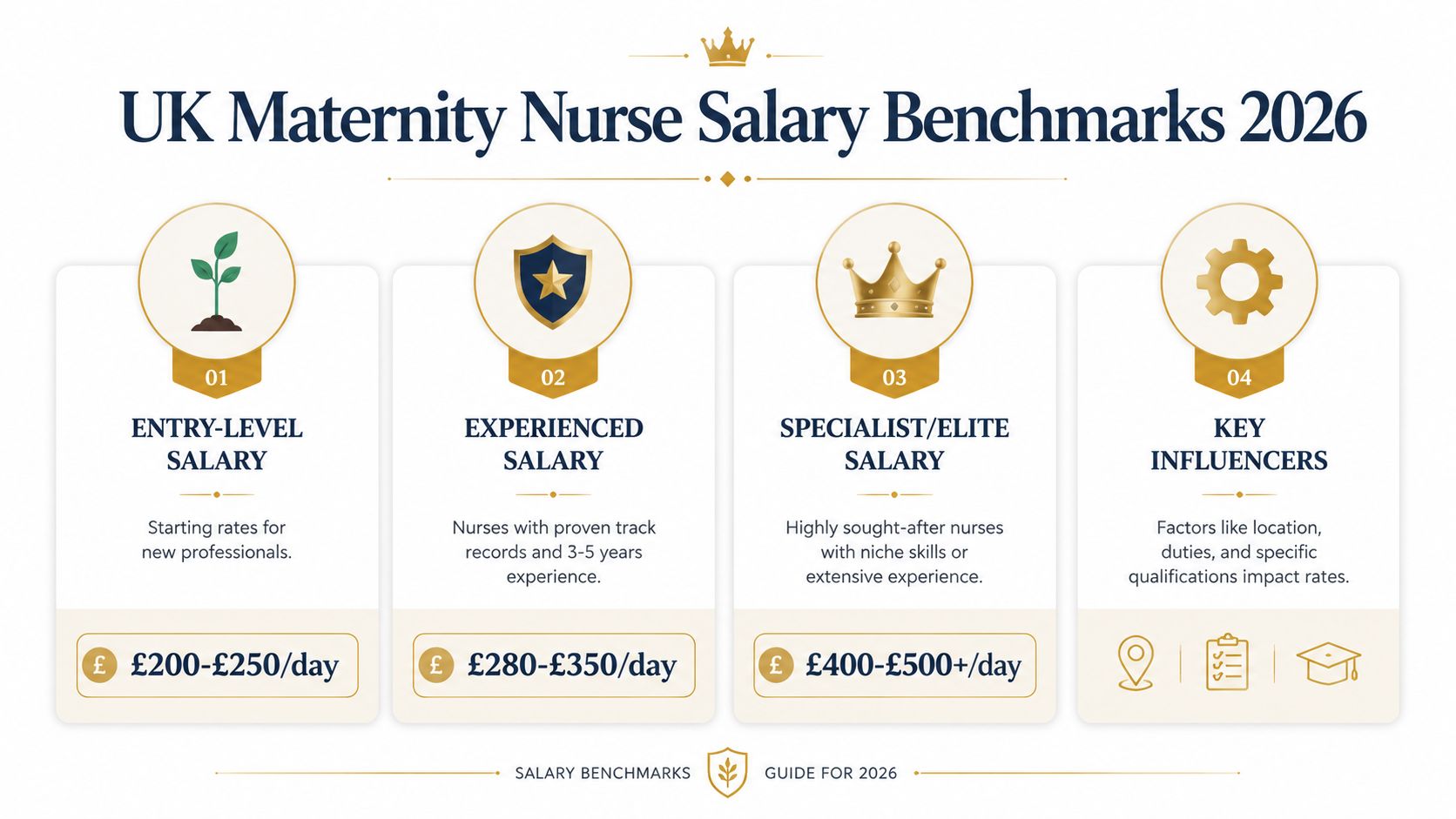
What the average figure does, and does not, tell you
Indeed's number helps place maternity nursing within the wider childcare field. It confirms that families are hiring a specialist newborn professional, not general help. Even so, annual salary data folds together different working patterns, regions, and engagement models, so it can make short-term intensive care look simpler to price than it is.
In practice, UHNW families rarely hire against an annual average. They budget against a live booking. That means testing the quoted figure against the assignment itself: 24-hour cover or nights only, single baby or multiples, London or regional base, and whether the professional is being engaged on payroll, as self-employed, or through an umbrella arrangement.
Premium market expectations
At the upper end, daily pricing rises quickly because the pool is smaller and the expectations are tighter. Families are not only paying for newborn knowledge. They are paying for stamina, calm judgement at 3am, polished communication, and the ability to work discreetly inside a fully staffed household or alongside medical teams, private chefs, security, and travel staff.
As noted earlier, premium training routes and specialist presentation can place a candidate well above the broad market average. In this bracket, a quoted 24-hour rate is only the starting point for budgeting. The actual number depends on how that rate is structured and what sits around it.
A practical way to benchmark the market
For budgeting purposes, I advise clients to separate maternity nurse pay into three layers:
- Market context. The annual average gives a rough sense of where maternity nursing sits in UK childcare pay.
- Assignment rate. The day rate, night rate, or 24-hour rate attached to the actual booking.
- Total cost of hire. The full household spend once tax treatment, agency fee, payroll administration, cover pattern, travel, and accommodation are accounted for.
That last figure is the one that matters in a private household. Two candidates can quote similar working rates and still produce very different final costs once PAYE, self-employed status, or umbrella deductions are handled properly.
The benchmark high-net-worth families should actually use
A sensible benchmark for 2026 starts with the market rate, then stress-tests the structure behind it. I would treat any salary or day-rate comparison as incomplete until the family knows whether they are looking at gross pay, net expectations, or an invoice arrangement that shifts tax handling elsewhere.
That approach prevents the usual surprise. The headline rate may be competitive. The total cost can still be materially higher.
Key Factors That Influence Salary Rates
A maternity nurse's rate changes for understandable reasons. The headline number rises when the role becomes more demanding, less flexible, or harder to staff well. Families who understand those drivers usually budget more accurately and hire more successfully.
Care model and schedule
The first question is not who the candidate is. It is what sort of cover you need. Nanny & Butler's maternity nurse guide notes that experienced live-in rates are typically £270–£350 per 24 hours for a single baby, rising to £320–£400 for twins and £350–£420 for triplets. The same guide shows live-out night or day shifts often priced at £22–£30 per hour for one baby, with triplet care at £32–£40 per hour.
Short version. Intensive continuous cover costs more than a narrower shift because the responsibility window is wider and the rest opportunity is different.
Multiples increase the workload
Families sometimes expect twin care to be only slightly higher than single-baby care. In reality, multiples change the whole rhythm of the booking. Feeds stack up. Settling takes longer. Night disruption is heavier. Record-keeping becomes more important, not less.
That is why compensation scales with neonatal workload rather than with a simple flat add-on.
| Care Scenario | Typical Rate Single Baby | Typical Rate Twins |
|---|---|---|
| Live-in 24-hour care | £270–£350 per 24 hours | £320–£400 per 24 hours |
| Live-out hourly care | £22–£30 per hour | Not listed in the verified data |
| Triplet hourly care | Not listed in the verified data | Not applicable |
Location and household standard
London remains the strongest premium market, and not only because of geography. The city tends to involve more complex schedules, more formal staffing standards, and higher expectations around presentation, flexibility, and prior private-household experience.
A regional placement may cost less on paper, but the final package can still move upward if the family requires travel, unusual hours, bilingual support, or a candidate comfortable in a fully staffed environment.
If two maternity nurses have similar newborn skills, the one who can step seamlessly into a private household routine usually commands the stronger rate.
What works when setting the rate
Families get better outcomes when they benchmark the care model first and the individual second.
- Start with the structure. Decide whether you need 24-hour live-in support, overnight-only care, or a defined day arrangement.
- Price the intensity accurately. Twins, recovery needs, and disrupted nights all justify a premium.
- Account for household conditions. Travel, accommodation, and privacy expectations change the commercial reality.
- Avoid generic comparisons. A permanent nanny salary is not a reliable shortcut for a specialist newborn placement.
What doesn't work is asking for elite flexibility on a basic budget. The market usually corrects that quickly.
Agency Hire vs Private Hire Explained
A family calls two weeks before the due date. They have a recommendation from a friend, a shortlist from an agency, and one question: which route costs less once the paperwork, screening, and contingency planning are counted. That is the right question.

What an agency route changes
An agency fee buys more than introductions. It usually covers market mapping, candidate screening, reference verification, right-to-work checks, interview coordination, and support with the booking terms. In a newborn placement, that matters because timing is tight and mistakes are expensive.
For UHNW households, privacy is often the deciding factor. The family avoids advertising the role widely, answering speculative enquiries, and exposing household routines to candidates who are not suitable. A good consultant also pressure-tests the brief early, so the family does not spend a premium budget on the wrong care model.
Agency hire also tends to reduce replacement risk. If the selected maternity nurse becomes unavailable, the family is not starting from zero.
What private hire asks the family to take on
Private hire can work well with a trusted referral and a family office or EA who has time to run the process properly. The savings can look attractive at first, particularly if there is no visible agency commission.
The hidden cost sits in the work the family must now handle themselves:
- Due diligence. Identity, references, newborn experience, and employment history still need checking.
- Terms and documentation. Hours, sleeping arrangements, confidentiality, travel expectations, handover dates, and notice all need to be agreed clearly.
- Status and payroll decisions. The family must establish whether the arrangement is PAYE, self-employed, or run through an umbrella structure.
- Contingency planning. If the match fails or the nurse withdraws close to the start date, the family carries the replacement problem.
That last point is often underestimated.
The real trade-off
Private hire can be cheaper on the first invoice. Agency hire often proves cheaper in management time, risk control, and course-correction if something is missed.
I advise clients to judge the two routes by total cost of hire, not by placement fee alone. A lower headline figure loses its appeal quickly if the family has to spend internal staff time on vetting, rush payroll setup, correct a misread tax position, or replace the candidate at short notice. For a household with a new baby arriving, convenience is not the issue. Control is.
Understanding the Total Cost Gross vs Net Pay
Many maternity nurse salary UK articles cease to be useful. They quote a rate and leave the family to figure out what that rate means in practice.
The key distinction is gross versus net. Royal Nannies' guidance on maternity nurses highlights an often-misunderstood point. A self-employed nurse's net day rate and an employed nanny's gross salary are not equivalent. The family may need to budget for employer tax contributions and benefits on top, and that hidden difference can materially affect the final cost.
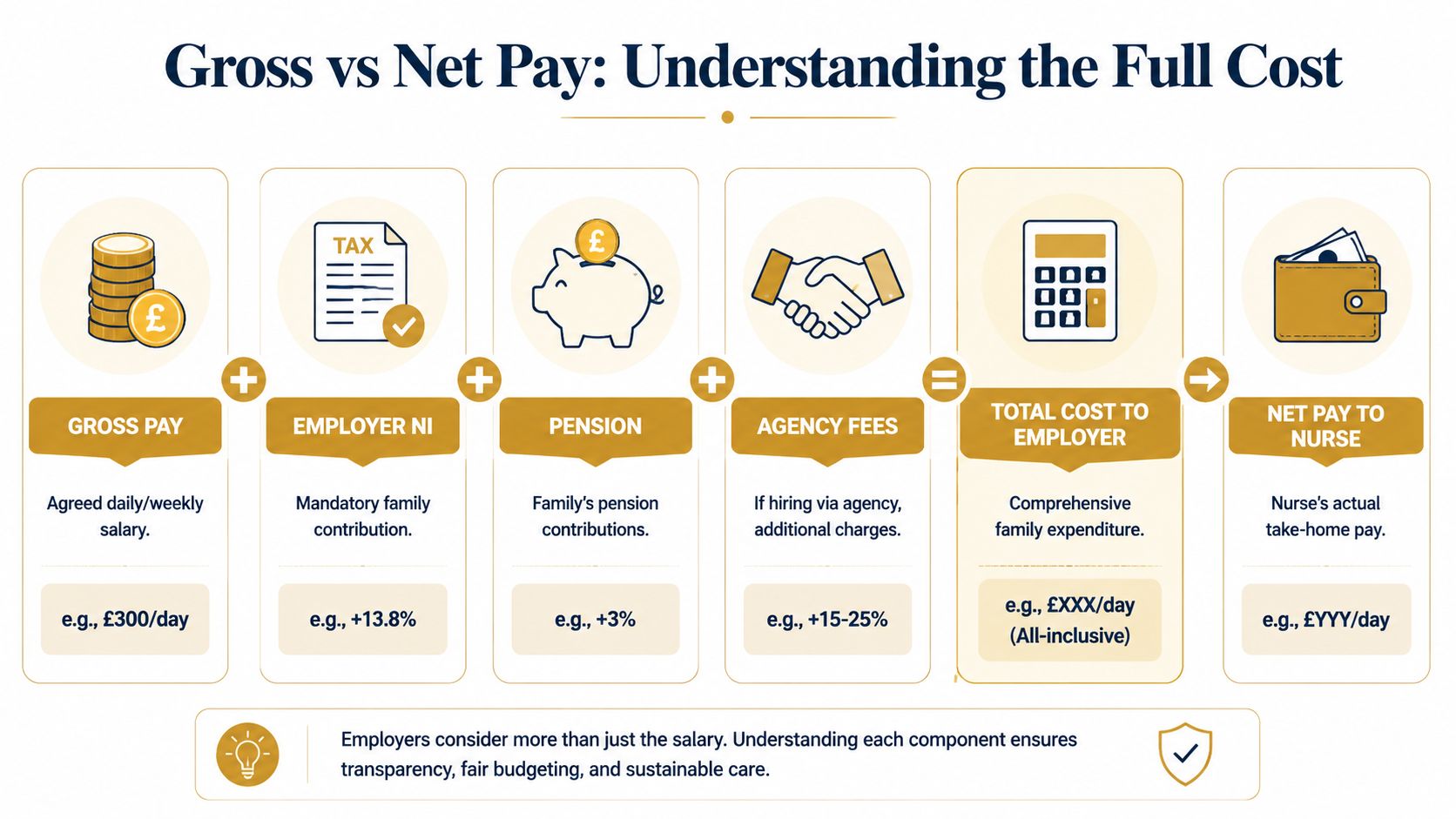
PAYE means clarity, but not just salary
When a maternity nurse is engaged on a PAYE basis, the agreed pay is only one part of the family's spend. The household also needs to consider employer-side obligations and employment administration.
The practical advantage is clarity. The arrangement is structured, deductions are formalised, and expectations are easier to document. The downside is that the cost to the family doesn't stop at the quoted pay figure.
Self-employed rates can look simpler than they are
Self-employed pricing often appears cleaner because the candidate quotes one day rate and the family assumes that is the whole answer. Sometimes it is not. Sometimes the setup creates questions around status, responsibilities, and what is or isn't included.
A net figure also doesn't help you compare one booking fairly against another if another candidate is being considered on a gross employed basis. That's why rate shopping without structure shopping usually leads to poor comparisons.
Costing rule: If one candidate quotes net and another quotes gross, you are not comparing like with like.
Umbrella arrangements and third-party payroll
Some households and candidates prefer an umbrella or managed payroll route because it reduces direct administration. That can be sensible, particularly when the booking is short and everyone wants the paperwork handled professionally.
Even then, the family still needs to ask the right questions:
- What exactly is included in the quoted figure
- Who is responsible for payroll administration
- How are benefits and statutory elements handled
- What happens if the booking extends or changes
What families should check before approving a budget
The safest approach is to ask for the full cost view in writing before confirming the placement.
- Quoted pay basis. Is the figure gross, net, hourly, daily, or per 24 hours?
- Employment structure. PAYE, self-employed, or umbrella.
- Included practicals. Accommodation, meals, travel, and overnight arrangements.
- Placement terms. Booking length, cancellation terms, and extension terms.
- Agency charges. If there is an agency involved, confirm what support is covered.
What doesn't work is approving a candidate on the strength of one attractive daily rate and trying to decode the rest afterwards. That usually creates friction just when the family needs calm.
Budgeting for a Maternity Nurse in a UHNW Household
High-net-worth budgeting is rarely about finding a single number. It's about building the right envelope around the placement so the service works in real life. The family's property setup, staffing style, privacy expectations, and travel calendar all matter.

London twins with round-the-clock support
Consider a London household expecting twins and requesting a live-in 24-hour arrangement for the earliest newborn period. The commercial starting point would usually sit in the twin-care live-in range already outlined earlier, rather than the single-baby benchmark.
From there, the budget often shifts because London placements tend to carry stronger premiums, and twin care usually requires a candidate with proven composure in intensive settings. If the family wants formal staffing standards, flexibility around guest schedules, and the option to travel between residences, the quote should be stress-tested for structure as much as rate.
The families who budget well in this scenario usually ask four questions before they shortlist anyone:
- How many continuous days of cover are needed
- Whether the rate assumes live-in accommodation and meals
- How tax handling will work
- What happens if support needs to extend
Country estate with overnight cover
Now take a different household. A family based outside London has one newborn, established day staff, and only wants experienced overnight support. That brief doesn't need the same pricing logic as a 24-hour twin booking.
The budget still needs care, though. If the household is remote, the family may need to provide accommodation before or after shifts, cover travel, or widen the search to attract the right person. The assignment can look simpler on paper than it is operationally.
The cleaner the brief, the easier it is to control cost without lowering standards.
What sensible budgeting looks like
In UHNW households, good budgeting is usually less about squeezing the rate and more about defining the brief tightly enough that the right professional can say yes without endless renegotiation.
A useful internal checklist includes:
- Care pattern first. Confirm 24-hour, rota, or overnight-only support.
- House logistics next. Address rooms, privacy, meals, transport, and travel.
- Payroll method early. Don't leave tax structure until after the offer is accepted.
- Extension planning. Many bookings change once the baby arrives.
What tends not to work is vague scope. The more ambiguous the brief, the more likely the final cost drifts.
Secure Your Ideal Maternity Nurse with Confidence
A family can approve a day rate on Monday and discover by Friday that the actual spend is materially higher once payroll, cover pattern, travel, and accommodation are set out properly. That is the point at which a straightforward hire starts to feel expensive.
The right decision comes from treating salary as one line in a wider hiring budget. Before you confirm a candidate, pin down the working structure, who carries tax responsibility, what the household is providing, and how any extension would be costed if the booking runs longer than planned. For UHNW families, those details matter as much as the quoted rate because they determine the true cost of hire and the amount of administration your office will need to absorb.
I advise clients to sanity-check three things before they approve terms. First, whether the figure they have been given is gross or net. Second, whether the maternity nurse will be engaged through PAYE, as self-employed, or through an umbrella company. Third, whether the brief is realistic for the level of experience required. A cheaper quote can still become the more expensive option if the structure is wrong or the assignment has been underspecified.
Good placements feel calm from the outset.
That usually comes down to disciplined preparation. A clear brief attracts stronger candidates, shortens negotiation, and reduces the risk of last-minute changes once the baby arrives. If you want discreet guidance on budgeting, shortlisting, and setting up a maternity nurse hire with proper cost clarity, contact Superstar Nannies for a personalised consultation.
Frequently Asked Questions
Is maternity nurse pay usually quoted as an annual salary in the UK
Maternity nurse pay is usually quoted as a daily, nightly, or weekly figure. These bookings are temporary and intensive, so families rarely budget for them as annual salaried roles.
The point to clarify is not just the rate itself, but what that rate represents. Ask whether the quote is gross or net, whether tax still needs to be accounted for, and who is responsible for payroll if the engagement sits under PAYE or an umbrella arrangement.
Do twins always cost more than a single baby
In most cases, yes.
Twin bookings tend to command higher rates because the care load is heavier, night work is more demanding, and families often want a practitioner with proven multiple-birth experience. That said, the quoted premium varies. A well-scoped rota, strong parental support, and suitable accommodation can affect what a candidate is prepared to accept.
Should I choose the cheapest quoted day rate
Judge value by total cost and delivery risk, not by the lowest headline figure.
A lower quoted rate can become the more expensive hire if payroll has been set up incorrectly, overtime has not been discussed, or the candidate lacks the level of experience the household needs. I regularly advise clients to test whether the cheaper option still works once tax treatment, agency fees, travel, and any extension terms are added in. That is where budgets often drift.
What expenses should families clarify before confirming
Confirm the full package in writing before the booking starts. That usually includes accommodation, meals, travel, hours, rest breaks, overtime, and whether the household is covering any overnight or international costs.
Also confirm the payment structure. A family can receive the same quoted rate from two candidates and still face very different total costs depending on whether the arrangement is PAYE, self-employed, or through an umbrella company. For UHNW households, that distinction affects both spend and administrative workload.
If you're planning a newborn hire and want clarity before making commitments, Superstar Nannies can help you assess the brief, define the employment structure, and budget for the full cost of a maternity nurse placement with discretion.