
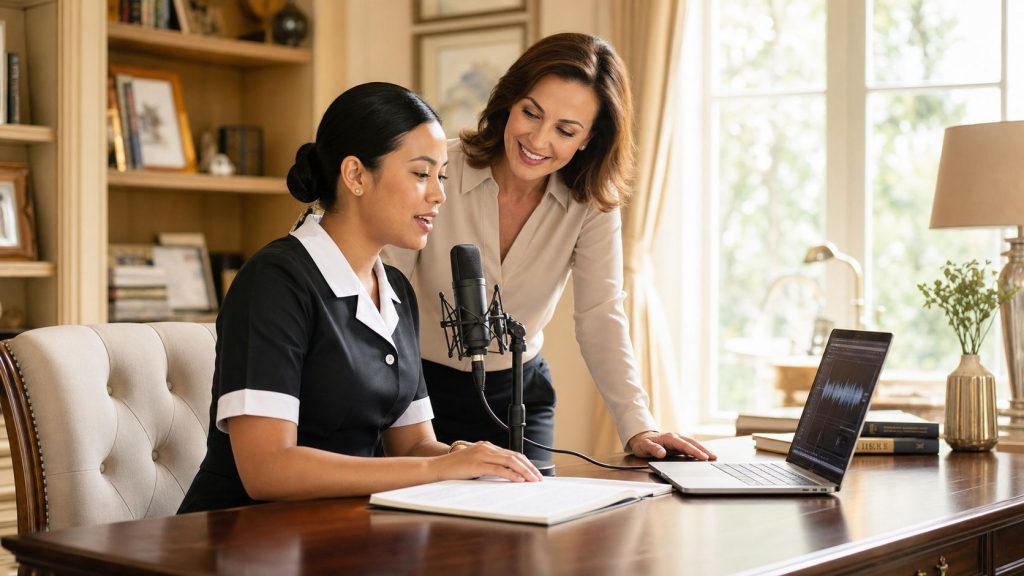
A family can run a tight house and still lose hours to one simple problem, people not quite catching each other the first time. A nanny's instructions sound fine in her own head, a tutor's update feels clear on the call, and a house manager's message still needs repeating. Accent reduction training is the practical fix when the issue is not effort, but intelligibility.
For private households, that distinction matters. You are not asking staff to erase identity. You are asking them to be understood quickly, calmly, and with less friction in the moments that shape trust.
What Accent Reduction Training Really Means in a Private Home
A bedtime story goes wrong in a small but familiar way. The child keeps asking, “What did you say?” and the nanny repeats herself, slower each time, until the moment loses warmth. The same thing happens on a parent video call, in a school office, or when a butler answers the phone and has to spell out a name twice.
That is where accent reduction training earns its place. The goal is clarity, not accent removal. A strong programme helps a speaker shape pronunciation, stress, and rhythm so listeners catch the message the first time, while the speaker keeps a natural voice and cultural identity.
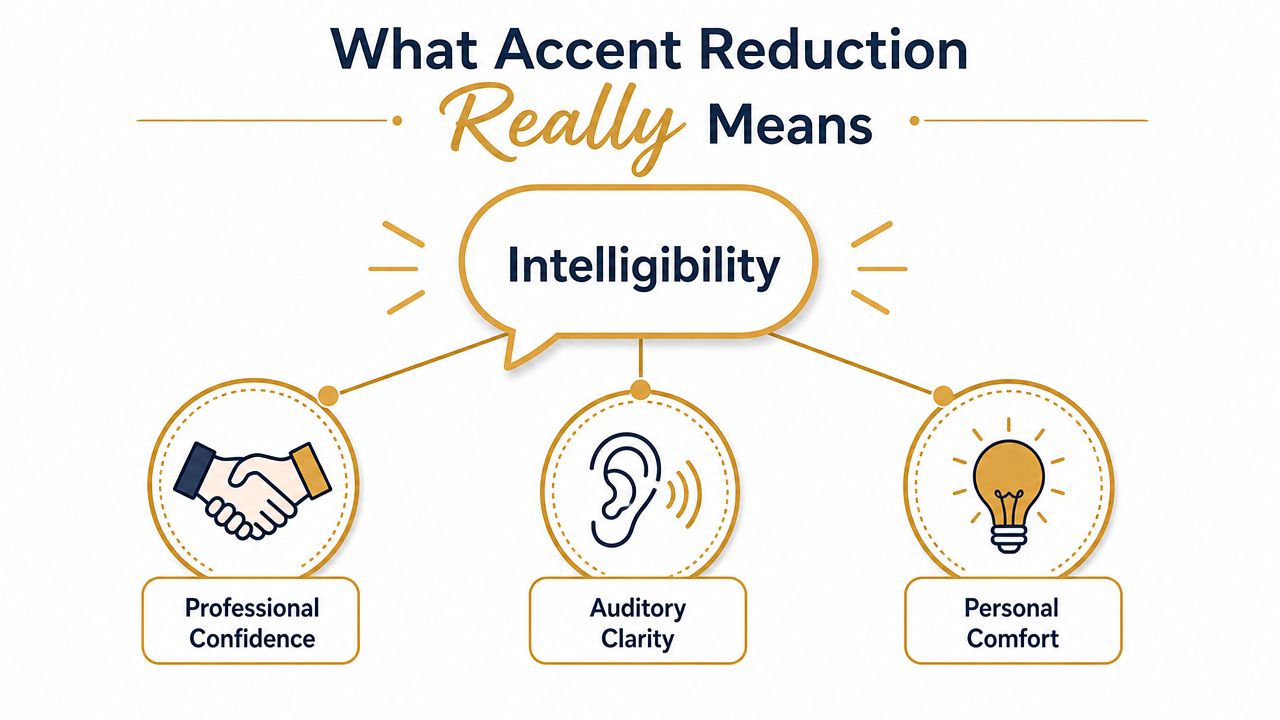
The best evidence-backed approach treats accent work as targeted speech intervention. A systematic review found that, across the studies it examined, all but 2 reported some benefit, while 2 studies were inconclusive, with gains showing up in pronunciation, academic or clinical performance, and listener perceptions systematic review. It also showed that focused work on specific speech features is more sensible than trying to erase a whole accent.
That matters in a house because the win is not sounding generic. It is sounding composed, clear, and easy to work with. If you want a useful parallel, Smart Language Learning Academy coaching frames pronunciation as a skill-building process rather than a personality rewrite, which is the right mindset for household staff too.
For families already thinking about broader training, see the wider approach to household staff training. Accent work belongs in that same professional-development bucket, because it affects daily operations, not just personal presentation.
Practical rule: if the training focuses on confidence, clarity, and listener understanding, it's on the right track. If it focuses on sounding “less foreign”, walk away.
Segmental and Suprasegmental Features Explained Simply
Most weak programmes obsess over individual sounds and ignore the bigger pattern. That's backwards. In real conversation, listeners do not process one vowel at a time. They rely heavily on stress, rhythm, linking, and pausing, which are the suprasegmental features that carry meaning across a sentence ASHA guidance.
Segmental features are the individual consonants and vowels, like the difference between a crisp /t/ and a softer one, or between two similar vowel sounds. Suprasegmental features are the flow around those sounds, the word stress in “important”, the pause before a new thought group, or the way a sentence rises and falls. In a private home, that's the difference between a nanny reading a picture book in tidy thought groups and one who rushes so the child loses the thread.
A good trainer works both layers, but not equally. Research comparing pronunciation teaching approaches found that suprasegmental training can outperform segmental-only work for some outcomes, and combining segmental and prosody training improved pronunciation accuracy while listeners perceived a lesser accent and easier understanding reviewed study summary. That lines up with what you see on the ground. Staff often need help with rhythm and stress before they need dozens of individual sound corrections.
A serious consultation should ask a few blunt questions:
- Which speech features are reducing intelligibility?
- Are you training rhythm, pausing, and word stress, or only consonants and vowels?
- Will practice include recorded feedback and read-aloud work?
- Will the material match the staff member's real household duties?
For a simple practice lens, a daily English pronunciation routine can help structure repetition, but it should sit inside a coached plan, not replace one. As discussed in the earlier section, the point is not to “sound native”. The point is to make speech easier to follow in the rooms and routines that matter.
More on bilingual development in private families is also relevant here, because bilingual households often need clarity without flattening the language richness they value.
Why Accent Reduction Training Matters for Nannies Tutors and Household Staff
Children copy what they hear, but they also copy the ease or strain they hear around language. If a nanny's instructions are always slightly unclear, a child may need more repetition than the routine really deserves. If a tutor can't be understood cleanly on a parent call, confidence drops even when the teaching itself is solid.
That is why accent reduction training is not a vanity project for staff. It is professional development tied to daily performance. A clearer update at the gate, a sharper handover to parents, or a more understandable message to a school office changes the tone of the whole household.
Clarity supports the role, not the ego
In a discreet home, the staff member often speaks for the household. They liaise with schools, clubs, drivers, suppliers, and sometimes visiting staff. The stronger the communication, the fewer unnecessary follow-ups and the less room there is for friction.
Accent bias also has to be faced directly. UK commentary around accent bias makes one thing clear, people do judge speakers through accent in hiring and customer-facing settings, and a “neutral” accent is not objectively better. The right response is twofold, help staff with clarity where needed, and keep challenging bias in the listener. The UK's Equality and Human Rights Commission has treated accent discrimination as a workplace equality issue, which is exactly why this topic can't be handled as shallow image polishing UK commentary on accent bias.
Staff shouldn't have to become a different person to be taken seriously. They should be given tools to speak clearly in the settings where they work.
Families who treat this well usually compare it to first-aid or safeguarding training. Not because the subject is the same, but because the outcome is operational. A nanny who is easier to understand can do the job with less stress, and a household that communicates well feels more composed to everyone inside it.
For agencies and principals, the simple standard is this. If the speech issue affects handovers, parent confidence, or external presentation, it is worth addressing. If it does not, don't manufacture a problem. Respect the speaker, and train only where the work needs it.
Common Methods Drills and Exercises Used by Trainers
A serious trainer starts with a baseline check, not a pile of generic exercises. That assessment usually looks at how the speaker handles stress, pacing, links between words, and the sounds that most affect understanding in real conversation. The point is to find the bottleneck before anyone starts drilling.
Then the work becomes practical. A nanny might read a bedtime page aloud while the trainer marks thought groups and pauses. A tutor may record a short parent update, then listen back for rushed endings or unclear stress. A house manager can practise a polite phone message, then replay it and refine the parts that blur under pressure.
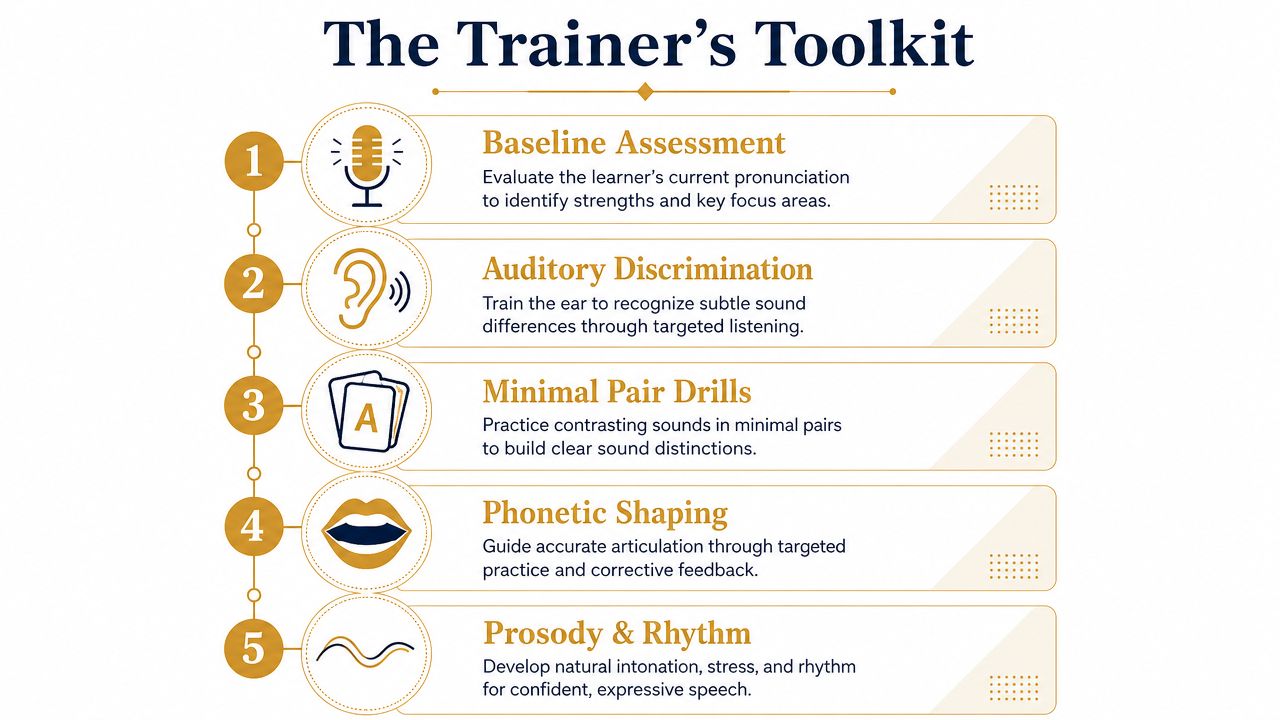
What the toolkit should include
A proper programme usually combines several methods, because one drill alone won't hold up in a busy household.
- Auditory discrimination: staff learn to hear the difference between their own production and a clearer model.
- Minimal pair work: short contrasts help sharpen sounds that listeners confuse.
- Shadowing: the speaker repeats a model aloud to match rhythm and stress more closely.
- Recording and playback: the speaker catches habits they miss in the moment.
- Roleplay: bedtime stories, dinner service explanations, and parent-teacher calls are practised before anyone needs them for real.
Generic apps can help with repetition, but they rarely know what happens in a kitchen at 7 p.m. or on a school call at 8:30 a.m. A real trainer tailors the drills to the job, then reassesses in the same type of scenario. That is the difference between busywork and improvement.
For staff development systems, the internal professional development staff resource is a useful reminder that training should be built around role demands, not a random set of lessons. Accent work is no exception.
Choosing Between In-Person Online and In-House Programmes
The best format depends on the household, not the trainer's favourite setup. A rota-based home with travel weeks needs different logistics from a static residence with regular office hours. Confidentiality also changes the answer, especially where UHNW families want a discreet process with minimal exposure.
| Format | Best for | Confidentiality | Typical intensity | Cost band |
|---|---|---|---|---|
| One-to-one in-person | Staff who need close feedback and live correction | High, if the trainer is vetted | Moderate | Varies by trainer and location |
| Live online coaching | Busy schedules, cross-border households, travel-heavy roles | High, if platforms and files are controlled | Moderate | Varies by trainer and location |
| App-based self-study | Supplementary practice between sessions | Lower, because it is less controlled | Low | Lower |
| In-house intensive | Bespoke household routines, high privacy needs | Very high, with signed NDA and controlled access | High | Highest |
A strong language school platform can help track lessons, homework, and feedback notes without scattering information across messy email threads, which is why language school software is worth considering as the back-end if a provider runs several staff programmes at once. But software alone doesn't make a programme good. Trainer judgement does.
The better agencies match format to actual life. If a bilingual nanny is due in London before a placement starts, pre-arrival coaching can be done remotely, then tightened in person once she's on site. If a house manager only needs sharper guest-facing telephone work, short live sessions may be enough. If a family wants a full household communication reset, an in-house intensive is more realistic.
Decision shortcut: choose the format that lets the trainer practise the real job, not the one that merely looks convenient on paper.
Realistic Timelines and How to Measure Real Progress
Principals often want results fast, and that's understandable. Still, serious improvement takes consistency. A sensible programme usually runs across 8 to 16 weeks of weekly practice, then shifts into maintenance once the main speech habits are stabilising. Anything promising full transformation in a handful of sessions is selling hope, not training.
The better question is not, “Does the accent sound different yet?” It is, “Is the staff member being understood more reliably in the situations that matter?” That is where measurement gets useful. Roleplays, live comprehension checks, and listener feedback tell you more than a polished recording ever will.
Measure what happens in the house
Good tracking does not need to be complicated. It needs to be repeatable and tied to real work.
- Family comprehension checks: did the parent need repetition during a handover?
- Roleplay performance: can the staff member handle a school call or guest greeting cleanly?
- Listener perception: do colleagues report smoother understanding?
- Self-review: does the speaker feel less strain during longer conversations?
In UK-facing workplace communication, the strongest benchmark is practical comprehension in meetings, calls, and client-facing exchanges, not an abstract “accent score”. That fits the logic of the evidence-based model already discussed, assessment first, targeted practice second, coached roleplay third, reassessment last. It also gives agencies a clean way to show progress without turning the person into a speaking sample.
For a household manager, progress might mean a cleaner phone explanation to a supplier. For a nanny, it might mean a child following instructions without a second prompt. For a tutor, it might mean parents hearing lesson feedback the first time and asking better questions because the message was clear.
Costs Confidentiality and Bespoke Programmes for UHNW Households
UHNW households don't buy generic training, and they shouldn't. They buy discretion, reliability, and a plan that fits the role. Price depends on trainer seniority, how bespoke the material is, whether sessions happen in person or online, and how much preparation the trainer has to do around a particular family's routines.
Confidentiality is essential. That means signed NDAs, tight vetting, secure handling of recordings, and a respectful way of talking to the staff member about why the training exists. The programme should be framed as professional development, not correction for its own sake.
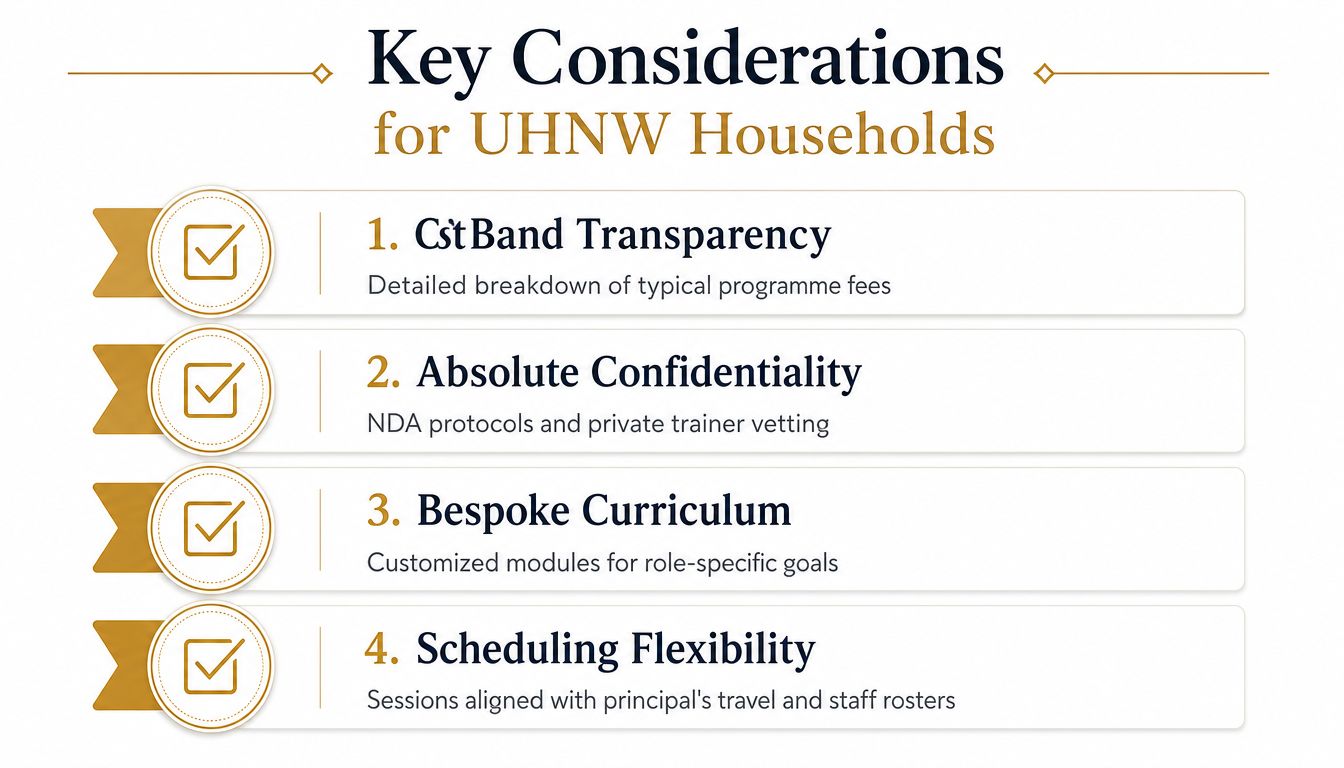
The strongest providers adapt to placement realities. A pre-arrival coaching plan for a bilingual nanny heading to London looks different from an ad-hoc intensive before a family trip. Ongoing check-ins after placement start are useful when a principal wants small corrections without creating a big event around them.
For a deeper privacy framework, the internal guide on private staff confidentiality for high-profile families is the right companion piece. It matches the way accent work should be handled professionally.
What to brief a trainer on
- Role duties: nursery, classroom, front-of-house, chauffeur liaison, or executive support.
- Likely pressure points: phone calls, guest arrivals, bedtime reading, parent handovers.
- Privacy expectations: who can know, who should never be told, and how files are stored.
- Travel calendar: because a useful programme respects real rota movement.
If the provider can't explain those basics clearly, keep looking.
A Sample 12-Week Plan and How to Get Started
A workable plan starts narrow and gets broader. Week 1 is usually a baseline recording plus a short conversation check. Week 2 can focus on word stress, Week 3 on clear endings, Week 4 on pacing and pausing, then later weeks move into linking, polite request forms, and role-specific scripts.
Three household tracks
A bilingual nanny usually needs clearer bedtime reading, simpler instruction chunks, and smoother handovers with parents. A private tutor needs sharper lesson delivery and parent-facing explanations that feel calm under pressure. A front-of-house or house manager needs concise phone language, guest greetings, and confident explanations of logistics.
Each week should end with one short check. That might be a recorded paragraph, a roleplay, or a quick comprehension test from the parent or principal. By the end of the programme, the family should be able to say whether speech is easier to follow in ordinary household moments, not just in a polished practice session.
Start with one question, what role is the speech work serving? If the answer is daily clarity, smoother handovers, and a more composed family experience, then the training brief is strong. If you want a discreet, role-specific plan for a nanny, tutor, house manager, or other household professional, contact Superstar Nannies for a confidential consultation.