


The right English tutor starts with the work your child finds difficult. That might be understanding a demanding text, organising an argument or writing clearly under exam conditions. Each calls for a different teaching plan.
When choosing a private English-language tutor, look beyond credentials. Ask how they will assess your child's work, teach within their curriculum and show progress. The arrangement should also suit your household's languages, routines and safeguarding expectations.
Why Hire a Private English Language Tutor?
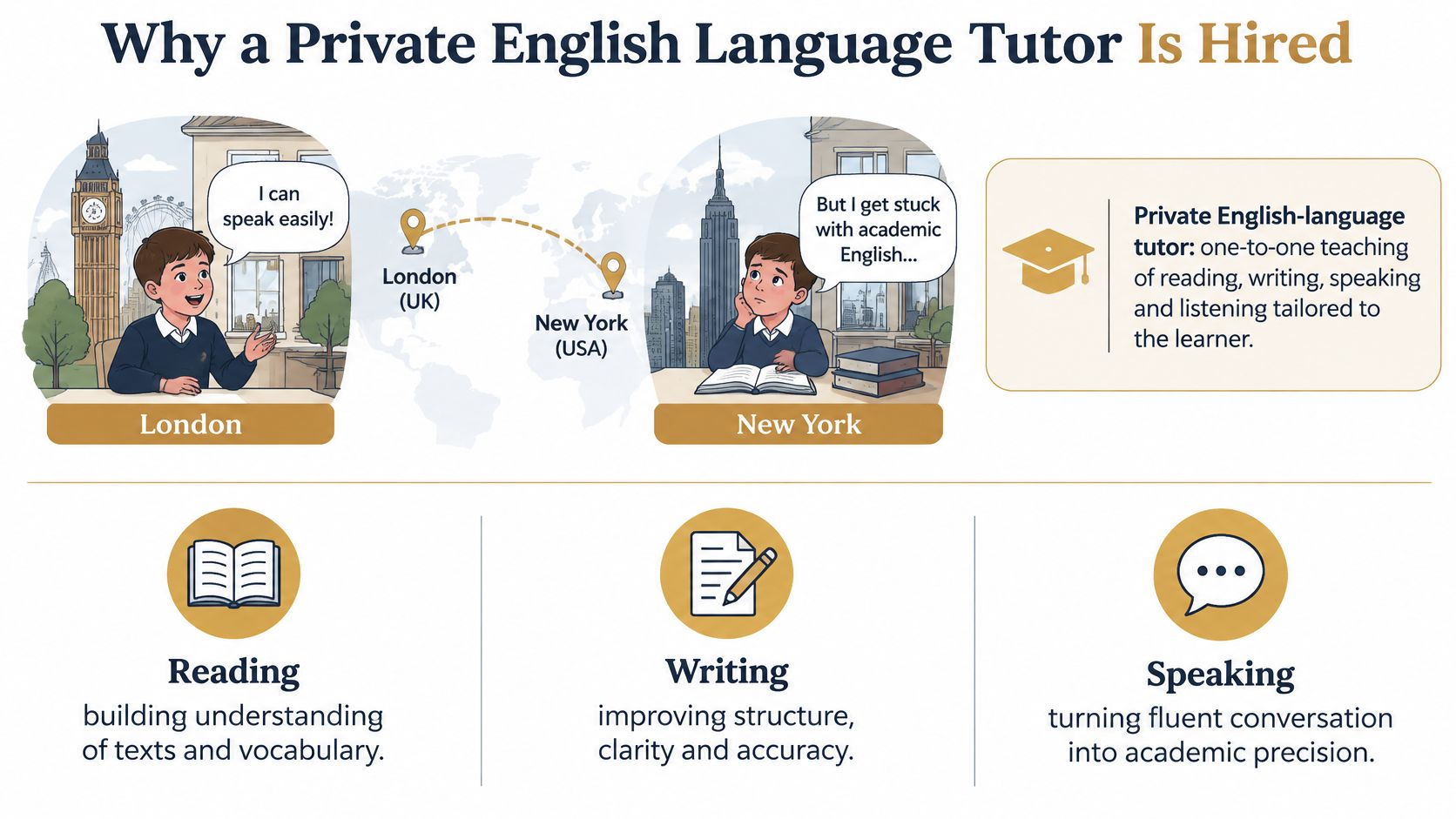
Conversational fluency does not always translate into academic English. A child moving between London and New York, for example, may speak comfortably with friends but find demanding texts or structured essays difficult.
A tutor provides planned, one-to-one teaching with feedback and learning goals. That is different from a conversation club or general homework help. The starting point is the child's specific difficulty, not a standard set of lessons.
The Sutton Trust's report on private tutoring says 29% of secondary pupils in England and Wales have received private tuition, rising to 45% in London. Those figures show how common tutoring is, not whether it improves an individual child's results.
Before choosing a tutor, establish the child's curriculum and pathway, whether that means the English national curriculum, an independent-school programme, an international curriculum, GCSE or A level. If the family moves between schools, ask for a portable record of work and goals. For younger children, child language development stages can help families frame questions about their needs.
Match the Lessons to the Need
| Need | Teaching focus | Useful progress check |
|---|---|---|
| Gaps in core skills | Short, regular work on reading, vocabulary, grammar or writing | Compare work at the start and end of a defined cycle |
| GCSE or A level English Language | Specification-led planning, timed writing and precise expression | Review scripts for recurring errors and stronger structure |
| English as an additional language | Separate goals for understanding and expression | Track fluency, accuracy and independent work |
| English for school in a bilingual home | Academic reading and vocabulary alongside the family language plan | Check confidence and independence without displacing the home language |
The Education Endowment Foundation's review of one-to-one tuition finds around five additional months of progress on average. It identifies sessions of about 30 minutes, three to five times a week, for up to ten weeks as a useful pattern. The evidence is rated moderate; it is a starting point, not a promised outcome.
Start with an assessment
Ask the tutor to assess reading, vocabulary, grammar, writing and spoken interaction. A child may understand a text but struggle to express that understanding in an essay. Targets should reflect the difference between receptive skills and productive skills.
Keep the review process simple: collect a baseline sample, check work and recurring errors during the programme, then reassess at an agreed date. If the child is not progressing, the tutor should adapt the approach. Between lessons, families may use short comprehension routines for kids to support reading.
Lessons can move between the home and online settings during travel, provided goals and feedback remain consistent. Exam support needs its own brief: ask for timed writing and work against the relevant specification, not extra conversation practice. The Sutton Trust reported that 18% of pupils undertook private tutoring during Year 10 or Year 11 in its 2023 findings.
For a marketplace reference, the average UK platform price for an English tutor was £37.51 per hour as of June 2024, in Tutorful figures reported by this UK tutoring-cost guide. A household placement is priced separately. Agree the lesson rhythm and first review date before booking.
Check Qualifications and Teaching Fit
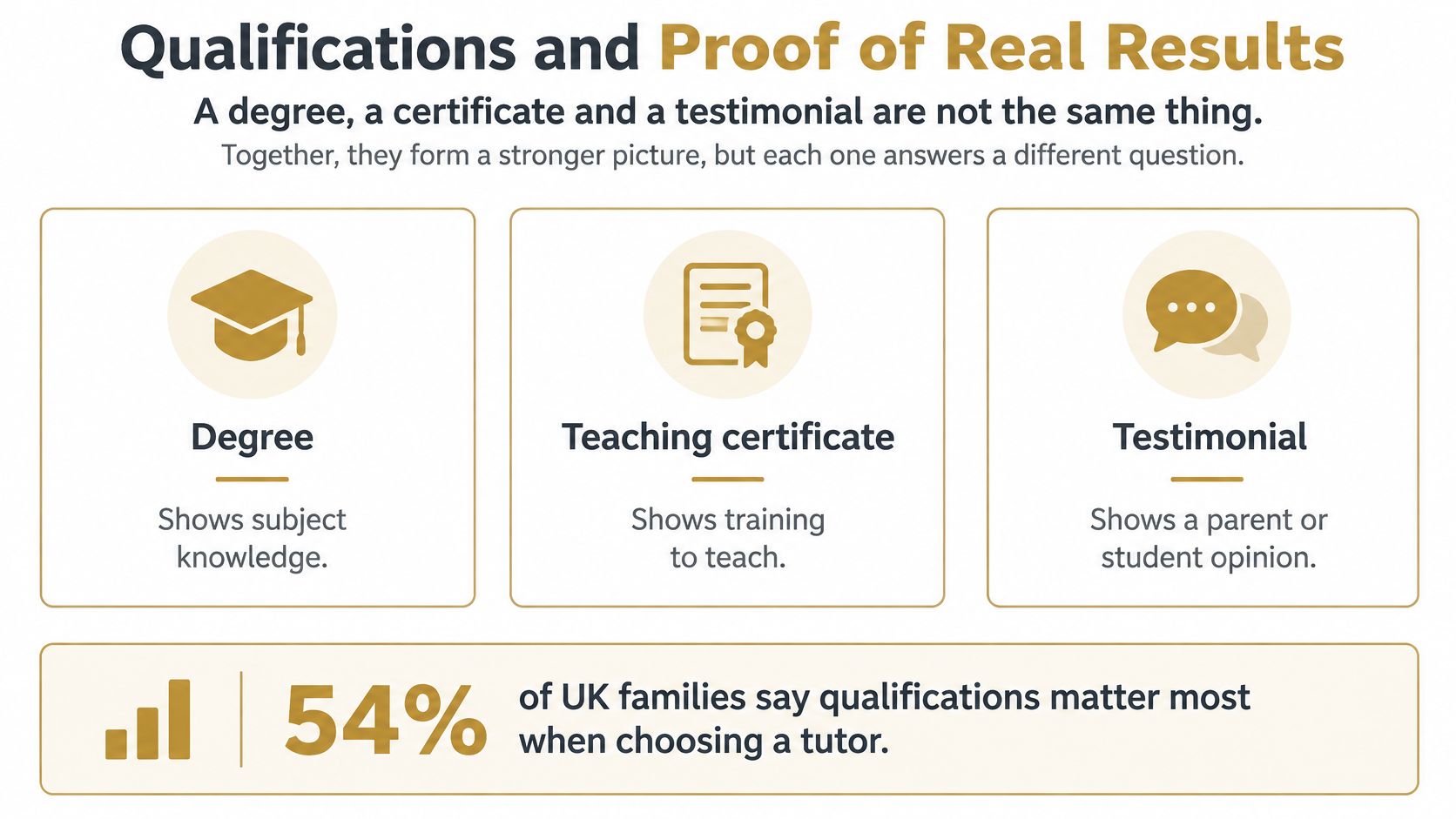
A degree demonstrates subject knowledge; a teaching qualification indicates training; a testimonial describes an experience. None alone establishes that a tutor can teach this child safely and effectively.
According to Tutorlab's UK tutoring statistics, 54% of adults believe tutors should hold a recognised teaching qualification, 53% expect a DBS check, and only 7% knew that private tutors lack a dedicated UK regulatory body. These are public expectations, not substitutes for checking an individual candidate.
Ask for:
- Relevant expertise: knowledge of the child's curriculum and particular English difficulty.
- Specific references: a referee who can confirm claimed GCSE or English as an additional language experience.
- A marked work sample: evidence of how the tutor explains improvements, not just corrects errors.
- A progress method: a baseline, clear goals and a scheduled review.
- Household fit: an approach suited to the child's languages, timetable and setting.
Verify identity and employment history as well as credentials. Superstar Nannies' guide to private tutor qualifications offers more detail. Before a trial, ask that substantial CV claims be supported by a named referee or suitable work sample.
Set Safeguarding Arrangements Before Lessons Begin
In England, teaching or supervising children may count as regulated activity when it occurs on more than three days in a 30-day period, or overnight between 2 a.m. and 6 a.m. with an opportunity for face-to-face contact. Certain advice given mainly to children is subject to the same thresholds, according to government guidance on regulated activity with children.
A DBS check is not automatically required for every private tutor. Check what screening applies to the role, then agree how lessons and communications will work:
- Verify the tutor: confirm identity, references, employment history and relevant DBS status. A self-employed tutor undertaking regulated activity can apply for an Enhanced DBS check with Children's Barred List information through a DBS Umbrella Body.
- Set lesson boundaries: decide who may be present, how the tutor and child may communicate, whether online lessons may be recorded and who can access notes.
- Know how to raise a concern: ask for the child-protection policy and the route for reporting concerns, including how an unresolved concern can be raised with the local council in England.
A certificate is one part of safer recruitment, not a replacement for references and clear procedures. Families can use this guide to vet London tutors and check DBS credentials when preparing questions. For lessons in New York, Florida, California or during travel, agree practical boundaries for each setting and provide an emergency contact. Superstar Nannies also explains checks for working with children.
Make the Plan Work in the Household
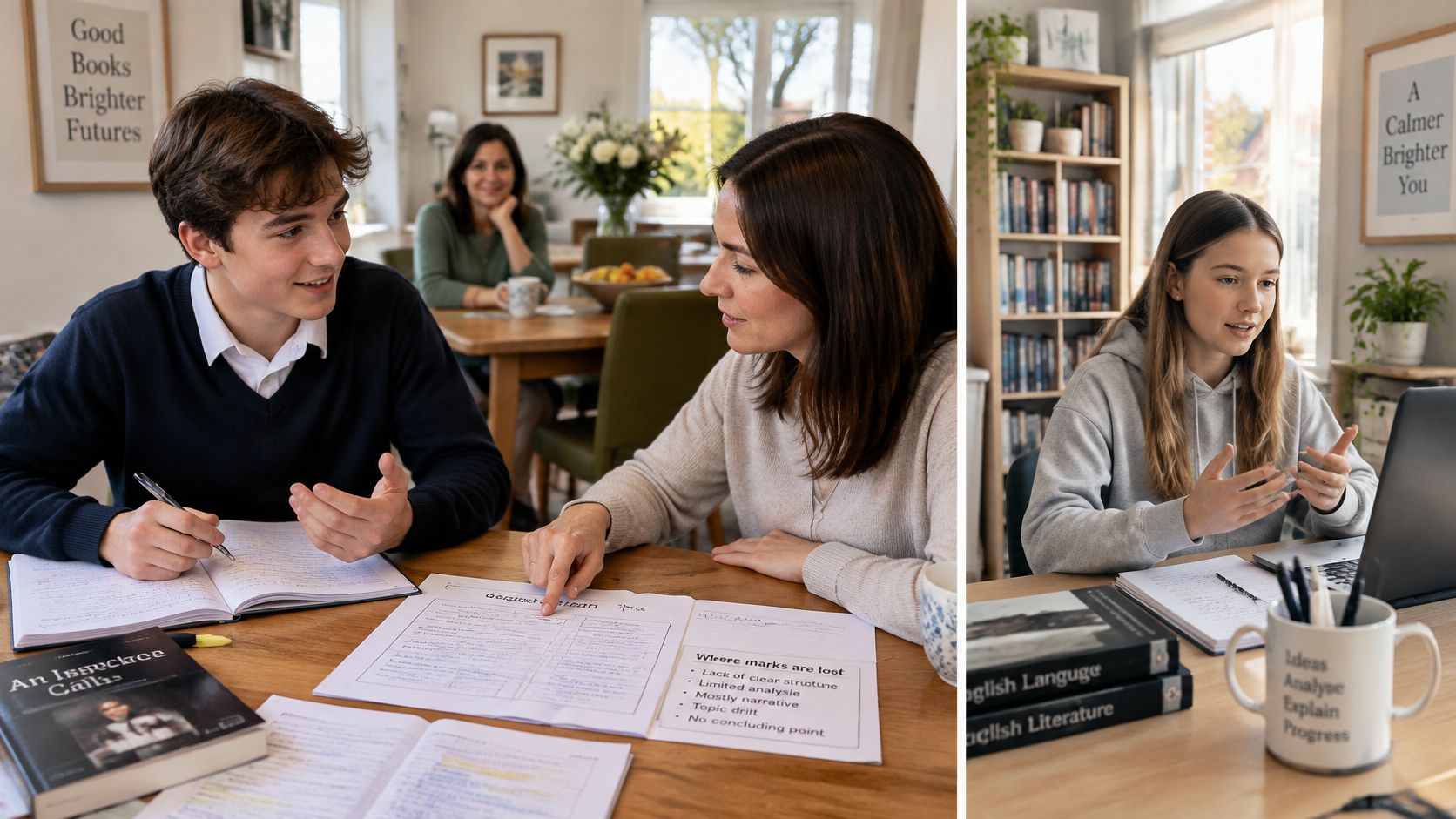
A Year 10 pupil who understands a novel but writes an unclear argument needs help with planning, paragraph control and timed responses, not unstructured conversation. A child moving between Los Angeles and London may need academic vocabulary aligned with the receiving school's expectations. In a bilingual Miami or Palm Beach home, the aim may be stronger English schoolwork while respecting the family language.
For younger learners, visual prompts can help start a discussion. This guide to help kids practise English through pictures offers ideas a tutor can connect to schoolwork.
Whether the tutor works at home or online, specify the English skills to be taught, the work to be reviewed and when parents will receive an update. A governess or mentor may support several subjects, but English should still have its own goals.
Keep Exam Preparation and Entry Separate
A tutor can prepare a child for an exam but cannot act as the examination centre. Ofqual's 2026 student guidance on exam arrangements says private candidates must register as soon as possible with a school, college or approved exam centre.
The family should confirm who is arranging the entry. The centre or school should confirm the specification, deadline, assessment requirements and access-arrangement process. The tutor should teach and review the assessed skills, while keeping a record of topics covered and scripts marked.
This distinction matters when a child changes schools or countries mid-course: a portable record supports continuity, but tuition cannot secure an entry or extend a missed deadline. Families considering GCSE support can read Superstar Nannies' guidance on a private tutor for GCSE while confirming formal arrangements with the school or centre.
Brief the Tutor Around Your Child
Give candidates a concise brief: the child's curriculum, precise difficulty, languages spoken at home, preferred lesson format, travel pattern and first review date. Ask how they would assess the need, teach the skill and report progress. The tutor's biography may justify an interview; the teaching plan and the child's response should inform the appointment.
Superstar Nannies places private tutors and governesses with attention to academic needs and household fit. Its process includes a personal consultation, tailored candidate selection, interviews and trial periods, followed by ongoing support and aftercare. Agree written goals and a review date before making a longer commitment.
To discuss one-to-one English tuition, share your child's curriculum, current difficulty and preferred format with Superstar Nannies.