


For an internationally mobile family, appointing a private GCSE tutor is rarely a matter of finding someone to deliver an hour of revision each week. The tutor may need to maintain academic continuity between homes and schools, work within a demanding travel schedule, and prepare a pupil for a particular UK examination without losing sight of their wider education.
An Oxford or Cambridge degree may be an attractive credential, but it is not, by itself, evidence of expertise in the relevant GCSE specification or an ability to teach a particular child. The strongest appointment combines subject knowledge, diagnostic teaching, sound judgement and a practical understanding of exam entry.
Access to private tuition is unequal. The Sutton Trust tutoring research published in 2023 found that participation was 32% among pupils in the highest household-income quarter, compared with 13% among those in the lowest quarter. That disparity is a reminder that tutoring should be judged by the educational value it delivers, not by prestige or price alone.
Why Families Appoint Private GCSE Tutors
The Sutton Trust and Ipsos Mori survey published in 2018 found that 27% of 11 to 16-year-olds in England and Wales had received private or home tuition at some point, compared with 18% when the time series began in 2005. Among pupils who had received tuition, 33% said it was for specific GCSE examinations, while 47% said it supported schoolwork generally.
That distinction shapes the appointment. A pupil approaching examinations may require focused work on assessed skills, timing and recurring errors. A pupil moving between countries, schools or curricula may first need continuity of teaching and a careful assessment of what has and has not been covered. Others need both.
Private tuition can offer individual attention that is difficult to provide in a whole-class setting. Its value depends on whether the tutor identifies the pupil's needs accurately, teaches the appropriate qualification and shows that the pupil can apply what they have learned.
Location also affects access. In the same survey, 41% of pupils in London reported having received private tuition, against 27% across England and Wales. For families based across several locations, the more important question may be how to preserve a coherent plan when lessons alternate between in-person and online delivery.
This guide compares the available arrangements, explains what an effective teaching plan should contain, and sets out the exam-entry responsibilities that matter particularly to private and home-educated candidates. For wider context, see maximising academic potential with private tutors.
Private GCSE Tutoring Arrangements for International Families
GCSE tutoring formats, their uses and practical limitations
| Arrangement | Best suited to | Delivery | Principal consideration | Fee comparison |
|---|---|---|---|---|
| One-to-one subject specialist | A defined subject gap or examination objective | In person or online | Verify expertise in the precise specification and tier | £30 average listed UK hourly price for GCSE tutoring in 2025, as a market reference only |
| Online one-to-one tutor | Families who travel or divide time between homes | Video lessons | Agree how resources, marking and lesson continuity will be managed | Request the hourly rate and any platform or booking fees in writing |
| Small-group tuition | Pupils who benefit from discussion with peers | Scheduled group sessions | Individual feedback may be limited | Request the per-pupil fee and maximum group size |
| School or centre-based intervention | Pupils whose needs match the support already available | On site | Scope depends on school provision | Confirm whether it is included or charged separately |
| Governess-led or multi-subject programme | Home-educated pupils or those needing structured teaching across subjects | Regular lessons, with delivery agreed to suit the family | Exam entry and assessed components require separate planning | Request an itemised proposal covering subjects, hours and materials |
| Tutor-mentor | Pupils who need revision planning and accountability | Regular check-ins | Mentoring does not replace specialist subject teaching | Clarify the frequency of meetings and support between them |
Put price in context
Atom Learning's UK private-tuition pricing analysis reported that the average listed UK hourly price for GCSE tutoring in 2025 was £30. This is a market benchmark, not a quotation for a specialist or bespoke arrangement. Rates differ by subject, experience, location and the scope of work.
For a meaningful comparison, ask what the fee includes: preparation, marking, work between lessons, written progress reports and any travel or booking costs. A lower hourly rate offers little advantage if essential work is billed separately or progress is not reviewed.
Appoint to the educational need, not the title
A specialist may be appropriate for a discrete challenge such as quadratic equations, analytical writing or unseen poetry. A pupil who has missed substantial teaching needs a more sustained sequence of lessons. A home-educated pupil studying several GCSEs needs teaching, assessment and an agreed route to sitting each examination.
Likewise, distinguish a gap in knowledge from difficulty performing under examination conditions. A pupil who understands the subject but loses marks under time pressure needs timed work and precise feedback. A pupil who has missed a term of teaching may need to rebuild understanding before extensive paper practice is productive.
Ask two questions of every arrangement: How will progress be measured against a baseline? And, for a private candidate, how will the pupil enter and complete every required assessment? Neither an impressive academic biography nor a premium fee answers those questions.
School-based targeted intervention may be sufficient for some pupils, or it may complement carefully selected private lessons. Families considering a managed appointment can review what a home tutor agency typically coordinates.
What Expert GCSE Teaching Should Look Like
The starting point is the pupil's exam-board specification. It identifies the content, skills and assessment requirements for the qualification. The Ofqual GCSE qualification level conditions require GCSE assessments to permit learners who have acquired the specified knowledge, skills and understanding to attain across the full range of specified levels. Tuition should therefore connect teaching, practice and feedback to the specification and its assessment objectives.
A baseline assessment establishes what the pupil can already do. It allows the tutor to prioritise rather than assume that every topic requires the same amount of attention.
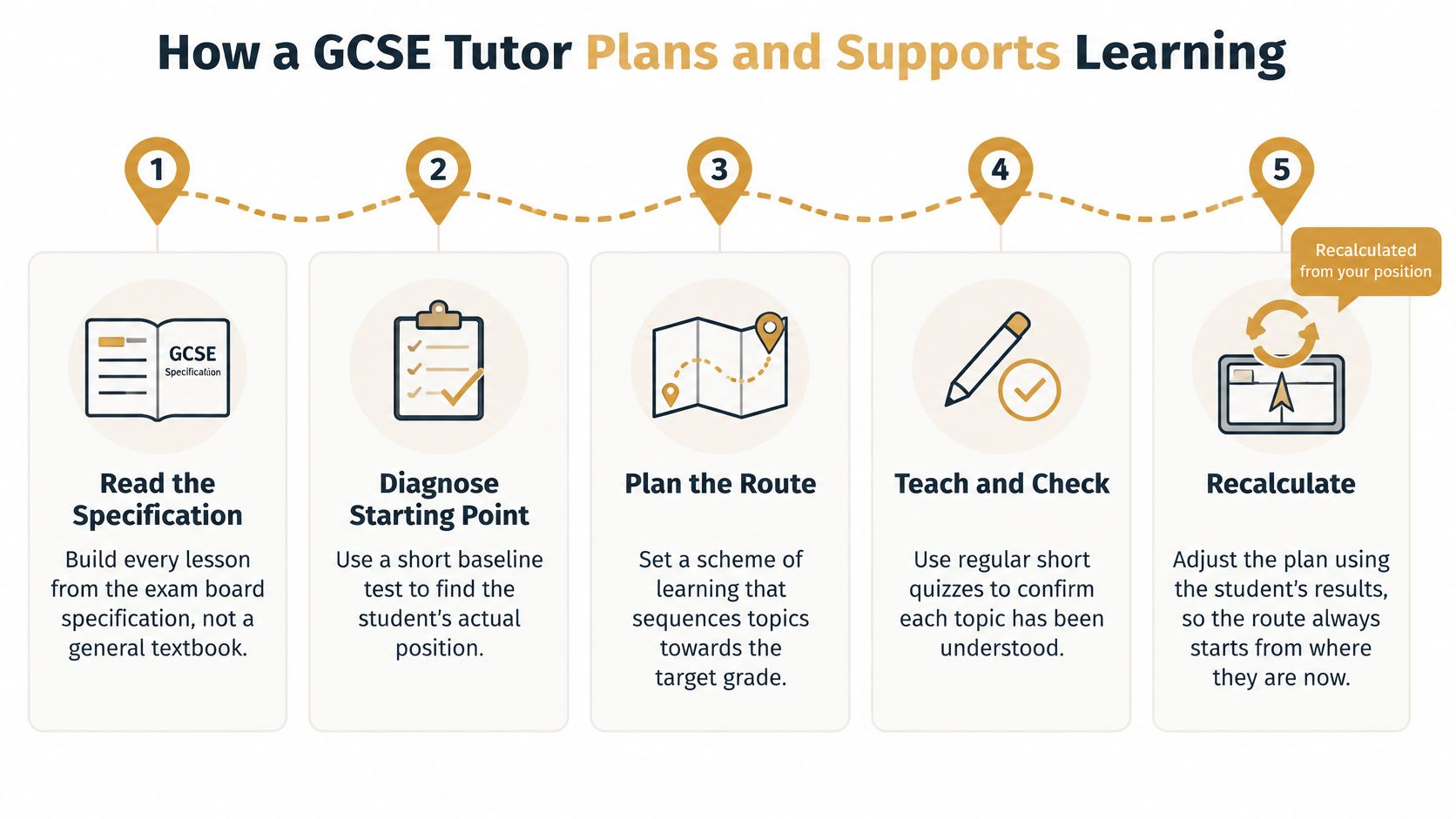
Six elements of a rigorous tutoring plan
- Confirm the qualification: Record the awarding organisation, specification, tier where applicable, assessed components, permitted materials and assessment-objective weightings.
- Establish the baseline: Use relevant exam-board-style questions and timed work when appropriate.
- Diagnose errors: Separate gaps in knowledge, application, reasoning and exam technique.
- Sequence the teaching: Combine explicit explanation, retrieval practice, worked examples and timed answers as needed. It can help to sequence lessons around learning outcomes so each session builds on prior work.
- Mark against the criteria: Explain where marks were gained or lost and identify recurring patterns.
- Review and report: Track performance by topic and assessed skill, with written updates that explain any change in approach.
Why the diagnosis matters
A knowledge gap calls for teaching and opportunities to retrieve information. An application gap calls for practice using familiar concepts in less familiar contexts. A reasoning error may require closer examination of how the pupil reaches an answer.
Exam-technique errors call for a different response. A pupil may misread a command word such as "evaluate", spend too long on an early question or omit an element required by the mark scheme. Timed answers and specific feedback make these issues visible.
A useful interview question: Which errors are currently costing this pupil marks, and what will you do differently because of that evidence?
Preserve continuity across locations
Where a pupil studies in more than one country or home, agree how the tutor will maintain records of topics covered, marked work and next steps. The same baseline and review measures should apply whether a lesson is held in person or online. This helps the family judge progress on evidence rather than on an unsupported grade prediction.
Exam-focused work is necessarily narrower than teaching across a full course. In either case, revisit comparable tasks at agreed intervals and adapt the plan in response to results.
Exam Entry for Private and Home-Educated Candidates
A tutor does not, simply by teaching the pupil, secure a GCSE examination place. The Ofqual student guide on GOV.UK states that private candidates must register through a school, college or other approved exam centre, whether they study with a tutor, a parent, a distance-learning provider or independently.
This is especially important when a family is planning from abroad. Not every centre accepts private candidates or offers every component. Establish the entry route before committing to a specification or target exam series.

Responsibilities to confirm by candidate circumstance
| Candidate circumstance | Who arranges exam entry | First point to confirm |
|---|---|---|
| Private candidate | Approved school, college or exam centre | Whether the centre accepts private candidates and offers all required components |
| Home-educated child | Approved school, college or exam centre | Whether the centre can register the pupil and accommodate any non-exam assessment |
| Pupil studying online or abroad | Approved exam centre operating under UK exam arrangements | Which specifications and assessed components are available to private candidates |
| Pupil with SEND or access needs | Approved centre, which manages access arrangements | What evidence is required and when applications must be made |
Resolve assessed components and access needs early
Access arrangements, such as extra time, a reader or a separate room, are managed through the exam centre. Ask the centre what evidence it needs and when it must receive it. A tutor may supply supporting information but cannot authorise an arrangement independently.
Non-exam or internally assessed work, including portfolios, also requires advance planning. The centre must be able to administer the relevant assessment. In art and design, work is developed over time; Design (OCAD) OCAD's guide to KS3 art provides background on a sustained portfolio process, although the GCSE requirements must be checked against the selected specification and centre.
For families moving internationally, do not assume that a course studied abroad leads to entry for the same specification at a prospective UK centre. Confirm availability with the awarding organisation and centre. Before teaching begins, record the centre, specification, assessed components, entry deadlines and person responsible for each step.
Families arranging a wider programme may also find the guide to private tutoring for homeschooling useful. For a retake, check the applicable entry arrangements directly with the chosen centre.
How to Assess an Oxford or Cambridge-Educated Tutor
An Oxford or Cambridge education can indicate strong academic attainment. It does not establish that a candidate has taught the relevant GCSE, understands its mark schemes or can build rapport with the pupil. Treat university background as one point of enquiry, then test the teaching evidence.
Criteria for a specialist tutor appointment
| Criterion | Question to ask | Strong evidence | Reason for caution |
|---|---|---|---|
| Academic and subject background | What did you study, and which GCSE subjects do you teach? | Credentials are clear and relevant, with subject knowledge demonstrated in discussion | Prestige is offered as a substitute for teaching evidence |
| Specification expertise | Which awarding organisation, specification and tier will you teach? | The tutor can link lessons to assessed content and objectives | A generic approach that overlooks the qualification |
| Diagnostic method | How will you establish the pupil's starting point? | Relevant exam-style work and analysis of errors | A grade prediction without evidence |
| Reporting | What will the family receive, and when? | Concise written updates tied to topics, assessed skills and next steps | General assurances without work to support them |
| International continuity | How will you maintain the plan when the pupil travels? | Clear arrangements for scheduling, resources and records across lesson formats | No plan for interruptions or changes in location |
| Exam entry awareness | Who is responsible for entry and access arrangements? | A clear account of the centre's role and any actions for the family | An assumption that tuition alone secures entry |
| Teaching fit and safeguarding | How do you adapt your approach, and what checks and references are available? | Specific examples of adaptation, clear checks and references on request | Vague responses about suitability or safeguarding |
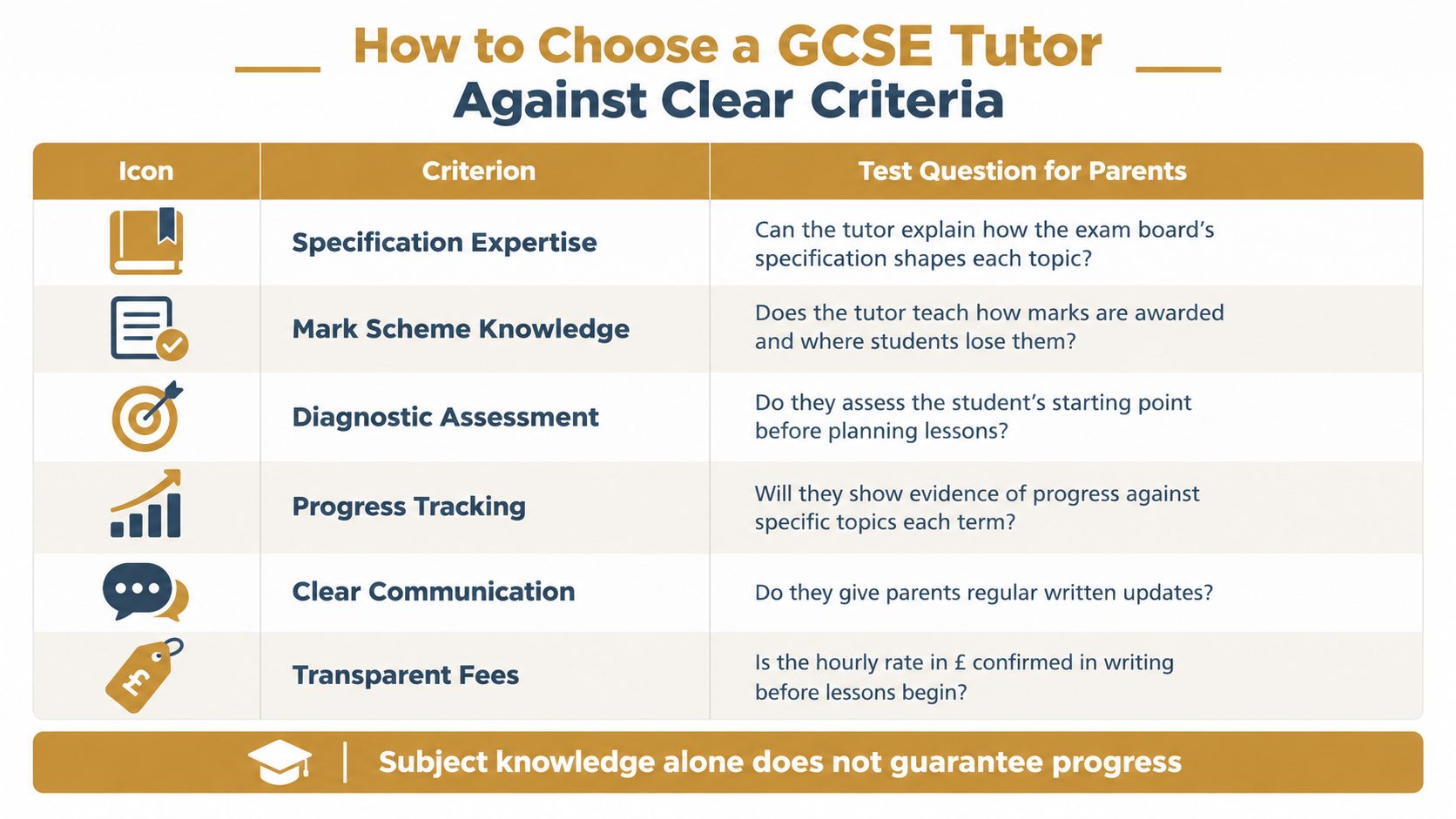
Evaluate discretion alongside teaching quality
For a family managing education across homes, schools and time zones, a tutor's professional judgement matters beyond the lesson itself. Agree who receives progress reports, what information may be shared with the school, and how changes to the pupil's schedule will be handled. These arrangements should support effective teaching without making the pupil's education unnecessarily complicated.
Specification knowledge keeps the teaching relevant. A baseline diagnostic makes improvement measurable. Written reporting allows the family to see what has changed and why. The guide to private tutor qualifications offers further interview questions.
An exceptional academic record is valuable. For a GCSE appointment, it should be supported by a demonstrable teaching method and evidence of pupil progress.
Set targets without promising grades
GCSE grades in England use a 9-to-1 scale, and grade 9 is not tied to a fixed percentage in every subject. Ofqual's guide to 9-to-1 grades for parents explains that its approach is designed so approximately 20% of students achieving grade 7 or above receive grade 9, although the proportion can vary by subject.
Set targets with reference to the specification, assessment evidence and relevant grade boundaries. Ask for topic-level evidence of improvement, not simply a predicted grade. Be cautious of anyone who guarantees an outcome, cannot explain the pupil's errors or treats exam entry as a minor formality.
Arrange a Diagnostic Before Making an Appointment
A considered appointment begins with a short, evidence-led process:
- Define the brief: Identify the subjects, examination timetable, school context, travel pattern and type of support required.
- Confirm the qualification route: Check the awarding organisation and specification. For a private candidate, identify a suitable exam centre.
- Select the arrangement: Decide whether the pupil needs a single-subject specialist, continuing online support or a broader teaching programme.
- Request a diagnostic: Ask what work the tutor will use to establish a baseline and what the family will receive afterwards.
- Agree a review point: Compare subsequent work with the baseline before deciding on frequency, scope or a longer engagement.
How Superstar Nannies can help
Superstar Nannies offers a bespoke, discreet and highly selective recruitment service for UHNW and VIP families. Its education services include private tutors, mentors, governesses and governors, with support for children attending schools in the UK and internationally. Tutors offer one-to-one tuition, including English, GCSE Maths and exam technique, in person or online.
The team works with families to understand a child's educational needs and match them with a tutor whose subject expertise, teaching style and personality suit the pupil. Discuss the required qualification, locations and schedule before considering a tutor appointment.
If you are seeking a private GCSE tutor for a pupil studying across locations, begin with the specification, a diagnostic assessment and a confirmed examination route. Visit Superstar Nannies to discuss an appropriate tutor match and options for in-person or online tuition.