


A DBS check tells you what was on record on one date, for one type of role. It doesn't transfer safeguarding duty from your family to an agency, and it doesn't turn a private home into a regulated childcare setting.
That's the point most families miss when they search for a nanny agency UK families can trust. A good agency narrows risk, tests fit and keeps your brief private. You're still the employer in most placements, you're still responsible for supervision after the start date, and you still need to know exactly what each check does and doesn't prove. Choose the agency model first, then judge vetting by its limits, not by a badge.
UK Nanny Agency Models Compared
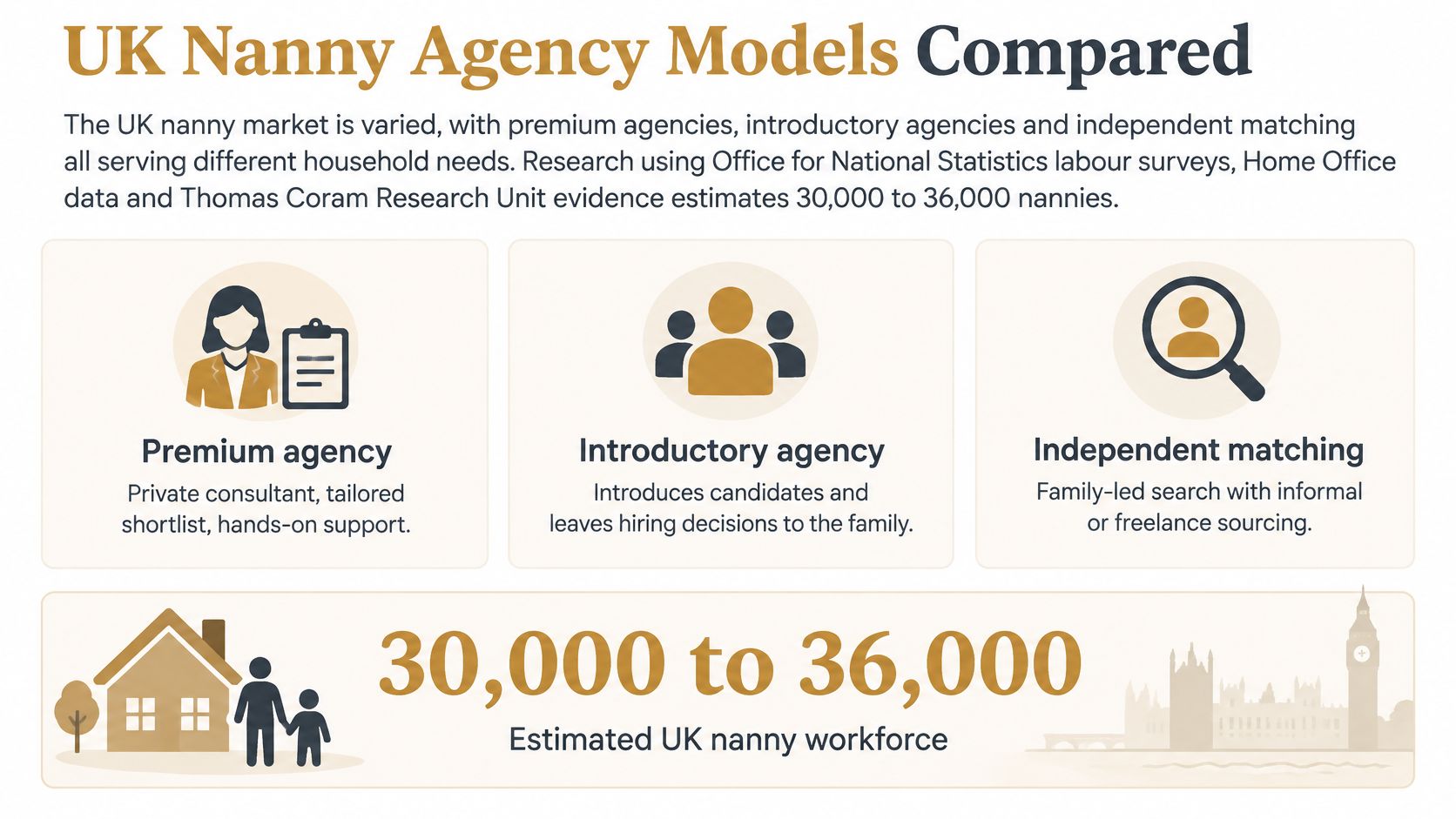
The UK nanny market is varied, with premium agencies, introductory agencies and independent matching serving different household needs. Research drawing on Office for National Statistics labour surveys, Home Office data and Thomas Coram Research Unit evidence estimates between 30,000 and 36,000 nannies work in England, according to Nursery World's analysis of the nanny workforce.
Treat that as an England estimate, not a UK-wide census. Nannies have no dedicated Standard Occupational Classification and no single mandatory national register. Many work in private homes, employed directly, self-employed or placed through an agency, so official counts can't rank agencies for you. Proven experience, check quality and match outcomes are the differentiators.
Four Models Judged by Fit
| Model | Who it suits | How matching works | Screening depth | Discretion |
|---|---|---|---|---|
| High-volume placement desk | Standard hours and a fast shortlist | Large pool and quicker first introductions | Identity, references and a DBS check | Lower; the brief may circulate widely |
| Boutique specialist | A defined brief and fewer roles | Consultant-led shortlist of fewer candidates | Role-matched checks and recent references | Higher; limited sharing of the brief |
| Elite private household agency | UHNW, VIP and multi-home families | Bespoke search and a long-term match | Layered vetting, overseas history and household protocols | Highest; need-to-know handling |
| International or rota desk | Travel, dual-city and shift-pattern homes | Team or rotational cover across homes | Extra right-to-work and jurisdiction checks | High, including travel confidentiality |
A high-volume desk works when hours are standard and speed matters more than privacy. You'll see candidates quickly, but your brief may travel further than you'd like. A boutique specialist suits a defined brief. One consultant sends fewer profiles and controls who sees what.
An elite private-household agency suits multi-home, fully staffed or high-profile households. Expect a bespoke search, layered vetting including overseas history, and need-to-know handling from the first call. An international or rota desk adds right-to-work and jurisdiction checks for travel and shift patterns. If you're weighing those patterns, read our guide to live-in, live-out or rota nanny arrangements for your household before you brief anyone.
For elite households, we recommend a specialist agency over private online hiring for privacy, continuity and standards.
Registration with an agency doesn't mean the agency employs the nanny. In the 2025 Coram PACEY survey of more than 100 UK nannies, 64% of respondents were employed directly by families, 23% were self-employed and 13% combined both arrangements, yet two-thirds reported being registered with a nanny agency.
Most respondents were career professionals, not casual cover. The same survey found 77% worked as nannies as their only job, 56% had been nannies for more than 10 years, and 56% worked for one family.
Choose the row that matches your privacy, complexity and speed. Don't choose the largest database. A big pool helps a standard brief. It doesn't help a confidential, multi-home search where the wrong circulation is the main risk.
What Properly Vetted Means After Placement
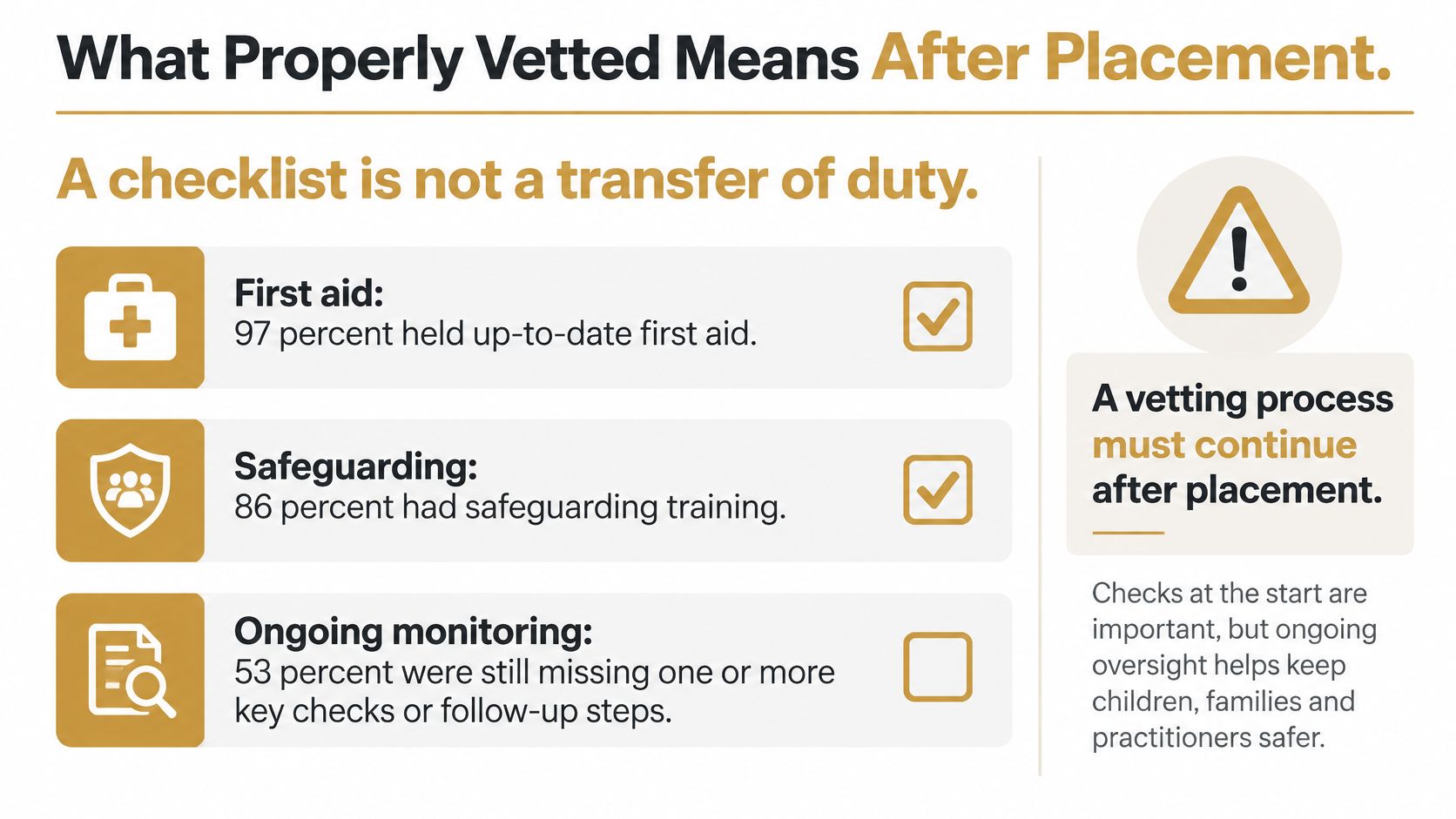
A check is a snapshot, not a transfer of safeguarding responsibility. Training, registration and experience vary between nannies, so assess each candidate against the duties of the role. A clean record check cannot predict future conduct or prove someone is suitable for every responsibility you may later add.
Registration on Ofsted's voluntary Childcare Register is a choice in England, not a licence every capable nanny holds. An agency introduction does not make your home a regulated setting, and neither registration nor a DBS certificate removes the family's responsibility to supervise and respond to concerns.
What Each Check Leaves Open
| Check | What it confirms | What it does not confirm | How current |
|---|---|---|---|
| Enhanced DBS with children's barred list | Record and barred-list status for the role | Future conduct or fitness for every duty | Within three months, or DBS Update Service |
| Home-based versus usual DBS | The check matches live-in or live-out work | That the nanny is Ofsted registered | Repeat if address or duties change |
| Ofsted voluntary Childcare Register | The nanny chose to register in England | That every capable nanny is registered | Check status at placement |
| First aid and insurance | A current first-aid certificate and public liability cover | That safeguarding training is also in date | Check certificate expiry separately |
| References, right to work, overseas character | Recent work history, eligibility, and overseas residence where relevant | That the agency employs the nanny after placement | Speak to recent referees; consider good-character checks for relevant time abroad |
| Family duties after the start date | Who supervises, reports incidents and updates the role | Any handover of safeguarding duty to the agency | Review continuously, including when duties change |
For an Ofsted-registered nanny, GOV.UK guidance on Ofsted suitability checks says the appropriate check is generally an enhanced DBS certificate with a children's barred-list check, issued within the previous three months unless the applicant is subscribed to the DBS Update Service. A live-in nanny needs a home-based DBS check. A nanny who does not live in the household needs the usual check for childcare workers.
The type of setting matters. In England, GOV.UK guidance on childcare providers who need a DBS check explains that a nanny working in a child's own home may care for children from one or two families at a time. A nanny cannot provide childcare from their own home without registering instead as a home-based childminder. Ofsted registration also involves first-aid training, public-liability insurance and, where relevant, a certificate of good character covering time lived overseas during the previous five years.
Consider everyone who may have access to the children. For nannies on the voluntary register, GOV.UK guidance for nannies registered on the voluntary Childcare Register states that every person providing childcare must be suitable and hold an enhanced DBS check with the children's barred list. Children must not have unsupervised contact with someone who lacks the required barred-list check. People aged 16 or over who live or work on domestic childcare premises may need their own enhanced clearance and suitability assessment. Include rota staff, travelling staff, other household employees and temporary cover in your arrangements.
What Your Family Still Owns
Every nanny Superstar Nannies represents is vetted through the Disclosure and Barring Service and reference-checked. Those checks give you a starting point, not ongoing supervision. Use this guide to checks for working with children to distinguish the checks and agree who will keep each one current.
- Right to work and identity: Confirm eligibility yourself and store copies securely.
- Reference currency: Ask who spoke to each referee, when, and which gaps remain unexplained.
- Change triggers: Review checks when live-in status, address, unsupervised access or duties change.
- Escalation: Agree who records incidents, who supervises day to day, and whom you call first.
Ask the agency for a role-specific safeguarding matrix, not a yes-or-no DBS flag. It should record the check level, workforce category, home-based classification, issue date, Update Service status, live-in address and unsupervised access. If the agency cannot explain those details, its check process is not clear enough for you to assess.
How a Premium Agency Works and How to Test It
Treat a premium search as a private brief, not a job advert. Say a London household needs a live-out nanny for two school-age children, with travel in the holidays and a housekeeper already in place. The first call isn't about availability. It's about how the family lives.
One consultant takes the full picture. Children's ages and routines, solo charge or shared care, languages, school runs, homework, newborn nights if relevant, travel pattern, pets, other staff and deal-breakers. You then receive a short written brief to correct before any candidate hears your name, area or security details. That's the control point. Don't skip it.
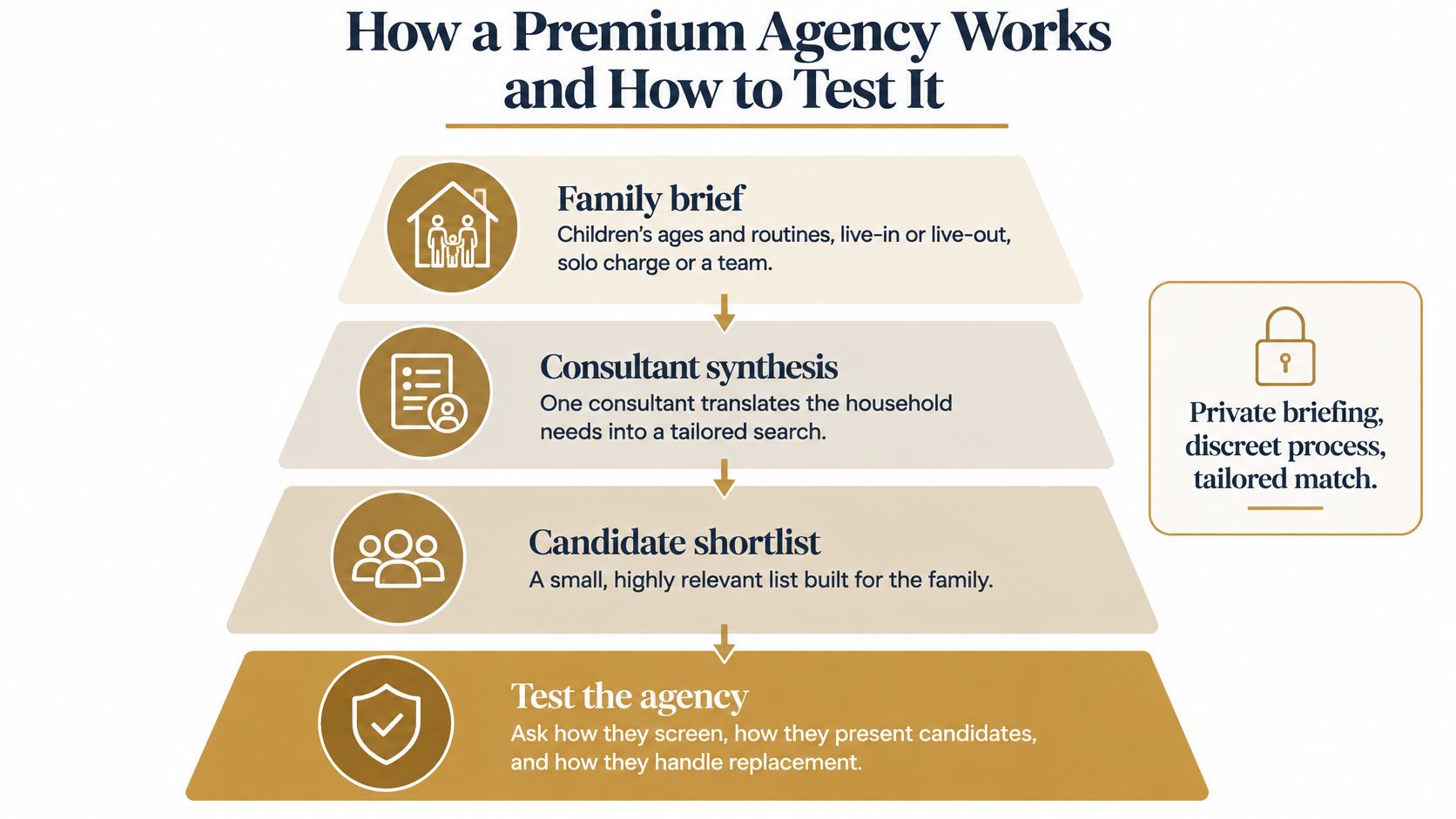
We offer a bespoke, discreet and highly selective recruitment service, so the shortlist stays small. Each profile should show relevant private-household experience, the check type for that living arrangement, first-aid status, references the consultant has spoken to, and gaps explained, including time abroad. If you receive a bulk pack of CVs before anyone asks whether the role is live-in, stop the search there.
From Shortlist to Month Three
Interviews happen only after that filter. A good consultant prepares both sides on duties, hours, accommodation if live-in, pay outline, notice and what a trial week is meant to test. A trial isn't free childcare. It's a structured test of routines, discipline style, communication and fit with the wider household.
After placement, premium support means a named consultant, a check-in once real routines have replaced first-week politeness, and a clear route back if the role, address or household membership changes. It doesn't make the agency your employer or your safeguarding lead. Anyone who implies otherwise is overselling.
A strong answer is specific and slightly cautious. A weak answer promises you the best nannies and refuses to say who employs the nanny after the start date.
Six Questions Before You Share a Name or Address
Ask these in order, and insist on answers in writing.
- Who owns the search? Has that consultant placed similar private households, and will you deal with that person throughout?
- Who sees the brief? How many candidates receive it, and what details stay withheld until interview stage?
- Who employs the nanny? After the start date, is employment with your family, and what exactly does the agency still do?
- What if it ends early or late? If notice is given in month two or month fourteen, what's the replacement position, fee position and temporary cover route?
- Can the same desk staff the wider home? Can they introduce a housekeeper, family assistant or driver later without restarting from zero?
- Where do the consultants work? A London family should expect a UK conversation with someone who understands UK checks, contracts and household norms.
Score the answers, not the brochure. A consultant who declines a brief that doesn't fit is protecting you. A consultant who accepts every brief, sends profiles within the hour and can't explain check types is optimising for a fee.
Watch for three red flags. First, no named owner. Second, no explanation of who rechecks a changed role. Third, no one who'll pick up the phone after month three. If you hear all three, it isn't a premium search, whatever the website says.
Good agencies also protect candidates. They won't circulate a nanny's documents widely, they'll brief clearly on hours and accommodation, and they'll step back if your expectations don't match the role you've described. That candour serves your children. Mismatched placements fail unnoticed at first, then suddenly.
Placements That Suit Private Households
Name the picture that matches your week before you ask for candidates. A vague request for a nanny produces a vague shortlist.
Four Household Pictures
School-age children in Kensington or Mayfair. You may need a live-out nanny who handles school runs, homework, clubs and parts of a parent's diary. That's closer to a nanny and personal assistant than a babysitter. Brief it that way and you'll meet different, better-suited candidates.
A household split between London and another city. You may need a rota or travel nanny, sometimes as a pair covering alternating blocks. Right-to-work status, travel documents and check category need revisiting when the base address changes. Continuity for the children comes from a proper handover routine between the two nannies, not from one person working without rest.
Parents of a newborn. Don't force one hire to cover two different jobs. A maternity nurse or night nanny can cover the early weeks, feeding support and sleep shaping, then hand over to a separate longer-term nanny. Splitting the roles usually gives you stronger specialists in both phases.
Children raised in more than one language. You may want a bilingual nanny, sometimes alongside a governess or private tutor when academic progress matters more than general care. Superstar Nannies offers bilingual nanny services in Mandarin, Spanish, French, German and Russian, which covers the requests London families make most often.
Roles General Childcare Sites Skip
Private households also ask for a manny, a special-needs nanny, emergency cover at short notice, and a housekeeper-nanny where childcare is only part of running the home. After-school nannies, live-in and live-out nannies, maternity nurses, governesses and private tutors all sit in the same placement range. We place nannies and private household staff for elite families in the UK, the US and internationally, so a London brief that later extends to a second home doesn't need a new agency.
Use these pictures to test fit, not as templates to copy. Your brief should state ages, hours, languages, travel, other staff and the one outcome that matters most this year, whether that's calm school mornings, confident reading or settled nights. Give a consultant that picture and the shortlist sharpens. Give them a job title alone and you'll interview people who were never right for your home.
What a UK Nanny Agency Charges and Who Pays
Fee structures aren't standardised, so compare them in writing before any shortlist arrives. Our breakdown of the costs of a nanny is a useful starting point, but your agency's own terms are what bind you.
Send these questions by email and keep the replies.
- Agency fee: What's the fee, how is it calculated, when is it payable, and is it tied to a placement rather than a subscription?
- Pay outline: What pay range fits this role given live-in or live-out status, hours, solo or team charge, and any household duties beyond childcare?
- Contract holder: Who holds the employment contract after the start date?
- Replacement terms: What applies if notice is given in month two or month fourteen, and how quickly can temporary cover be discussed?
- Extras: What's included in the fee, and what's charged separately, such as checks, travel for interviews or trial weeks?
If your family is the employer, you take on employer responsibilities, including contract terms, payroll arrangements and statutory duties. Confirm those with a qualified adviser before the start date, not during the first pay run. Don't let an agency blur this point to close the placement.
Ignore public childcare averages when budgeting. Figures for subsidised places, part-time nursery care or government schemes describe different arrangements. They won't estimate what a private, full-time nanny in your home costs.
Apply one simple test. A firm that answers these points clearly in writing is easier to hold to account than one that quotes a single headline figure and moves on.
Register and Brief a Discreet Placement
Once a firm has passed your questions, move in a fixed sequence. Don't interview first and clarify terms later.
- Register online. State that you need a private-household search, your city, live-in or live-out, and how confidential the approach must be.
- Take the consultant call and lock the brief. Confirm ages, hours, languages, travel, newborn or night cover, other staff and deal-breakers.
- Set the evidence bar. Ask to see only candidates whose DBS type, first aid, references, right to work and overseas history match that brief.
- Interview against the week ahead. Then agree a start or trial with written duties, accommodation and notice.
- Confirm employment in writing. Record that your family employs the nanny unless a different contract is on offer, and name the post-placement check-in date.
- Agree recheck triggers. A house move, a second family sharing care, new adults with unsupervised access, or a switch from live-out to live-in should each prompt a fresh review.
Confidentiality runs through every step. Our guide to private staff confidentiality for high-profile families sets out what to withhold, when to disclose and how to handle references without exposing your household.
Register with the picture of your week already written down. Consultants match routines and standards, not job titles.
We ask potential clients to register online, and our dedicated consultants then get in touch to discuss their needs. Our UK office is at 45 Albemarle Street, Mayfair, London, W1S 4JL. You can reach us in the UK on +44 203 488 3722 and in the USA on +1 332 269 5124. We also have a Palm Beach office for families who split time with the United States.
Bring specifics to that first conversation. School times, travel dates, languages at home, who else works in the house and what didn't work last time will do more for your placement than any statement about wanting the very best. The aim is a calm, well-documented hire, not a pile of CVs and a rushed start date you'll revisit within the quarter.
If you want a discreet, consultant-led search with role-specific vetting and a small, well-matched shortlist, register your brief with Superstar Nannies and tell us how your household runs. We'll discuss live-in, live-out, rota, bilingual and wider household roles, including what stays your responsibility after placement.