


A family arriving in London after moving between Dubai and New York often faces a childcare problem that standard local advice does not solve. The children may need familiar routines, the parents may need dependable support during travel and irregular working days, and the household may already include a house manager, chef, security team and other staff. Hiring an international live-in nanny can create continuity, but only when the family understands the difference between finding an excellent candidate and lawfully employing an overseas domestic worker.
This guide is written for wealthy families, internationally mobile households and family offices assessing that decision. It covers role design, international nanny recruitment, safeguarding, UK immigration limits, PAYE, accommodation rules, cultural fit and relocation planning. The central question is often not, "How do we hire an international nanny?" It is, "Can this person work in our chosen country, under which route, for how long, and with what employment structure?"
As a discreet international recruitment agency, Superstar Nannies approaches these placements as a complete household project. The right candidate must be professionally capable, emotionally suited to the children, comfortable with international travel and able to work within the family's privacy expectations. A live-in arrangement can suit a family that values continuity and immediate availability, while a live-out nanny may offer clearer separation between work and home. A rota nanny may be more appropriate where coverage must continue across alternating teams, and a travelling nanny may be the better answer when the family's principal need is frequent movement.
A lawful, harmonious placement is achievable. It starts with an honest role brief, continues through careful screening and immigration planning, and succeeds when accommodation, working boundaries and communication are agreed before the nanny arrives.
International Live-In Nanny Hiring for Wealthy and International Families
An internationally mobile family rarely experiences childcare as a simple local vacancy. The family may be leaving a trusted nanny behind, moving children into a new school system, or establishing a UK residence while continuing to travel. A candidate who understands the children's routines, speaks a familiar language and can work calmly across changing environments may be more valuable than a locally available person who has never worked in a travelling household.
For wealthy families, childcare hiring is shaped by more than basic coverage. The role may sit within a wider household operation that includes principals with complex diaries, multiple residences, residential staff and heightened confidentiality expectations. In that setting, the nanny must not only care well for the children, but also operate smoothly inside an established private service environment.
The phrase international live-in nanny can describe several different hiring goals. Some families want a permanent resident nanny based in one principal home. Others want a nanny who travels between residences, supports school holidays or accompanies parents during business trips. Those arrangements can look similar in an advert, but the employment, accommodation, travel and immigration questions can be very different.
When a live-in nanny is the right fit
Live-in childcare can be a strong fit where the family needs early starts, evening support, school-run flexibility or continuity during travel. It can also help children settle after relocation because one trusted adult remains part of the daily rhythm while the surroundings change.
The arrangement is less suitable when the family expects the nanny to be constantly available without defined working time, or when there is no private and suitable accommodation. A room inside the home does not remove the need for rest, privacy, a written role description or proper employment treatment.
Recruiter's recommendation: Decide whether you need residence, flexibility or round-the-clock coverage. These are related requirements, but they are not the same thing.
For a fully staffed home, the nanny should also have a clear reporting line. The parents may set childcare priorities, while a household manager coordinates logistics, schedules and communication with other staff. Defining that structure early prevents duplicated instructions and avoids placing the nanny between competing expectations.
The strongest placements begin with a family conversation about lifestyle rather than salary alone. Consider travel patterns, children's ages, school commitments, languages spoken at home, preferred childcare philosophy, privacy requirements and the level of staff already in place. Once those decisions are clear, recruitment becomes a search for a precise professional match rather than a rushed attempt to fill a vacancy.
What an International Live-In Nanny Does in a Private Household
An international live-in nanny is a professional childcare employee who lives in accommodation provided by the employing family. The simplest analogy is that the nanny is both a specialist responsible for the children and a resident whose home happens to be within the family's property. The first role requires professional judgement. The second requires boundaries, privacy and mutual respect.
The job may include school preparation, nursery routines, meals for the children, developmental activities, homework support, children's laundry, organising outings and maintaining communication with parents. The exact duties should be written into the contract and household handbook. A nanny should not automatically become a housekeeper, family assistant, personal assistant or general domestic worker because she lives on site.
Comparing live-in, rota, travelling and bilingual nanny roles
A local live-in nanny may already have the right to work in the country and may be recruited for one established residence. An international nanny candidate can bring cross-border experience, language ability or continuity from another country, but her right to work still needs separate verification.
A rota nanny works within a planned alternating team, usually where the family needs ongoing coverage and structured handovers. A travelling nanny may be live-in at one residence but spend substantial time accompanying the family elsewhere. A bilingual governess generally combines childcare with a stronger educational or language-development remit, so the family must distinguish teaching expectations from ordinary nanny duties.
For wealthy families, those distinctions matter because the wrong structure can create unnecessary pressure inside an already complex household. A family with multiple properties, security procedures and changing guest schedules may need a nanny who is highly adaptable, but still working within a role that remains clearly defined.
Accommodation, privacy and availability
Private accommodation should be described before interviews. Clarify whether the nanny has a self-contained room, access to a bathroom, a private entrance, use of household facilities and an uninterrupted place to rest. Families should also state whether the nanny may receive visitors, how time off works and who manages household access.
Working hours must be planned rather than implied. A nanny who sleeps in the home is not automatically working throughout the night, and being physically present is not the same as being on duty. Overnight care, travel days, weekend work and additional children should be discussed openly and recorded in the employment terms.
In a staffed household, the best arrangement resembles a well-run relay. Parents set the family's priorities, the nanny owns the children's daily care, and the household manager coordinates practical operations. That clarity protects the children, the nanny and the family's privacy.
International Nanny Recruitment and Vetting for Cross-Border Hires
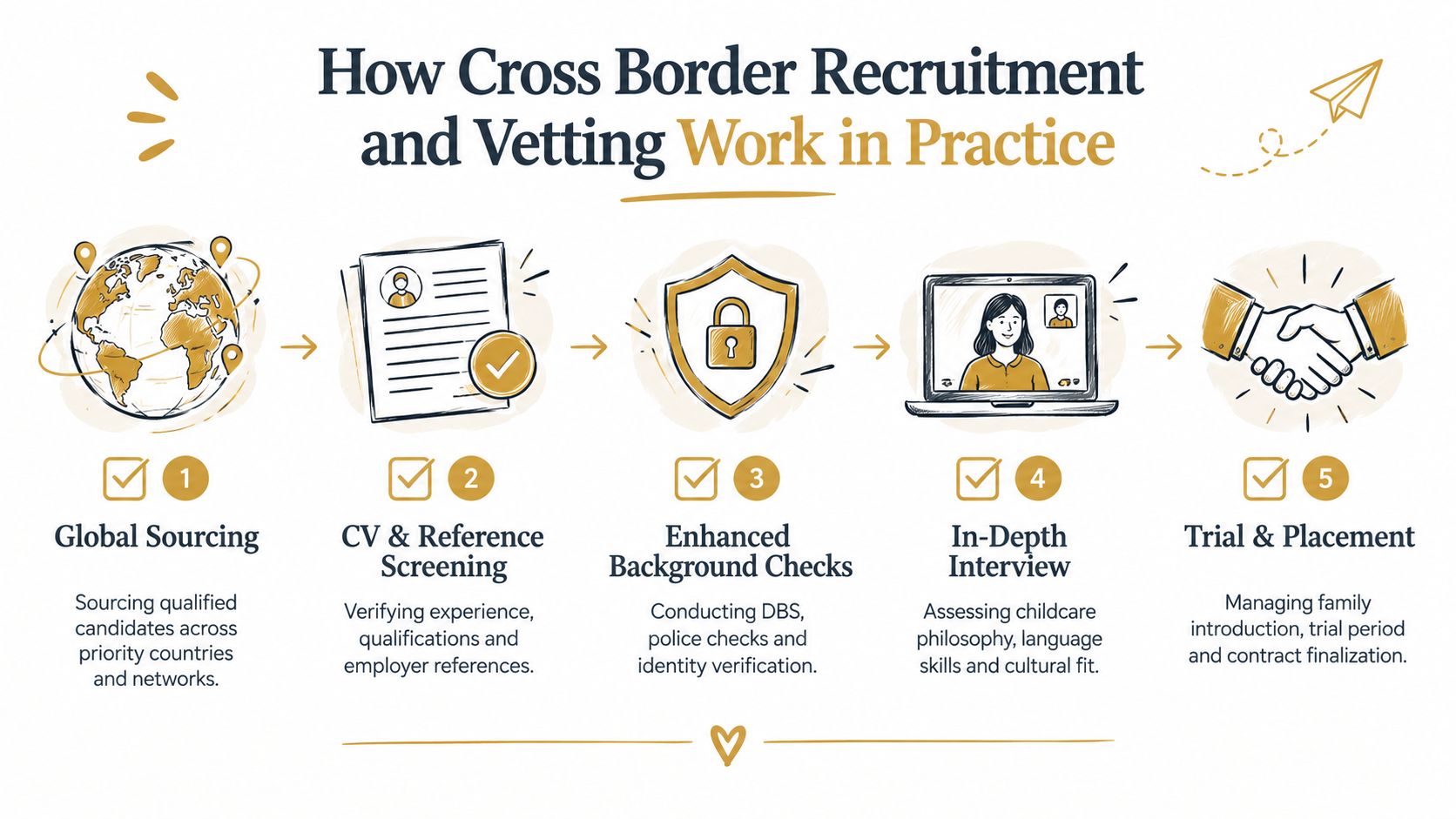
International recruitment should feel measured, not improvised. A reputable process starts by defining the family's actual need, then searches for candidates whose experience, documents, availability and working preferences align with it. A polished CV alone does not establish suitability for a private household.
For wealthy families, this process usually demands a higher level of discretion. Search activity may need to remain confidential, references may need to be handled with particular care, and the candidate may need experience working in homes where privacy, protocol and trust are non-negotiable.
A safeguarding-led recruitment process
The first stage is discreet sourcing through professional networks and relevant candidate pools. Shortlisting should examine the candidate's experience with the children's age range, travel history, languages, education or specialist skills, and comfort with live-in work. References must be obtained and assessed rather than treated as a formality.
The next stage is identity, right-to-work and safeguarding verification. For England, GOV.UK explains that a person can register with Ofsted as a nanny to care for children in their own home, and that childcare in domestic premises can include people who live where the care is provided. The same guidance makes clear that the relevant registration framework applies to England, so families in Scotland, Wales or Northern Ireland should check the rules for their specific jurisdiction through the appropriate authorities. GOV.UK guidance on becoming a childminder or nanny
Families should also understand that live-in status does not automatically remove registration or safeguarding responsibilities. GOV.UK lists circumstances in which a nanny in England does not need to register, including being under eighteen, being related to all the children cared for, lacking the legal right to work in the UK, or being barred from working with children. These points should be checked against the individual facts, not assumed from a job title.
For international candidates, families should request the documents needed for lawful employment and examine references from comparable households. Superstar Nannies' international background check service can be considered as part of a broader screening process, alongside direct document checks and professional judgement.
Interview questions that reveal family fit
A family interview should test practical judgement, not just warmth. Ask the candidate to explain how she would respond when children are overtired, how she records medication instructions, how she handles confidential information and how she manages a change to the day's schedule.
Useful questions include:
- Childcare judgement: How would you preserve a child's routine during a move between homes?
- Communication: Which language would you use with each child, and how would you report concerns to the parents?
- Professional boundaries: What would you do if another member of staff asked you to take responsibility for children outside your brief?
- Travel readiness: How do you prepare children for unfamiliar environments and changing routines?
- Household integration: How do you prefer to receive instructions from parents and a household manager?
For wealthy families, it is also sensible to test how a candidate responds to the realities of private service. That may include confidentiality, working around principals' changing schedules, coordinating with house staff, maintaining discretion around guests and adapting to formal or informal household cultures.
A common hiring mistake is selecting a candidate because she has worked internationally, then discovering that she dislikes resident employment or expects a different level of privacy. Another is assuming a family's resources make operational detail unnecessary. Clear questions protect both sides.
UK Visa Options for an International Live-In Nanny
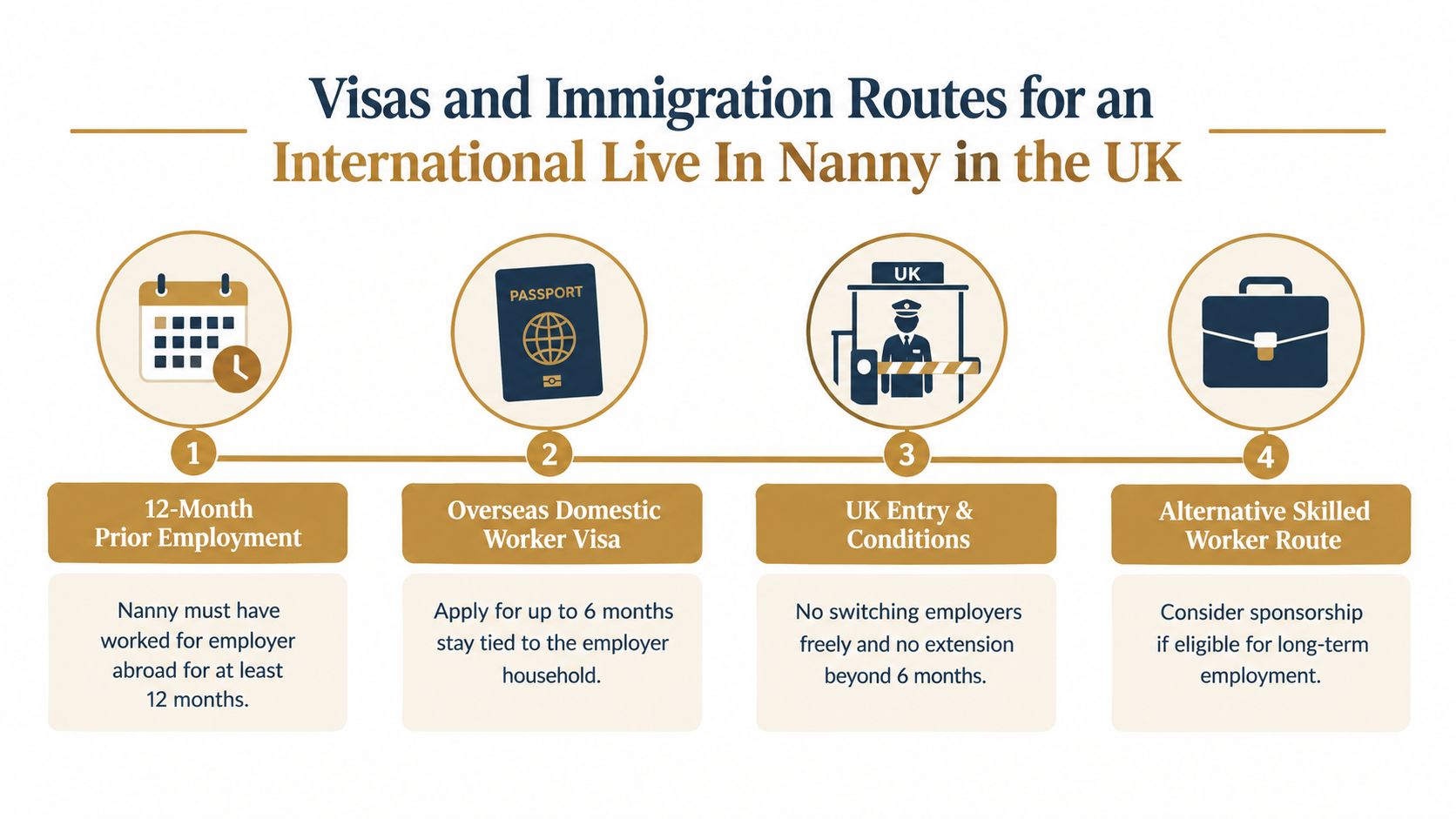
A family may arrive in Britain with a trusted nanny already caring for the children. That can support continuity during a relocation, but it does not automatically create permission for long-term UK employment. The first decision is whether the family is hosting an existing household employee for a limited visit or recruiting for an ongoing UK role.
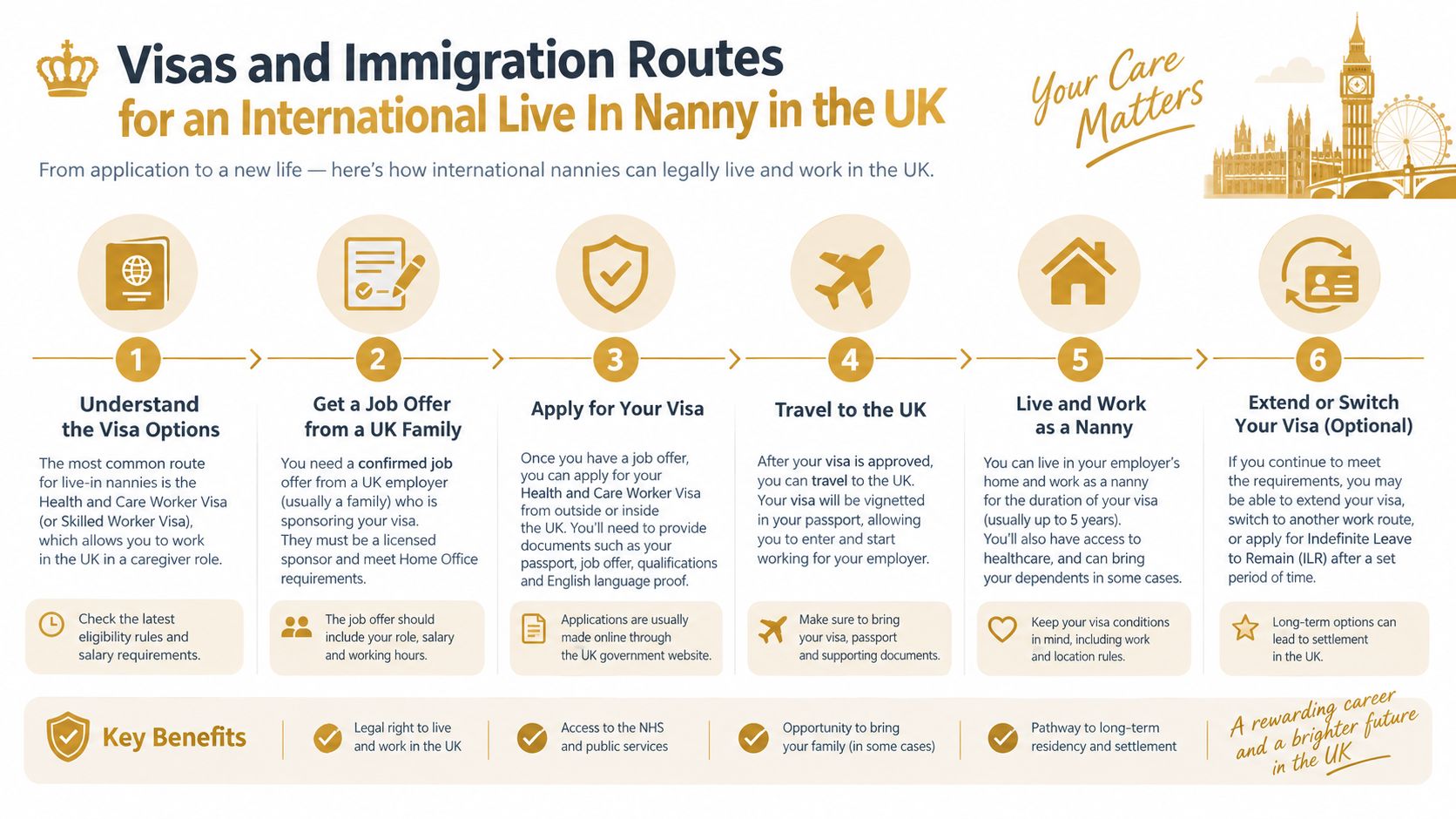
The Overseas Domestic Worker route is designed for the first situation, not as a general long-term nanny visa. Under the route described in current guidance, the nanny will usually need to have worked for the same employer for at least 12 months, travel to the UK with that employer and normally remain for up to 6 months without extension. Review the GOV.UK information on employing an au pair or domestic worker with current immigration guidance and qualified advice, since eligibility depends on the family's circumstances.
What the short-stay limit means in practice
That six-month limit should shape the relocation plan from the beginning. It affects childcare continuity, the resident nanny's accommodation, payroll arrangements and the point at which the family must arrange a return, replacement or different lawful route. A salary figure alone does not show the true cost. The family must also allow for immigration advice, travel, employer administration, accommodation planning and the disruption of changing carers.
For wealthy families, this planning is often part of a wider mobility strategy. The nanny's immigration status may intersect with school terms, multiple residences, family office scheduling, seasonal travel and wider staff planning. Leaving these details until arrival can create avoidable disruption in an otherwise carefully managed move.
The prior employment requirement is equally important. A family generally cannot recruit a completely new overseas nanny, place her in the family home and rely on this route because the role is live-in. A long-term plan requires an immigration route that permits the proposed work, with the employer, role and candidate meeting its conditions.
Family migration routes do not automatically give a nanny the right to settle through her employment. Obtain advice from a qualified immigration adviser before promising a permanent position or building the children's long-term routine around one visa category.
After the lawful route is confirmed, organise arrival messages, transport details and mobile connectivity. An eSIM for UK travel can help the nanny stay connected during arrival, but it does not replace immigration permission or a right-to-work check.
Before the first shift, complete right-to-work verification for the UK placement and retain the required records. Set a succession plan at the same time. If the permission has a defined endpoint, decide whether the nanny will leave with the family, end the role, or be replaced by someone with an independent lawful basis to work in the UK.
Nanny Payroll, Tax and Accommodation Rules in the UK
A family may agree a nanny's salary in one conversation and discover a much larger employment cost during payroll setup. A UK live-in nanny is generally a household employee, not a self-employed contractor. The family usually needs a written employment contract, payslips, employer registration, payroll administration and PAYE deductions for Income Tax and National Insurance. Statutory entitlements may include paid holiday, sick pay, maternity pay, redundancy pay and pension enrolment where the worker is eligible. The domestic employment rules noted earlier should be checked before the offer is finalised.
For wealthy families, it is particularly important to distinguish convenience from compliance. A sophisticated household operation may involve accountants, private office staff or household managers, but those practical supports do not change the nanny's employment status. The role still needs to be structured correctly under UK law.
Room and board do not turn employment into an informal exchange of care for accommodation. Salary is one line in the budget. Employer National Insurance, payroll administration, statutory leave, pension duties, recruitment and relocation can all sit outside the nanny's take-home pay. Families wanting a plain-language introduction can read this payroll explained for small businesses, then obtain advice suited to domestic employment.
Understanding the accommodation offset
Employer-provided accommodation has a specific role in UK National Minimum Wage calculations, subject to statutory conditions. HMRC describes the accommodation offset as a notional amount used for National Minimum Wage purposes, rather than a cash wage increase. If the room is free, or charged at or below the permitted offset, the arrangement does not reduce pay for that calculation. A charge above the permitted offset can reduce pay for National Minimum Wage purposes by the excess. HMRC's accommodation offset guidance
From April 2026, the accommodation offset is £11.10 per day and £77.70 per week. The calculation applies for each day accommodation is provided and has a weekly cap of seven times the daily rate. GOV.UK accommodation offset rules
The practical question is whether the family's proposed room charge has been reflected correctly in payroll, while still meeting the agreed cash-pay terms.
| Cost Element | What It Includes | Why It Matters for Live-In |
|---|---|---|
| Gross pay | Contracted salary or hourly pay before deductions | Forms the basis for PAYE and statutory calculations |
| Employer costs | Employer National Insurance and payroll administration | Increases the family's cost beyond take-home pay |
| Accommodation | Private room and agreed household facilities | May interact with the statutory accommodation offset |
| Paid leave and statutory entitlements | Holiday, sick pay and other applicable rights | Needs a planned budget rather than an unexpected expense |
| Pension duties | Enrolment and contributions where eligible | Depends on the worker's circumstances and legal eligibility |
| Recruitment and relocation | Screening, advice, travel and arrival support | Can materially affect the placement budget without appearing in salary comparisons |
For a family-specific review, use Superstar Nannies' nanny tax obligations resource alongside advice from a payroll or tax professional. Before the offer is accepted, record the cash pay, accommodation arrangement, working time and any proposed deductions in writing. This gives the family and nanny the same understanding of the true all-in arrangement.
Cultural Fit, Language Skills and Staffing Dynamics
Legal permission and payroll accuracy create the foundation, but daily harmony depends on how the nanny and family communicate. In a private residence, professional conduct includes discretion, emotional steadiness, respect for different customs and the ability to ask questions without creating friction.
For wealthy families, cultural fit often extends beyond personality alone. The nanny may need to understand formal service boundaries, work respectfully alongside senior household staff, adapt to varying levels of formality and remain composed in homes where privacy is closely protected.
Language deserves a practical assessment. A nanny may speak a child's heritage language fluently but need stronger English for school communication, medical appointments or household meetings. Another candidate may have excellent formal English but little experience supporting bilingual development. Test the language needed for the actual role, not an abstract idea of fluency.

A practical framework for choosing the right nanny
A useful decision matrix weighs three dimensions:
| Priority | Questions for the family |
|---|---|
| Language | Which languages must the nanny use, and in which situations? |
| Experience | Has she worked with the children's ages, routines and travel demands? |
| Personality | Will her manner suit the children, parents and existing staff? |
No single category should dominate automatically. A family prioritising bilingual development may accept a candidate who needs time to learn household systems, while a family with medically complex routines may place greater weight on directly relevant experience. The decision should reflect the children's needs rather than the glamour of international travel.
In a fully staffed home, the nanny also needs a clear place in the team. A house manager may coordinate schedules, a chef may prepare family meals, and a tutor may lead academic work. The nanny should know who gives instructions, who receives updates and which matters go directly to the parents.
Anonymised placement insight from private household recruitment is consistent. Arrangements become strained when families describe "flexibility" without defining whether it means occasional schedule changes, travel, additional children or duties outside childcare. A strong briefing makes those expectations visible before the candidate accepts.
Families can support this process with cultural sensitivity training for household professionals. The purpose is not to erase personal identity. It is to help everyone work respectfully across languages, customs and household norms.
Relocation Planning for Long-Term Success With an International Nanny
Arrival is only the beginning of the placement. Send the nanny a written schedule, address, emergency contacts, travel instructions and accommodation details before departure. Explain who will meet her, what she should bring and when the first formal household meeting will take place.
A thoughtful settling-in period protects the relationship. Give the nanny time to learn school routes, children's preferences, security procedures, staff responsibilities and the family's communication style. A household handbook should cover confidentiality, visitors, personal devices, photographs, travel expectations, sick days, escalation procedures and the boundaries of overnight responsibility.
For wealthy families, long-term success usually depends on treating the placement as part of the household's broader infrastructure. A nanny who is excellent with children can still struggle if reporting lines, travel planning, privacy rules and practical support are not clear from the start.
International nanny relocation checklist
- Immigration: Confirm the route, permission and dates with qualified advice.
- Employment: Issue the contract, arrange payroll and record agreed working terms.
- Accommodation: Provide the promised private space and explain household access.
- Childcare: Share routines, allergies, school information and emergency contacts.
- Communication: Set a regular check-in with the parents or household manager.
- Travel: Clarify who pays travel costs, how itineraries are shared and how rest periods are handled.
Travel support should distinguish employment obligations from general travel expenses. Families reviewing travel and subsistence questions may find this Umbrella Company travel and subsistence guide useful as general background, but domestic employment arrangements should be checked with the appropriate UK adviser.
The strongest international placements are not necessarily the least expensive option compared with nursery care. Wealthy families often choose live-in care for flexibility, privacy, continuity and the ability to preserve routines across residences. Those benefits only appear when the legal route, employment terms and household culture support the arrangement.
Final Thoughts on Hiring an International Live-In Nanny
Hiring an international live-in nanny in the UK is rarely just a childcare decision. For wealthy families, it is a cross-border employment project that touches immigration, payroll, privacy, accommodation, safeguarding and daily household operations. The best outcomes come from matching the right candidate to the real lifestyle needs of the family, then building a lawful structure around that match.
If your household needs continuity across countries, bilingual support, discreet childcare recruitment or a live-in nanny who can work confidently in a fully staffed private home, planning matters as much as personality. A clear brief, proper vetting and realistic relocation planning will do more to protect your family than a rushed hire ever can.
Reviewed by the Superstar Nannies recruitment team.
Superstar Nannies can help a wealthy international family define the role, identify suitable live-in, travelling or bilingual candidates, and coordinate discreet screening around the household's routines. Visit Superstar Nannies to discuss your relocation timeline, childcare requirements and the practical route to a lawful, well-supported placement.