


A family’s first days at home with a newborn rarely unfold in a calm or predictable way. Feeding patterns change quickly, maternal recovery needs shift day by day, visitors come and go, and the household must establish new routines under pressure. Obstetricians, pediatricians, lactation consultants, and postpartum medical teams remain essential, but they are not engaged to provide private overnight newborn care, manage a household nursery routine, or coordinate a fully discreet in-home support structure.
This is where a newborn care specialist agency in the US becomes especially valuable. For high-net-worth families, celebrity families, family offices, principals with security requirements, and households that require complete discretion, a specialist agency offers more than access to an individual caregiver. It provides a structured private staffing solution built around safeguarding, professional vetting, confidentiality, continuity, and household-specific support.
A well-run agency does not replace medical care. Instead, it places vetted newborn care specialists, maternity nurses, night nannies, and postpartum support professionals who work alongside the family’s doctors and wider domestic team. For households that need calm execution, privacy, and reliable infant support from the earliest days, the agency model is often the most secure route.
What a Newborn Care Specialist Agency in the US Actually Does
Most families begin their search in one of two situations. Some start during the third trimester, often around the 28 to 32 week mark, when they realize that experienced newborn care specialists and maternity nurses are booked well in advance. Others begin searching after the baby arrives, when the reality of sleep deprivation, recovery, feeding logistics, travel plans, older siblings, and household staffing pressures becomes harder to manage than expected.
A professional newborn care specialist agency turns that urgency into a defined recruitment and placement process. It helps shape the role, identifies relevant candidates, verifies experience, completes background and reference checks, assesses household fit, and manages introductions. Depending on the engagement model, the agency may also coordinate payroll, scheduling, NDAs, rota structures, contract terms, and ongoing support after the placement starts.
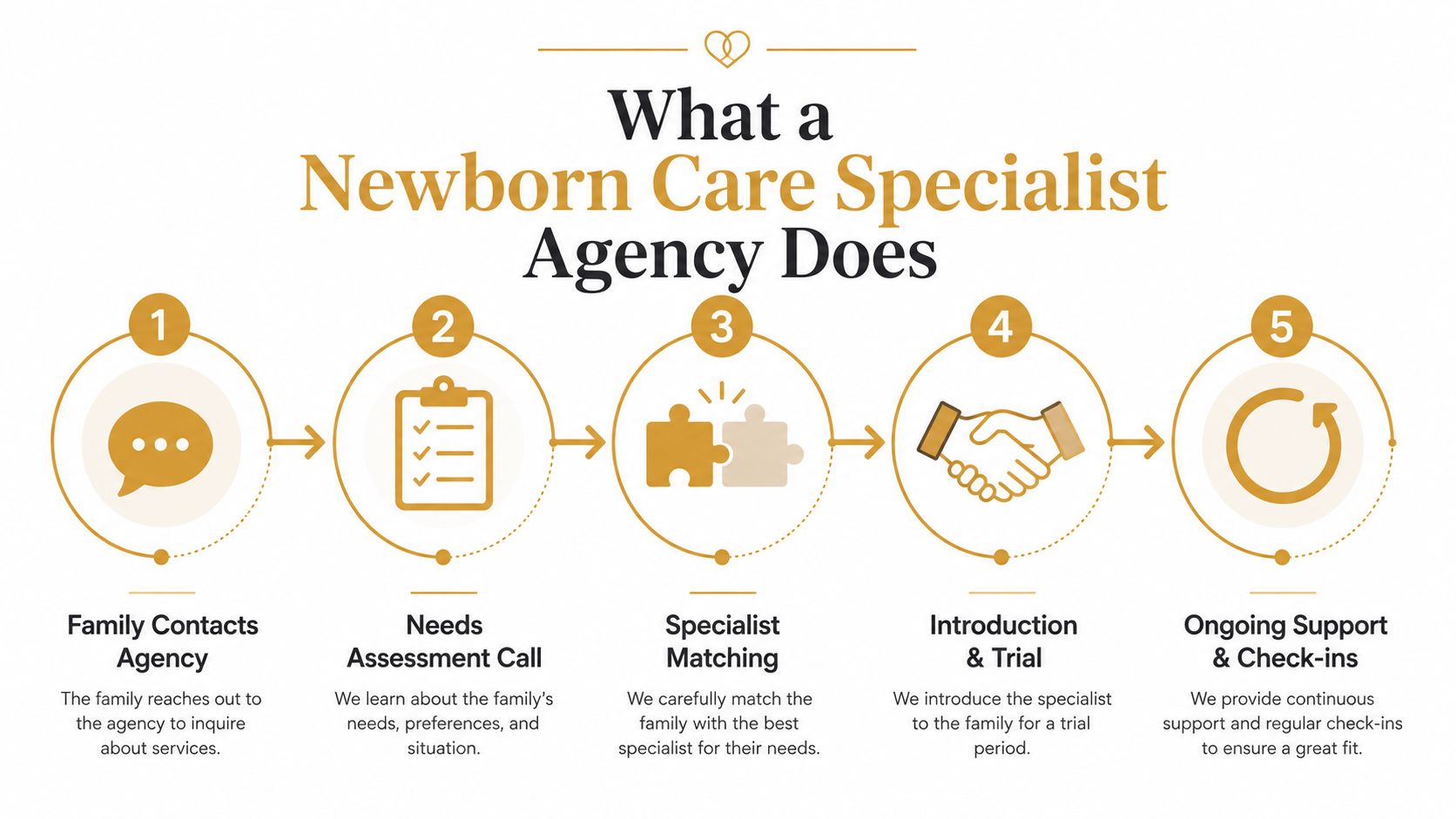
The operational difference for private households
A referral, parenting group recommendation, social platform profile, or marketplace listing may give a family access to an individual caregiver. It does not necessarily provide a documented vetting framework, confidentiality structure, professional replacement process, or high-level household protection.
A doula network may offer meaningful emotional and practical support. A general nanny platform may offer speed and volume. Neither automatically provides the same degree of discretion, management, and accountability that many HNW families and celebrity households require.
For a private home, the real question is simple: who takes responsibility if the specialist becomes unavailable, a background concern emerges, the fit is wrong, or the household’s security expectations change after placement?
A credible agency should be able to explain:
- Candidate sourcing: How it identifies professionals with genuine newborn expertise rather than broad childcare experience alone.
- Vetting standards: Which identity, right-to-work, criminal background, and reference checks are completed, and how records are handled.
- Matching process: How feeding goals, travel expectations, family culture, schedule demands, staffing layers, and communication style influence the shortlist.
- Continuity planning: Who manages sick cover, performance concerns, rota gaps, and emergency replacement.
- Household protection: Which confidentiality provisions, NDA procedures, liability policies, data-handling standards, and privacy controls apply.
This operational layer matters even more in households with a 24/7 rota, multiple residences, travel between states, estate staff, or a principal who requires a tightly controlled private environment. A private staffing agency should make those systems clear from the start. Families considering broader household recruitment can review private household staffing support as part of wider planning.
Recruiter’s recommendation: Do not judge an agency only by the quality of its first shortlist. Judge the systems that protect your household after the placement begins.
US Locations Served by Superstar Nannies
For families seeking a newborn care specialist agency in the US, location matters because staffing expectations, travel patterns, privacy needs, and household structures often vary by market. Superstar Nannies supports private households across major US locations that regularly require premium newborn and domestic staffing.
This includes placements and consultations for families in:
- New York City
- The Hamptons
- Los Angeles
- Beverly Hills
- Malibu
- Miami
- Palm Beach
- Aspen
- Dallas
- Houston
- Austin
- Chicago
- Washington, DC
- San Francisco
- Silicon Valley
- Boston
- Atlanta
- Nashville
- Seattle
- International and travel-based placements linked to US households
For HNW families, celebrity parents, athletes, executives, founders, and family offices, these locations often involve complex schedules, second homes, security detail, domestic teams, and travel expectations. A newborn care specialist agency must be able to recruit with those realities in mind.
Newborn Care Specialists, Maternity Nurses, and Night Nannies Compared
These titles are often used interchangeably, but in premium private staffing they should be distinguished carefully. The right appointment depends on whether the household needs infant-specific expertise, wider postpartum support, reliable overnight coverage, or a managed rota with multiple professionals.
A newborn care specialist, often shortened to NCS, focuses on the baby’s immediate needs. Responsibilities commonly include feeding support, bottle preparation, sleep shaping, soothing, nursery setup, age-appropriate routines, and practical parent guidance during the early weeks and months. Families should ask what newborn-specific training the candidate has, how recently they have worked with newborns, and whether they understand when pediatric concerns must be escalated appropriately.
A maternity nurse is a broader term often used in private staffing. The role may cover newborn care, maternal recovery support, nursery organization, feeding guidance, parental education, and household transition during the postpartum period. A maternity nurse may work live-in, on a schedule, or as part of a rota. Families wanting a fuller explanation of the role can read what a maternity nurse does.
A night nanny is typically engaged for dedicated overnight support. The focus is practical and routine-led: night feeds, bottle sterilization, diaper changes, settling, baby monitoring within agreed safe practices, and helping parents achieve uninterrupted rest. This arrangement often suits parents who feel comfortable during the day but want professional overnight care.
| Role | Primary Focus | Typical Qualifications | Shift Pattern | Best Fit For |
|---|---|---|---|---|
| Newborn care specialist | Infant care, feeding, settling, nursery routines, and early sleep structure | Newborn-focused training, infant-care expertise, pediatric first aid, strong recent newborn experience | Days, nights, travel, or short-term contracted placements | Parents needing specialist newborn expertise and calm household structure |
| Maternity nurse | Baby care plus broader postpartum and maternal support | Maternity or newborn training, pediatric first aid, substantial private household experience | Live-in, day-based, rota, or full postpartum coverage | First-time parents or households needing intensive post-birth support |
| Night nanny | Overnight feeds, settling, routine support, and parental rest | Infant-care experience and current pediatric first aid | Overnight shifts | Families who primarily need consistent night coverage |
The distinction matters even more in households with twins, premature babies, strict privacy protocols, multiple staff members, or complex travel demands. It can also matter when coordinating related appointments, such as newborn photography, where an organized routine often makes the experience much smoother. Parents arranging a session may find newborn photos with Liz by Design useful when planning the wider arrival schedule.
How a Newborn Care Specialist Agency Vets Candidates for HNW and Celebrity Families
A polished interview is not enough. For celebrity families, public figures, athletes, founders, and ultra-private households, candidate vetting must be layered, documented, and appropriate to the level of access the professional will have to the baby, the home, the family’s routines, and sensitive personal information.
official criminal-record guidance for childcare workers
The process should start with administration and verification. The agency should review the application, confirm identity and legal work authorization, establish a full employment history, and examine whether prior roles genuinely involved newborn care. Gaps should be explained. Titles should match actual responsibilities. A candidate who presents as a newborn care specialist should be able to describe exactly what they handled, with which age groups, in what setting, and with what degree of autonomy.
In the US, agencies should also be able to explain how they approach work eligibility verification through Form I-9 procedures, which USCIS requires for most US hires, including domestic workers in applicable circumstances. USCIS states that employers must complete and sign Section 2 within 3 business days of the employee’s first day of employment and examine acceptable identity and work authorization documents accordingly (USCIS Form I-9).
Competence must be assessed directly
A serious interview process should cover feeding, sleep routines, safe sleep principles, household discretion, communication with parents, boundaries, emergency judgment, and collaboration with doctors or lactation consultants where relevant. Scenario-based questioning is often more revealing than general conversation.
Ask how the candidate would respond to poor feeding, repeated vomiting, signs of lethargy, a possible fever, prolonged inconsolable crying, or unusual newborn behavior. The correct response is not independent diagnosis. It is recognition of limits, sound immediate action, and timely escalation to the appropriate medical professional.
Professional standards should also align with current US newborn safety guidance. The American Academy of Pediatrics and HealthyChildren.org advise that babies should be placed on their backs for every sleep, on a firm, flat sleep surface, with no pillows, loose blankets, bumpers, or soft objects in the sleep space (AAP safe sleep guidance, HealthyChildren safe sleep guide). For HNW and celebrity families employing overnight infant support, an agency should be able to explain how it evaluates a candidate’s understanding of these principles.
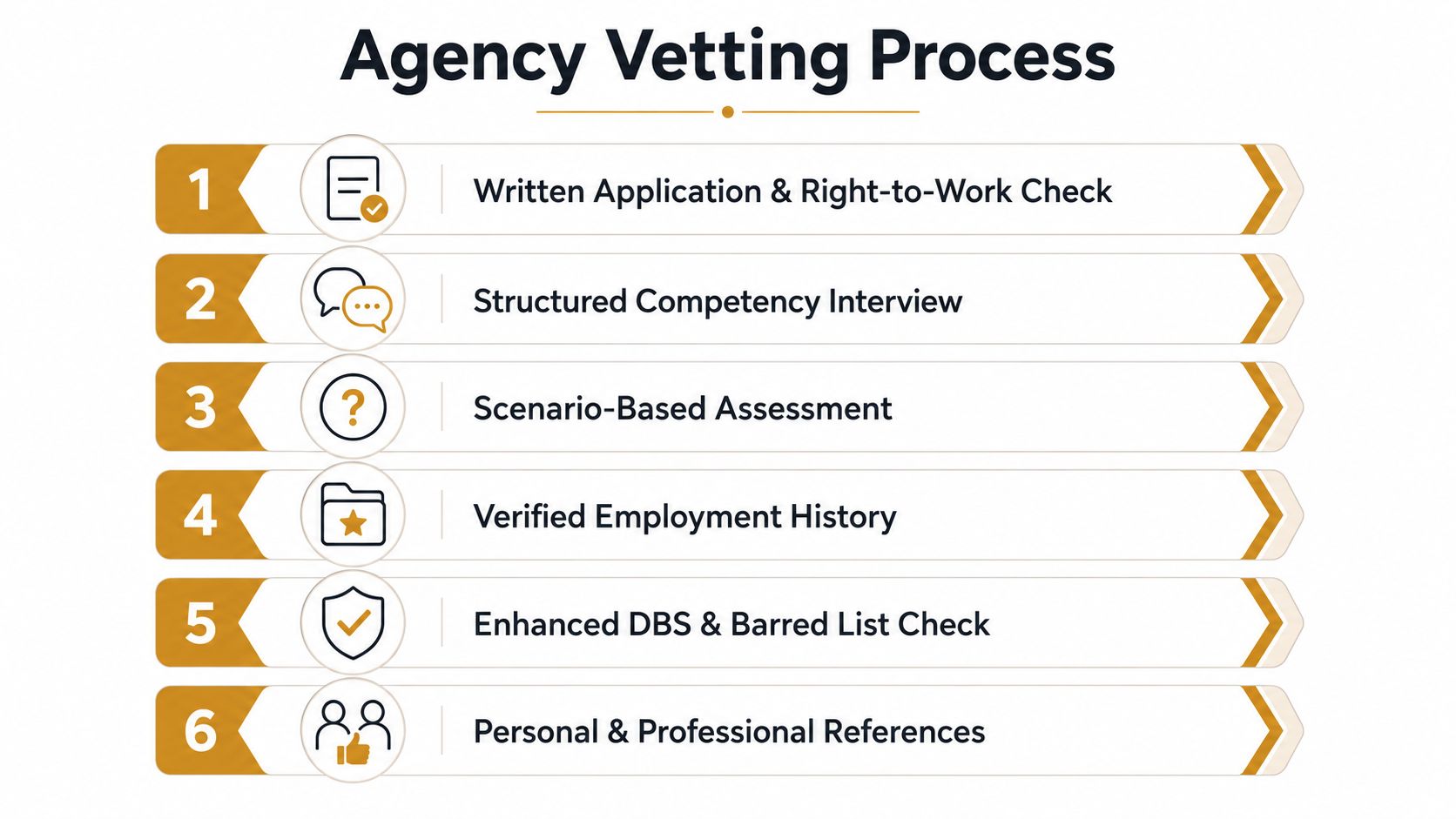
Families in the US should also ask how criminal background screening is handled across states, whether the agency verifies legal work status properly, how reference calls are documented, and what happens if a concern arises after the placement begins.
References should be verified, not collected passively
Certificates should be checked, pediatric first aid should be current, and any newborn or maternity training should be verified rather than accepted at face value. Where a candidate has worked internationally, the agency should address the limitations of domestic screening and explain how overseas experience is evaluated.
For families that require a more formal explanation of background screening, it is reasonable to ask how the agency approaches multistate checks, sex offender registry screening where relevant, and fingerprint-based screening standards when available. Federal childcare background rules are not identical to private household hiring, but they offer a useful benchmark for rigor because they commonly include FBI fingerprint checks, registry screening, and review of prior states of residence within the past five years (Maine child care background checks overview, Wisconsin background check guidance, Colorado provider background checks).
References deserve equal rigor. Ask the agency:
- Coverage: Do references cover the candidate’s recent newborn or infant-facing employment?
- Verification: Were referees contacted directly by phone as well as in writing?
- Specificity: Did the referee comment on reliability, confidentiality, infant-care competence, flexibility, and conduct in a private home?
- Follow-up: Did the recruiter challenge inconsistencies, vague praise, or unexplained timeline gaps?
A well-managed placement should also include a trial structure, scheduled reviews, and a clear route for escalation if the placement is not working. Families can also review the agency's nanny vetting guidance for discerning families before comparing providers.
When HNW and Celebrity Families Genuinely Need Specialist Newborn Support
Private newborn support is most valuable when a family needs continuity, discretion, and execution that standard medical or public health services are not designed to provide. Pediatricians, hospital discharge teams, and postpartum clinicians remain the correct professionals for diagnosis, clinical follow-up, and medical escalation. A private newborn specialist supports the household practically, but should never position themselves as a substitute clinician.
ACAS guidance on neonatal care leave and pay
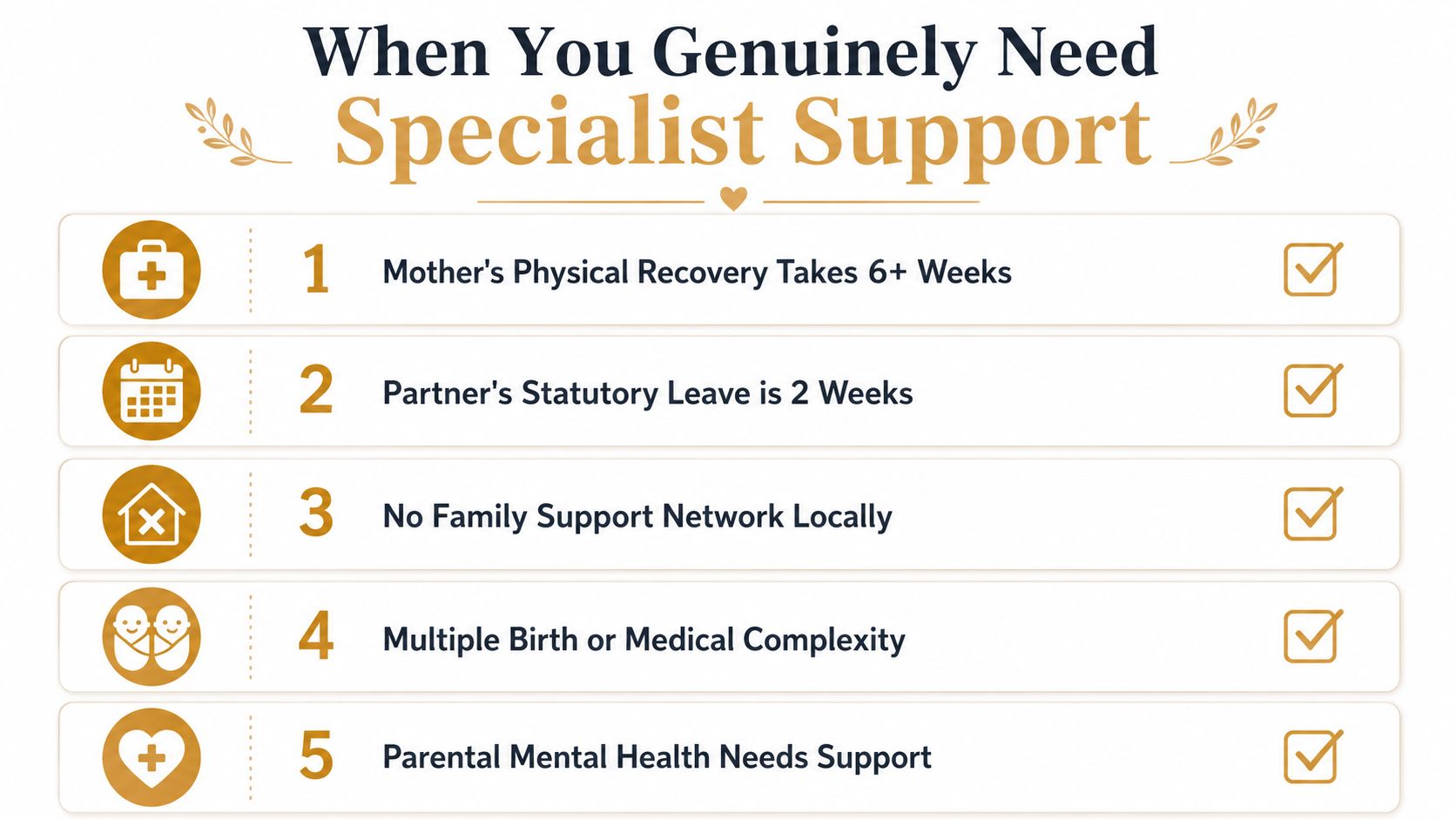
Common triggers for premium newborn staffing
Specialist support becomes particularly valuable where the household is managing:
- Multiple births: Twins or higher-order multiples require more structured feeding, settling, and scheduling support.
- Prematurity or medical complexity: Families may need a professional who can follow discharge instructions carefully and work within a clinician-led care plan.
- Feeding challenges: A newborn care specialist can support the agreed feeding routine while medical concerns remain with the appropriate doctor or consultant.
- Surrogacy or adoption: The household may need thoughtful, structured support around bonding, transition, logistics, and round-the-clock newborn care.
- High-profile privacy needs: Public figures often require support professionals who understand confidentiality, controlled access, and reputational sensitivity.
- Travel-heavy schedules: Athletes, entertainers, founders, and globally mobile families may need travel-ready newborn support.
- Limited family support nearby: Families relocating temporarily or living between residences may not have a stable local support network.
Safe practice remains central. In addition to AAP guidance, the CDC advises room-sharing without bed-sharing and emphasizes a separate, firm, flat sleep surface for infants (CDC safe sleep guidance). An agency serving HNW and celebrity families should be able to explain how it places candidates who can respect parental preferences without departing from recognized infant safety standards.
In many cases, the ideal time to begin discussions is during the second trimester, especially for families who want a specific schedule, a rota arrangement, or a candidate experienced in formal private homes.
Contracts, Rotas, and Fee Structures for Premium Newborn Care
Fee discussions should start with the engagement model, not a headline number. Families need to understand who employs the specialist, how wages are paid, whether overtime applies, what level of agency management is included, and which costs sit outside the initial quote.
Common structures include a 24/7 live-in rota, a single live-in newborn care specialist, dedicated overnight coverage, and a daytime postpartum package. The rota structure matters because it directly affects continuity, rest periods, handovers, travel arrangements, housing, and replacement planning.
The supplied brief does not include verified fee ranges, so a responsible agency should provide a written proposal rather than broad market estimates. Any premium quote should clearly separate:
- Gross compensation: The specialist’s agreed pay.
- Agency fee: Recruitment, placement, and account management charges.
- Employment costs: Payroll taxes, insurance obligations, overtime issues where applicable, and any statutory employer liabilities.
- Expenses: Travel, accommodation, meals, car service, and related logistics.
- Additional coverage: Emergency backup, extra nights, holiday travel, or short-notice schedule extensions.
| Engagement Model | Hours Covered | Indicative Weekly Cost (USD) | Best Fit |
|---|---|---|---|
| Live-in rota | Continuous household coverage according to an agreed alternating rota | Quote required from the agency | Families requiring consistent 24/7 support and strong continuity |
| Single live-in or night engagement | Agreed overnight or live-in coverage | Quote required from the agency | Parents needing focused recovery support or dedicated nights |
| Daytime newborn support | Agreed daytime hours and postpartum assistance | Quote required from the agency | Families with night support in place but limited daytime capacity |
Contract terms deserve close review
At a minimum, the agreement should address the trial period, notice, confidentiality, NDA language, privacy expectations, accommodation, replacement policy, cancellation terms, travel, liability, and escalation procedures. It should also explain what happens if the family changes residence, expands the schedule, or ends the placement early.
For celebrity and HNW households, contracts should also align with broader household governance. If estate managers, chiefs of staff, executive assistants, or security teams are involved, the reporting line should be defined clearly before the specialist starts.
For US households, employment structure should not be treated casually. The US Department of Labor defines domestic service employment broadly to include workers such as nannies and caregivers in private homes, and covered domestic workers generally must receive at least the applicable minimum wage and overtime under federal law unless a specific exemption applies (US Department of Labor, domestic workers, FLSA domestic service hours worked, live-in domestic workers guidance). The IRS also requires household employers to assess whether Schedule H reporting and household employment taxes apply, depending on wages paid and the structure of the employment relationship (IRS household employment taxes, IRS Topic No. 756).
Questions to Ask Before Signing With a Newborn Care Specialist Agency
An agency’s willingness to answer detailed questions is itself a useful signal. Families should test the agency’s standards before focusing too heavily on personality, branding, or speed.
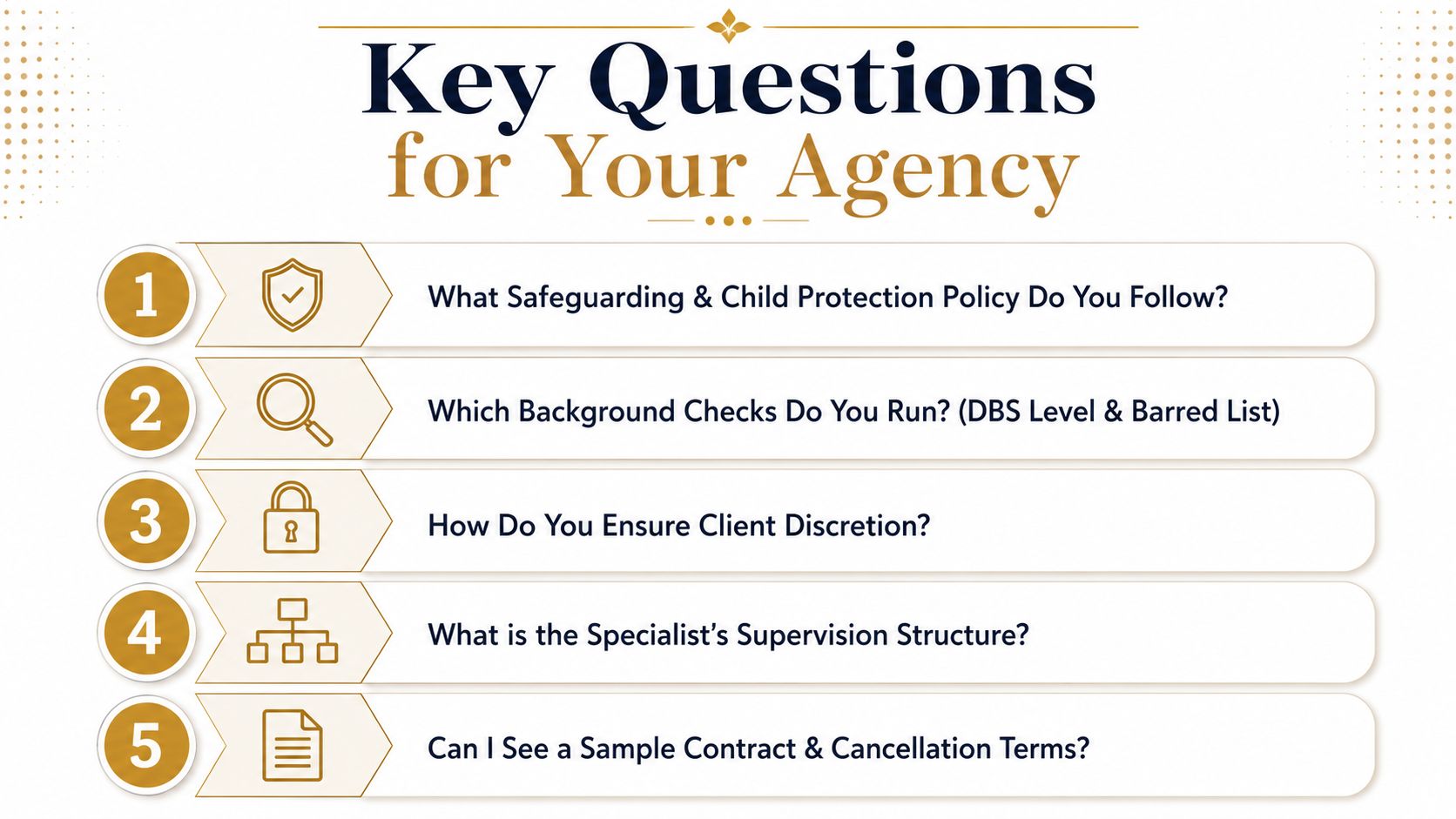
Vetting, household fit, and privacy
Ask for written responses to the following:
- How are background checks completed for this role? The agency should be able to explain its process clearly, including identity checks, work authorization review, and relevant criminal screening.
- How are credentials verified? Ask about newborn care specialist training, maternity nurse education, pediatric first aid, and any specialist infant-care certifications.
- How many references are checked? Ask whether recent employers were contacted directly and whether confidentiality, professionalism, and performance in private homes were discussed.
- How are concerns escalated? You need names, response expectations, and a clear chain of communication if the specialist identifies a medical or household concern.
- Who manages the placement after the start date? Confirm whether you will have a named consultant, senior placement lead, or director after day one.
- What is the replacement process? If the specialist falls ill, resigns, or proves to be the wrong fit, the process should already be defined.
- How do you support celebrity or high-profile households? Ask specifically about NDAs, security awareness, controlled information-sharing, and privacy training.
Discretion must be built into operations
Families should ask whether profiles are anonymized before introduction, how residential addresses are protected, who can access family data, and how documents are stored and transferred. An NDA can be useful, but it is not a substitute for disciplined internal process.
Request a sample contract, privacy policy, cancellation terms, and replacement policy. Also ask how the employment structure is handled and whether outside payroll or legal advisors should be involved.
One request should be approached sensibly. Asking for direct access to current celebrity or UHNW clients may not be appropriate and may itself breach the standard of discretion you want the agency to uphold. A serious firm should be able to provide process transparency and, where suitable, an authorized reference without exposing another household.
A refusal to discuss privacy, employment structure, or escalation is more serious than an elegant website or polished sales process. Documentation matters more than presentation.
How to Choose a Discreet US Agency for HNW and Celebrity Families
A high-value household should compare agencies in a disciplined order. Marketing language, polished candidate profiles, and urgency should come later.
Start with compliance and structure
Ask how the agency handles legal work authorization, payroll, employer responsibilities, confidentiality requirements, and any interstate or international travel issues. Do not assume that a contractor model, payroll partner, or travel arrangement is correct for your specific household.
Then review written standards. A newborn specialist should be able to work within the family’s preferences while maintaining safe, professional infant-care practices.
Test the agency’s privacy controls
Discretion involves much more than asking candidates to be discreet. Look for:
- Signed confidentiality terms: Clear restrictions on social media, photography, and disclosure.
- Controlled candidate presentation: Profiles shared only with decision-makers who need access.
- Secure document transfer: Sensitive household and identity documents should not circulate casually.
- Managed references: The agency should protect existing clients rather than using them as sales tools.
- Defined escalation: A senior contact should own serious placement or safeguarding concerns.
Review the agency’s liability language, replacement commitment, trial provisions, and communication structure. Whenever possible, speak directly with a senior decision-maker before proceeding. A family office, estate manager, or principal should be able to reach someone with authority, not only a recruiter operating from a script.
For broader planning around privacy, staffing layers, and household governance, see this guide to discreet private staffing solutions.
Common red flags include vague language around screening, no written privacy policy, resistance to sharing a sample agreement, pressure to pay before due diligence is complete, or no clear replacement route if the placement fails.
Why HNW and Celebrity Families Choose Superstar Nannies in the US
For premium newborn staffing, families are rarely buying only childcare support. They are securing privacy, operational reliability, household fit, and professional judgment during one of the most sensitive periods in family life.
Superstar Nannies supports families seeking:
- Newborn care specialists in the US
- Maternity nurses for HNW families
- Night nannies for celebrity families
- 24/7 newborn rota staffing
- Discreet private staffing for infants and young families
- Travel-ready newborn specialists for multiple residences
- Short-term and post-birth placements with high confidentiality standards
The agency’s value lies not only in introducing candidates, but in understanding how newborn staffing functions inside sophisticated private households.
Next Steps for Families Seeking a Newborn Care Specialist Agency in the US
Start by defining the brief before contacting agencies. Include the due date or expected arrival window, preferred start date, primary residence, travel expectations, feeding preferences, accommodation details, household staffing structure, security requirements, schedule expectations, and whether you need one specialist or a managed rota.
Next, request a written proposal and sample contract before interviewing candidates. The proposal should separate agency fees, compensation, employment costs, expenses, and replacement terms. It should also identify who manages the relationship after placement.
Finally, arrange a confidential discussion with a senior agency lead. Ask how the team handles sudden unavailability, concerns raised during the first week, privacy incidents, a change in residence, or the need to travel with the family on short notice. A serious agency will welcome that level of scrutiny.
Superstar Nannies places maternity nurses, night nannies, and newborn care specialists for private households across the US, alongside wider nanny and household staffing needs. Families can use Superstar Nannies to request a confidential consultation, share the household brief, and assess whether the agency’s process matches the family’s expectations for privacy, newborn expertise, and premium in-home support.
Superstar Nannies can help you define the newborn role, structure the rota, and identify appropriately vetted maternity nurses, night nannies, or newborn care specialists for HNW and celebrity households across the US. Visit Superstar Nannies to arrange a private consultation before committing to a shortlist or contract.