


You've found a driver who can collect the children, meet a principal at the airport and present impeccably at the front door. The question is whether that person can also work discreetly inside a fully staffed household, protect family routines, manage a vehicle properly and remain dependable when plans change at short notice. For a private family, a personal driver for hire is not a transport booking. It's a high-trust appointment.
A professional driver may spend more time around children, household managers, guests and confidential conversations than many families initially realise. The right hiring decision therefore depends on household fit, safeguarding, discretion, driving competence and operational reliability, not just an attractive CV or a clean-looking vehicle.
What a Personal Driver for Hire Does in a Private Household
A family's day often starts before the household is fully awake. One child needs a school run, another has a medical appointment, a principal has an early flight and a house manager needs the vehicle prepared for guests. A dedicated driver keeps these movements organised without requiring the family to arrange separate transport for every journey.
That's the difference between a personal driver for hire and an occasional chauffeur service. The dedicated driver learns the family's preferences, understands which entrances to use, knows how the principals prefer to travel and communicates with the people managing the household. The role can include school runs, appointments, airport transfers, shopping support, guest transport and travel between residences.
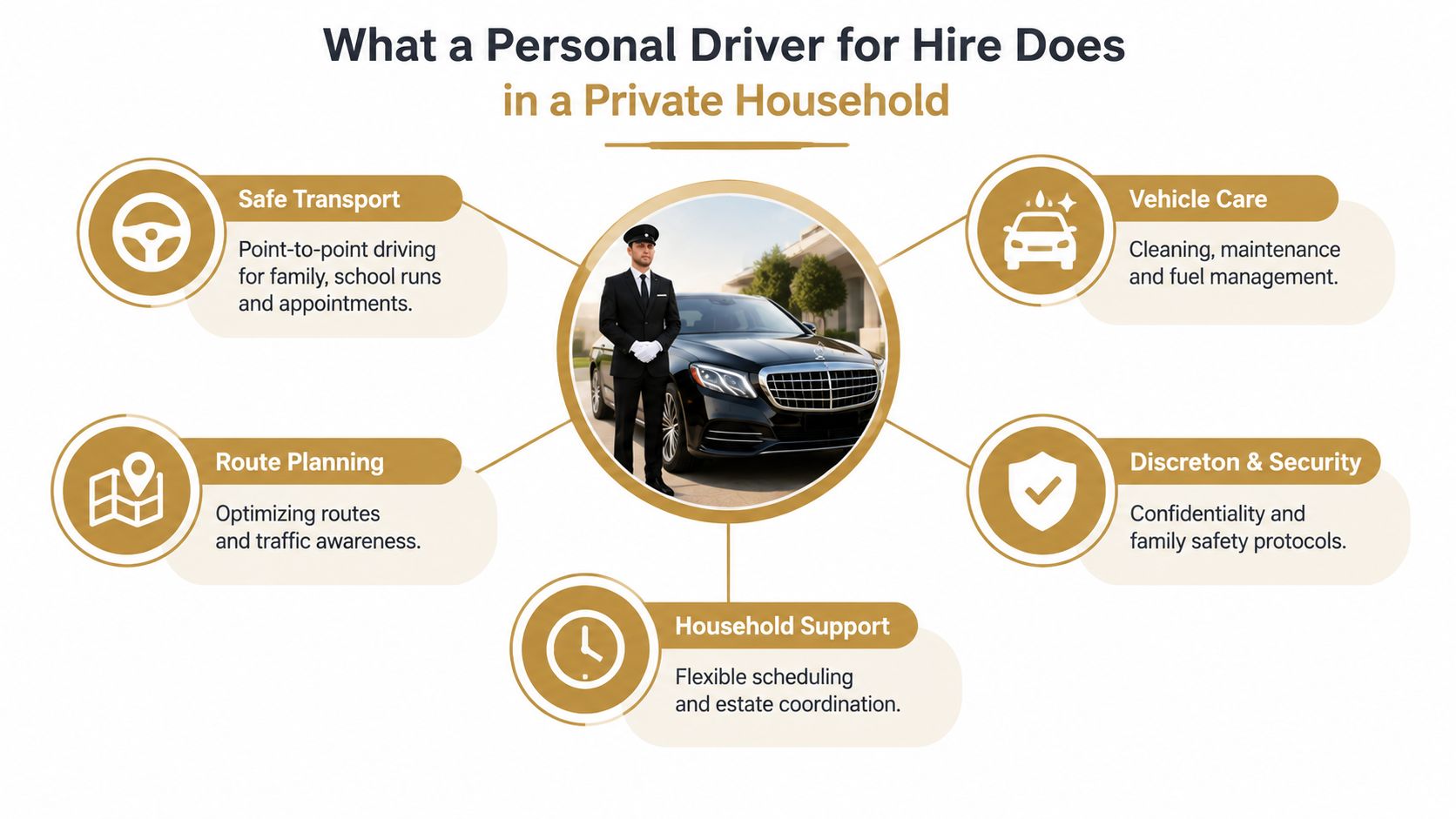
The work extends beyond the journey
A capable private driver also takes ownership of the vehicle and the planning behind each journey. Depending on the brief, responsibilities may include:
- Vehicle care: Keeping the car clean, checking fuel arrangements and recording maintenance needs.
- Route planning: Monitoring practical routes, allowing for traffic and identifying suitable drop-off and collection points.
- Family safety: Following agreed procedures for children, older passengers, guests and sensitive movements.
- Household coordination: Working with the house manager, personal assistant, nanny or estate team through a clear communication system.
- Discretion: Avoiding unnecessary conversation and protecting information about the family's movements, visitors and routines.
The engagement may be live-out, live-in or arranged around a rota, depending on the estate, travel schedule and required coverage. A family with predictable school and appointment commitments may need a full-time driver. Another may need flexible cover around travel, events or multiple residences. Decide the coverage first, then recruit for it. Hiring a driver whose availability doesn't match the actual pattern creates frustration on both sides.
Recruiter's recommendation: Write the weekly rhythm before reviewing candidates. Include school times, airports, evening commitments, travel between homes, expected standby periods and who gives instructions.
Where to Find a Trusted Personal Driver for Hire
The sourcing route affects the quality of the shortlist and the amount of risk left with the family. No channel is automatically sufficient. The family should choose based on confidentiality, verification, urgency, geography and replacement support.
| Sourcing route | Strength | Limitation |
|---|---|---|
| Specialist private staffing agency | Structured brief-taking, targeted search and support through the process | Requires a clear brief and professional engagement |
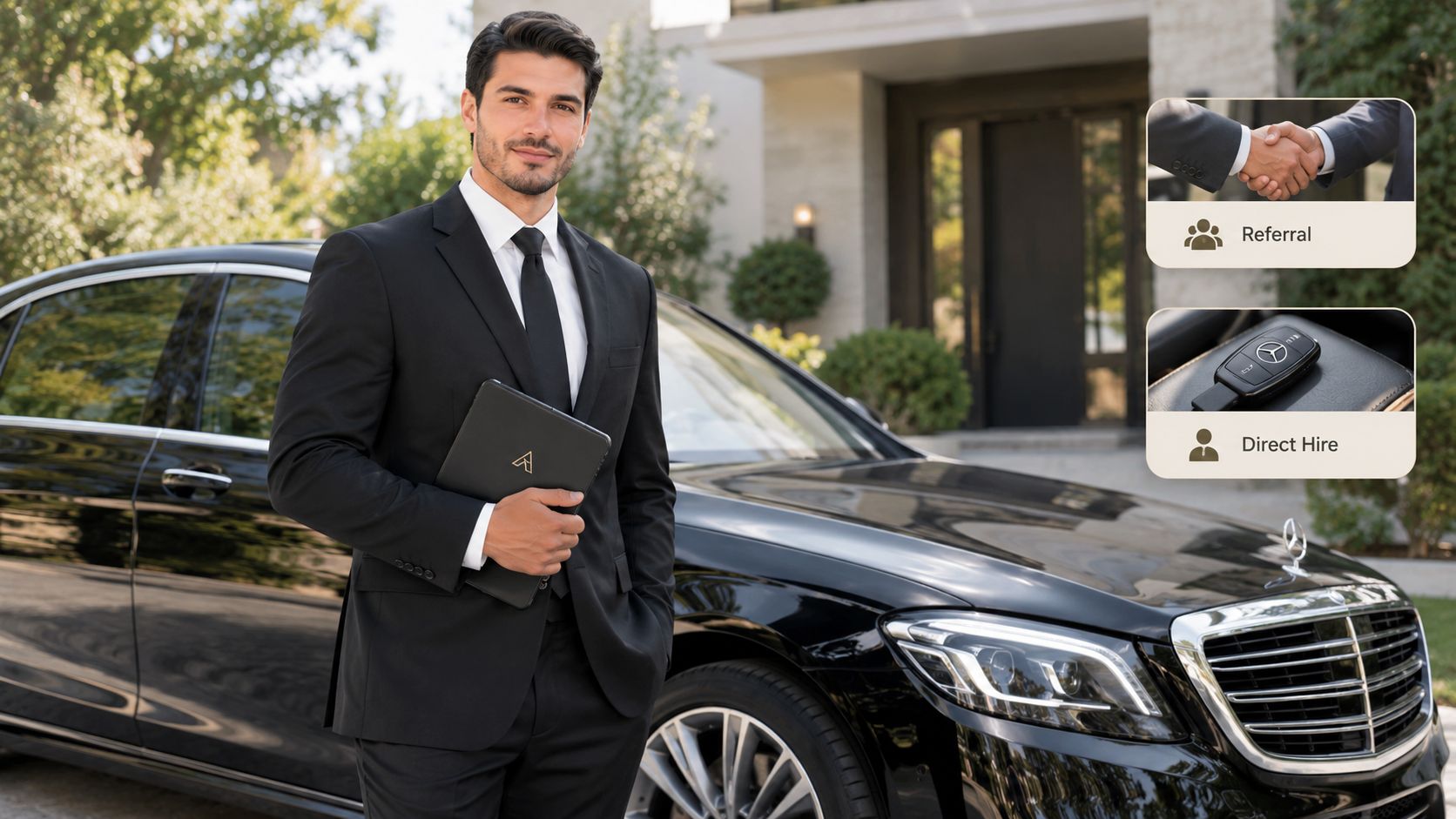
| Personal referral | Useful insight into temperament and reliability | A referral isn't a substitute for independent checks |
| Direct advertising | Broad access to applicants and direct control | The family carries the screening, administration and confidentiality burden |
A specialist agency can be especially useful when the driver must coordinate with nannies, house managers, security personnel and principals across more than one location. London, New York, Dubai and other international private-staffing centres have different licensing environments, traffic patterns, working cultures and candidate pools. Local knowledge matters, particularly when the role involves international travel or a move between residences.
What to ask before sharing household details
Before giving an introducer the family's address, school information or travel calendar, ask how they handle candidate identity, references, documentation and confidential instructions. Establish who speaks to the family, who verifies documents and what support is available if the placement doesn't work.
A useful comparison is the broader staffing principle behind how Talent Pronto helps home care, where matching people to private environments requires attention to reliability and suitability, not merely availability. The same discipline applies to household driving.
Families looking for a dedicated route into this specialist market can review the private chauffeur recruitment service. Whether you use an agency, a referral or direct hiring, insist on the same standard of evidence. A warm introduction should open the door to screening, not bypass it.
How to Vet and Background Check Your Driver Thoroughly
A licence proves that a person is authorised to drive within the relevant framework. It doesn't prove that they'll manage a child's anxiety, respect private conversations, remain calm after a delayed flight or work appropriately around domestic staff. Household-grade vetting must test all of those areas.
Use a layered screening sequence
Start with identity, driving entitlement and the candidate's driving history. In England and Wales, a person must hold a private hire vehicle driver licence to drive a private hire vehicle, and private hire journeys must be pre-booked. Driving without the required licence can lead to prosecution, as explained by GOV.UK's taxi driver licence guidance. Verify documents directly rather than relying on a screenshot or verbal confirmation.
Then assess the person behind the paperwork:
- Driving record: Ask about accidents, claims, penalty points, vehicle types and experience with children or vulnerable passengers.
- Enhanced DBS screening: Confirm what check is appropriate for the role and consider the driver's regular lone-working contact with children.
- References: Speak to previous employers, not only personal referees. Ask about punctuality, discretion, conflict, vehicle care and reasons for leaving.
- Employment history: Investigate gaps calmly and consistently. The purpose is to establish a credible timeline, not to penalise ordinary career changes.
- Health and practical ability: Check that the candidate can safely perform the duties required, including luggage handling or support for passengers with mobility needs.
- Overseas residence: For internationally mobile candidates, establish where they've lived and what additional checks may be needed.
For London candidates, the formal process includes an enhanced DBS check and DVLA Group 2 medical standards, alongside mandatory assessments set by Transport for London. Families should still carry out their own household suitability assessment. Formal licensing and private employment are related, but they aren't interchangeable.
Use a properly structured practical assessment before the first unsupervised school run. Test punctuality, vehicle presentation, navigation, child-friendly judgement and communication. If the case is unusually sensitive, a family may also consider an appropriately instructed private investigator, subject to lawful and proportionate use of investigative services. For international histories, the international background checks service can help families organise the screening question before making an offer.
The common mistake: A single enthusiastic reference doesn't establish a safe household appointment. Require a documented history, multiple conversations and a practical assessment.
Licensing Insurance and Legal Essentials Before You Hire
The correct legal structure depends on where the driver works, who supplies the vehicle and whether journeys are private household employment or private hire work. Families in England and Wales should separate the driver's licence, the vehicle's licensing position and the operator's authority.
A PHV driver licence is required to drive a private hire vehicle. The vehicle can only be used for pre-booked private hire journeys, and the driver, vehicle and operator licences must be issued by the same authority under the GOV.UK operator licence rules. An operator also needs a separate licence to accept bookings or supply drivers for hire.
UK private hire licensing at a glance
| Licence type | Validity | Key requirement |
|---|---|---|
| PHV driver licence | Usually 3 years | The driver must meet the issuing authority's requirements and hold the required driving entitlement |
| PHV vehicle licence | Set by the licensing authority | The vehicle must be licensed by the same authority as the driver and operator |
| PHV operator licence | Up to 5 years | Required for receiving payment for bookings or supplying drivers for hire |
London applicants face additional requirements. Transport for London requires applicants to be at least 21, hold a full driving licence that's at least 3 years old, have the right to live and work in the UK, pass an enhanced DBS check, meet DVLA Group 2 medical standards and complete the required topographical, speaking and listening, and Safety, Equality and Regulatory Understanding assessments. Families should review the current London driver hiring guidance alongside official licensing information.
Insurance needs equal care. Confirm that the vehicle is insured for the actual use, including business journeys where applicable, and establish who is responsible for the policy, excess, maintenance and damage reporting. Right-to-work checks, payroll, working time and employment status should be handled with appropriate professional advice. Don't accept “the agency has checked it” as a complete answer. Ask to see what has been checked, by whom and for which jurisdiction.
Salary Rates Contracts and Confidentiality for Your Driver
There's no responsible universal rate for a private driver because the job can vary from a straightforward daytime appointment to a complex role involving multiple vehicles, international travel, evening availability and coordination with a fully staffed estate. Location, hours, live-in provision, travel expectations and the level of vehicle responsibility all affect the package.
Start by choosing a payment structure that matches the work. A salaried arrangement may suit a regular household schedule. A day rate can suit defined cover, while flexible or on-call arrangements need especially clear rules around availability and payment. Don't describe someone as “available whenever needed” without defining what that means in practice.
Put the working relationship in writing
The contract should set out:
- Duties and reporting: Who gives instructions, who approves schedule changes and whether the driver reports to a house manager or principal.
- Hours and additional work: Normal hours, rest arrangements, overtime treatment, standby expectations and travel days.
- Vehicle responsibilities: Cleaning, servicing, fuel, inspections, parking, authorised users and incident reporting.
- Expenses and travel: Which costs the family covers and how receipts or advances are handled.
- Confidentiality: Protection for conversations, addresses, school information, guest details, travel plans and photographs.
- Data handling: Rules for phones, messaging, navigation records, social media and personal information.
- Notice and termination: The agreed process, handover expectations and return of keys, passes and documents.
A separate NDA may be appropriate, but it shouldn't replace sensible daily rules. The driver needs to know whether family conversations can be discussed with other staff, whether photographs are prohibited, how to handle journalists or unknown callers and where sensitive items must be stored.
For UK employment administration, families should use authoritative guidance from ACAS and HMRC. The personal chauffeur cost guide can help frame the commercial discussion, but the final package must reflect the actual role rather than an online headline figure.
Onboarding Your New Driver for a Smooth Start
A careful hire can fail through poor onboarding. The driver may be experienced, yet still misunderstand which family member can change a school collection, how a child's medical information is handled or whether a principal prefers a quiet journey after a long flight. Give the person a controlled introduction to the household instead of expecting instant familiarity.
The first days
On day one, complete the vehicle handover. Cover keys, controls, charging or fuel arrangements, maintenance records, insurance documents, emergency equipment and cleanliness standards. Record existing marks or damage so the driver isn't left responsible for an unclear starting condition.
During the first week, introduce the house rules and communication chain. Clarify who can authorise a route change, how the driver receives school instructions, what happens if a child isn't collected on time and how the driver should respond to an unfamiliar person requesting access. Cover confidentiality directly, including phones, photographs, social media and conversations with other staff.
Families may find a broader pre-boarding training checklist useful when organising the practical information a new employee needs before arrival.
The first month
Use the second week for route familiarisation and protocols. Run the key journeys with supervision, including school, medical, airport and secondary-residence routes. Confirm suitable waiting locations, emergency contacts and procedures for delays, illness, accidents or a sudden change in the principal's schedule.
By the end of the first month, hold a structured review with the driver and the household manager. Discuss punctuality, presentation, communication, vehicle standards, workload and whether the schedule reflects the original brief. Adjust small issues early. A driver who receives clear feedback can build confidence, while a family that leaves expectations unspoken often creates avoidable tension.
For long-term retention: Consistency matters more than ceremony. One clear instruction channel, realistic hours and respectful communication protect the relationship.
A personal driver should become a dependable part of the household's operating rhythm, not an invisible resource expected to absorb every change. Define the boundaries, review the arrangement and keep the standard consistent.
Superstar Nannies recruits personal chauffeurs and wider private household staff with attention to licensing, references, confidentiality and fit within fully staffed homes. Visit Superstar Nannies to discuss a discreet, tailored driver search with the recruitment team. The article has been reviewed by the Superstar Nannies recruitment team.