


A principal may call a private housekeeper agency after a familiar failure: the housekeeper is capable, but references are thin, expectations were never written down, and nobody knows whether the family or agency is responsible once the placement begins. In a fully staffed home, the cleaning itself is rarely the hardest part. The risk sits in discretion, employment status, safe working arrangements, payroll, and continuity.
The right agency should do more than forward CVs. It should define the role, test practical competence, verify identity and references, clarify the household's employer responsibilities, and remain useful after the first day. That matters even more now, as the UK's available housekeeping workforce has contracted sharply. The British Cleaning Council recorded 16,300 housekeepers in its 2026 update, alongside 29,500 people in housekeeping manager or supervisor roles, and said both occupations had “halved in the last five years” in its 2026 research.
When a Family Calls a Private Housekeeper Agency
The call often comes late in the afternoon. A household manager has two properties, an upcoming period of travel, and a departing housekeeper who knows the family's routines but hasn't left reliable notes. The principal doesn't need someone who can clean. They need a professional who can work around contractors, manage laundry and wardrobe standards, respect security protocols, and understand that a family calendar is confidential.
That's the moment an agency earns its fee. A good consultant slows the brief down before speeding up the search. They ask about the size and rhythm of the home, pets, children, entertaining, travel between residences, preferred products, staff hierarchy, accommodation, working hours, and who gives instructions on a difficult day.
The UK has a long history of formal domestic staffing intermediaries. Massey's Agency says it was founded in 1845, describes itself as the world's oldest housekeeper agency serving clients nationwide, and records that its London branch opened at 100 Baker Street in 1920 in its agency history. That lineage helps explain why serious families expect references, confidentiality, and professional vetting rather than an informal introduction.
Recruiter's view: If an agency can't explain how it will protect the household after placement, it hasn't understood the assignment.
For a family appointing staff in several countries, the brief must also distinguish between a housekeeper, house manager, domestic couple, and housekeeper-nanny. Those titles describe different levels of responsibility. A household that needs someone to coordinate vendors and supervise other staff shouldn't advertise for a purely hands-on housekeeper and hope the role evolves.
Families considering the wider UK market can review private household staff agencies in the UK as part of their initial comparison. The important question isn't which agency has the longest candidate list. It's whether the consultant understands the household's operating model and can defend every recommendation.
What a Private Housekeeper Agency Actually Does
A private housekeeper agency should provide a structured service, not a database search. The work begins with a consultation, continues through candidate assessment and references, and should include enough post-placement clarity to prevent avoidable disputes.
The practical sequence is straightforward:
- Define the post. The agency turns broad instructions such as “keep the house immaculate” into duties, reporting lines, schedule, travel expectations, accommodation terms, and standards for laundry, silver, wardrobes, flowers, errands, and entertaining.
- Source against the brief. A specialist recruiter looks for experience that matches the property, not just a familiar job title. A candidate who has worked in a private residence may still be unsuitable for a formal home, a rural estate, or a multi-property schedule.
- Screen and interview. The consultant tests communication, discretion, technical knowledge, reliability, and the candidate's reasons for leaving previous posts.
- Verify. Identity, right to work, references, qualifications where relevant, and practical ability should be checked before an introduction.
- Manage the decision. The agency coordinates interviews, clarifies questions on both sides, helps structure a trial where appropriate, and records agreed terms.
- Support the start. The family should receive a written role profile and clear information about contracts, payroll, insurance, confidentiality, and escalation.
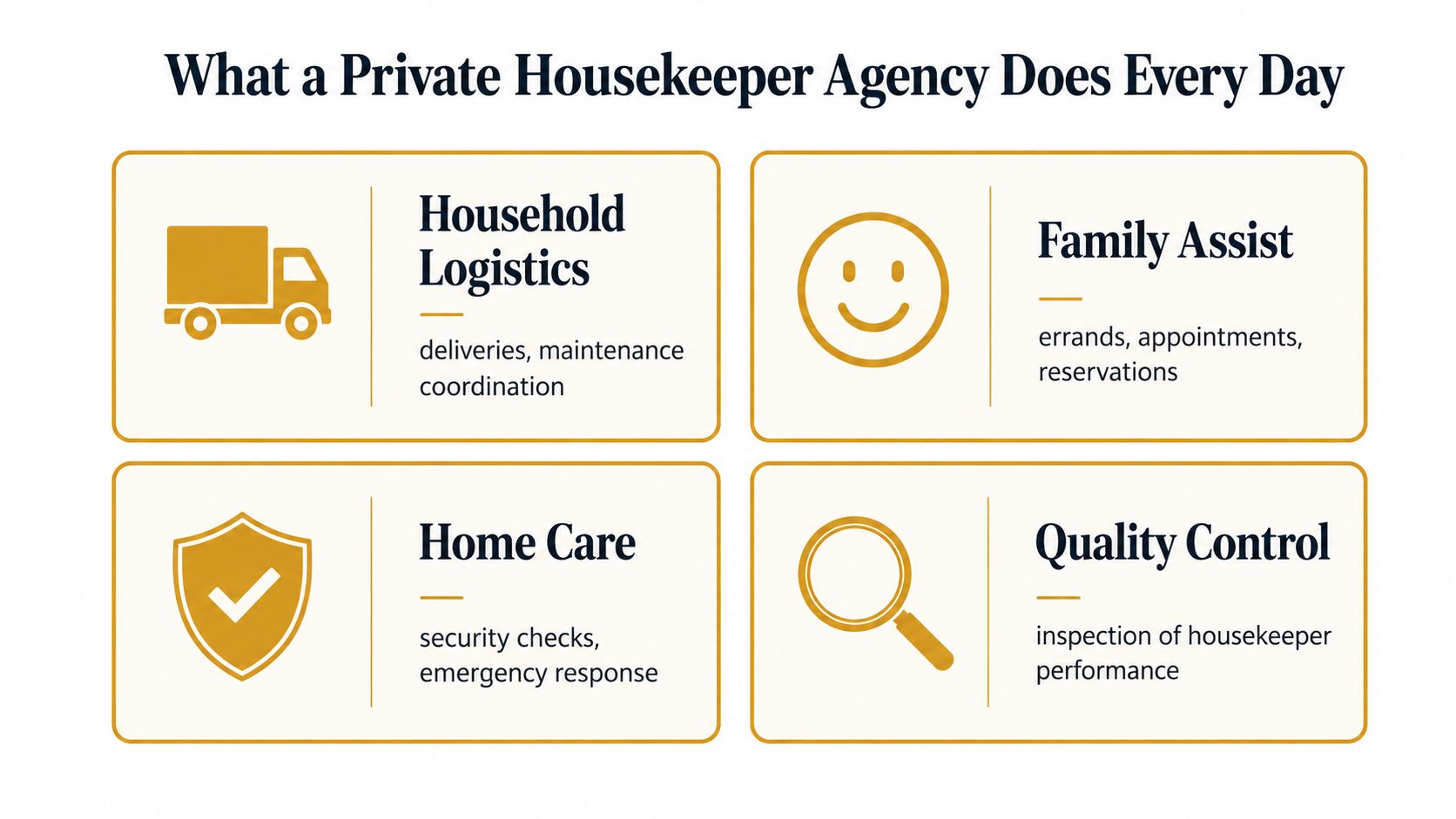
A general cleaning firm usually supplies a service rather than recruiting a dedicated household employee. A domestic staffing portal gives the family access to profiles, but the family remains responsible for judging suitability and completing the checks. Neither model is automatically wrong. They shift more work and risk back to the household.
The distinction becomes critical when the role involves keys, alarm systems, private offices, children, valuable wardrobes, sensitive documents, or more than one residence. In those settings, a recruiter must understand the household as a workplace and the housekeeper as a professional employee, not as an interchangeable service provider.
A useful description of day-to-day responsibilities appears in what a housekeeper does. Read it as a starting point, then make the final brief specific to the property. “Housekeeping” is a category. The actual post is a set of decisions, standards, boundaries, and routines.
Live-In, Live-Out and Rota Arrangements Compared
The arrangement determines more than where the housekeeper sleeps. It affects privacy, availability, recruitment geography, management style, and the quality of the employment package. Families often choose live-in because they want presence, then discover that unclear off-duty boundaries create tension. Others choose live-out for privacy, then underestimate travel time and coverage gaps.
| Arrangement | Privacy Level | Typical Hours | Accommodation | Candidate Pool | Weekly Cost Range |
|---|---|---|---|---|---|
| Live-in | Lower separation between work and home, unless boundaries are explicit | Agreed schedule with defined off-duty periods | Private, suitable accommodation is expected | Wider geographic reach, particularly for rural homes | Confirm with the agency and payroll adviser |
| Live-out | Stronger separation after working hours | Fixed daily schedule, with overtime terms agreed | Not provided by the household | More dependent on local transport and commuting | Confirm with the agency and payroll adviser |
| Daily or part-time | High outside scheduled visits | Set days or shifts | Not normally provided | Useful for local candidates and smaller briefs | Confirm with the agency and payroll adviser |
| Rota | Clear working and rest blocks when properly designed | Longer coverage periods followed by defined leave | Usually provided for on-duty periods | Can attract candidates seeking concentrated work patterns | Confirm with the agency and payroll adviser |
Live-in
Live-in works well when the property is remote, the family travels frequently, or a continuous household presence is useful. It can also make recruitment possible outside the immediate commuting area. The weakness is privacy. A bedroom alone doesn't create a sustainable arrangement if the worker is expected to remain available, answer messages during rest time, or absorb last-minute duties without a defined policy.
Accommodation should be inspected as part of the recruitment decision. Discuss bathroom access, meals, visitors, pets, smoking, internet use, security, and what “off duty” means. A live-in role needs a professional relationship with domestic space, not an assumption that presence equals availability.
Live-out
Live-out is usually the cleaner choice where the family values firm separation and the property sits within a realistic commuting area. It can attract candidates who have established homes and strong local networks. The trade-off is coverage. Early starts, late entertaining, two properties, and frequent travel may require additional staff or a rota rather than repeated favours.
Rota
Rota arrangements suit families who need dependable coverage across travel, estates, or complex household operations. They demand excellent scheduling and written handovers. A rota that looks efficient on paper becomes unattractive when rest periods, travel days, overtime, and responsibility during the handover are vague.
My recommendation is simple. Choose live-in for a real operational need, live-out for privacy and stable hours, and rota for predictable coverage that one person cannot reasonably provide.
Vetting, References and the Safeguarding Layer
A housekeeper enters private rooms, observes family routines, and may work around children or vulnerable adults. Vetting must therefore be layered. No single certificate or reference can establish suitability.
Begin with identity and role relevance. For a post involving children or vulnerable adults, the agency should explain which DBS level is appropriate and whether the role requires consideration of barred-list information. It should then verify the candidate's right to work through the Home Office online process and retain a dated record of the check.
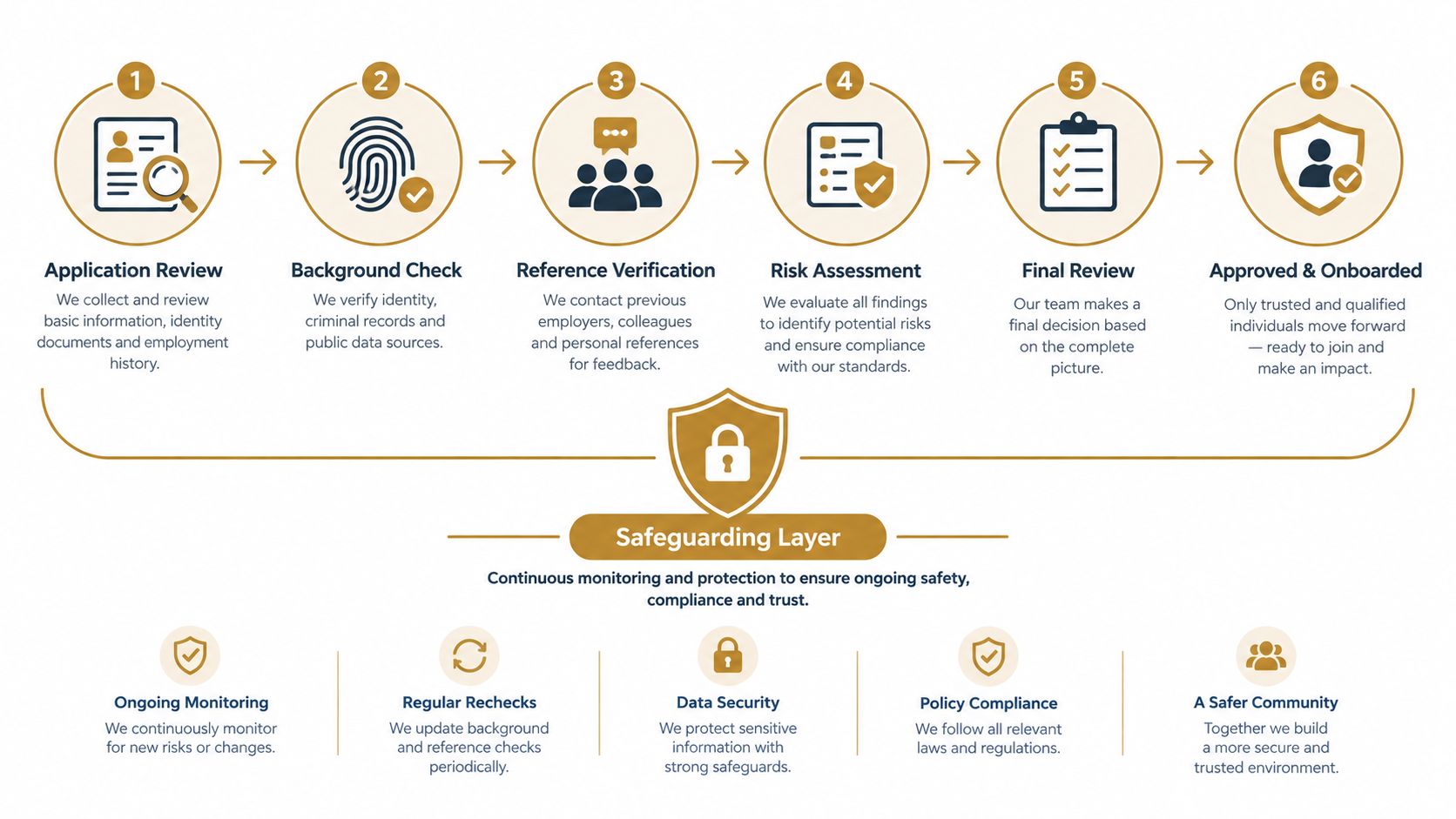
What robust screening looks like
References deserve more attention than polished CVs. The agency should contact previous employers directly, ask structured questions, and explore reliability, discretion, performance under pressure, length of service, and the reason the arrangement ended. A single written reference supplied by the candidate is not enough for a sensitive household role.
Practical assessment should follow:
- Working trial: Use a supervised shift or suitable test environment to assess standards, pace, product knowledge, folding, ironing, and communication.
- Household portfolio: Review the types of homes and responsibilities the candidate has handled, without requesting confidential details from former employers.
- Live-in conversation: Discuss sleep arrangements, allergies, pets, visitors, food, privacy, and emergency expectations before an offer.
- Scenario questions: Ask how the candidate would respond to a damaged garment, a contractor arriving early, a child entering a restricted area, or a principal changing the plan mid-shift.
Families shouldn't outsource every judgement to an agency. The principal or household manager should conduct the final interview, visit the proposed accommodation, and ask directly why the candidate left each previous role. Those conversations often reveal more than a polished profile.
For international or cross-border searches, agencies may also need specialist international background checks. The final file should include a written profile, reference summary, signed confidentiality terms, and a clear route for raising concerns after placement. Safeguarding doesn't end when the candidate starts work. It becomes part of supervision, induction, and household culture.
Pay Benchmarks and What Drives a Competitive Package
Salary advice for private housekeepers is often too broad to help a principal make an offer. For private household roles, a more accurate working range is £18 to £25 per hour, with London, formal households, and multi-property roles often sitting at the upper end of that bracket.
That range is still only a starting point. A housekeeper working in a demanding private residence may need a stronger offer because the role requires confidentiality, flexibility, wardrobe care, entertaining support, travel, or work across properties.
| Arrangement | Regions excluding London | London and South East | Premium drivers |
|---|---|---|---|
| Standard domestic role | Around the UK median, adjusted for duties and experience | Higher regional benchmark | Scarcity, transport, discretion |
| Experienced private housekeeper | Set according to the household brief and verified experience | Usually above the regional benchmark | Formal service, multi-property work, travel |
| Live-in housekeeper | Salary plus suitable accommodation and defined off-duty time | Higher pressure where accommodation and commuting are difficult | Privacy of quarters, location, hours |
| Housekeeper with management duties | Price the supervisory responsibility separately | London market may require a stronger package | Staff oversight, inventories, vendors, principal travel |
What makes an offer competitive
Money is only one part of retention. Candidates notice whether the family behaves like a professional employer:
- Written duties and hours: Remove the expectation that every favour is included.
- Overtime policy: Agree how additional time is requested, recorded, and paid.
- Travel terms: Clarify travel between residences, expenses, and time spent moving between sites.
- Review process: Put a formal review date into the employment arrangement.
- Benefits: Consider the household's overall package, including pension arrangements and health support.
- Accommodation: For live-in roles, the room, privacy, facilities, and boundaries can decide whether an offer is accepted.
Remote estates can be difficult to staff even when the headline pay is attractive. Geography, housing quality, transport, and the expectation of being constantly available may matter as much as salary. London and lower-cost regions can't be treated as interchangeable, especially when the household expects a housekeeper to combine cleaning, service, errands, and family support.
For a broader family budgeting discussion, see the private staff salary guide for UHNW families. Ask the agency to separate the salary from accommodation, benefits, overtime, agency fees, and employer costs. That's the only way to compare offers.
Contracts, HSE Coverage and 2026 Compliance Shifts
Before anyone starts, establish who is the employer. An introductory agency that sources and introduces a candidate will often leave the family responsible for the contract, payroll, tax deductions, payslips, statutory benefits, pension duties, and employers' liability insurance.
An agency that supplies workers through its own payroll may carry different responsibilities. That arrangement does not remove risks specific to the household. Ask the agency to confirm the structure in writing, including who pays the worker, manages absence, directs the work, and provides insurance covering the property. “We handle everything” is not an adequate answer.
The HSE distinction matters. A domestic servant employed directly by a householder in a private household may fall outside the Health and Safety at Work legislation, while an agency-hired domestic worker is generally covered by the Act under HSE guidance on domestic work. Treat an agency placement as a formal workplace arrangement. Set up suitable risk assessments, training, supervision, equipment, and safe working procedures before arrival.
The paperwork to settle before day one
GOV.UK says household employers should check whether a worker can work in the UK, hold employers' liability insurance, and register as an employer in its employment guidance for household employers. With an agency placement, assign each task clearly and retain the supporting evidence.
Right-to-work checks need particular care for an Overseas Domestic Worker. The worker must have been employed by the same employer for at least one year, be at least 19, travel to the UK with that employer or specified family members, and normally remain for six months. GOV.UK also states that the worker must receive at least the National Minimum Wage under the Overseas Domestic Worker visa rules. Obtain immigration advice for the specific circumstances rather than relying on an agency summary.
The Employment Rights Act 2025 gives families another reason to review contracts before hiring. Industry guidance describes changes phased across 2026 and 2027, including wider statutory sick pay and parental-leave access from April 2026, plus a proposed reduction in the unfair-dismissal qualifying period from two years to six months planned from 1 January 2027, subject to confirmation in its summary of the changes. Use those proposals as a prompt to obtain current employment advice.
Confidentiality provisions should cover family information, photographs, security details, guests, travel, devices, and social media. A generic template rarely captures the requirements of a discreet household with multiple residences. Draft the agreement around the property, reporting lines, access arrangements, and the household's working pattern.
A Shortlist of Questions for Any Agency Before You Sign
A family should be able to ask direct questions without worrying that it will appear difficult. The answers reveal whether the agency is acting as a recruitment partner or pushing profiles.
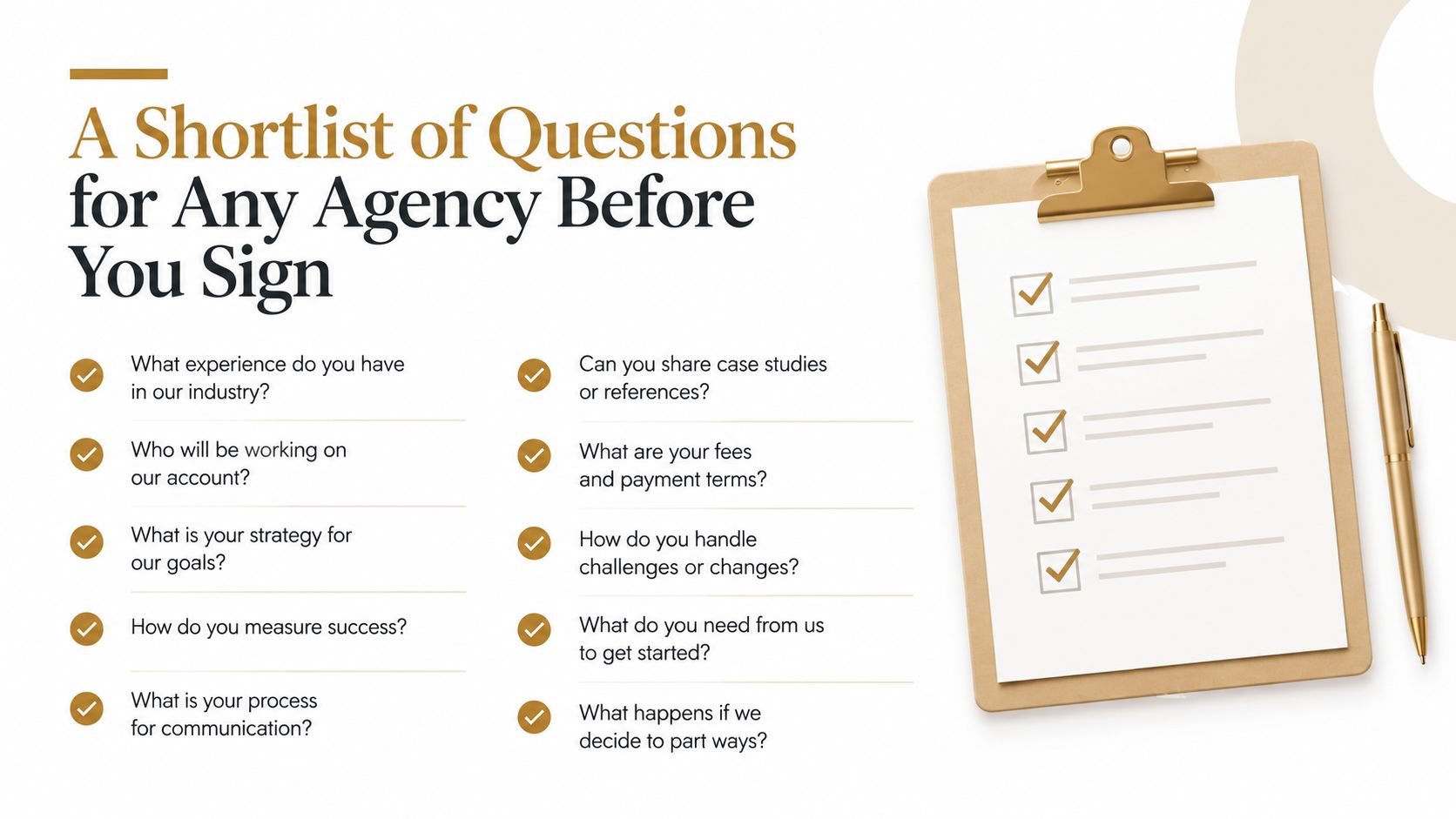
Questions about the candidate
- How do you interview candidates? Ask whether the assessment is in person, by video, or based mainly on a form and CV.
- Who speaks to referees? Email verification is not the same as a direct conversation with previous employers.
- What practical testing do you use? Find out whether the candidate has completed a working trial or demonstrated relevant housekeeping skills.
- How do you assess discretion? The agency should discuss keys, codes, family schedules, valuables, private offices, guests, and social media.
- How do you test boundaries? Scenario questions can expose whether a candidate understands the difference between being helpful and overstepping.
Questions about the placement
- What does the replacement guarantee cover? Ask what happens if the placement fails at week three, what exclusions apply, and whether the guarantee provides another search or a fee credit.
- Who is the legal employer? Get the answer in writing, including responsibility for payroll, tax, pension administration, and absence.
- Which payroll provider is used? If an umbrella or payroll provider is involved, ask for its name and the precise division of responsibility.
- Does insurance cover the placement household? Request evidence of employers' liability cover and check whether agency-placed staff working at your property are included.
- Can we review the documents first? Ask for a redacted sample contract, fee schedule, replacement terms, and privacy or confidentiality provisions before paying a deposit.
If your household has several employees, frequent travel, or complicated reporting lines, an independent HR risk consultant selection resource can help you identify the kind of external employment support you may need. It shouldn't replace a specialist agency's recruitment work, but it can expose gaps in payroll, contracts, supervision, and risk ownership.
A quiet warning: Never sign a fee agreement while the job description, employer model, insurance position, and replacement terms remain unclear.
Superstar Nannies recruits private household staff, including housekeepers, housekeeper-nannies, live-in and live-out professionals, and wider household roles for families with complex requirements. Visit Superstar Nannies to discuss a discreet search with a team that can align candidate vetting, household expectations, and post-placement employment considerations.