


You're looking for part time babysitting jobs, perhaps after work, around university, or as a first step towards private-household childcare. One candidate treats each booking as quick evening cash. Another arrives prepared, earns a family's confidence, and gradually builds a dependable roster with stronger responsibilities and better rates. Private families notice the difference quickly.
The work now demands more than being pleasant and punctual. You may be expected to follow a structured bedtime routine, enforce screen-time boundaries, prepare allergy-aware meals, coordinate a school pickup, and keep the family's shared online calendar accurate. The most successful babysitters treat every booking as a professional service, not an informal favour.
What Part Time Babysitting Really Looks Like in 2026
Part-time babysitting sits between an occasional evening booking and a full-time nanny position. Many candidates build their week around recurring after-school care, date nights, weekend support, or holiday cover. The exact pattern varies, but the principle is consistent: families want someone dependable enough to plan around.
England's paid childcare workforce reached an estimated 368,100 staff in 2024, an increase of 6% from 2023, according to the government's childcare and early years provider survey. Group-based provision accounted for 277,900 staff, school-based provision for 59,800, and childminders and childminding assistants for 30,400. That structure matters because babysitting belongs to a wider, established childcare labour market, even when the work takes place in a private home.
A serious candidate should make four decisions before applying:
- Choose the route: Decide whether you'll use an agency, platform, local network, or referrals.
- Set your rate: Price according to location, children, hours, responsibilities, and travel.
- Present evidence: Prepare a clear CV, references, DBS documentation, and training records.
- Build continuity: Treat each booking as an opportunity to earn repeat hours through reliable habits.
Recruiter's view: Families rarely hire the most enthusiastic applicant. They hire the person who makes care feel organised, safe, and easy to trust.
Your reputation is built through small details. Confirm arrangements in writing, arrive prepared, follow the household's routine, and leave a concise update. That's how part-time babysitting becomes a gateway to repeat private-household work.
Where to Find the Best Part Time Babysitting Jobs
The route you choose affects the quality of families you meet, the amount of screening involved, and how much control you have over your schedule. Don't rely on one source. A platform can create volume, while networking and referrals create continuity.
| Channel | Typical screening | Cost to candidate | Best for | Earning potential |
|---|---|---|---|---|
| Specialist nanny or babysitting agency | Agency-led screening, references, and suitability checks vary by role | May involve registration or placement terms | Candidates seeking carefully matched private-family work | Stronger where experience and presentation support premium placements |
| Mainstream platforms such as Bubble, Koru Kids and Childcare.co.uk | Platform checks vary, so families may ask for further evidence | Fees and terms vary by platform | Fast applications and flexible availability | Broad, but depends heavily on profile quality and competition |
| Local networks, including school gates, faith groups and parenting WhatsApp groups | Trust is often personal and informal | Usually no direct candidate fee | Building a local client base | Often steady once confidence has been established |
| Warm referrals from existing clients | Based on a known family's recommendation | Usually no direct candidate fee | Converting good work into repeat introductions | Particularly valuable for regular private bookings |
Specialist agencies can save time because they pre-screen families and may carry out reference checks, but they charge or structure their service through placement terms and may offer less freedom over which bookings you accept. Mainstream platforms give you speed and reach, yet your profile must do more work. A vague biography disappears among candidates who show clear availability, relevant experience, and usable references.
Local networks can produce loyal clients because the recommendation starts with existing trust. The drawback is that your initial earning power may depend on how established you are in that community. Word of mouth is powerful, but it's earned through consistent delivery rather than requested at the end of a single booking.
For candidates targeting private-household work, maintain one polished platform profile and actively develop local and professional contacts. If you want agency support and access to structured private-family opportunities, review nanny jobs near you and understand the agency's screening process before registering.
Building a Profile and CV That Families Trust
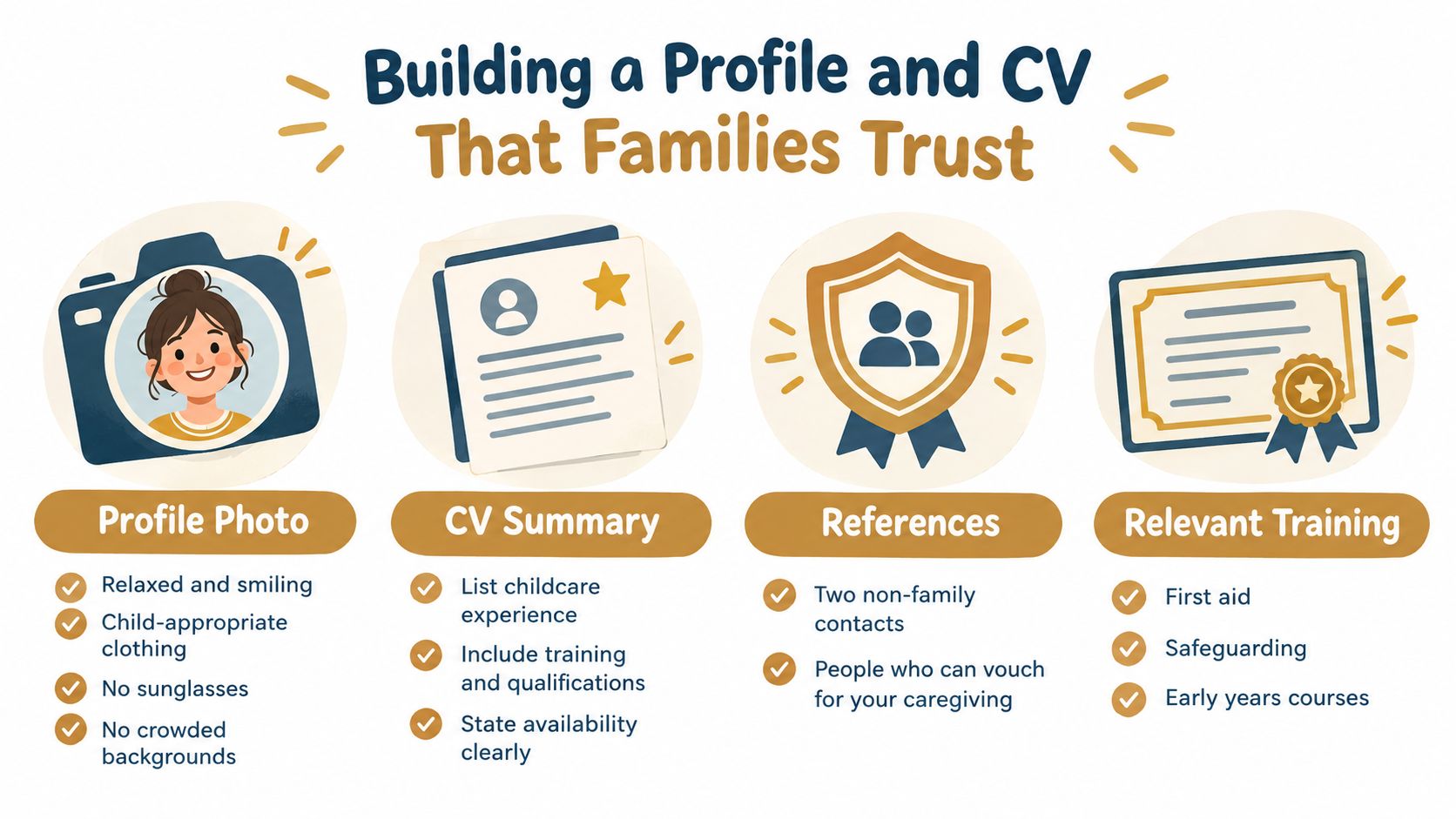
Your profile should read like a childcare professional's introduction, not a social media bio. Use a relaxed, smiling photograph with child-appropriate clothing and a clean background. Leave out nightlife images, sunglasses, crowded scenes, and anything that makes a family question your judgement.
The opening summary should answer the questions a parent or recruiter has immediately: how much childcare experience you have, which age groups you've cared for, what specialist skills you bring, and when you're available. Newborn care, twins, school-age children, SEN experience, driving, and holiday support can all be relevant when they're accurate and supported by experience.
Use evidence instead of personality claims
“Love working with children” tells a family almost nothing. A stronger entry explains the responsibility and the outcome:
Example: Managed the bedtime routine for two children aged three and six, including bath, story, and lights-out by 7.30pm.
Organise your CV by family or employer rather than relying on generic job titles. Under each entry, identify the children's ages, the type of care provided, regular duties, and any responsibility involving school coordination, meals, activities, or household communication. Keep the language factual and easy to verify.
References deserve the same care. Secure two written references, ideally including one family that remains contactable and one professional contact. Ask permission before listing anyone, and make sure the referee understands the type of role you're pursuing.
For additional guidance on describing caregiving responsibilities clearly, consult StoryCV caregiver advice. Keep a digital portfolio containing feedback messages, certificates, reference letters, and a clean scan of your DBS certificate. Families often move quickly, and sending organised evidence within hours can separate you from a candidate who needs several days to assemble basic documents. Continue developing your credentials through professional development for childcare candidates.
Setting Realistic Rates and a Sustainable Schedule
Rate-setting should be evidence-led, not emotional. A current UK benchmark places the typical babysitting rate at around £11.38 per hour nationwide, while London commonly falls between £12 and £18 per hour and smaller towns often sit closer to £9 to £11 per hour, according to UK babysitting rate guidance from Sitly. The same source notes that parents often pay £12 to £16 per hour overall, so location and role design matter.
There isn't a reliable single rate for every setting. An occasional late evening, a regular after-school arrangement, shared care, and part-time live-out nanny work carry different expectations. Multiple children, specialist care, meal preparation, school transport, and unsociable hours justify a clear premium where the responsibility increases.
| Region | One child (£/hr) | Two children (£/hr) |
|---|---|---|
| London | £12 to £18 | Set a higher rate within or above the local range according to responsibility |
| Smaller towns | £9 to £11 | Add a responsibility premium for the second child |
| UK nationwide benchmark | Around £11.38 | Agree a location-adjusted rate with the family |
The table gives a starting point, not a promise. Your written quote should state the hourly rate, minimum booking expectation, number and ages of children, travel arrangements, and additional duties. A three to four-hour minimum booking can protect your earning power when travel and preparation make a short appointment uneconomic.
Remember that gross income isn't take-home income. Travel between bookings, late-night transport, unpaid gaps, and cancelled hours all affect what the work produces in practice. Build a schedule around realistic availability rather than accepting every request and becoming unreliable across several households.
Safeguarding, DBS Checks and Core Qualifications
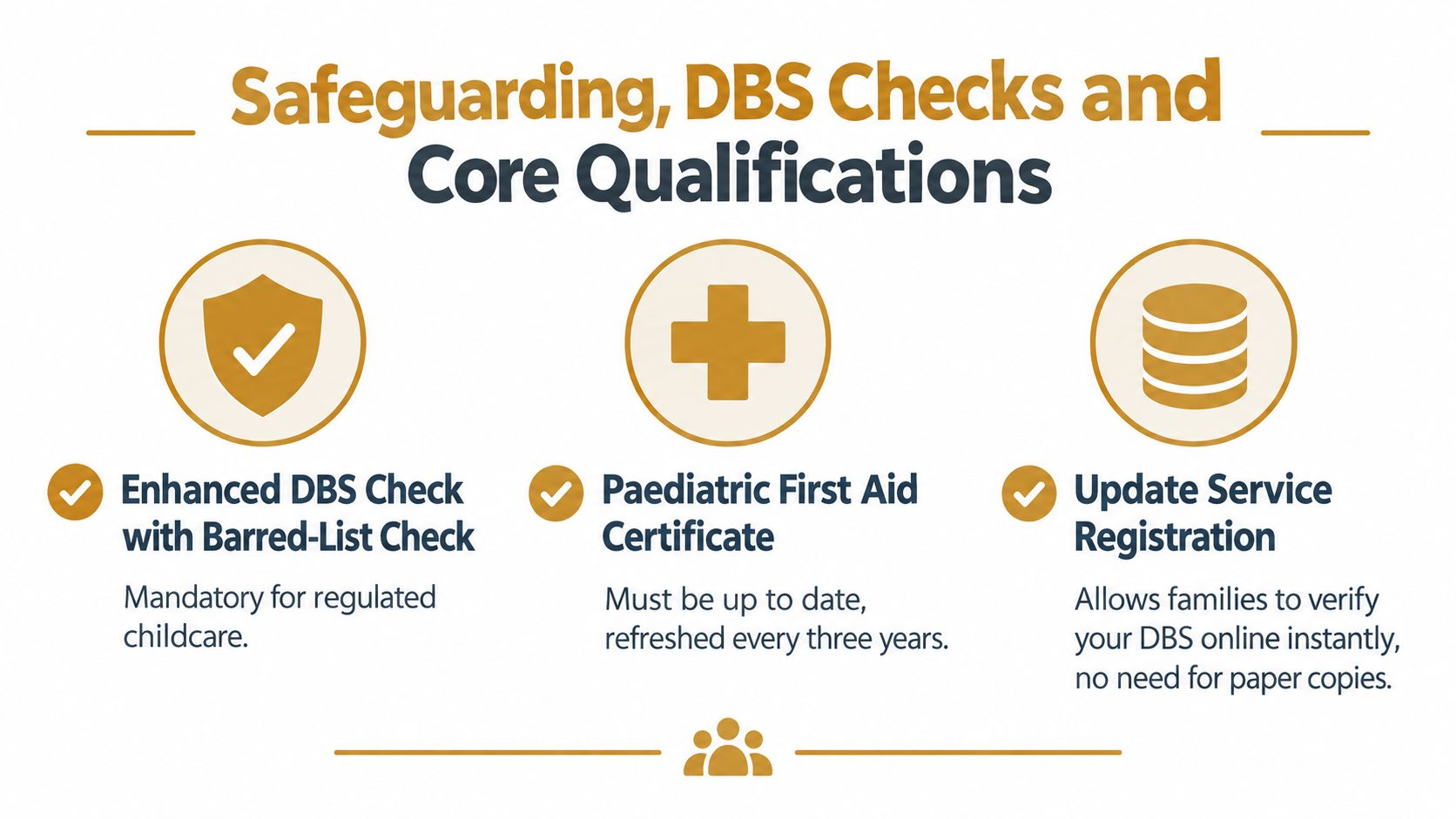
Families recruiting for private homes want evidence that you understand safeguarding before they hand over responsibility. Prepare your documentation before applying, not after receiving an offer. A serious candidate should understand the difference between a clean certificate, the checks a family or agency may request, and the suitability assessment attached to the specific role.
For childcare settings on domestic premises, the Department for Education's DBS guidance states that adults aged 16 and over who live or work in households where childminding or childcare is provided must be suitable for regular contact with children. DBS checks can apply even when an adult doesn't directly care for children.
Ofsted guidance also says providers must verify references, complete DBS checks, and avoid leaving staff alone with children until suitability has been confirmed. Read the Ofsted safeguarding requirements carefully, particularly if you're moving from informal babysitting into regulated early-years work.
Put your preparation in the right order
Start by confirming the role's screening requirements. Then gather references, arrange relevant DBS checks through the appropriate route, and keep certificates easy to share. Paediatric first aid, safeguarding refreshers, food hygiene, and SEND awareness all strengthen your profile when you can explain how the training affects your practice.
Qualifications such as Level 2 or Level 3 childcare awards, CACHE, or NNEB can matter greatly for some families and roles. Practical experience can carry substantial weight for occasional babysitting, but don't present informal experience as equivalent to a regulated qualification. For useful background on first aid renewal facts from TP Training, check the course-specific guidance rather than assuming every certificate follows the same renewal cycle. Candidates can also review checks for working with children before approaching agencies or private households.
Acing the Interview and the First Trial Evening
A strong interview is practical. Families may ask what you'd do if a child refused bedtime, how you'd handle an allergy-aware meal, what you'd do during an emergency, or how you'd respond if your approach to discipline differed from a parent's. Don't answer with broad promises. Explain the sequence of actions you'd take, when you'd contact the parents, and how you'd keep the child safe.
A recruiter looks for calm judgement rather than performance. If a family values limited screen use, explain how you'd offer an alternative activity and follow the household rule without turning the evening into a negotiation. If a child becomes distressed, describe how you'd acknowledge the feeling, maintain the boundary, and communicate the outcome in the handover.
The trial evening begins before you enter the house. Arrive with enough time to receive a proper handover, put your phone away, and learn the essentials. During the first thirty minutes, watch how the child responds to you, ask focused questions, and avoid taking over the routine before you understand it.
Families judge the practical finish as closely as the opening:
- Punctuality: Arrive ready to work, not just at the moment the booking begins.
- Transitions: Move from play to food, bath, and bed without unnecessary friction.
- House standards: Return dishes, toys, and activity materials to their proper places.
- Handover: Explain meals, mood, activities, sleep, and anything that needs attention.
A trial evening should feel like a test of judgement, not a staged performance. Follow the family's system, notice the child's cues, and leave the parents confident that you understood both.
Send a short follow-up after the booking. Thank the parents, confirm that you enjoyed meeting the children, and mention one relevant observation from the evening. Ask whether they'd like to reserve another date. That final message is often where an occasional booking becomes a professional relationship.
Turning One Booking Into Long-Term Family Work
Repeat work comes from predictability. Parents need to know that you'll arrive when agreed, remember the household's preferences, and communicate before a small issue becomes a problem. Your aim is to become easy to rebook.
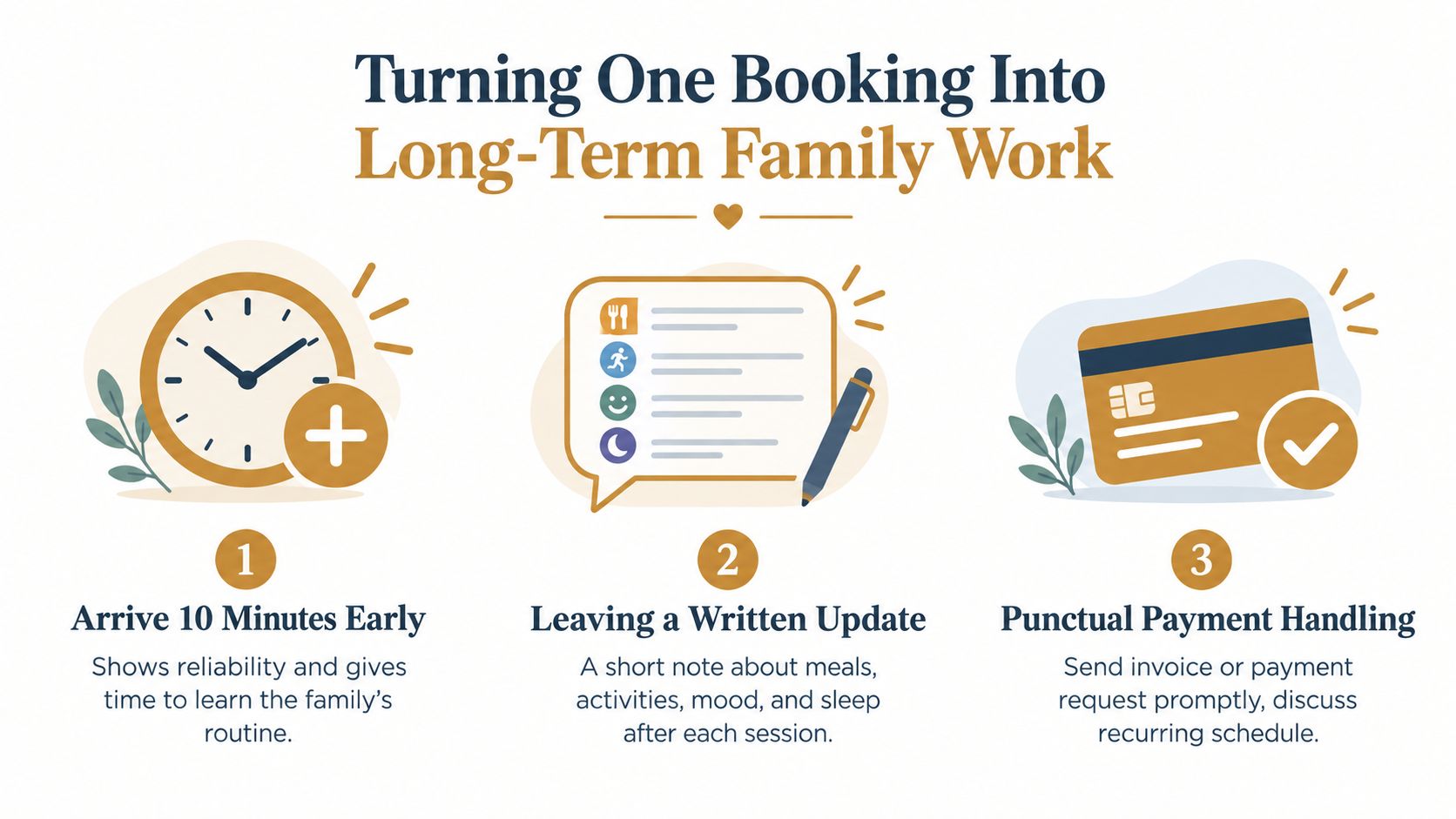
Arrive early enough to receive the handover without rushing. Learn where shoes, coats, medical information, food, bedtime items, and emergency contacts belong. Respect the family's customs, whether that means removing shoes at the door, using a particular bedtime script, or keeping shared spaces orderly.
Make the handover useful
A written update should be brief but specific. Record what the children ate, what you did, their mood, and whether they slept. Don't write a dramatic essay, and don't send a message that says everything was fine. A parent returning home wants useful information they can act on.
Use the family's preferred communication method and keep messages professional. Guidance on communication with parents can help you establish a consistent approach, particularly when several adults share responsibility for the children.
Payment handling also affects trust. Agree the payment method and timing in advance, then send an invoice or payment request promptly when appropriate. If the family wants a recurring schedule, confirm the diary a week ahead and record changes in writing.
Protect your availability
A dependable babysitter doesn't accept every slot. Block out late evenings, weekend work, study, rest, and travel time. If you can't cover a date, give reliable notice rather than cancelling close to the booking. Families remember uncertainty more sharply than they remember a polite refusal.
Once the relationship is established, signal where you can add value. You might offer school-pickup support, holiday cover, help with a sibling, or flexibility during a family trip, but don't absorb new responsibilities at the old rate. Added driving, multiple children, complex routines, and regular household coordination change the role.
When work becomes regular and nanny-like, propose a more formal arrangement. Discuss agreed hours, duties, payment, leave, notice, and how increased responsibility will affect the rate. A written agreement protects both sides and prevents a casual booking from becoming an underpaid permanent commitment.
Your practical preparation list
Complete the following before you begin a serious search:
- Start the relevant enhanced DBS process: Check what the agency or family requires and keep documentation organised.
- Refresh first aid training: Make sure your certificate and practical knowledge match the children's ages and needs.
- Prepare two written references: Confirm that both contacts are available and comfortable answering follow-up questions.
- Rewrite your CV: Describe specific childcare responsibilities, not generic enthusiasm.
- Set your rate: Use your region, the number of children, the setting, and the hours to justify the figure.
- Block your diary: Show realistic evening, weekend, school-run, and holiday availability.
Tax also needs attention once babysitting becomes a meaningful side income. HMRC treats babysitting as casual extra income, and the trading allowance can mean there's nothing to register or declare when total earnings from babysitting and other side jobs are up to £1,000 in a tax year. Once earnings exceed £1,000, Self Assessment reporting is generally required, while tax only becomes payable once total income exceeds the Personal Allowance, according to this HMRC-focused babysitting tax guide. Keep records and obtain professional tax advice if your circumstances are complicated.
You should also be realistic about the market. England had 54,700 early years providers in 2024, including 21,200 group-based providers, 9,700 school-based providers, and 23,800 childminders, while registered childcare places rose by 44,400, or 3%, to 1,602,500 between 2023 and 2024, as reported in the government childcare survey. That scale confirms ongoing demand for childcare, but it doesn't guarantee that informal babysitting will provide steady income. Formal childcare roles and private bookings operate in different parts of the market.
The clearest route depends on your objective. Use platforms and local networks if maximum flexibility matters most. Register with a reputable specialist agency if you want repeat bookings with professional families, careful matching, and a path towards more structured private-household work. Superstar Nannies handles part-time, temporary, and permanent childcare placements, including live-out part-time roles, and can be considered by candidates seeking agency-supported family work.
Your immediate job is simple. Prepare the documents, price the service properly, protect your schedule, and behave as though every booking is a reference for the next one. That's how part time babysitting jobs become a long-term childcare career rather than a collection of disconnected evenings.
If you want repeat private-household work rather than occasional bookings, prepare your CV, references, DBS documentation, and availability before registering with Superstar Nannies. The agency matches childcare professionals with part-time and other family roles, so you can present your experience clearly and pursue opportunities that fit your skills and schedule.