


You're not looking for a general recruiter. You're trying to fill a role that has to run a household smoothly, hold boundaries with staff, and protect privacy from day one. That's why a butler recruitment agency is a different decision from hiring through a generic staffing firm, and why the brief has to be tighter than most families expect.
The wrong channel wastes time. The right one knows how to interpret a formal service household, who can work under pressure, and which candidates are credible once references, discretion, and practical standards are tested. If you're comparing this with broader household hiring, it's useful to start with verified babysitter hiring tips, then recognise that a butler brief sits at a very different level of complexity. For context on the agency model itself, see what a luxury staffing agency does for discerning families.
Why Hiring a Butler Is Different From Hiring Any Other Staff
A family office often reaches this point after a familiar frustration. The house manager says the candidate pool is thin, the generalist recruiter keeps sending CVs that look polished but feel wrong, and nobody on the shortlist seems ready to manage service standards across several properties. A butler isn't just another domestic hire, because the role usually sits at the intersection of service, supervision, and confidentiality.
That's the core problem a butler recruitment agency solves. It isn't there to flood you with applicants. It is there to identify one person who can absorb a household's rhythm, coordinate with other staff, and stay composed when the principal's schedule changes at short notice. In practice, that means a tighter brief, more selective sourcing, and a far more disciplined screening process than general household recruitment usually delivers.
Practical rule: if the role touches guests, staff supervision, and private routines, treat it as a specialist placement, not a standard staffing exercise.
For fully staffed homes, the distinction matters even more. A butler often has to fit into an existing hierarchy, not just complete tasks. That's why families who already know how carefully they would hire a nanny or household assistant should expect the same rigor here, only with a higher burden on discretion and judgement.
What a Butler Recruitment Agency Actually Does
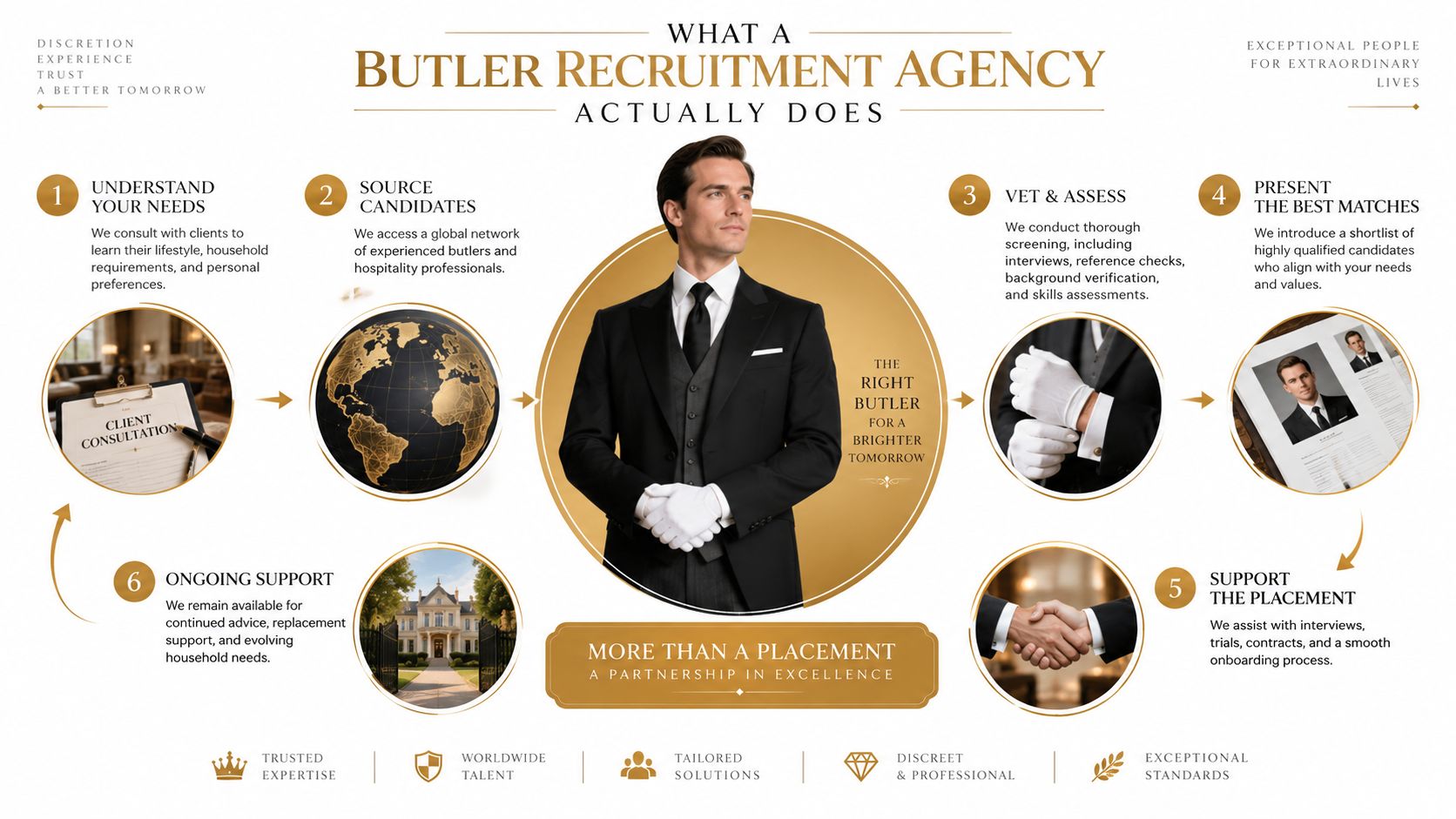
A proper agency starts by defining the role precisely. That means whether the household needs formal service, multi-property oversight, staff coordination, guest reception, or a butler who can also support the house manager. Without that step, you end up paying for senior experience you don't need, or underbuying a role that's going to fail within months.
The second job is sourcing. The strongest candidates for senior domestic roles rarely sit on open job boards, and serious agencies lean on specialist networks, referrals, and direct approaches. The Royal Archives collection contains more than 386,000 employment records covering royal residence staff in the UK between 1526 and 1924, spanning the reigns of Henry VIII, Queen Victoria, and King George V. That historical record is useful because it shows how long British households have relied on structured service hierarchies and documented employment systems, which is still the mindset modern butler agencies work from Royal Archives collection.
The agency is a recruitment partner, not a CV broker
A CV broker sends profiles. A real household specialist manages a process. That includes briefing, candidate pre-screening, interview coordination, trial arrangements, and support after the placement starts. A good agency also understands that a butler role can't be treated as an ordinary vacancy, because the household is buying trust, not just labour.
The legal distinction matters too. UK agencies operate within the framework of the Employment Agencies Act 1973 and the Conduct of Employment Agencies and Employment Businesses Regulations 2003, which shape what can be charged, what must be disclosed, and how domestic service placements are handled. In a household setting, the agency's job is to make the match more informed before anyone steps through the front door.
Why Specialist Butler Recruiters Beat Generalist Channels
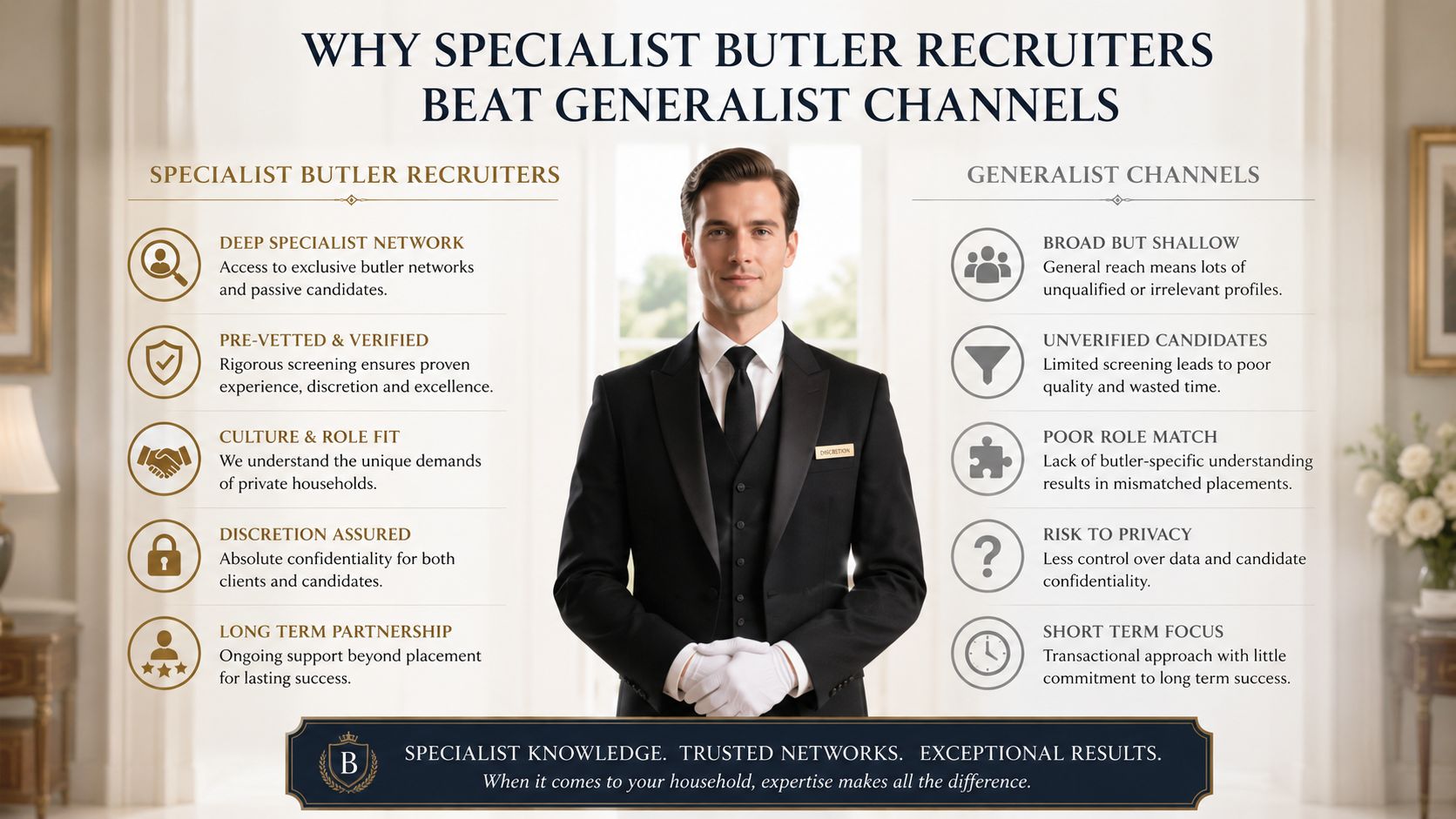
Generalist channels struggle with butler hiring because they're built for volume, not precision. Senior domestic candidates are selective, and the people you want usually care about household structure, working culture, accommodation, confidentiality, and whether the principal knows how the role should function. A generic recruiter often misses those questions entirely.
Specialist recruiters do better because they already know the market's unwritten rules. They understand service hierarchy in fully staffed homes, know which references are worth more than a glossy profile, and can judge whether a candidate is credible for a principal residence, a multi-estate household, or an international rota environment. They also benchmark compensation in a way that makes sense for the estate, not just the postcode.
The market reality is less cheerful than most sales pages suggest. A recent UK household-staffing market report says the sector is in an adjustment phase, with roles taking longer to fill, longer decision timelines, increased competition between agencies, and greater price pressure household-staffing market report. That means families should stop expecting speed alone to solve a specialist brief.
A narrow brief beats a broad one every time. If the household wants formality, travel readiness, and staff oversight, say so early. If it doesn't, don't pretend it does.
One practical recruiter's note from the Superstar Nannies team is simple. If the household is split between “must have” and “nice to have”, the search drags. Briefing precision shortens the search more than pushing for more agencies, more interviews, or more discretion after the fact.
For readers comparing specialist domestic search models, the UHNW domestic staff recruitment guide is the right next reference point.
The Vetting and Placement Process Step by Step
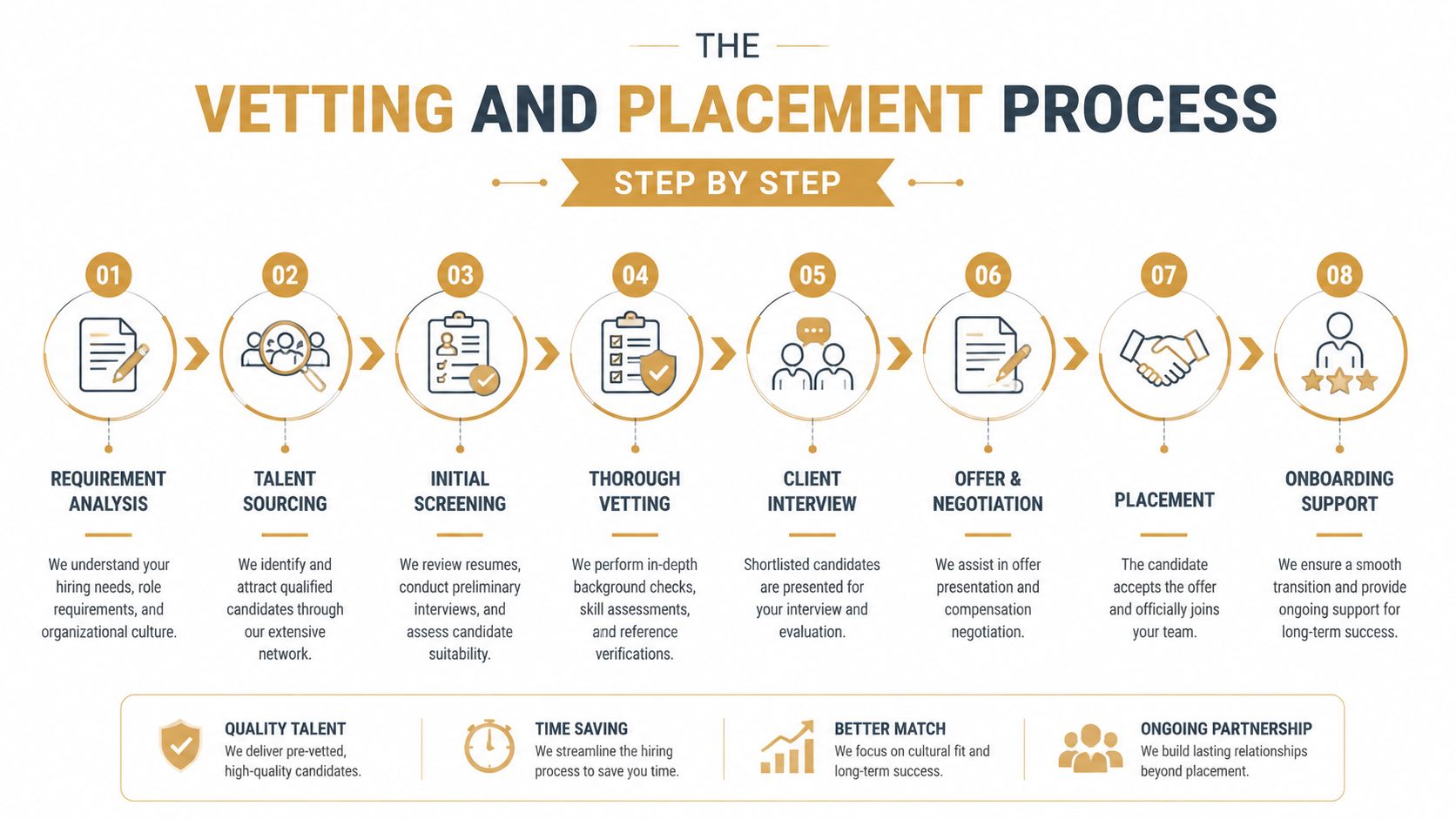
The process should feel measured, not rushed. First comes a consultation to define the role, reporting lines, work pattern, and house culture. Then the agency starts sourcing and filtering against the brief, which is where specialist judgment matters, because not every polished household professional is a fit for a formal butler post.
The screening should be layered
A proper domestic-staff vetting process includes identity and right-to-work verification, DBS screening, employment-history review, and verified references, with at least two employer references where possible. A DBS check alone is insufficient to judge suitability, because it doesn't test reliability, judgement, consistency, or household fit domestic staff vetting process.
From there, the agency should shortlist only the candidates who can withstand proper interviews. That means practical questions about service etiquette, staff supervision, guest handling, travel expectations, and how they've worked inside private households before. If the role is live-in or estate-based, the conversation should include accommodation, boundaries, and availability rather than leaving those details until the end.
A strong agency will also help with the offer stage and keep a close eye on the start date. In private households, the handover often matters as much as the hiring. If a butler is joining an existing team, the first weeks should be treated as an induction into household rhythm, not a test of improvisation.
Good agencies reduce uncertainty before placement. They don't ask the family to discover problems after someone has already started.
If you want to compare the level of scrutiny across domestic roles, Superstar Nannies' vetting process shows the standard a serious household should expect.
Butler Salaries and Agency Fees You Should Expect
Salary guidance for butlers in the UK is broad because the role is broad. Experience, estate complexity, live-in expectations, London-based demand, and supervisory burden all shift the number. A family should never pick a salary by headline alone, because the wrong figure creates either a weak shortlist or unrealistic expectations.
Typical UK Butler Salary Ranges by Seniority
| Experience Level / Role | Typical Gross Salary Range | What Drives the Range |
|---|---|---|
| Entry-level | £35,000–£50,000 | Smaller households, lighter oversight, narrower service scope |
| Mid-level | £50,000–£80,000 | More responsibility, formal service, stronger independent judgement |
| Senior | £80,000–£125,000+ | Larger estates, staff supervision, multi-property work, complex service standards |
| 2 to 5 years' experience | £45,000–£65,000 | A guide for established butlers with solid practical experience |
| 5+ years' experience | £65,000–£90,000+ | Seniority, confidence, and broader operational responsibility |
| Head butler | £80,000–£120,000+ | Leadership burden, standards management, team oversight |
| Head butler at large principal residences | £95,000–£150,000 | Multi-property management, formal service, extensive team control |
These published ranges come from 2026 UK salary guidance, including one guide that places butlers at £45,000–£65,000 for 2 to 5 years' experience, £65,000–£90,000+ for 5+ years, and head butlers at £80,000–£120,000+, while another sets entry-level at £35,000–£50,000, mid-level at £50,000–£80,000, and senior roles at £80,000–£125,000+, with head butlers at large principal residences reaching £95,000–£150,000 butler salary guide.
What drives the spread is straightforward. A live-in arrangement changes the value proposition. London and other high-cost environments can tighten the market. If the role includes multiple homes, senior staff oversight, formal dining, or travel coordination, the agency should price the search against that actual burden, not against a neat national average.
Agency fees are usually employer-side costs in this market. UK law generally prohibits agencies from charging work-seekers fees for finding employment, subject to narrow exceptions, so the household should expect placement costs to sit with the client rather than the candidate agency regulation overview. For a family office, that's not a surprise, but it is a reason to insist on fee clarity before a search starts.
For a fuller benchmark across domestic staff categories, the private staff salary guide is the right internal reference.
How to Evaluate a Butler Recruitment Agency
Start with specialism. If the agency mostly handles general domestic staffing, it may not have the network or judgement for a senior butler brief. A serious household recruiter should be able to explain how it sources discreet candidates, how it vets them, and how it handles a household that already has a hierarchy in place.
Ask these questions before you brief anyone
- How are references verified? Ask whether they speak to employers directly and how many references they normally seek.
- Who holds the candidate data? You need to know how confidential information is stored and who can access it.
- What happens if the placement fails? Replacement support and aftercare matter more than glossy promises.
- How do you confirm right-to-work? This should be part of the first screening, not an afterthought.
- What information will the candidate receive before interview? The law requires meaningful pre-placement disclosure for domestic service roles.
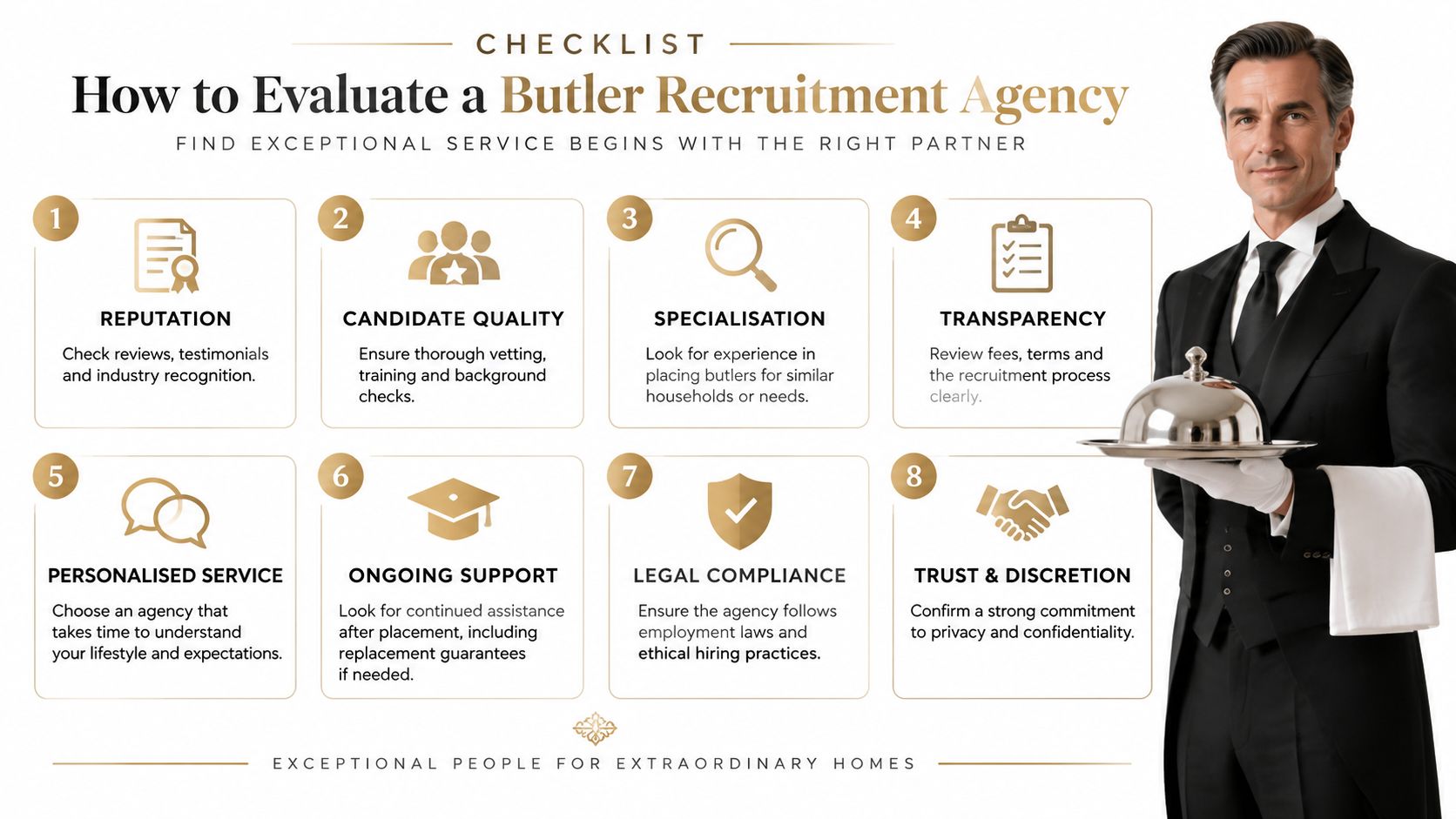
The regulatory backdrop is not decorative. UK employment agencies and employment businesses are regulated by the Employment Agencies Act 1973, which allows rules on record-keeping, qualifications, advertising, and safeguarding clients' money, while generally prohibiting charges to work-seekers for finding employment, except where the regulations allow it Employment Agencies Act overview. The Conduct of Employment Agencies and Employment Businesses Regulations 2003 also requires an agency placing someone into domestic service in a private household to provide information the work-seeker may reasonably request so they can decide whether to accept the role.
The best agencies don't hide behind generalities. They explain the process, show how they vet, and tell you what they'll disclose before interviews begin. If they dodge those questions, keep looking.
Benefits and Risks for UHNW and VIP Families
The upside of using a specialist agency is simple. You gain access to a hidden candidate pool, a more rigorous safeguarding process, and better fit for households that need discretion, hierarchy, and long-term stability. You also get a more realistic salary conversation, which matters when a role could sit anywhere from capable support to full estate leadership.
The risk is just as clear. The market is more fragmented than the marketing suggests, fee sensitivity is rising, and the official labour data is thin. The UK Labour Market Enforcement Strategy 2025-26 says there is a lack of data specific to personal assistants and domestic workers delivering elements of social care, which shows how much of this market remains under-measured in official statistics Labour Market Enforcement Strategy annex.
The smart response is not to chase the cheapest agency. It is to insist on layered vetting evidence, precise role scoping, and clear disclosure before interview. Treat salary guides as market commentary, not doctrine. If the agency can't explain how it works, it's probably not the right agency for a household that needs the job done properly.
Choosing Your Next Steps and Common Questions
Start with three decisions. Define the role properly, choose a specialist agency with verifiable vetting, and brief the household's working reality in plain language. In the current market, expect a considered process rather than a fast one.
If you're a family office, principal, or household manager ready to discuss a butler brief, speak with the Superstar Nannies household staffing team. Every consultation is confidential, and the process is handled discreetly from the first call.
FAQs
Can butlers be placed internationally?
Yes. A specialist agency can recruit for international households, but the brief must account for location, travel patterns, household structure, and any country-specific hiring requirements. International placements usually need a tighter timeline and more careful coordination than a local hire.
Can a family brief more than one agency at once?
Yes, but it should be managed carefully. If you brief multiple agencies, keep the message consistent and tell each one whether the search is exclusive or non-exclusive. Mixed instructions cause duplicated outreach, weaker candidate confidence, and less disciplined feedback.
How long does a typical placement take?
There isn't a single standard timeline, and the current market is taking longer than many families expect. In practice, the time depends on role complexity, the quality of the brief, and how quickly interviews and references are completed. For senior butler searches, patience usually produces a stronger outcome than speed.
If you're ready to hire a butler with discretion and proper screening, Superstar Nannies can help you shape the brief, benchmark the role, and manage a confidential search from first enquiry to final placement. Visit Superstar Nannies to speak with the household staffing team about your requirements and next steps.