
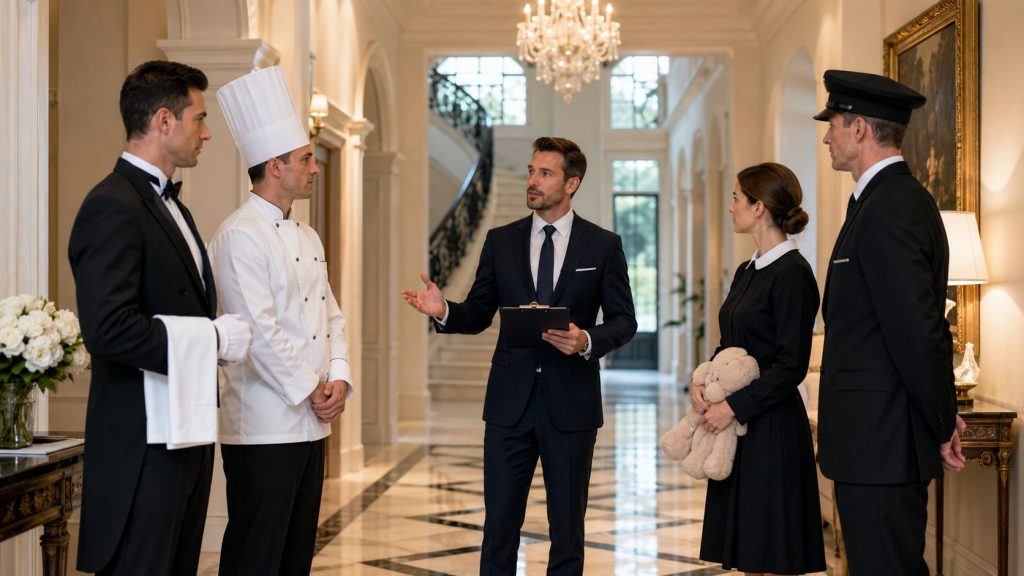
You're already doing the hard part. The household runs, the calendar fills, and the family expects polished service, but the newest hire still learns by watching, guessing, and asking the nearest person in the corridor. That kind of household staff training usually looks efficient at first, then the gaps show up in tone, timing, confidentiality, and compliance.
A bespoke programme changes that. In UK homes, the economics support it, since employers spent an average of £1,530 per employee on training a new employee in 2019, with higher figures in England (£2,570), Northern Ireland (£2,190), and Wales (£2,130), which makes onboarding a real business decision rather than a casual handover (employee training cost evidence). In UHNW residences, the cost of getting standards wrong is usually higher than the cost of teaching people properly, especially where discretion, routines, and safety all matter at once.
Introduction and Strategic Imperatives
A new housekeeper arrives on a Monday, the nanny knows the children's breakfast routine from memory, and the chauffeur has a different understanding of guest arrivals than the estate manager. By Friday, the family has noticed small inconsistencies that don't look dramatic on their own, but together they make the home feel less calm and less private. That's the core problem with ad hoc onboarding, it lets each person interpret the job in their own way.
In UHNW homes, inconsistency travels fast. One staff member leaves documents on a side table, another assumes a rule, a third forgets to log a visitor, and the result is not just a service wobble, it's a reputational risk. The practical gap is bigger than etiquette, because how to train household staff for legal compliance, safety, and record-keeping in UK homes is still rarely explained in useful detail, even though domestic employers carry real obligations (compliance gap in household training).
Practical rule: if a task affects privacy, children, chemicals, lone working, or visitors, it needs formal training and not just a quick verbal reminder.
A strong programme protects the family's lifestyle, but it also supports retention. Staff are far more likely to stay engaged when they know what “good” looks like, who judges it, and when feedback arrives. That's why a trained household doesn't run on memory alone, it runs on clear standards, recorded routines, and steady reinforcement. For a practical management framework, see this elite household staff management guide.
Structuring a Comprehensive Induction Framework
Start before the first day. A pre-arrival briefing should give the new hire a clean view of the house rules, the family's routines, the reporting line, and the essential expectations, so no one walks in blind. If you leave the first day to improvisation, you teach people that the household accepts improvisation.
Build the first six months in phases
The most reliable model is simple, structured, and boring in the best way. Guidance recommends clear job objectives, one-to-one instruction, printed task schedules, and monthly reviews for six months, then quarterly or bi-annual reviews once the role is established (household staff training guidance). That rhythm gives the trainer something to observe and gives the employee something steady to work towards.
A useful rollout looks like this:
- Pre-arrival briefing. Send the schedule, dress expectations, household map, escalation chain, and the first-week priorities.
- Week-one shadowing. Pair the hire with one named mentor and demonstrate tasks before expecting repetition.
- First-month checkpoint. Review accuracy, pace, discretion, and comfort with the household's culture.
- Six-month consolidation review. Sign off the role only after the employee can work independently across the routine without prompting.
Keep the mentor consistent. Changing the trainer every few days makes the household feel disorganised and forces the new hire to relearn the same standards in different voices.
The point of this structure is not bureaucracy, it's stability. Families want staff who can absorb routines quickly, and staff need to know that progress is being measured fairly. If you're managing a multi-role residence, align each phase with the broader operating standard in the household manager responsibilities checklist.
Crafting Role-specific Training Modules
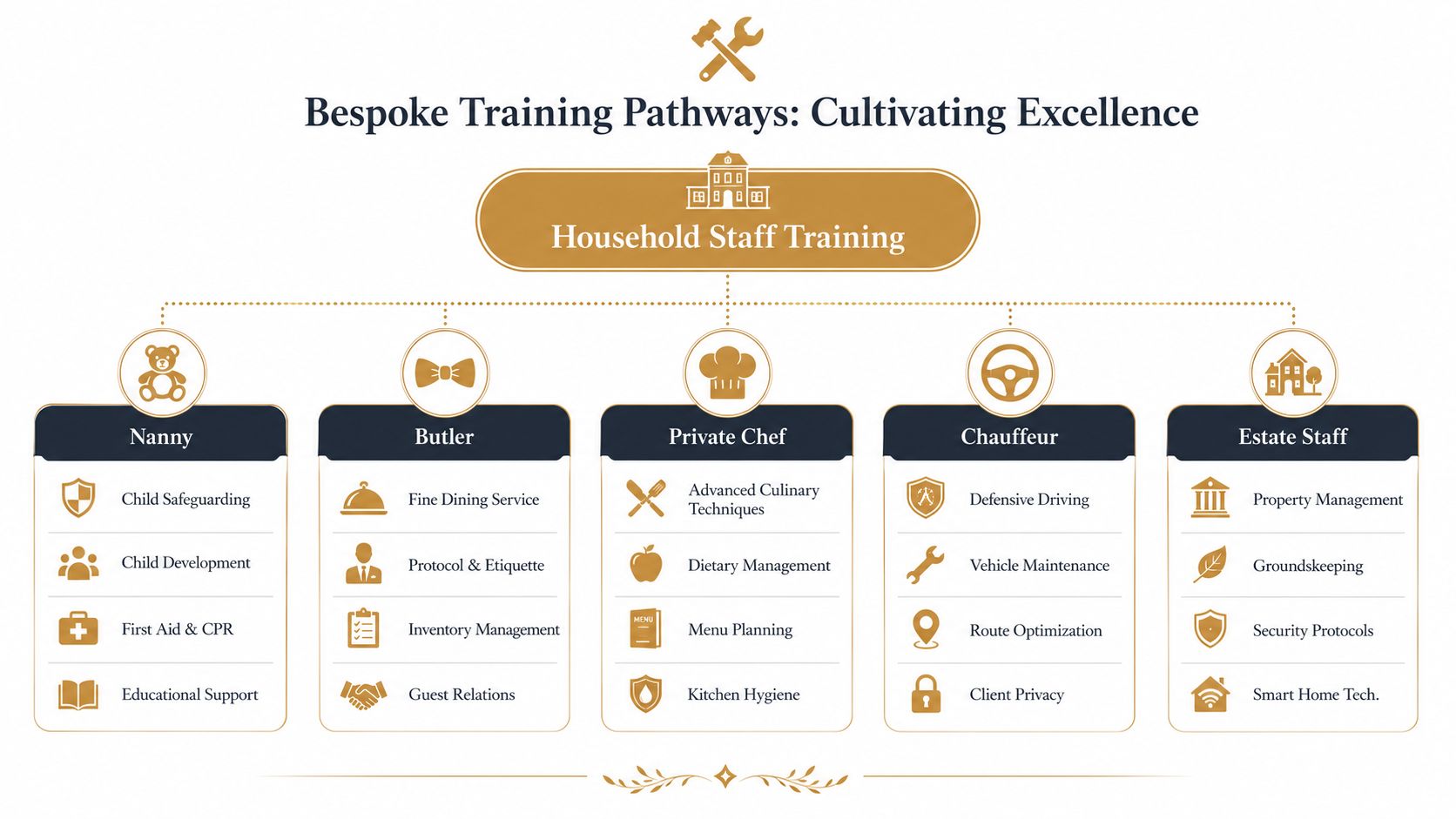
A single induction pack won't fit a nanny, a butler, a private chef, and a chauffeur. Each role has its own risk points, tools, and service expectations, so the training path has to be different from the outset. The cleanest way to build it is to define one core competency set per role, then test that set in real work.
Match each role to the work it actually does
A nanny module should centre on child safeguarding, child development, first aid awareness, and educational support. A butler module needs fine dining service, protocol, inventory handling, and guest relations. A private chef needs culinary technique, dietary management, menu planning, and kitchen hygiene, while a chauffeur needs defensive driving, vehicle care, route planning, and privacy discipline. Estate staff need property oversight, groundskeeping, security awareness, and smart-home fluency.
The lesson plan can be short, but it has to be specific. For a nanny, for example, the trainer might set a lesson on school-run preparation with three outputs, a checked bag list, safe handover language, and an emergency contact drill. For a chef, the same pattern works with a dietary briefing, a plating standard, and a fridge labelling check. The structure stays consistent, the content changes by role.
For managers looking for a development framework that combines mentorship and periodic review, professional development staff resources can help shape the learning path without forcing every role into the same mould.
Keep the lesson measurable
A good module ends with proof, not a discussion. The trainee either performs the task independently, follows the checklist, or needs another supervised run. That's where bespoke training beats loose shadowing, because it makes expectations visible.
Integrating Soft-skills and Legal Compliance
Soft skills in UHNW homes are not decorative. They're the difference between a staff member who completes a task and one who completes it in a way that preserves trust, privacy, and calm. Confidentiality, cultural sensitivity, and safeguarding all have to be trained explicitly, because people rarely absorb them just by being around polished service.
The UK model for mandatory training in safety-sensitive care roles is useful here. The Care Quality Commission approach treats training as mandatory when it is required by law, required for all staff, or required by a regulator or local authority, which gives domestic employers a sensible benchmark for roles involving childcare or vulnerable adults (mandatory training model). In practice, that means you decide what cannot be skipped, then you document it, revisit it, and sign it off.
Turn compliance into daily habits
Train the following through short workshops and repeated scenarios:
- Confidentiality protocol. Staff practise what to say when asked about family movements, guests, schedules, or school matters.
- Cultural sensitivity. Staff learn preferred forms of address, dietary boundaries, house customs, and holiday routines without making assumptions.
- Safeguarding. Staff rehearse what to do if a child, guest, or vulnerable adult is at risk.
- Records and risk. Staff complete simple logs for incidents, visitors, hazards, and emergency checks.
The best compliance system is the one your team can actually use during a busy day.
A good trainer doesn't bury this material in a dense handbook. Use short case discussions, “what would you do next” scenarios, and role-play around a visitor arriving early, a child going off routine, or a delivery driver asking for access. Those exercises build judgment, and judgment is what keeps the household steady when the plan changes.
Scheduling Evaluations and Ongoing Refreshers
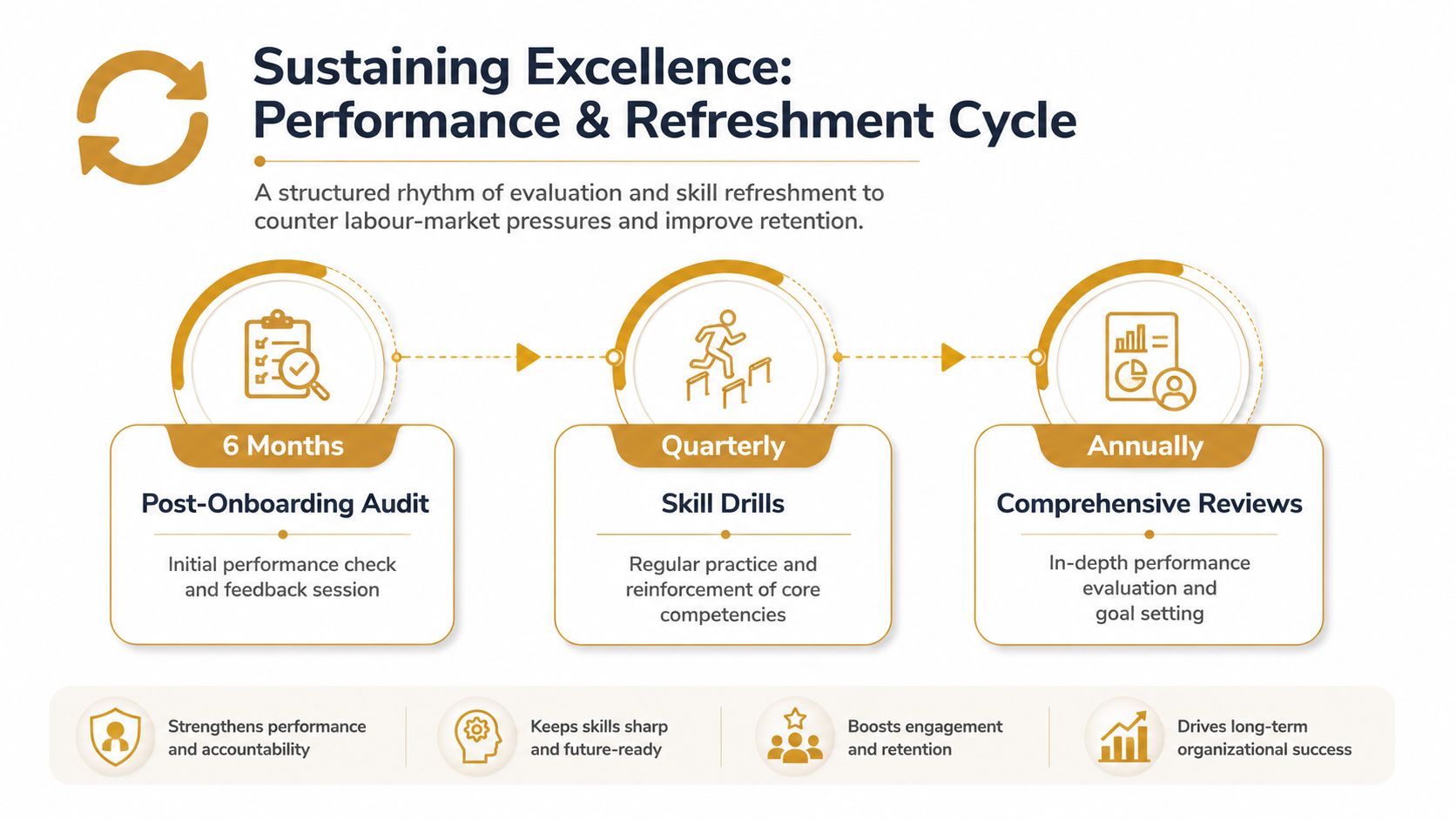
Household staff training works better when review dates are fixed before emotions enter the room. That matters more in a tight labour market, because UK employers have been dealing with difficult retention conditions, and the labour-market peak in mid-2023 saw 934,000 vacancies reported, which underscores the need for ongoing training that supports staff loyalty (UK labour market pressure). In a competitive hiring environment, the households that keep people are usually the ones that keep developing them.
Use the review cycle as a retention tool
A six-month post-onboarding audit should test whether the role is being performed the way the family expects. Quarterly skill drills keep critical routines fresh, especially where schedules change, guests arrive unexpectedly, or the home uses new technology. Annual reviews are the right place to reset standards, update documentation, and decide what needs another learning block.
The logic is simple. People forget, routines drift, and homes evolve. If you don't refresh training, the original standard slowly disappears into habit.
Simple benchmark: if a task has a privacy, safety, or child-facing element, schedule a refresher before the household assumes it's still being done correctly.
For households that want a practical way to track performance, staff performance metrics can support the review conversation without turning it into guesswork. The goal is not to judge every move, it's to spot where the service line is weakening before the family feels it.
Developing Sample Lesson Plans and Templates
A trainer saves time when the tools are already written. The best templates are plain, repeatable, and easy to adjust for the rhythm of a particular residence. They also stop a common mistake, which is building a beautiful onboarding pack that nobody can use in a real house.
| Template Name | Purpose | Customisation Tip |
|---|---|---|
| Welcome and house rules sheet | Sets expectations on privacy, reporting, and daily rhythm | Add family-specific phrases, visitor rules, and device policies |
| First-week shadowing plan | Guides the mentor and the new hire through observed tasks | Match each task to the actual room, vehicle, or schedule used in the home |
| Daily task schedule | Clarifies what must happen, when, and by whom | Separate recurring duties from one-off errands so nothing gets missed |
| Role-play feedback form | Captures responses from safeguarding, discretion, or guest scenarios | Keep the language short and behaviour-based |
| Review meeting template | Documents strengths, gaps, and next steps | Add one section for household culture and one for compliance follow-up |
The strongest lesson plans follow the same simple shape. Give the task a title, state the objective, list the materials, describe the steps, and finish with a sign-off criterion. That format works whether the lesson is about table setting, nursery handover, pantry stock rotation, or airport arrival procedure.
If you want a ready-made option, Superstar Nannies provides a structured placement and support model for elite households, which can sit alongside your own in-house training tools. Use it as part of a wider system, not as a substitute for clear standards.
A quick template approach
- Objective: name one observable skill.
- Materials: include the checklist, equipment, or reference note.
- Practice: let the trainee repeat the task under supervision.
- Check: confirm accuracy, tone, and timing.
- Record: note what needs reinforcement before the next review.
Best Practices and Next Steps
Strong household staff training starts with stakeholder buy-in. The family, the household manager, and the trainer all need to agree on the standard, because a programme falls apart fast when one person keeps changing the rules. Assign one lead trainer, keep the documents current, and make the first months feel purposeful rather than improvised.
The common failures are predictable. Teams skip refreshers because everyone seems busy, compliance documents drift out of date, and new hires get overloaded with too many instructions at once. Another weak spot is hygiene and maintenance routines, which is why a resource such as maintaining high hygiene standards is worth keeping close when you're tightening daily practice.
A future-proof programme usually has three habits. It audits the system annually, it updates for new household tech and new routines, and it expands soft-skills workshops so service stays polished even as the household changes. The aim is simple, staff should know the standard, know how to meet it, and know that the standard still matters next quarter.
If you're building or refining a UHNW training programme, start with one role, one checklist, and one review date. Then contact Superstar Nannies to discuss a bespoke staffing and support approach for your household.