


Your diary is full. The children's schedules keep shifting. Deliveries arrive, laundry multiplies, wardrobes need attention, and the person who comes in to clean does an honest job but leaves the house still feeling unmanaged. That's usually the moment a London family realises they don't need more cleaning. They need household support with judgement, consistency, and discretion.
If you're trying to find a housekeeper London families would trust in a private home, the challenge involves more than locating someone available. It's defining the right role, screening properly, setting expectations clearly, and hiring in a way that protects both your household and the person joining it.
Your Guide to Hiring a Professional London Housekeeper
A common pattern in London homes is that the household has outgrown ad hoc help. At first, a weekly cleaner is enough. Then wardrobes become disorganised, linens aren't rotated, guest rooms aren't kept ready, delicate surfaces need specialist care, and no one is really taking ownership of the home's day-to-day running.
That's where a professional housekeeper changes the rhythm of a household. A strong housekeeper doesn't just clean. They notice what's running low, maintain standards room by room, protect finishes and fabrics, manage laundry properly, and work with discretion around family life. In larger or more formal homes, they may also help keep routines consistent across deliveries, tradespeople, and informal staff.
London makes this search more complex. Standards are high, privacy matters, and expectations vary sharply between a family flat in Chelsea and a fully staffed house in Knightsbridge. Many households also need someone who understands security, presentation, and how to work around children, guests, or hybrid working.
A professional search starts with clarity. Before you interview anyone, decide what you need managed daily, weekly, and seasonally. That single step prevents most poor hires.
For families reviewing broader private household staffing support, it often becomes clear that the right hire isn't just about availability. It's about fit, trust, and whether the candidate can maintain your home to the standard you live at.
Practical rule: If you find yourself repeatedly rewriting the cleaner's list, following up on missed household details, or handling linen, wardrobes, and supplies yourself, you're likely hiring below the level your home now requires.
Defining Your Needs Housekeeper vs Cleaner
A common hiring mistake in London is defining the role too loosely. A family asks for “a cleaner,” interviews candidates on that basis, then expects wardrobe rotation, careful laundry handling, guest-room readiness, stock control, and an eye for presentation. The result is predictable. The cleaner feels set up to fail, and the household still lacks proper support.
In prime London homes, the distinction is not about job title alone. It is about ownership, judgement, and standard.
A cleaner usually works from a task list. The focus is surface cleaning and general tidiness, often within a set number of hours. That can work very well in a smaller flat or a home where the family manages laundry, cupboards, supplies, and day-to-day order themselves.
A housekeeper is hired to maintain the home properly. That includes cleaning, but it also includes noticing. Running low on linen spray, spotting that a guest room needs resetting before the weekend, separating specialist laundry, keeping wardrobes in order, and protecting delicate finishes all sit within a strong housekeeper's remit.
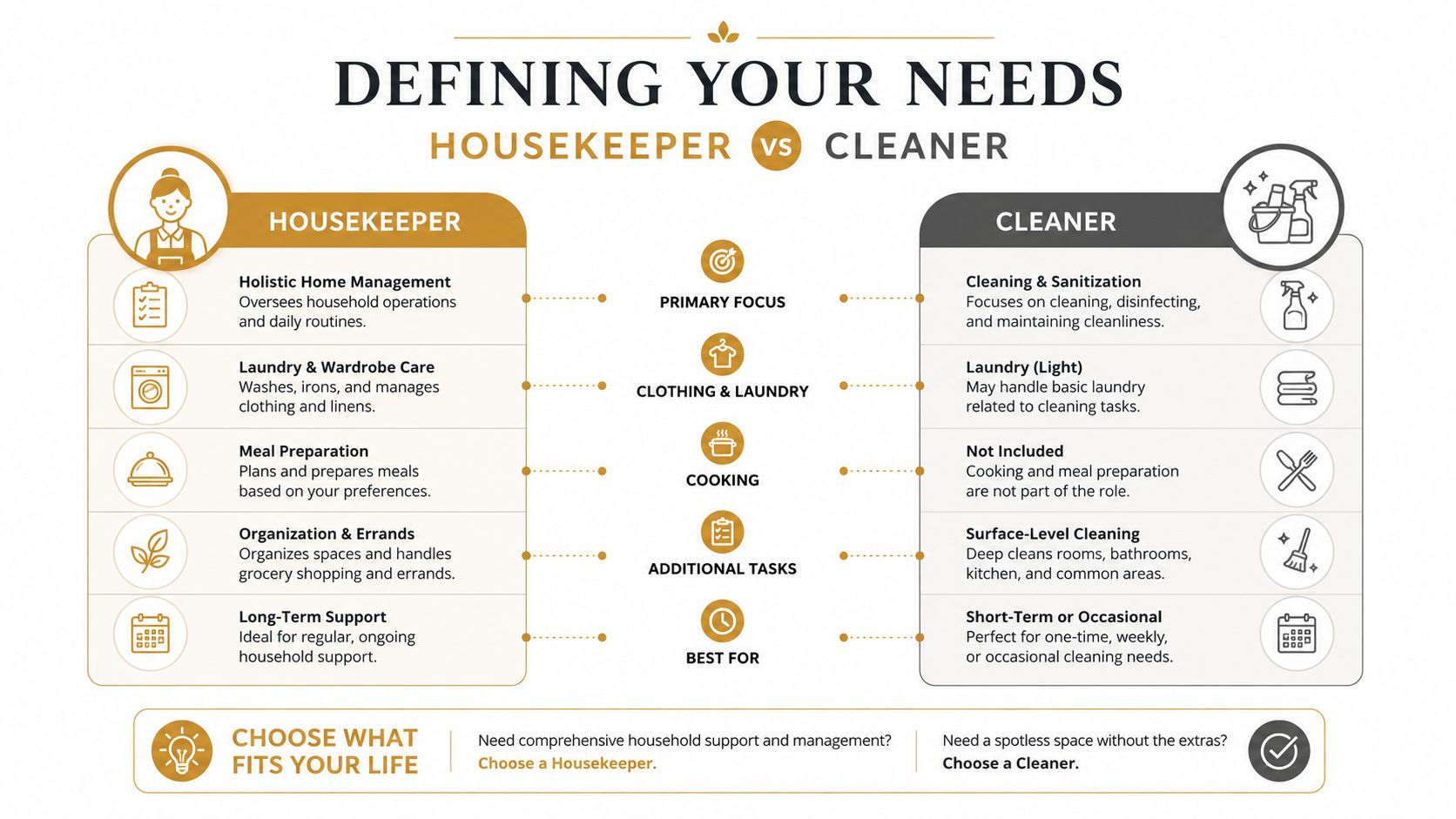
Here is the practical difference most households need to define before they hire:
| Role | Primary focus | Typical scope |
|---|---|---|
| Cleaner | Surface cleaning | Kitchens, bathrooms, vacuuming, mopping, dusting |
| Housekeeper | Household maintenance and presentation | Laundry, ironing, wardrobe organisation, bed linen, silver polishing, stock control, household routines |
The gap becomes even clearer in higher-value homes where materials and expectations are less forgiving. Marble, cashmere, silk, antique wood, formal table settings, and rotated seasonal wardrobes require method, discretion, and experience. A candidate who is excellent at standard cleaning may never have been trained in any of that.
This is why I advise families to write the brief around outcomes, not labels. Ask who will own the laundry from start to finish. Ask who checks household supplies before they run out. Ask who prepares rooms for guests, who keeps cupboards orderly, and who notices the small standards that slip when no one is responsible for them.
Some families find it helpful to first simplify family chore management internally. Once the household can see what still sits with parents, children, or other staff, it becomes much easier to separate casual cleaning help from a true housekeeping role.
A useful brief usually covers three areas:
- Core daily ownership such as bedroom resets, kitchen upkeep, laundry processing, and supply checks
- Weekly and seasonal care including linen rotation, fabric care, wardrobe organisation, and specialist polishing
- Role boundaries around childcare, cooking, pet care, errands, service support, or liaising with trades
Families who need a clearer duties list can review this guide on what a housekeeper does in a private home before drafting the role.
The sharper the brief, the better the shortlist. In London's top end of the market, that single step often decides whether you hire basic cleaning support or a housekeeper who can discreetly keep the entire home to standard.
Sourcing Your Housekeeper Agency or Direct Hire
Once the role is clear, the next decision is where to search. In London, families usually choose between a specialist agency and a direct hire route through personal referrals, job boards, local groups, or their own network.
Both routes can work. They don't carry the same workload or the same risk.
When direct hire makes sense
Direct hire appeals to families who want control over the process and who are comfortable managing every stage themselves. That means writing the advert, fielding applications, screening calls, reference checking, document review, interviews, trial arrangements, and contract setup.
For straightforward homes with lower privacy concerns, that can be acceptable. But the hidden cost is time. The stronger the role, the more unsuitable applications you'll need to filter out before you even reach a serious shortlist.
Direct hiring also places the burden of judgement on the household. A polished CV can look reassuring until references are chased properly, dates are checked, and inconsistencies emerge.
Why agencies are often the safer route
For high-trust household roles, agencies exist to reduce noise and raise standards. In the UK private household sector, top London agencies are described as following a 7-step vetting process and reviewing approximately 34 applicants before presenting a single candidate, according to Lighthouse Careers' London housekeeper hiring benchmark.
That gives families two advantages. First, time is protected. Second, the shortlist has already been tested against the role rather than collected.
A specialist agency route is usually strongest when you need:
- Confidentiality around a high-profile family, valuable home, or sensitive schedule
- Precision because the role includes fine fabrics, formal service standards, or household coordination
- Speed with quality when a departure has left the home exposed and the search can't drift
For readers comparing options, this overview of private household staff agencies in the UK gives a practical sense of how specialist household recruitment differs from general staffing.
The real trade-off
Direct hire can look less expensive at first glance. Agency recruitment can look more structured and more expensive upfront. But in private households, the cost of a poor hire usually isn't measured only in money. It's measured in disruption, lost time, security concerns, and the strain of restarting the entire process.
A London housekeeper should enter your home as a considered appointment, not as an experiment.
The Vetting Process Non-Negotiable Security Checks
A housekeeper will often have access to bedrooms, wardrobes, laundry, deliveries, and the private rhythm of your family life. In some homes, they'll hold keys, alarm codes, or daily visibility over children's routines. That level of access means vetting can't be casual.
The standard should be the same whether you hire through an agency or run the search yourself.
The checks that should always be done
Start with identity and legal working status. A private household must confirm the candidate's right to work in the UK before employment begins. That isn't paperwork for later. It's a pre-employment requirement.
A DBS check is also commonly required or expected in London housekeeping roles, particularly where trust, household security, and access to private family areas are involved, as reflected in current London housekeeper job listings on Indeed.
Then come references. Not written references filed away in a PDF. Actual conversations with previous employers. Dates, duties, reliability, reasons for leaving, handling of confidential information, and whether the person would be rehired all need to be verified directly.
For households conducting early-stage screening themselves, this guide to online background checks is useful as a preliminary overview. It doesn't replace formal employment checks, but it can help families think more carefully about what they are and aren't confirming.
Privacy standards matter in private homes
In UHNW households, confidentiality should be formalised. If the candidate will see guest lists, travel plans, financial paperwork, family routines, or high-value belongings, an NDA is sensible. So is a written household manual that sets out standards around phones, visitors, social media, dress, and how rooms are maintained.
Use a simple checklist during final-stage vetting:
- Documents verified, copied, and stored securely
- References spoken through, not merely received
- DBS position clear before start date
- Confidentiality terms included in the paperwork
- Household expectations written down, not assumed
Households wanting a benchmark for a more rigorous screening standard can review this guide to uncompromising vetting for high-profile staffing.
Trust is built before the start date. The checks are part of the hire, not an administrative detail after it.
Budgeting and Employment Contracts in London
A family may set out to hire “someone to keep the house in order” with a cleaner's budget, then discover they are asking for wardrobe management, fine laundry, supplier coordination, guest-room readiness, and discretion around a busy household. That is not a cleaner's brief. It is a housekeeper's role, and the package needs to reflect that from the outset.
In London, pay moves quickly once the role goes beyond straightforward cleaning. Scope drives salary. So do schedule, property size, standards of finish, whether the post is live-in or live-out, and how much independent judgement the housekeeper is expected to use.
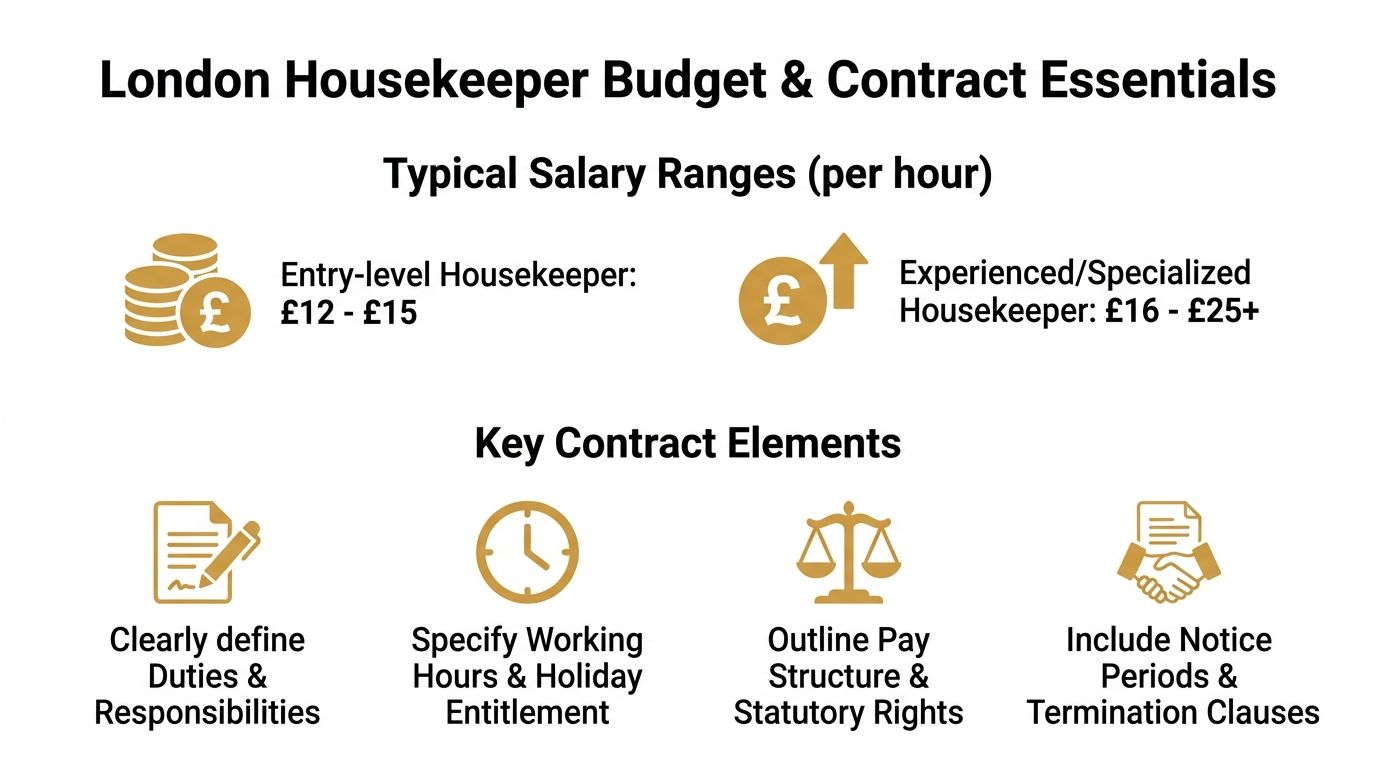
For current market context, the 2026 UK housekeeper compensation guide places London entry-level housekeepers at £25,000 to £30,000 and senior housekeepers in luxury households at £45,000 to £65,000. The same source notes a 15 to 25 per cent premium over the UK average for London roles, with senior London positions reaching £50,000 to £70,000 and live-out senior posts reaching £48,000 to £68,000 in top homes.
A weak brief usually creates one of two problems. Either the family overpays for a role that was defined too loosely, or they underbudget and attract candidates with cleaner-level experience when the home needs a true housekeeper. Clear scoping at this stage saves time and protects standards later.
Budget beyond salary
Gross pay is only one line in the cost. Employer National Insurance, pension auto-enrolment where applicable, statutory holiday, payroll administration, and sick pay provisions all need to be allowed for before an offer is made. If the role is live-in, accommodation and meals may make the package more attractive, but they do not replace proper pay or clear legal terms.

A sensible household budget should account for:
- Core pay tied to experience, responsibility, and weekly hours
- Statutory costs including payroll, tax administration, and pension duties where they apply
- Benefits such as meals, travel contribution, or accommodation
- Cover costs for agency support, temporary staff, or overlap during handover
- Retention costs such as annual reviews, bonuses, or long-service incentives where appropriate
For UHNW households, I advise clients to budget for stability, not only for the initial hire. A strong housekeeper who stays, protects routines, and handles the home properly is usually better value than a cheaper hire who needs replacing within the year.
Contract terms that protect both sides
A polished household runs better with a precise written contract. The document should match the actual scope of the job, not a generic domestic template pulled together at the last minute. This matters even more where the role includes keyholding, alarm setting, family laundry, silver care, wardrobe organisation, or support around guests and travel.
At minimum, set out:
| Contract area | What to include |
|---|---|
| Duties | Cleaning standards, laundry, wardrobe care, errands, supplies, pet care if relevant |
| Hours | Start and finish times, days worked, flexibility expectations |
| Pay | Gross salary, payment frequency, overtime approach if applicable |
| Leave | Holiday entitlement, bank holiday treatment, sickness reporting |
| Exit terms | Notice period, probation or review structure, return of keys and devices |
The better contracts also deal with the points that cause friction in private homes. Define who can authorise extra hours. State whether babysitting, service support, or travel packing is included or paid separately. Record confidentiality expectations, use of household equipment, and what “presentable by end of day” means in your home.
Household principle: The more polished the home, the more precise the contract needs to be. Informality causes most domestic employment disputes.
The Interview and Trial Period to Ensure the Right Fit
The interview shouldn't focus only on whether someone can clean well. In a private home, the stronger question is whether they can work calmly, discreetly, and consistently inside your family's routine.
Start with real scenarios. Ask how they'd prioritise a day when the children are home unexpectedly, a delivery arrives, the principal bedroom needs resetting, and a guest room must be prepared by evening. A capable housekeeper will answer with order and judgement, not panic.
What to ask in interview
Useful questions tend to be specific:
- “Tell me about a home with high standards.” Listen for detail on finishes, fabrics, routines, and presentation.
- “How do you manage wardrobes and laundry?” You want systems, not generalities.
- “How do you handle discretion?” Strong candidates understand privacy instinctively.
- “What would previous employers say about your reliability?” This often reveals self-awareness and consistency.

Why the trial period matters
A paid trial day or trial period tells you more than any CV can. You'll see pace, standards, initiative, and whether the person responds well to the atmosphere of the house. You'll also see whether your instructions are realistic and clear.
One data point is worth taking seriously here. Establishing a mandatory trial period with a performance review increases long-term retention by 45 per cent compared with direct hires without a testing phase, according to this vetting discussion on housekeeper recruitment practices.
A useful trial should test ordinary work, not stage an artificial inspection. Include a normal bedroom reset, laundry handling, kitchen upkeep, and one detail-sensitive task such as wardrobe organisation or fabric care. End the period with a structured review. Discuss what went well, what needed clarification, and whether both sides feel the fit is right.
Sometimes the candidate is strong and the fit is wrong. The trial protects everyone from forcing a placement that won't hold.
Your Housekeeping Solution and Frequently Asked Questions
To find a housekeeper London families can rely on, the process has to be sharper than a quick online search. The households that hire well tend to do four things properly. They define the role accurately, choose the right search route, vet without compromise, and formalise the working relationship clearly.
That approach doesn't just produce a better shortlist. It creates a calmer home. The right housekeeper brings order, protects standards, and removes a great deal of invisible household pressure that families often carry themselves for too long.
Frequently asked questions
How do I know if I need a housekeeper rather than a cleaner
If the issue is no longer just dust, floors, and bathrooms, you likely need a housekeeper. Homes that require laundry management, ironing, wardrobe care, guest-room preparation, stock control, or detailed presentation usually need someone operating at a broader level than a standard cleaner.
Should I hire live-in or live-out
That depends on the household's routine, space, and desired boundaries. Live-in can suit homes that need early starts, evening coverage, or continuity across the week. Live-out often works best for families who want clear separation between work and private time and who can offer a stable daily schedule.
What are the biggest red flags when trying to find a housekeeper in London
Be cautious if the role title and duties don't match, if references can't be verified directly, or if the candidate gives vague answers about previous households. Another warning sign is resistance to formal paperwork, vetting, or a paid trial period.
How should I manage a housekeeper once hired
Set expectations in writing, give clear household standards, and review performance regularly rather than only when something goes wrong. The strongest household relationships are professional, respectful, and consistent. Good people do better work when the brief is stable.
Is experience in private households more important than hospitality experience
Usually, yes. Hospitality can bring polish and discipline, but private household work requires judgement around privacy, family life, changing routines, and personal belongings. The best candidates often understand both standards and discretion.
If you'd like expert help to find a housekeeper in London with the discretion, standards, and private household experience your home requires, contact Superstar Nannies for a confidential consultation.