

A family usually starts the search for a superyacht nanny at the same point. The itinerary is nearly finalised, the yacht is immaculate, the guest list is set, and then one question sharpens everything else. Who will keep the children safe, calm, entertained, well-rested, and properly cared for when the setting itself changes by the hour?
For candidates, the moment looks different but feels just as consequential. You may already be an excellent nanny, governess, or travel nanny. Yet the minute childcare moves on board, the standards shift. A superyacht nanny isn't merely a polished nanny in a glamorous setting. The role sits at the intersection of childcare, hospitality, safety, discretion, and crew culture.
The Ultimate Luxury Meets a Unique Childcare Challenge
A week at sea can look effortless from the outside. Breakfast on deck. Swimming before lunch. Shore excursions in the afternoon. Children in crisp resortwear, smiling in every family photograph. What families discover quickly is that none of that feels effortless when childcare hasn't been planned with marine realities in mind.
A child who is perfectly settled at home may become overtired by tender transfers, changing cabins, unfamiliar routines, and constant stimulation. A younger child may need close supervision near stairs, swim platforms, and open decks. An older child may need structure, privacy, and intelligent engagement, not just supervision. That's where a specialist superyacht nanny becomes indispensable.

Families assembling an onboard team often focus first on chef, stewardess, deck crew, and itinerary. Childcare is sometimes treated as an add-on. In practice, it affects the whole charter. A well-matched nanny protects routine, lowers parental stress, helps children enjoy the voyage, and supports a smoother experience for crew and guests alike. This is one reason many families planning family charters also review broader advice on assembling an elite yacht team.
Why a standard nanny often isn't enough
A land-based nanny may be excellent in a residence and still be the wrong fit for a yacht. The difference isn't prestige. It's operating conditions.
On board, the nanny must work around:
- Water risk: Children are never far from water, ladders, gangways, or moving tenders.
- Compressed living: Bedrooms, play areas, storage, and quiet zones are limited.
- Fluid schedules: Meal times, naps, activities, and shore plans may change quickly.
- Crew hierarchy: The nanny must collaborate professionally with captain, chief stew, chef, and deck team.
A successful yacht placement protects both the child's experience and the vessel's rhythm. If either side is neglected, the arrangement starts to fray.
What families and candidates should expect
The role is high-touch and high-trust. Parents need someone who can switch from planning a sensory activity in the saloon to calmly managing sunscreen, snacks, and safety on a beach landing. Candidates need to understand that the glamour is real, but so is the pressure. The strongest placements happen when everyone treats the position as a specialist profession, not an adventurous variation of babysitting.
Defining the Superyacht Nanny Role
The simplest definition is this. A superyacht nanny is a childcare professional who can operate safely and discreetly within a maritime environment while supporting the standards of an ultra-high-net-worth household.
That sounds straightforward until you compare it with a conventional nanny role. In a residence, the environment is predictable. On a yacht, the environment itself becomes part of the job. Space, movement, weather, crew protocols, guest flow, and shore logistics shape every decision.
More than nannying on a boat
The role often blends several disciplines:
| Function | What it looks like on board |
|---|---|
| Childcarer | Daily routines, sleep support, play, emotional regulation, meals, hygiene |
| Governess-style support | Reading, homework oversight, educational outings, structured learning moments |
| Crew-facing professional | Coordinating with chef, chief stew, and deck team |
| Safety-conscious adult | Enforcing boundaries around water, stairs, equipment, and transfers |
A good comparison is a private nanny crossed with a travel coordinator and a safety-aware crew member. The standards remain child-centred, but the context is operational.
The myths that cause poor hires
The first myth is that warmth with children is enough. It isn't. A superyacht nanny must also function well in close quarters, remain composed around principals and guests, and adapt without fuss when plans change.
The second myth is that luxury service experience is optional. It's not always mandatory, but it often separates a capable candidate from a highly polished one. Families notice whether a nanny understands privacy, timing, presentation, and discretion.
The third myth is that this is an informal, temporary role. Even on shorter bookings, the expectations are professional and exacting.
Practical rule: If a candidate can describe activities beautifully but can't explain how they manage safety, crew communication, and routine disruption, they're not ready for yacht work.
Where role confusion happens
Some families want a pure childcare brief. Others expect a hybrid nanny-stewardess profile. Some candidates assume they will report directly to parents; others find themselves working closely with the interior team. None of these models is wrong, but lack of clarity creates friction quickly.
Before anyone signs a contract, the role should answer three practical questions:
- Who does the nanny report to day to day
- What happens during child-free periods
- Where does childcare end and interior support begin
When those points stay vague, placements rarely stay smooth.
Essential Qualifications and Certifications
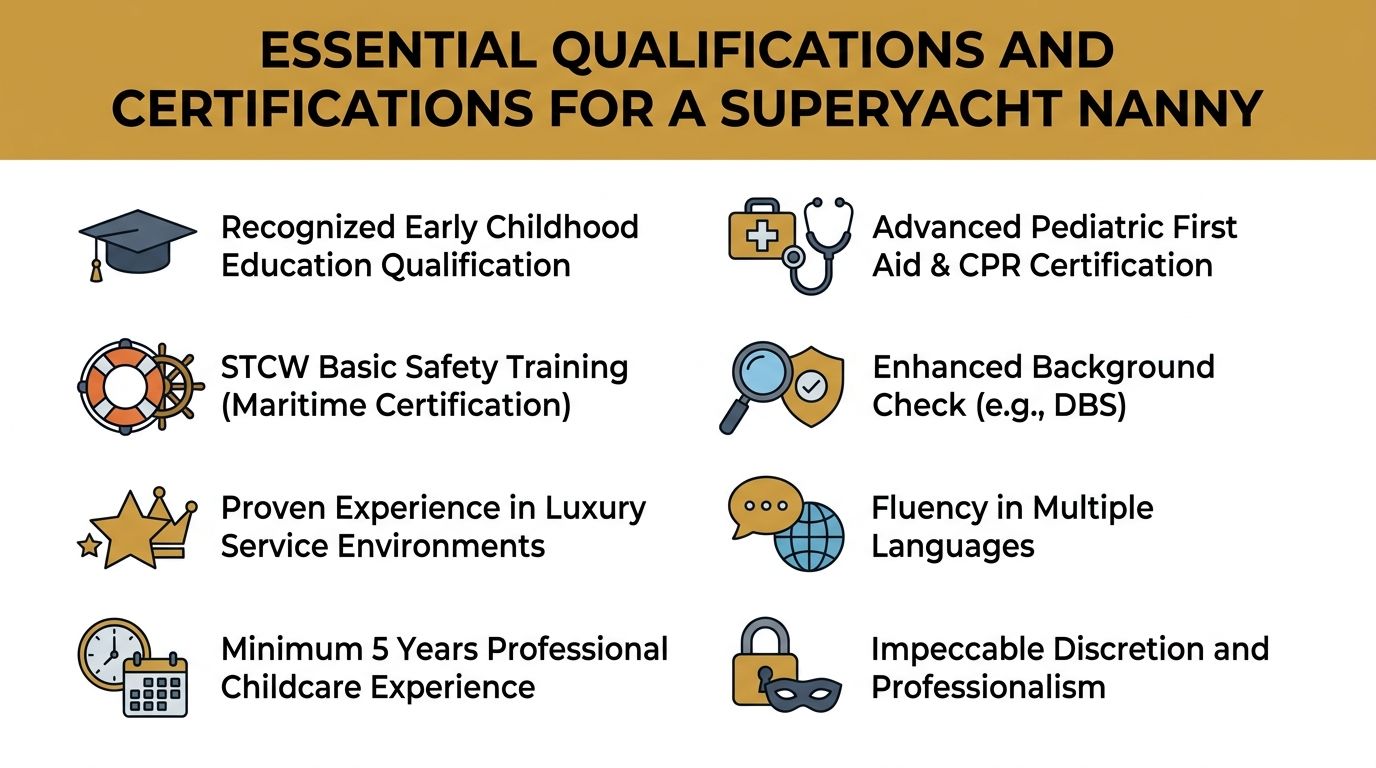
Strong instinct with children matters, but on a yacht, instinct must sit on top of verified competence. The role demands two separate forms of credibility. First, childcare excellence. Second, maritime compliance. Families who only assess one side usually miss the candidate's real suitability.
Childcare excellence
At the childcare level, families should look for formal training, relevant age-group experience, and references that describe calm judgement, consistency, and discretion. Higher-end profiles often include qualifications such as a Norland College background or CACHE diploma. In the yacht market, candidates with those credentials are typically valued because they bring structure and polish to a setting where routines can easily unravel, as reflected in marine industry hiring notes from Yotspot's yacht nanny overview.
A valid Paediatric First Aid certificate is a baseline requirement, not a bonus. At sea, medical support isn't immediately available, and emergency response may depend on what the nanny can do in the first critical moments, as outlined in Nannytax's guidance on superyacht and travel nanny qualifications.
Useful indicators when assessing childcare strength include:
- Age-range fit: Infant experience and teenage confidence are very different skill sets.
- Travel readiness: Some excellent home nannies struggle once routine and location shift constantly.
- Reference quality: Detailed references matter more than polished CV wording.
Maritime compliance
A land-based nanny can begin work with childcare credentials alone. A yacht nanny cannot.
In the UK maritime sector, a superyacht nanny must hold an ENG1 Medical Certificate issued by a UK-Approved Examiner (MCA-approved) and STCW Basic Safety Training, which includes personal survival techniques, fire prevention, and basic first aid, as these are non-negotiable maritime certifications distinct from land-based childcare roles, according to Lumiere Placements' yacht nanny guide.
That single fact changes the hiring lens. ENG1 confirms medical fitness for sea duty. STCW confirms the candidate can function within emergency protocols on board. Without them, a candidate may be a brilliant nanny and still not be suitable for a yacht placement.
The difference between impressive and appointable
A candidate becomes appointable when the paperwork, references, and experience all align. Families should verify:
- Certification validity: Dates, issuing bodies, and renewals.
- Luxury-service maturity: Not every nanny is comfortable in a guest-facing environment.
- Physical suitability: Swimming competence and comfort at sea matter in practical terms.
- Professional discretion: Families don't need performative personality. They need judgement.
The strongest candidates combine educational insight, genuine childcare skill, and the discipline to work as part of a vessel's operating system.
A Day in the Life Responsibilities and Realities
At 7:00 a.m., the yacht is due to anchor off Capri by lunch, one child has slept badly, another wants to swim before breakfast, and the parents have added guests for dinner. The nanny still needs to keep the day calm, safe, and developmentally sound while working inside a vessel that runs on timing, hierarchy, and changing sea conditions. That is the job in its real form.
The routine can look polished from the outside. In practice, it is constant adjustment. Breakfast, dressing, sun protection, educational time, rest periods, tender movements, and meal timing all have to be recalibrated around weather, itinerary changes, guest plans, and the children's energy.
What the job includes in real terms
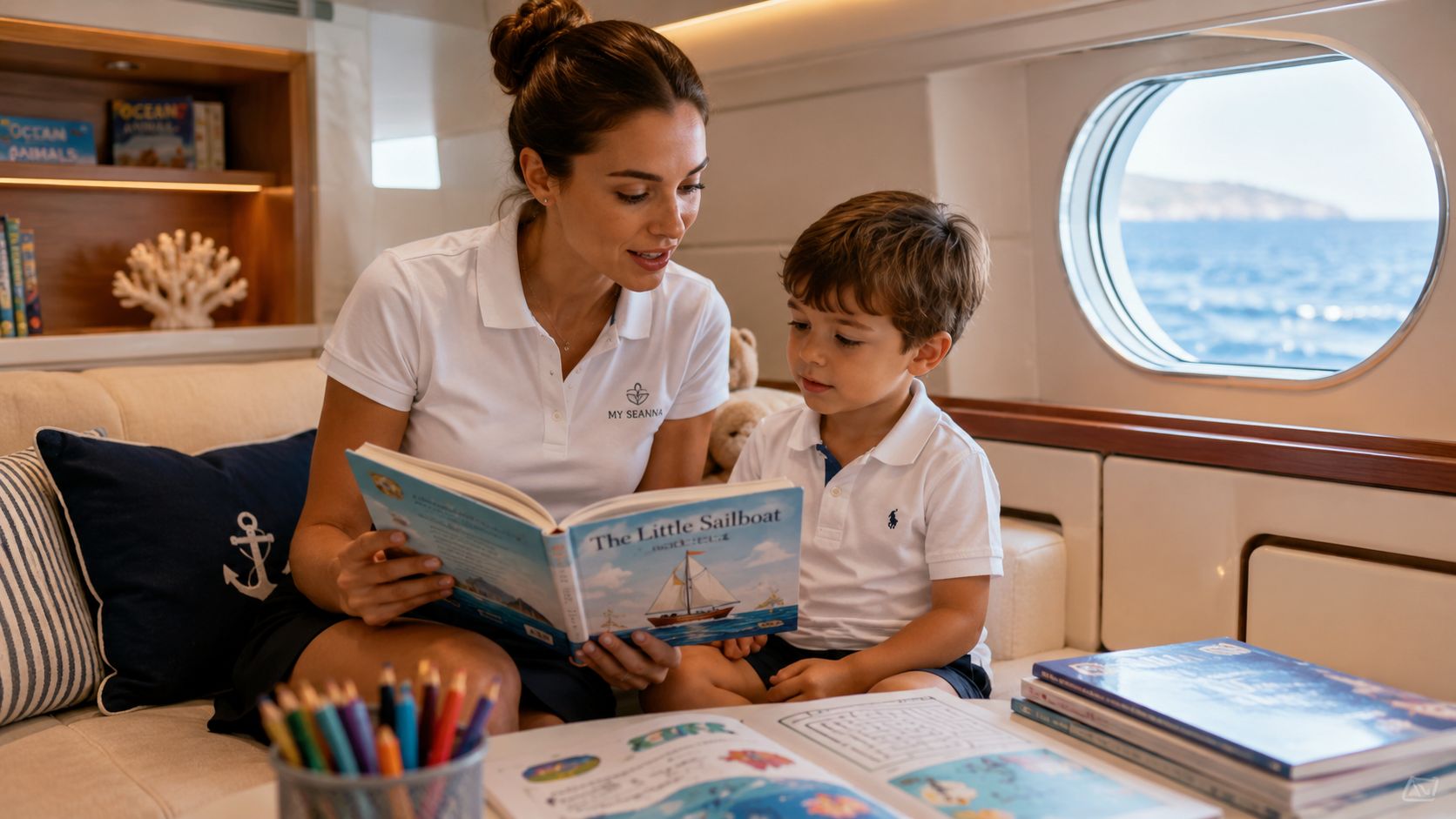
A strong superyacht nanny handles far more than playtime and bedtime. The role sits at the intersection of private childcare, hospitality awareness, and maritime discipline.
- Routine management: Meals, bathing, dressing, naps, bedtime, and the many transitions that can unsettle children on board.
- Activity planning: Quiet cabin-based play, reading, crafts, tutoring support, and shore-based outings that fit the child's age and the day's logistics.
- Crew coordination: Working with the chef on children's meals, with deck crew on swim stops and tender safety, and with interior on timing, laundry, and use of shared spaces.
- Environmental control: Keeping cabins orderly, toys contained, spare clothing ready, medications tracked, and child-specific items where they are needed fast.
- Behaviour and mood regulation: Spotting overstimulation early, protecting rest windows, and preventing a minor wobble from becoming a public meltdown during guest service.
Families who already use mobile childcare often recognise parts of this skill set from elite travel nanny placements for international families. The yacht setting adds tighter physical constraints, higher visibility, and a sharper safety culture.
The hybrid role many candidates underestimate
Many candidates still approach yacht work as if it were a travelling nanny post with a better view. It is more exacting than that.
On some vessels, the brief is pure childcare while the family is on board. On others, the nanny is expected to assist with child-related laundry, cabin resets, toy organisation, or light interior support during quieter periods. The sensible approach is to define that split before embarkation, in writing, with examples. Ambiguity causes more failed placements than workload alone.
The trade-off is straightforward. Families gain flexibility. Candidates give up some of the clean role boundaries they may be used to in a land-based household. The right hire is not the person who agrees to everything in interview. It is the person who understands the line between reasonable support and role drift, and can work professionally within it.
The emotional reality at sea
Mental resilience matters as much as childcare experience. A yacht compresses work, living space, hierarchy, and family dynamics into one environment. There is little privacy, children can become dysregulated quickly, and even an excellent schedule can be overturned by weather, customs clearance, a late departure, or parental spontaneity.
That pressure shows up in small moments first.
A child refuses lunch after a rough crossing. Parents want the children guest-ready in an hour. Crew are turning the yacht around for watersports. The nanny has to stay measured, kind, and operationally aware at the same time. In hiring, this is why agencies and principals should examine judgement, self-regulation, and communication style with the same seriousness as formal experience. This comprehensive guide to soft skills assessment is useful on that point because it breaks down how interpersonal strengths can be assessed in a more structured way.
Resilience is also a retention issue. A candidate may be polished, articulate, and excellent with children in a six-bedroom residence, then struggle after two weeks of shared crew space, split shifts, and constant visibility. The best yacht nannies know how to protect a child's routine while managing their own stamina, boundaries, and discretion.
The part families often overlook
The workday does not end when the children are asleep. There may be toy resets, clothing prep for the next port, coordination with the chef for an early breakfast, or quiet planning around a family excursion. Then there are the less glamorous realities that rarely appear in social media portrayals of yacht life. Fatigue accumulates. Privacy is limited. Jurisdiction, working location, and time on board can also create legal and tax grey areas that need to be addressed properly in the contract rather than left to assumption.
That is why the role demands dual expertise. The nanny must bring polished childcare judgement and function as a reliable onboard professional. Families who understand that distinction hire better. Candidates who respect it tend to last.
The Hiring Process Vetting for Excellence and Trust
When families hire for a yacht, they aren't filling a casual support role. They're managing risk. The right process screens for childcare judgement, maritime readiness, discretion, and crew compatibility long before embarkation.
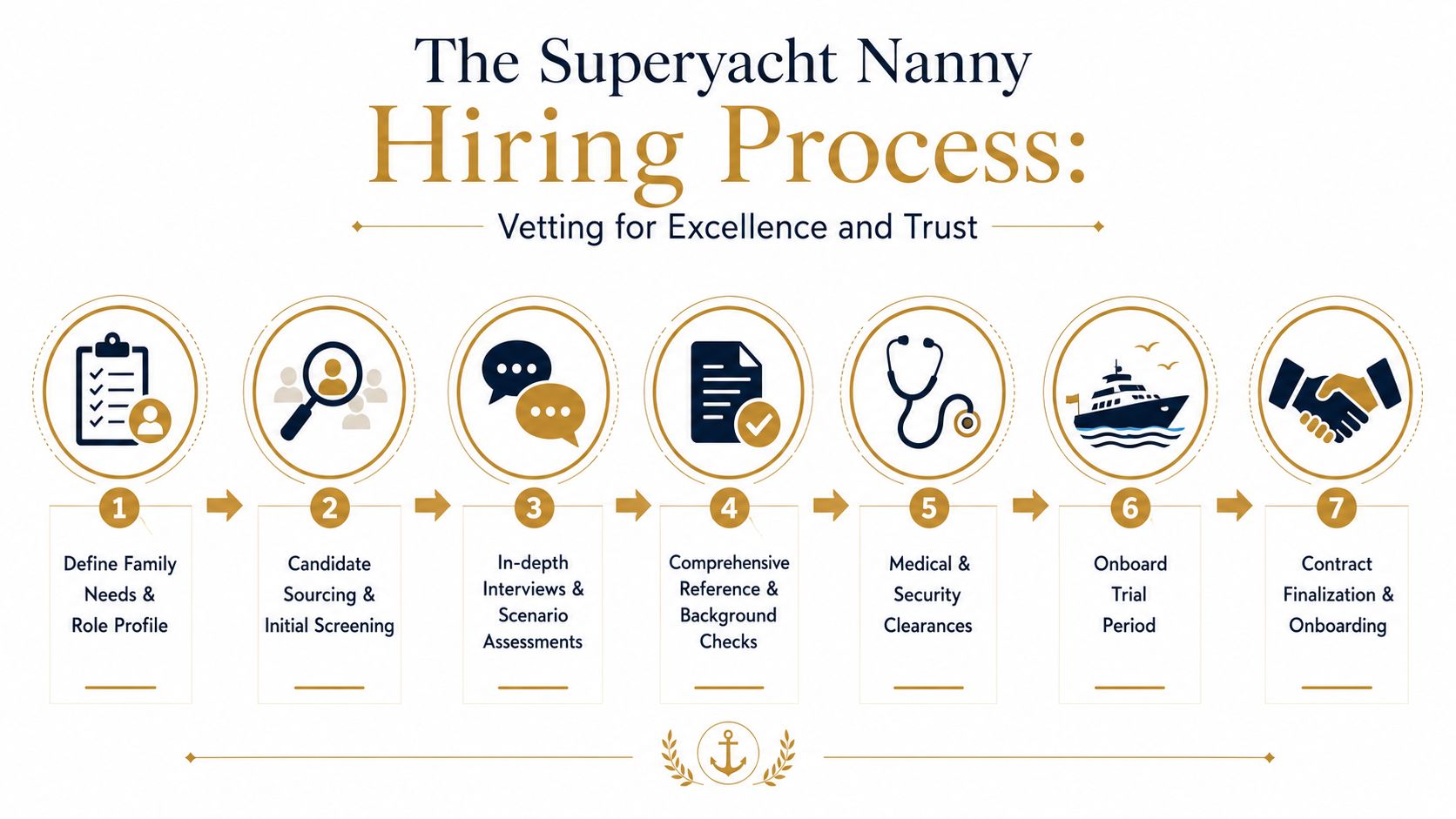
The most reliable hires come from a staged process, not a single persuasive interview.
The sequence that works
Define the brief properly
Separate nice-to-haves from essential requirements. Ages of children, educational expectations, reporting line, guest interaction, and any hybrid interior duties should all be written down before sourcing starts.Screen documents with discipline
CVs should be checked against certifications, references, chronology, and actual sea-readiness. If a candidate's profile sounds right but the paperwork is incomplete, pause there.Interview for judgement, not charm
Good questions are situational. Ask how the candidate would manage a missed nap before a formal dinner, a nervous child on a tender, or conflict between a parent request and onboard safety protocol.Check references in depth
Former employers should be asked how the candidate handled pressure, boundaries, privacy, and changing plans. Generic praise isn't enough.
Assessing soft skills without guessing
A superyacht nanny needs composure, adaptability, emotional regulation, and professional judgement. Those traits are harder to measure than certificates, but they can be assessed systematically. Families who want a clearer framework for interview evaluation may find this comprehensive guide to soft skills assessment useful when designing scenario questions and scoring responses.
For international households, security and background work should be equally thorough. A practical starting point is a specialist process for international nanny background checks, especially when a role involves travel across jurisdictions.
Why trials matter
A trial tells you what interviews can't. You see whether the nanny reads the room, speaks to crew respectfully, spots hazards without dramatics, and keeps children settled while adults are distracted.
A polished interview can secure interest. Only a trial reveals whether the candidate can live the role.
Families often focus on whether the child likes the nanny. That matters, but it's only one test. The stronger question is whether the nanny can operate calmly within the family's standards and the yacht's operational rhythm.
Contracts and Compensation Setting Professional Standards
A superyacht nanny contract has to do two jobs at once. It must protect the child's routine and wellbeing, and it must reflect that the nanny is working inside a regulated maritime environment with unusual hours, limited privacy, and cross-border exposure.
Families often focus on salary first. Sensible families focus on scope first, then price the role properly. If the brief includes sole-charge care, swimming supervision, travel packing, schedule changes around guest use, and standby availability during charters, the compensation should reflect that reality.
Current UK market guidance places superyacht nanny pay at £800 to £1,300 gross per week, with higher packages for candidates who bring strong yacht experience, respected childcare references, and the right onboard certifications, according to Harmony at Home's super-yacht nanny salary overview. In practice, title alone means very little. A dedicated nanny, a nanny-governess, and a nanny-stew hybrid should not be paid as if they are doing the same job.
What the contract needs to cover
A vague agreement creates problems quickly on a yacht. Space is tight, routines change fast, and assumptions about availability tend to grow unless the document sets boundaries clearly. Families who want a plain-language legal primer before drafting role-specific terms can review this definition of a contract.
A well-drafted agreement should address:
- Duties in detail: childcare, educational support, bedtime cover, travel preparation, toy and wardrobe management, and any agreed crossover with interior duties
- Hours and standby periods: what counts as working time, what counts as overnight cover, and how rest periods are protected
- Cabin arrangements: whether the nanny shares with a child, has separate accommodation, and how privacy is handled during guest trips
- Rotation and leave: whether the role is seasonal, full-time live-in, rotational, or charter-based
- Confidentiality and media restrictions: NDAs, photography rules, social media limits, and guest privacy
- Travel and repositioning terms: who pays, what happens between itineraries, and whether the nanny remains on payroll during non-charter periods
- Medical and safety expectations: sea sickness history, medication disclosure where appropriate, emergency procedures, and fitness to work onboard
One clause matters more than families sometimes expect. “On call” needs a definition. Without one, a nanny can end up technically off duty and practically unavailable to rest.
Compensation is about load, not image
The market still treats some yacht nanny roles as glamorous childcare with a travel perk. Serious families and serious candidates know better. This is skilled work carried out in a confined setting where the child may be tired, overstimulated, out of routine, surrounded by water, and waking in a different port every few days.
That combination changes the pay discussion.
Candidates are being hired for childcare judgement, but also for maritime readiness, emotional steadiness, and the ability to stay professional when plans change at short notice. If the role also expects support to the interior team, language tutoring, proxy parenting during late guest evenings, or long seasonal stretches without meaningful personal time, the package should reflect the cumulative load.
The grey areas that deserve direct discussion
Tax is one of the least understood parts of yacht employment. Families sometimes assume that offshore work or multi-country itineraries remove normal obligations. Candidates sometimes assume the same. Both assumptions can be expensive.
The position of a superyacht nanny can sit in a legal and tax grey area when work crosses jurisdictions, especially if the yacht's flag state, the employer's residence, the nanny's residence, and the cruising area all differ, as discussed in this review of superyacht nanny tax ambiguity. That is why contracts should be reviewed alongside payroll, immigration, and tax advice before the nanny joins, not after a season is underway.
Insurance deserves the same level of care. Families reviewing insurance arrangements for household staff usually find the same principle applies onboard. If responsibility, liability, and reporting lines are poorly defined, risk increases fast for everyone involved.
The strongest contracts do not try to cover every hypothetical conflict. They define the job accurately, set boundaries clearly, and price the role according to what the nanny is being asked to carry.
Your Partner in Maritime Childcare and FAQs
The call often comes after a difficult season. A family has hired an excellent nanny who struggled with crew hierarchy, cabin life, or the pace of constant itinerary changes. Or a yacht-ready candidate has joined a role that was presented as childcare and turned out to include broad interior support with little structure around hours, authority, or rest. In this market, the right fit depends on more than warmth with children or confidence at sea. It depends on whether both sides understand that this is a dual-discipline post with little room for ambiguity.
Families get the best results when the brief reflects the actual onboard environment. Candidates perform best when they assess the role with the same discipline they would bring to any high-trust private position. That means testing for judgement under pressure, mental resilience during long periods of proximity, and a clear grasp of where childcare ends and yacht service begins. It also means discussing jurisdiction, payroll, and reporting lines early, because those issues are rarely simple once a yacht is moving between countries.
Frequently asked questions
Do superyacht nannies also help with housekeeping
Sometimes. On some yachts, the post is fully dedicated to the children. On others, the nanny may support the interior team when the children are off schedule, ashore, or travelling separately.
The point to settle before hire is scope. A dedicated nanny, nanny-governess, and nanny-stew hybrid are different jobs. Each calls for a different background, different compensation, and different expectations around authority, presentation, and daily flow with the crew.
What qualifications matter most for a first yacht role
Families usually prioritise strong childcare references, current Paediatric First Aid, and the maritime certificates needed for legal onboard work. Beyond paperwork, I look for candidates who understand how safety culture changes behaviour at sea. A very capable land-based nanny can still find yacht protocol unfamiliar if she has never worked inside a command structure where timing, discretion, and emergency readiness are part of the day.
Is previous yachting experience always required
No, but it reduces risk if the role is complex. Candidates from rota childcare, travelling UHNW households, or fully staffed residences often transition well because they already understand confidentiality, stamina, and professional boundaries in close quarters.
What matters is practical suitability. Can the candidate live compactly, remain composed when plans change at short notice, and work respectfully within a crew operation rather than beside it. Those questions usually matter more than whether the CV already includes a yacht name.
What makes a candidate stand out to UHNW families
Discretion, calm judgement, polished communication, and genuine adaptability. Strong candidates bring structure to the children without creating friction around the parents, guests, or crew. They read a room well, protect routines where possible, and know when flexibility serves the family better than rigid adherence to a plan.
They also have emotional steadiness. That quality is often overlooked in interviews and felt immediately on board.
Can a superyacht nanny build a long-term career
Yes, if the early placements are chosen carefully. Some candidates stay within yacht childcare and build highly specialised careers. Others move into governess posts, travelling family roles, estate-based positions, or wider household management after gaining credibility in demanding mobile environments.
The role can open strong doors, but only when the contract, legal position, and daily remit are handled properly from the outset. Glamour attracts attention. Longevity comes from sound placement decisions.
If you're hiring a superyacht nanny or exploring whether your profile is right for this level of role, Superstar Nannies offers confidential consultation for families and candidates handling specialist childcare placements across the UK and internationally.