

Your driver knows where your children go to school, when the house is empty, which entrance your family uses, and how your day changes under pressure. That isn't a routine hire. It's a security appointment with wheels attached.
Many families start by thinking they need someone safe, polished, and punctual. They do. But they also need someone who won't overshare, won't improvise around protocol, and won't mistake proximity for trust. If you're hiring a private chauffeur, the right process matters just as much as the right person. An agency for driver recruitment should be judged on one thing above all else: how well it protects your household from avoidable risk.
Why an Agency for Driver Recruitment is Non-Negotiable
A direct hire looks simple until it doesn't. A candidate arrives well presented, speaks confidently, and has worked around wealth before. Then the cracks appear. References are vague. Identity checks were never handled properly. The candidate is polished in interview but careless with routine. He mentions former principals by name. He asks too many questions about travel plans.
That's the point where experienced households stop treating chauffeur recruitment like standard domestic hiring.
A private driver has unusual access. They learn your routes, your timings, your habits, your children's preferences, your vehicle movements, and your tolerance for delay. A weak hire can create reputational exposure, safeguarding concerns, insurance headaches, and household tension very quickly. The problem isn't just bad driving. It's misplaced familiarity, poor judgement, and preventable disclosure.
Why top households use specialist agencies
In high-end domestic staffing, this isn't a fringe view. The luxury household staffing market was valued at $1.8 billion in 2025, and recruitment agencies held a 55.3% revenue share, which shows that specialist agencies are the primary channel for vetted private staff in this market, according to Dataintelo's luxury household staffing market analysis.
That aligns with what seasoned principals already know. The best candidates are rarely found through casual advertising. They're introduced through discreet, structured networks with proper screening standards.
Practical rule: If a driver will have regular contact with your children, residences, or travel schedule, treat recruitment as part of your household security plan.
A proper agency also removes a common blind spot. Families often assess warmth and polish well. They're less equipped to assess compliance, document integrity, conflicting employment histories, and behavioural warning signs. Good recruitment practice depends on process discipline, which is why broader staffing guidance like GM GROUP Services' hiring advice remains useful even outside the household sector.
For a clearer view of how specialist domestic search works, review this guide to private household staff agencies in the UK. The standard is straightforward. For a role this sensitive, DIY hiring is false economy.
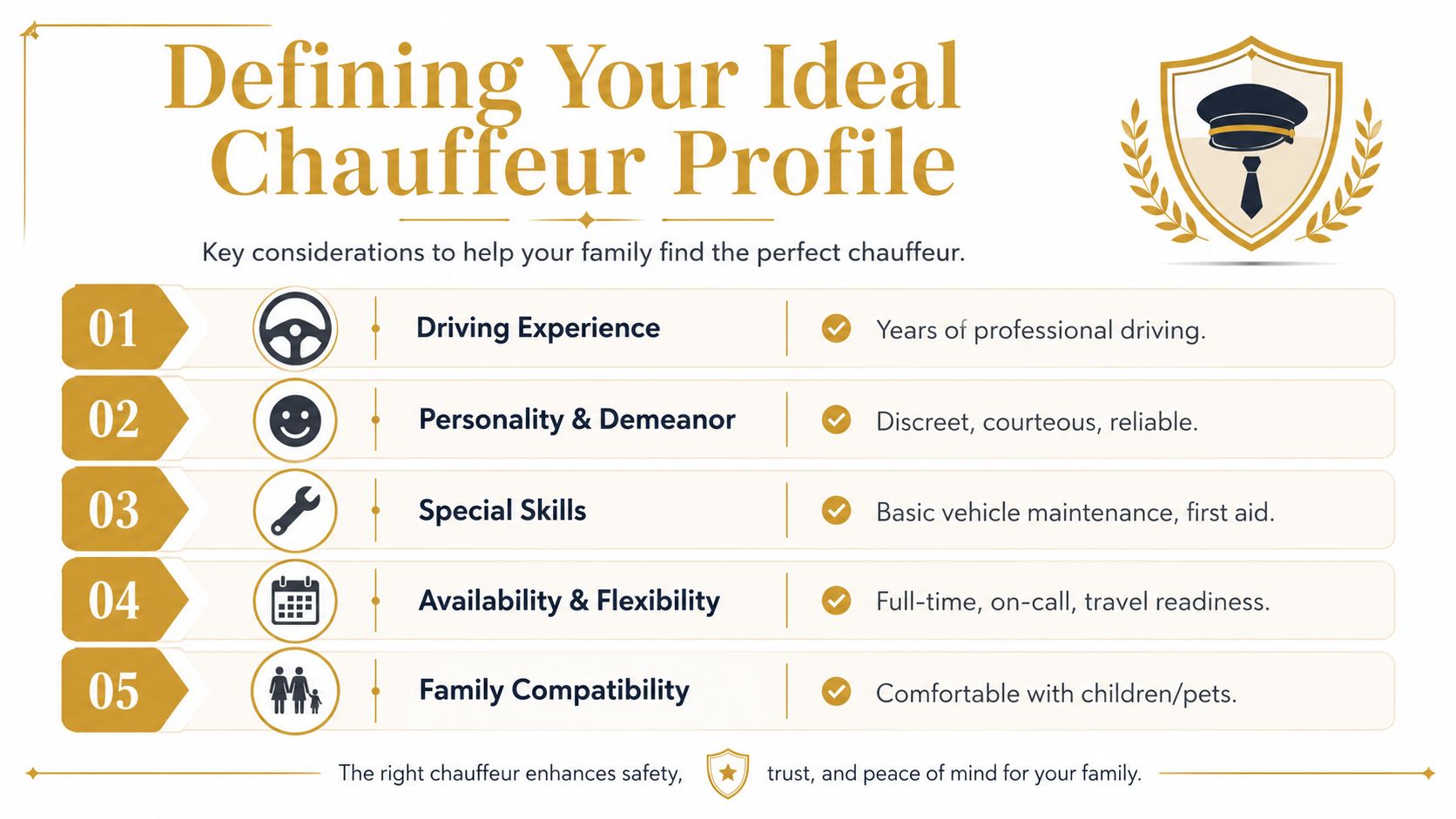
Defining Your Ideal Chauffeur Profile
Most families start with the wrong brief. They ask for “an experienced chauffeur” and stop there. That's too broad to be useful and too vague to produce a long-term fit.
A serious search begins with operational detail. Are you hiring a classic London-based chauffeur for school runs, airport transfers, and evening engagements? Or do you need someone who can pivot between child-facing duties, security-aware driving, discreet waiting, and international travel logistics? Those are different roles and they attract different candidates.
Build the brief around your real life
A proper chauffeur profile should answer practical questions, not aesthetic ones.
- Household pattern: Is your schedule fixed, or does it change daily with events, travel, and security adjustments?
- Service model: Do you need full-time cover, or would a rota arrangement fit better when family movements fluctuate?
- Residential setup: Is the role live-in, live-out, or split between multiple properties?
- Passenger profile: Will the driver work around children, pets, guests, household staff, or elderly relatives?
- Travel demands: Does the role require airport readiness, international flexibility, or familiarity with cross-border itineraries?
The staffing market supports this kind of flexible design. Data from the staffing industry shows that 64% of agency staff are placed to fill specific or fluctuating needs, which is highly relevant for households that need rota cover or travel-ready chauffeur support, according to the American Staffing Association's industry statistics.
Details that change the quality of the shortlist
The strongest briefs usually include one or more specialist requirements that families forget to state at the outset.
| Requirement | Why it matters |
|---|---|
| Bilingual capability | Helps with travel, international schools, overseas residences, and visiting principals |
| Motor-pool experience | Useful if you maintain multiple luxury vehicles and expect upkeep coordination |
| Child-friendly demeanour | Essential if the driver will handle school collections or accompany family outings |
| Event discretion | Important for households attending public functions, launches, or press-heavy environments |
| Flexibility outside standard hours | Necessary if your diary changes at short notice |
Some families also want a driver who presents at the level of a traditional chauffeur but can think like a modern household professional. That means communication discipline, comfort around principals and staff, and zero appetite for gossip.
A polished CV doesn't tell you whether someone can sit outside a private clinic, a school gate, or a high-profile event and behave with total restraint.
If you want a sense of how professional driving roles are framed from the candidate side, even a public-facing recruitment page like join our luxury driving team can help you see how service expectations are often positioned. For a household-focused benchmark, explore personal driver placements in London.
Write the brief as if you're hiring for confidentiality first and transport second. That will improve every decision that follows.
The Critical Vetting and Background Check Process
Your driver will know where your children are at 8:15 a.m., which entrance your family uses when avoiding attention, and when the house is empty. Treat this hire as a security appointment with driving duties attached.
A private chauffeur has unusual visibility into a family's life. They see patterns, overhear calls, handle last-minute schedule changes, and learn which routines never make it into writing. Poor vetting creates exposure fast. One careless hire can compromise privacy, household security, and the confidence your family should feel every time a car door closes.
Checks that should never be skipped
A serious agency verifies far more than whether someone can present well and handle a luxury vehicle. The baseline should include:
- Licence status: A current UK driving licence, plus any role-specific licensing if the post requires it.
- Right to work and identity: Original documents checked carefully and matched to the individual in person.
- Driving record: Endorsements, collisions, claims history where relevant, and any pattern of poor judgement.
- Criminal screening: Enhanced DBS where the household setup and duties call for it.
- Career chronology: Every role, every gap, and every departure explained clearly.
- References: Direct verbal references from former employers, estates, family offices, or chiefs of staff. Not recycled testimonials supplied by the candidate.
That is only the starting point.
For an elite household, I also want to know how the candidate handled confidential school collections, medical appointments, airport transfers under scrutiny, property access, vehicle logs, and changes to route or destination communicated at the last minute. A polished applicant can pass standard checks and still be wrong for a family that needs restraint, judgement, and total control of information.
Face-to-face assessment is required
If an agency is willing to place a chauffeur without meeting them properly, walk away.
The in-person interview is where identity, presentation, judgement, and consistency come into focus. It lets the recruiter compare documents to the person in front of them, test the accuracy of the candidate's timeline, and assess how they speak about past principals. Driving for Better Business guidance on agency driver standards also stresses the importance of proper screening and document checks for agency drivers.
I pay close attention to how a driver answers questions about privacy. Loose language is a warning sign. So is unnecessary name-dropping, overfamiliarity, or any hint that they enjoyed proximity to status more than responsibility.
Meet the driver before they come anywhere near your family, your residence, or your diary.
What high-level chauffeur vetting looks like
The best vetting process tests behaviour, not just paperwork. Superstar Nannies does this well because household placements demand more than compliance. They demand judgement under pressure, discretion without supervision, and loyalty that holds after the novelty of the role wears off.
That means probing for specifics. Which principals did they drive, and in what environment? Who managed them day to day? What information were they trusted with? How did they handle waiting time outside clinics, schools, hotels, and events where photographers or onlookers were present? What happened when plans changed abruptly or a family member asked for something outside protocol?
Background screening still matters, and Paradigm International's background check insights offer a useful general benchmark. Private household recruitment requires a tighter standard because the risk is personal, not corporate. For a clearer picture of that level of due diligence, review Superstar Nannies' guide to an uncompromising household vetting process.
The question is simple. Can this person be trusted with your movements, your children, your address book, and your silence. If you do not know the answer, the search is not ready to move.
Understanding Contracts Confidentiality and Fees
A private chauffeur can expose a family faster than almost any other household employee. They know where you live, where your children study, which entrance you use at the clinic, when the house is empty, and who travels with you. If those risks are not controlled in writing, you are relying on personality instead of protection.
A proper contract sets the standard from day one. It should define hours, overtime, standby expectations, travel days, vehicle care, dress, reporting lines, authorised passengers, expense handling, phone use, and what must be recorded after each shift. It should also spell out boundaries. No unauthorised detours, no discussing household matters with other staff, no posting identifiable details online, and no informal sharing of routines with suppliers, friends, or former employers.

Why confidentiality belongs in writing
Confidentiality is not a courtesy in a chauffeur role. It is a security control.
Your driver hears calls, sees access patterns, learns school pickup timings, recognises family friends, and can map your life within a week. A verbal instruction to “be discreet” is useless. The driver needs a detailed NDA drafted for private household risk, not a generic employment template. It should cover children's identities, photographs, addresses, routines, guest names, travel plans, medical appointments, financial exposure, social media restrictions, contact with press, and the driver's duties after employment ends. For a stronger benchmark, read this guide to private staff non-disclosure agreements for UHNW families.
The breach that causes the most damage is usually ordinary. A comment to a mechanic. A remark to a partner. A story told to another driver while waiting outside a venue. Elite families need contracts that anticipate those moments and agencies that know how to close those gaps before a placement starts. That is where a specialist household agency earns its fee.
What agency fees are actually buying
A serious agency fee covers risk reduction, not just introductions. You are paying for role definition, candidate filtration, confidentiality drafting, offer management, trial structure, and clear terms that protect the family if the fit is wrong.
That matters more in private driving than in many other hires because the access is so broad. Superstar Nannies approaches chauffeur placements with the same discretion used for high-trust household roles. The agency aligns the brief, pressure-tests expectations, and helps structure contracts around the realities of your family rather than using a one-size-fits-all template.
Cheap recruitment usually cuts corners in one of three places. Screening, matching, or post-placement support. In a chauffeur hire, each shortcut creates avoidable exposure. Save money on the wrong part of the process and you may pay for it in privacy loss, staff turnover, or a security failure that should never have been allowed near your family.
Interviewing Candidates and Conducting a Trial
A chauffeur interview should test restraint, judgement, and service instincts. If you spend the whole meeting talking about routes and parking, you'll miss what matters.
The strongest candidates answer calmly, don't overtalk, and understand hierarchy without becoming stiff. They know when to speak, when to wait, and when to document rather than improvise. You want confidence without ego.
Questions worth asking
Generic interview questions produce rehearsed answers. Use situational prompts instead.
A journalist approaches you while you're waiting outside a private event. What do you do?
You're looking for boundary control, not bravado.A child leaves a school bag in the car and a parent is unreachable for ten minutes. How do you handle it?
This tests safeguarding instincts and communication discipline.Your principal asks for a change of route while another staff member gives conflicting instructions. What happens next?
This reveals how the candidate handles chain of command.You overhear confidential information during a journey. How do you treat it?
The right answer should be simple and instinctive.A vehicle warning light appears before a formal engagement. What's your response?
You want caution, procedure, and composure.
What to watch during the interview
Listen for more than the answer itself.
- Over-familiarity: A candidate who slips too quickly into first-name ease may struggle with professional distance.
- Name-dropping: Mentioning former principals carelessly is a serious warning sign.
- Deflection: If a candidate can't explain role changes clearly, probe harder.
- Status obsession: Good chauffeurs serve with pride. They don't chase reflected glamour.
A strong interviewer also asks about waiting behaviour. Much of the role involves being present but unobtrusive. Some candidates drive beautifully and wait badly. That matters.
Ask yourself one blunt question after the meeting. Would I trust this person to know my routine and never discuss it?
Why a paid trial matters
A polished interview can still hide a poor fit. A paid trial shows you how the candidate works in motion.
Use the trial to observe:
- Punctuality and readiness
- Vehicle presentation
- Driving style with family on board
- Comfort around children, staff, and changing plans
- Response to delays, security instructions, and downtime
A proper trial should include at least one ordinary family movement, one wait period, and one schedule change. That gives you a realistic view of conduct under pressure. Watch whether the driver asks sensible questions, follows household protocol, and maintains the same level of discretion at the end of a long day as at the start.
Onboarding Your Driver and Identifying Red Flags
A good hire can still fail with poor onboarding. Private drivers need precise household context from day one.
Start with a structured handover. Introduce every vehicle, access rule, parking arrangement, charging or fuelling routine, maintenance expectation, and cleaning standard. Review school collections, preferred routes, gate protocols, staff reporting lines, emergency contacts, and family-specific privacy rules.
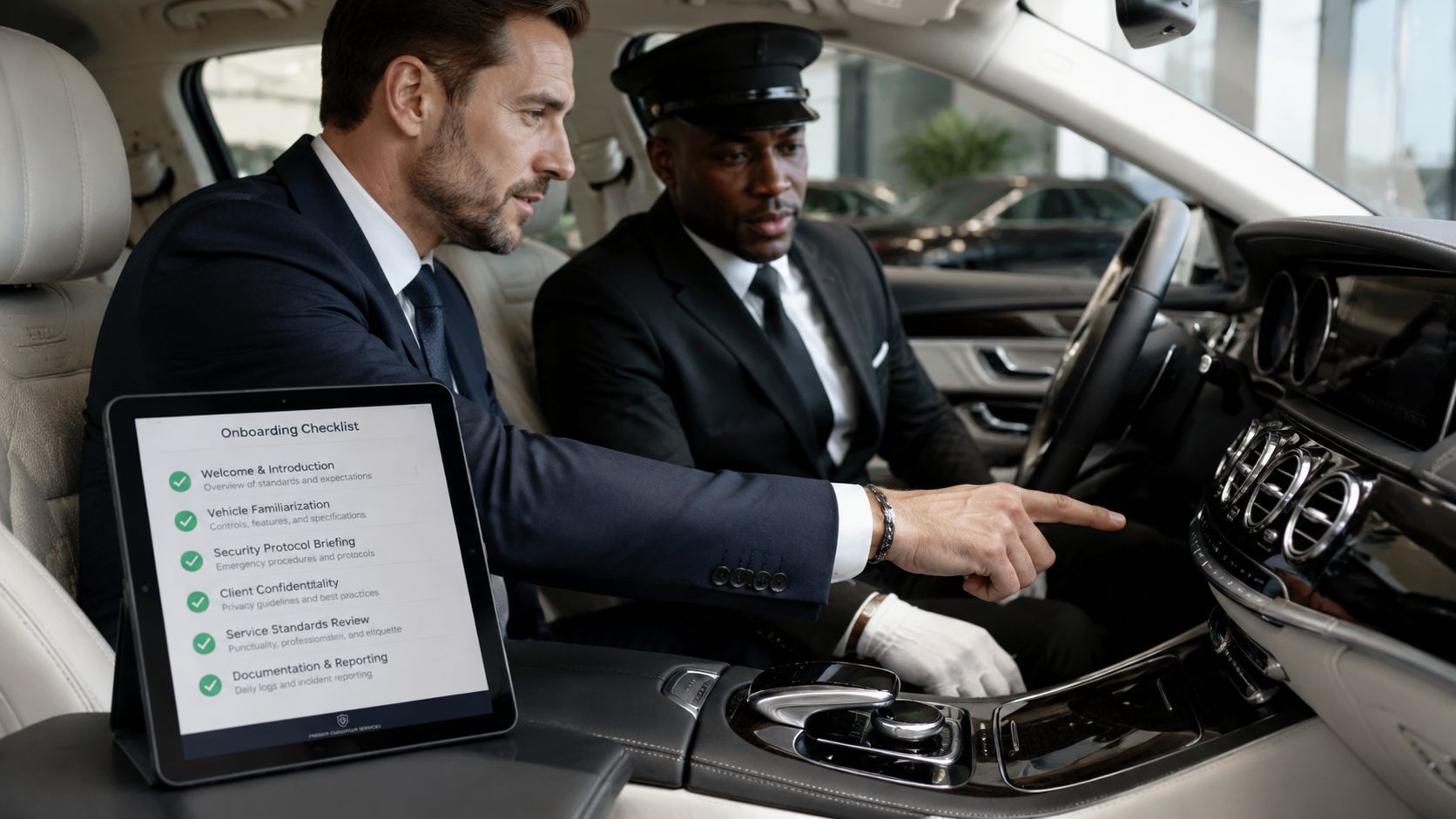
Early onboarding checklist
- Vehicle familiarisation: Every car has different systems, dimensions, and care requirements.
- Household protocol: Clarify entrances, waiting areas, staff hierarchy, and visitor rules.
- Communication style: Specify how updates should be sent and when escalation is required.
- Confidentiality reminders: Reiterate privacy standards in practical terms, not legal jargon.
Then watch the first months closely. The red flags are usually subtle.
| Red flag | Why it matters |
|---|---|
| Consistent lateness by small margins | Suggests weak discipline |
| Over-chatting with household staff | Often precedes information leakage |
| Unasked-for opinions about family logistics | Can become boundary creep |
| Casual handling of phone calls or messages | Signals poor confidentiality habits |
| Too much familiarity with children | Professional warmth should still have limits |
Correct small problems early. A chauffeur role depends on trust, and trust is built through repeated discipline.
Your Partner in Household Excellence
A private chauffeur sees more than your calendar. They see where your children go, when the house is empty, which entrance you use, who you meet, and how your family moves under pressure. That access demands a specialist agency for driver recruitment with the judgment to assess character, discretion, and risk, not just driving ability.
The right agency protects the household on two fronts. First, it filters out candidates who should never get near a family with a public profile, valuable assets, or a sensitive routine. Second, it builds the legal and practical framework that keeps boundaries clear once the driver is hired. That includes confidentiality terms that match the realities of the role, careful handling of references, and a search process customized for the family rather than a recycled shortlist.
Superstar Nannies approaches chauffeur recruitment with the same discretion expected in any high-trust household appointment. For principals who take privacy seriously, that standard is not a luxury. It is the baseline.
Frequently Asked Questions
How long does it take to hire a private chauffeur?
A clean brief shortens the search. A vague one creates risk.
If you need a driver for straightforward daily use, a search can conclude relatively quickly. If the role involves children, multiple residences, international travel, close protection awareness, or exposure to sensitive family routines, expect a longer process. That extra time is well spent. You are not filling a driving vacancy. You are giving someone repeated access to your family's movements, habits, and private conversations.
Should I hire a full-time chauffeur or a rota driver?
Choose the structure that protects service standards and driver judgement under pressure. A full-time chauffeur suits households with a stable weekly rhythm and one principal route pattern. A rota arrangement works better for long hours, frequent evening commitments, split residences, or households that need continuous cover without fatigue.
Security matters here too. An overtired driver makes poor decisions, misses details, and talks too much. The right staffing model reduces those risks.
Does a private chauffeur need childcare qualifications if children are passengers?
No. The driver's role is safe transport, sound judgement, and strict adherence to household protocol.
If children will be regular passengers, look for safeguarding awareness, calm authority, and proven professional boundaries. The driver should know who may collect a child, what to do if plans change mid-route, how to handle medical or school-related instructions, and when to call the principal instead of improvising. That standard matters more than a childcare label.
What should I check with my insurer before the driver starts?
Confirm that your insurer has approved the exact arrangement in writing. That includes employed or retained chauffeur use, named-driver requirements, high-value vehicles, school runs, overseas driving, and any regular transport of family members or staff.
Also check whether the policy covers substitute vehicles and temporary vehicle changes. Families often overlook that point until the principal car is unavailable. Fix it before day one.
What's the biggest mistake families make when hiring a driver?
They confuse polish with trustworthiness.
A refined manner, luxury marque experience, and good presentation do not tell you how someone handles confidential information, changing instructions, household politics, or idle time outside a school gate. The true test is discretion under routine conditions. Can the driver keep quiet, follow protocol, respect hierarchy, and avoid becoming overly familiar? That is what protects a family over time.
Why use a specialist agency instead of hiring directly?
Because direct hiring rarely uncovers the risks that matter most.
A private chauffeur can map your family's life within days. School routes, security habits, empty-house windows, travel patterns, preferred entrances, weekend routines. A specialist agency screens for the issues clients do not see in an interview. Character concerns, inconsistencies in employment history, weak confidentiality instincts, and references that sound polished but say very little. The right agency also puts proper contractual protections in place so discretion is enforceable, not assumed.
If privacy matters, specialist recruitment is the safer route.