


You're probably reading this after another broken night. The baby finally drifted off, you've opened three tabs, one forum says feed more, another says stop feeding to sleep, and a social post insists your child “should” already be sleeping through. None of that helps when you're exhausted and your judgement feels foggy.
An Infant Sleep Specialist can be useful, but only if you understand what that role should mean, how it differs from hands-on overnight care, and how to avoid unsafe advice in an unregulated market. The right support brings clarity. The wrong support can add confusion, guilt, or risk.
The 3 AM Search for a Solution to Sleepless Nights
At 3 AM, most parents aren't looking for theory. They're looking for something that works tonight.
That's why so many families end up in the same cycle. Baby wakes. Parent searches. Search results conflict. One article says wake windows are the answer. A video blames feeding habits. A comment thread says your baby is “overtired”. Another says “undertired”. By morning, you've consumed hours of advice and still have no clear plan.
That experience is common. A UK-based investigation into help-seeking for child sleep found that 47% of parents use general internet searches as their primary source of help for their child's sleep, which shows how heavily families rely on informal online advice instead of formal healthcare channels (UK parents' sleep help-seeking investigation).
Why online advice often feels so messy
Some sleep issues look simple from the outside but aren't simple in real life. A baby arching at bedtime, for example, might get labelled as “fighting sleep”, when parents may need to consider a wider set of common infant back arching reasons before assuming it's behavioural.
Then there's newborn settling. Many families search for one magic fix when what they really need is a calm, structured foundation. If you're still in those earliest weeks, practical guidance on how to settle a newborn can help you separate normal newborn behaviour from patterns that need closer attention.
Sleep advice only helps when it fits the baby in front of you, not the baby in someone else's comment section.
An Infant Sleep Specialist, at their best, offers that missing filter. Not more noise. A careful interpretation of your baby, your routine, your feeding pattern, your home, and your limits.
What an Infant Sleep Specialist Actually Does
An Infant Sleep Specialist isn't just someone who tells parents to put the baby down “drowsy but awake” and leave the room. That's a shallow version of the role, and often an unhelpful one.
A proper specialist works more like a family sleep coach with investigative skills. The job is to assess what's happening, rule out obvious mismatches in routine or environment, and help parents build a plan that is realistic, safe, and developmentally sensible.
The work is broader than sleep training
Sleep is connected to many moving parts:
- Feeding patterns often shape night waking, especially in younger babies
- Daytime rhythm can affect bedtime resistance, false starts, and early rising
- Sleep environment matters, including light, noise, temperature, and cot setup
- Developmental stage changes what is reasonable to expect
- Parental capacity matters because a plan that works on paper may fail in an exhausted household
That's why a good specialist doesn't start with a rigid method. They start with questions.
What a specialist should assess
In practice, families should expect an Infant Sleep Specialist to look at things like:
Current sleep pattern
Bedtime, naps, night wakes, early morning wakes, and how sleep begins.How the baby is soothed
Feeding, rocking, holding, dummy use, motion, contact naps, or repeated parental intervention.Family goals
Some parents want fewer wakes. Others want smoother bedtimes. Some need support without reducing responsiveness.Safety and age-appropriate expectations
Advice should fit the child's age, feeding needs, and overall wellbeing.
A specialist may also spot when sleep support alone isn't the answer. Sometimes the family needs a different type of newborn professional, especially in the earliest stage. In that case, understanding the role of a newborn care specialist can be more useful than forcing a sleep-focused solution too soon.
Clinical instinct matters: if advice ignores feeding, development, or parental wellbeing, it's probably too simplistic.
What works best is rarely dramatic. It's usually steady, customized, and boring in the best possible way.
The Spectrum of Sleep Support Explained
Parents often use several job titles as if they mean the same thing. They don't. Hiring the wrong type of support can leave you disappointed, even when the professional is competent in their own lane.
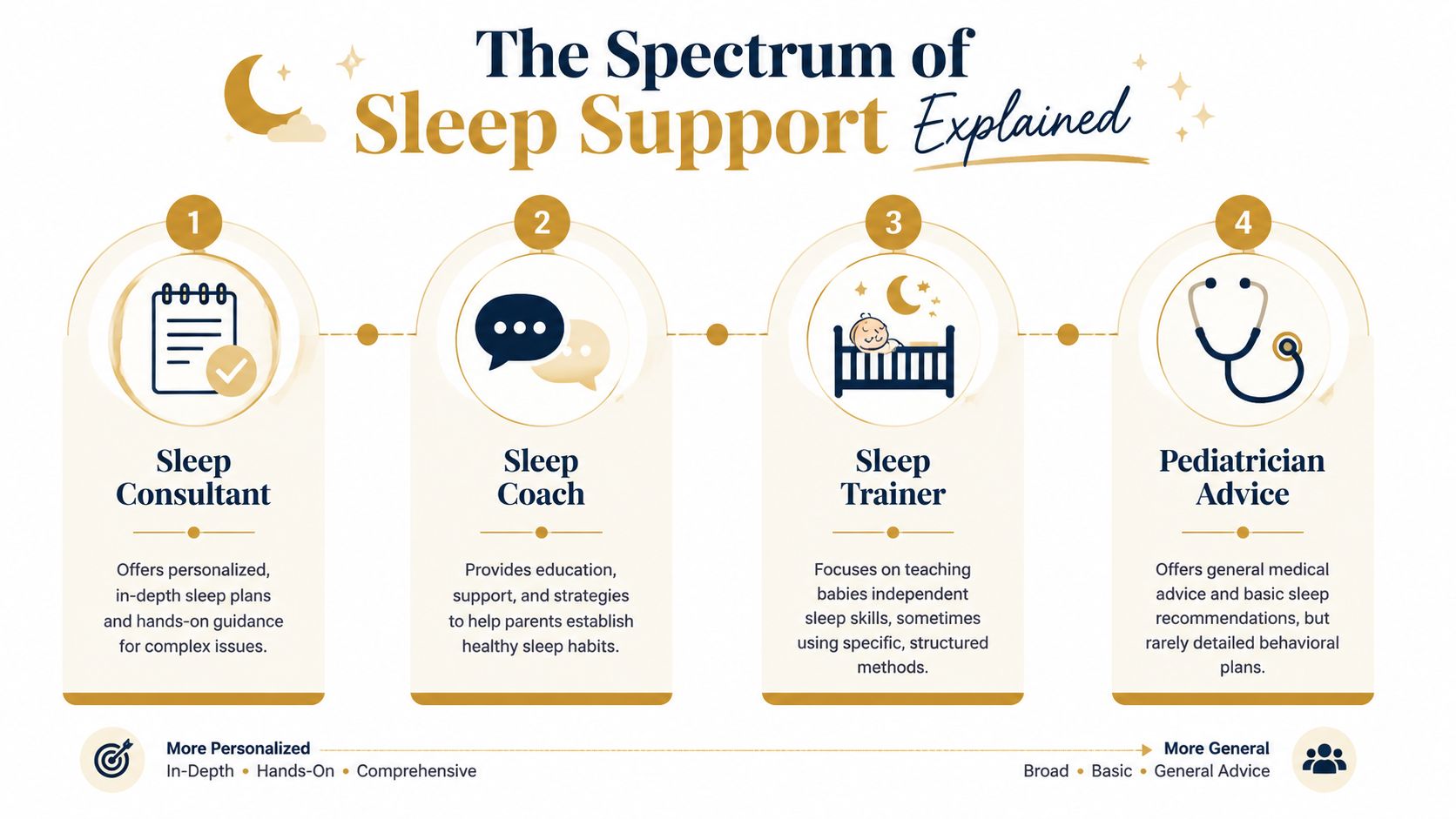
The key difference is scope
Some professionals create strategy. Some deliver overnight care. Some do both in limited ways. Some use the word “sleep” very loosely.
| Role | Main focus | Typical support style | Best for |
|---|---|---|---|
| Infant Sleep Specialist | Assessment and tailored sleep planning | Education, analysis, guidance, follow-up | Families needing a bespoke sleep plan |
| Sleep Consultant | Varies widely by provider | Can be structured or generic | Parents who vet carefully and understand the consultant's method |
| Night Nanny | Overnight hands-on care | In-home practical support at night | Exhausted parents needing rest and direct newborn care |
| Maternity Nurse | Newborn care and postnatal support | Intensive practical care and parental guidance | Early weeks, feeding support, routine foundations |
Infant Sleep Specialist versus generic sleep consultant
These labels often overlap, but not always helpfully.
An Infant Sleep Specialist should be able to explain not just what to do, but why. They should understand routine shaping, settling patterns, developmental change, and safety boundaries. A generic “sleep consultant” may be excellent, but the term itself doesn't guarantee depth, consistency, or clinical caution. In practice, families need to ask what training sits behind the label and whether the person adapts their approach or applies a preset programme directly.
Night nanny versus strategic sleep support
A night nanny serves a very different purpose. This role is usually practical and immediate. Feeding support, settling, burping, changing, monitoring, and helping parents recover sleep are at the centre of the job.
That can be invaluable in the early months, but overnight care isn't automatically the same as a long-term sleep plan. Some families need both. Others need one before the other.
If you're trying to decide between newborn-focused care and broader childcare support, this guide to maternity nurse vs nanny helps clarify where each role fits.
The most useful question to ask yourself
Ask this before you hire anyone:
- Do I need rest tonight
- Do I need a plan for the next few weeks
- Do I need someone to care for the baby hands-on
- Do I need someone to coach me through change
Those are different needs. The right title should match the actual problem.
Evidence-Based Methods and Safe Sleep Principles
Evidence-based sleep support should never mean cold, inflexible, or detached. It means the advice follows infant physiology, development, and safety principles rather than trend-driven promises.
Safety comes first, always
Any legitimate Infant Sleep Specialist must align with NHS safer sleep guidance. Infants should be placed on their backs to sleep, and that standard matters because some unregulated “experts” have advised front sleeping, a practice that can increase the risk of SIDS by up to threefold (safe sleep guidance and risk context).
This is not a minor detail. It's the baseline for safe practice.
If a sleep plan improves parental rest but compromises safe sleep, it is not a good plan.
What evidence-based practice usually looks like
Good sleep work is often built around a few core principles:
Rhythm before rigidity
Babies benefit from predictable patterns, but they don't follow a stopwatch perfectly.Age-appropriate expectations
A young baby who still needs frequent feeds should not be managed like an older infant.Sleep associations with context
Some associations are sustainable for a family, others become exhausting. The goal isn't perfection. It's choosing what remains workable over time.Observation over ideology
A method should fit the baby's temperament, feeding needs, and developmental stage.
The nursery setup matters too
Parents often focus on routine while overlooking physical setup. Cot safety, mattress fit, room conditions, sleep clothing, and swaddling decisions all affect both safety and sleep quality. Even small practical points matter. A poor mattress fit can create gaps that no specialist should ignore, so it's worth reviewing guidance on finding safe crib mattress fits when checking your sleep space.
What doesn't work well is using “evidence-based” as a marketing phrase while giving generic scripts to every family. Real evidence-based support is careful, safety-led, and personalised.
Signs It Is Time to Call a Specialist
Some sleep disruption is normal. Not every rough patch needs professional help. But there comes a point when “wait it out” stops being wise and starts becoming draining.
A practical self-check
It may be time to call an Infant Sleep Specialist if several of these sound familiar:
- You've tried multiple approaches and each one works for a night or two before falling apart.
- Bedtime has become tense and every evening feels like a long negotiation.
- Night waking is affecting the whole household and nobody is coping well.
- You and your partner disagree on what to do, which leaves the baby getting mixed responses.
- You're overwhelmed by contradictory advice and can't tell what is safe, realistic, or age-appropriate.
- Your baby's sleep issue feels bigger than a routine tweak, especially when feeding, reflux concerns, or developmental changes seem involved.
Seeking help is not giving up
Parents often wait too long because they think asking for support means they've failed. It doesn't.
A specialist can be useful when your judgement is blurred by fatigue, when your baby's cues are hard to interpret, or when every online answer seems to cancel out the last one. The right guidance can shorten the trial-and-error phase and make home life feel calmer again.
The best time to ask for help is usually before resentment, panic, or total exhaustion take over.
Your Vetting Checklist for Hiring a Specialist
Hiring sleep support in the UK requires caution because the market is not self-policing in the way many parents assume.
The infant sleep consulting industry in the UK is completely unregulated, which means anyone can claim to be an expert. A BBC investigation found self-described consultants giving advice that contradicted NHS safer sleep guidance and potentially put infants at risk (BBC investigation summary on unregulated sleep consulting).
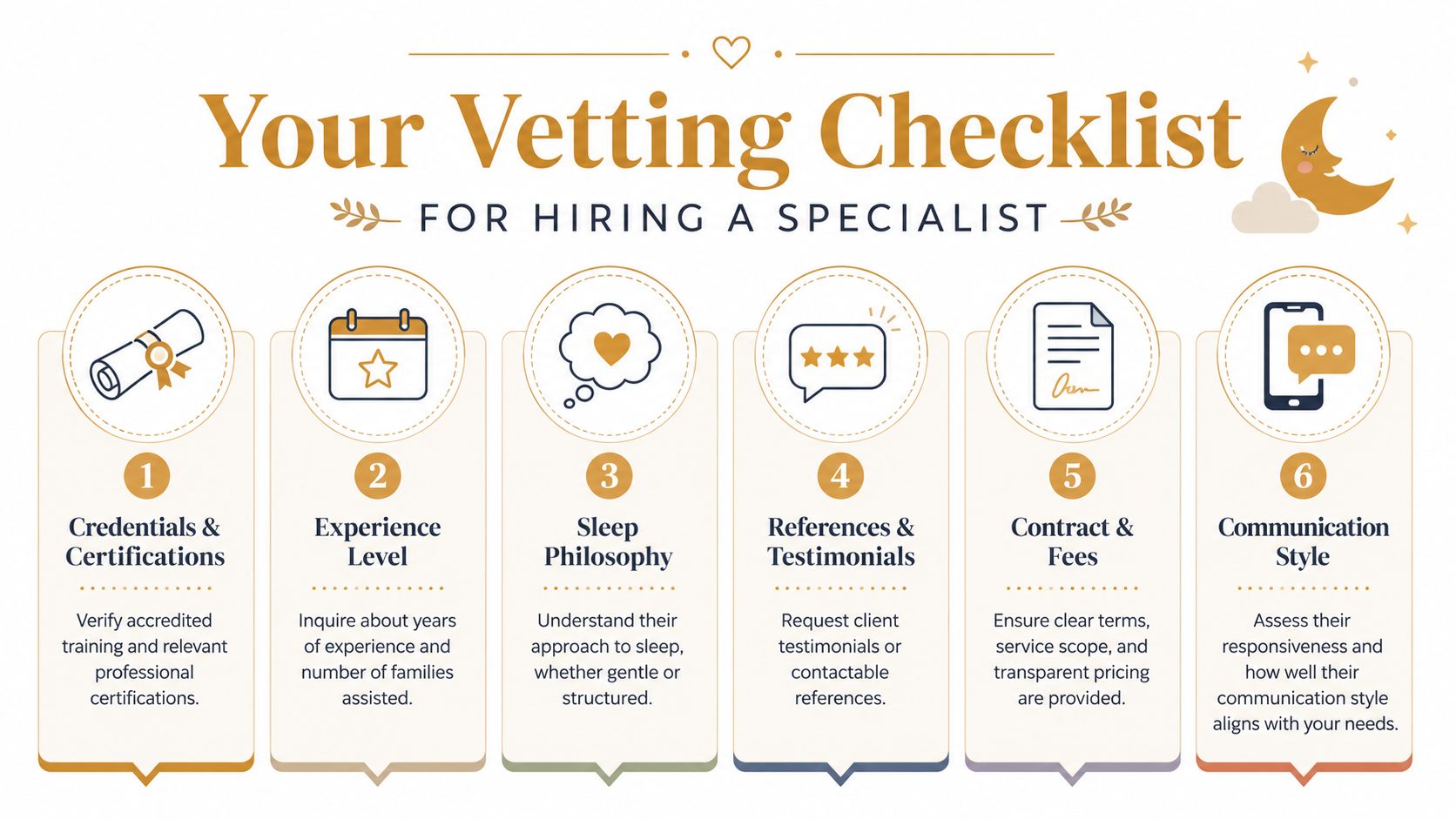
What to verify before you hire
Use a proper screening process, not just a warm Instagram presence.
Training that can be explained clearly
Ask where they trained, what infant age ranges they work with, and how they stay aligned with current safer sleep standards.A defined sleep philosophy
They should be able to explain whether they use gentle shaping, structured behavioural approaches, responsive settling, or a mixture depending on the family.Safety language that is immediate and confident
If you ask about sleep position, cot setup, or feeding-related wakes, the answers should be clear and cautious, not vague or defensive.Scope of practice
A good professional knows when a family needs medical review, feeding support, or a different kind of newborn care.
Red flags parents shouldn't ignore
Guaranteed outcomes
No ethical specialist can promise a specific result for every baby.One-method-fits-all language
Babies vary too much for a universal script.Dismissive views on parental instincts
Parents need support, not shaming.Unsafe shortcuts
Any casual suggestion that conflicts with safer sleep guidance should end the conversation.
Questions worth asking in the first call
| Ask this | Listen for this |
|---|---|
| How do you tailor your plan? | Specific questions about feeding, naps, environment, and temperament |
| What safety guidance do you follow? | Clear alignment with NHS safer sleep principles |
| What happens if the first plan doesn't fit? | Willingness to review and adapt |
| When would you refer a family elsewhere? | Professional boundaries and honesty |
For a broader look at how high-standard household professionals should be screened, this guide to the nanny vetting process shows the level of diligence families should expect.
The Superstar Nannies Approach to Sleep Support
Families don't just need credentials on paper. They need confidence that the person entering their home understands newborn care, respects discretion, communicates well, and can work within the rhythms of a private household.

Why agency-led matching can be safer
In an unregulated market, the burden often falls entirely on parents to judge training, safety standards, references, and professionalism. That's a lot to assess when you're already exhausted.
A strong agency process helps reduce that burden by filtering for the basics before a family even starts interviews. That matters with sleep support because technical knowledge alone isn't enough. Families also need reliability, calm communication, and a professional who can adapt to household dynamics without creating more stress.
What good matching should include
A careful placement process should look at more than availability.
Role clarity
Is the family seeking strategic sleep guidance, overnight newborn care, or a hybrid arrangement?Relevant experience
A candidate who is excellent with older children may not be the right fit for a newborn sleep challenge.Temperament fit
Some families want highly structured guidance. Others need a softer, more collaborative style.Discretion and professionalism
Particularly in private households, trust matters as much as technical competence.
The real benefit is peace of mind
When sleep support is matched properly, the outcome is bigger than a better bedtime. Parents often gain confidence, routines feel less chaotic, and the home becomes calmer.
That's the part many articles miss. Sleep isn't only about hours in a cot. It's about whether the family feels safe, informed, and supported while making decisions for a vulnerable baby.
Frequently Asked Questions about Infant Sleep Support
Does sleep training increase total sleep
Not necessarily. A common question is whether sleep training leads to more sleep overall. A 2023 study found no evidence that it increases total sleep duration. Instead, it mainly reduces parental signalling of night waking, which is an important distinction many parents don't hear clearly in online discussions (sleep training nuance explained).
What age should an Infant Sleep Specialist work with
That depends on the issue. In the newborn stage, support is often about settling, feeding rhythm, and realistic expectations rather than formal sleep training. With older babies, work may become more structured. The right specialist should adapt their approach to age and development rather than forcing one formula.
Can a specialist help without using rigid methods
Yes. Good sleep support doesn't have to mean leaving a baby to cry or following a strict script. Many specialists work responsively and focus on gradual change, clearer routines, and practical adjustments that parents can sustain.
What should I read alongside professional support
It helps to pair personalised guidance with sensible age-based resources. For broader expert tips on baby sleep, age-guided sleep information can help parents understand what tends to be normal at different stages without treating every baby as identical.
If you want discreet, high-standard help finding trusted newborn and childcare professionals, contact Superstar Nannies for a personalized consultation.