

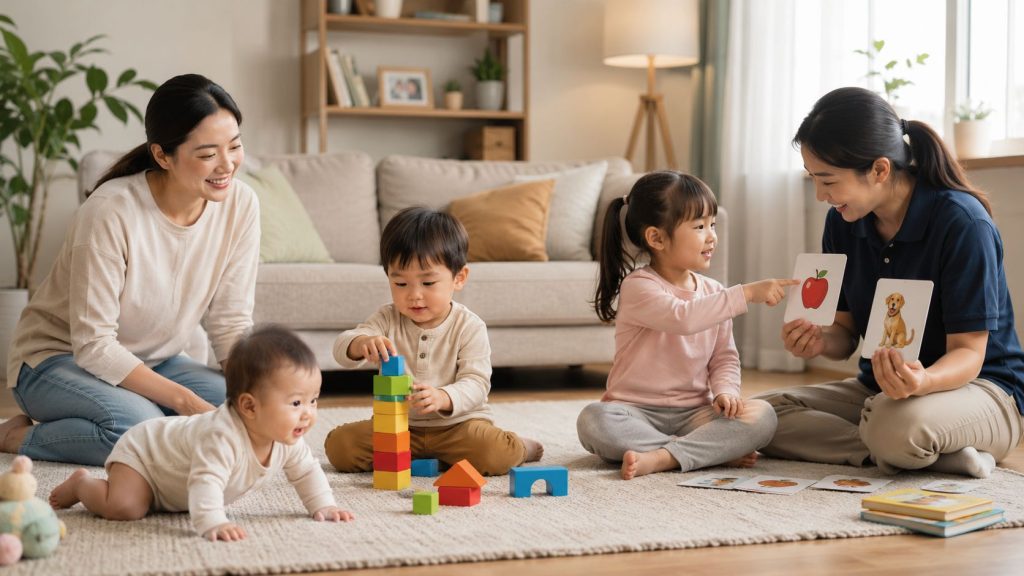
You're watching a child you know well. Perhaps a baby who suddenly fixes their gaze on your face for longer than usual. Perhaps a toddler who understands everything you say but says very little back. Perhaps a preschooler who chatters brilliantly at home and goes silent around new adults. In those quiet moments, the same question tends to surface for parents and nannies alike. Is this typical?
That's where child development milestones can help, provided we use them properly. They're not a league table. They're not a measure of parental success or nanny quality. They're a working guide that helps adults notice progress, support emerging skills, and recognise when a child may need a closer look.
In private households, this matters even more because the adults around the child often see subtle change before anyone else does. A skilled nanny notices patterns in movement, play, language, and regulation. A thoughtful parent notices what shifts across weekends, travel, illness, family routines, and cultural expectations. When those observations are shared well, children are better supported.
Your Child's Unique Journey An Introduction to Milestones
A child rarely develops in a perfectly tidy sequence. One baby may be physically adventurous and emotionally cautious. Another may speak early and climb later. A toddler might seem to pause in one area while pouring energy into another. That unevenness often worries adults, but it's part of how development works.
Child development milestones are best understood as markers along a road, not deadlines on a calendar. They help adults ask useful questions. What skills are emerging? What skills are consolidating? What kind of play, routine, and interaction would help next? That framing changes everything. Instead of watching for problems alone, you start watching for readiness.
Why milestones matter in real life
In practice, milestones are most helpful when they lead to better everyday care. A baby working on head control needs more floor time and less time contained in equipment. A toddler developing language needs responsive conversation, songs, pauses, and repetition. A preschooler learning self-regulation needs predictable boundaries, not constant correction.
Practical rule: Observe the child in front of you, not the child next door.
Families also need room to interpret development through their own values. Some households prioritise independence early. Others place more emphasis on close co-regulation, multilingual exposure, or intergenerational caregiving. Those differences shape how skills are expressed. They don't automatically signal delay or concern.
Social and emotional growth deserves equal attention here. Many adults focus first on walking and talking, yet emotional security, turn-taking, frustration tolerance, and connection sit underneath so much later learning. For a thoughtful overview, Soul Shoppe's approach to SEL offers a useful way to think about relationships, feelings, and the daily experiences that build emotional competence.
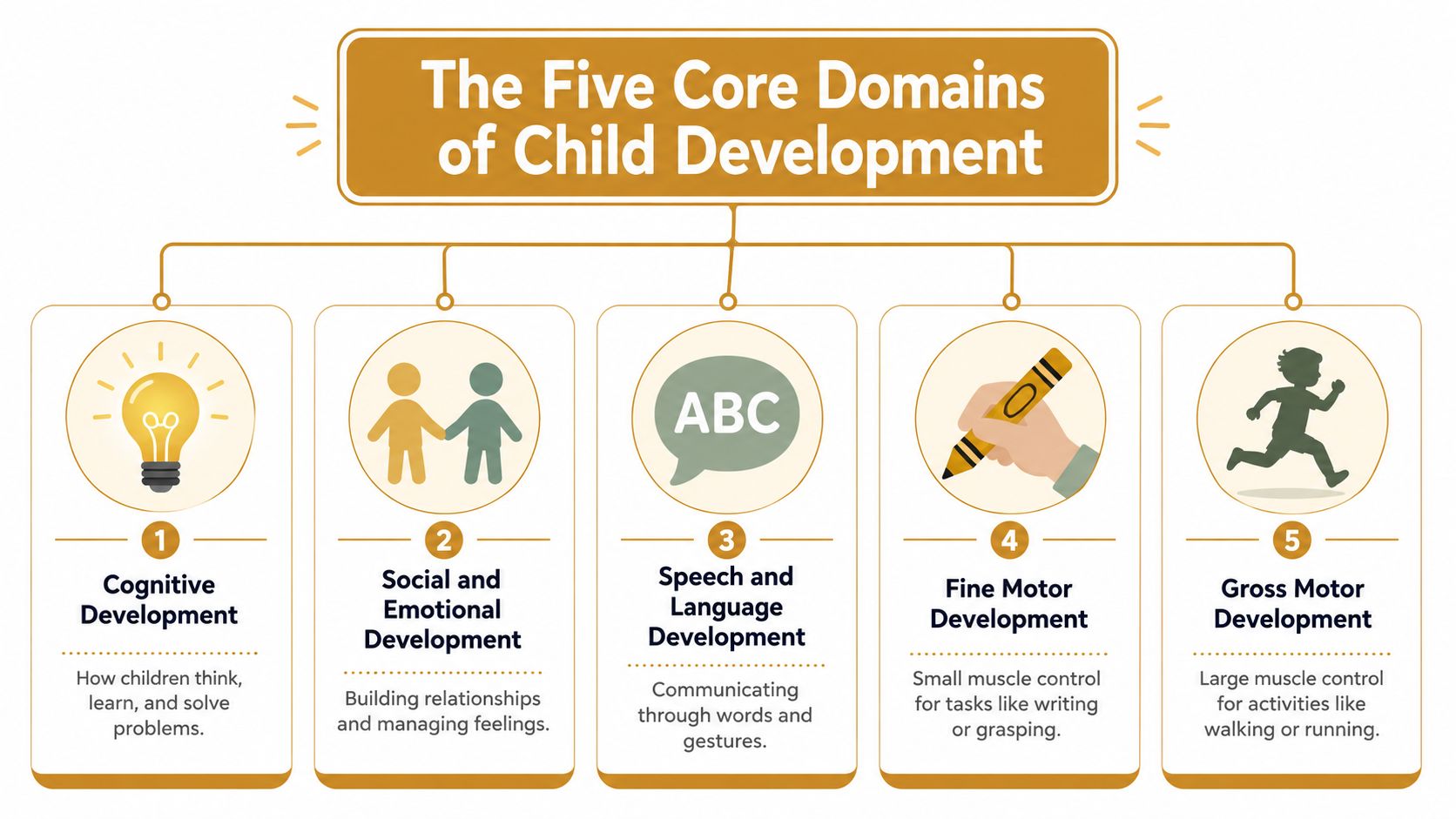
The Five Domains of Child Development
It helps to think of development as five toolkits for growth. Children don't use only one at a time. They borrow from all of them, often in the same activity. A child building a tower is using motor control, problem-solving, language, persistence, and social awareness all at once.
Gross motor and fine motor development
Gross motor development involves large body movements. Think rolling, sitting, crawling, climbing, walking, jumping, balancing, and running. These skills rely on strength, coordination, body awareness, and confidence in space. When gross motor skills are well supported, children can explore more freely and engage more fully with their environment.
Fine motor development is smaller and more precise. It includes grasping, pointing, turning pages, using cutlery, stacking blocks, drawing, fastening clothing, and later writing. Fine motor control depends on hand strength, wrist stability, visual tracking, and planning. In home settings, it often shows up first in practical tasks such as feeding, tidying, dressing, and mark-making.
Many adults separate these areas too sharply. In reality, they feed each other. A child who feels stable through the shoulders and trunk often finds hand tasks easier. A child who spends little time on the floor may have fewer opportunities to build that foundation.
Language, cognitive, and social emotional development
Language and communication include far more than spoken words. Babies communicate through eye contact, facial expression, cries, gestures, and shared attention long before fluent speech appears. Later, children develop listening, understanding, vocabulary, expression, storytelling, and conversational turn-taking. For a deeper look at progression in this area, see these child language development stages.
Cognitive development is how children think, remember, explore, notice patterns, solve problems, and make sense of cause and effect. It appears in small moments. Dropping a spoon to see what happens. Looking under a cushion for a hidden toy. Sorting objects by colour. Pretending a block is a phone.
Social and emotional development covers relationships, attachment, self-awareness, empathy, emotional expression, and regulation. It includes the ability to be comforted, to separate, to reconnect, to share attention, and gradually to manage disappointment.
Strong development rarely looks neat. It looks connected.
When one domain seems especially visible, don't assume the others are absent. Often they provide underlying support for the skill you can see.
An Age-by-Age Guide to Development Milestones
Parents and nannies often want a quick reference point, especially during phases that seem to change overnight. That's sensible. The key is to use milestone guides with a steady hand. They are reference points, not pass or fail tests.
A child may move ahead quickly in one domain and take more time in another. Temporary plateaus can happen. So can bursts of progress after illness, travel, family change, or a new routine. The aim is to notice patterns over time, not to scrutinise a single afternoon.
Child development milestones from birth to five years
| Age Range | Gross Motor | Fine Motor | Language/Communication | Cognitive | Social/Emotional |
|---|---|---|---|---|---|
| Birth to early infancy | Lifts head briefly during tummy time, begins to stretch and kick, shows increasing body control | Grasps reflexively, begins to open hands, brings hands towards mouth | Startles to sound, quiets to familiar voices, begins cooing or making early sounds | Watches faces, tracks nearby objects, shows interest in light and movement | Makes eye contact, settles with familiar care, begins social smiling |
| Later infancy | Rolls, sits with support then more steadily, may begin moving across the floor | Reaches for toys, transfers objects between hands, explores objects by mouthing and banging | Babbles, responds to name, uses sounds and gestures to seek attention | Searches for partly hidden objects, explores cause and effect, notices routines | Shows preference for familiar adults, enjoys social games, may show stranger wariness |
| Around the end of the first year | Pulls to stand, cruises, may begin walking | Uses pincer grasp, points, drops and picks up small objects | Understands simple familiar words, imitates sounds, may use first words meaningfully | Looks for hidden items, copies simple actions, experiments with containers and objects | Waves, shares attention, seeks reassurance from trusted adults |
| One to two years | Walks more confidently, climbs, squats, begins pushing and pulling toys | Scribbles, stacks a few blocks, attempts spoon use, turns pages with help | Follows simple directions, points to body parts or familiar objects, combines early words over time | Matches familiar objects, enjoys repetitive play, begins simple pretend play | Shows strong preferences, tests boundaries, brings adults into play, may play alongside other children |
| Two to three years | Runs, jumps with both feet, climbs furniture or playground equipment with growing skill | Builds taller towers, begins snipping with child-safe scissors, uses utensils with more control | Uses short phrases and sentences, asks questions, follows more complex directions | Sorts by simple categories, completes easy puzzles, expands pretend play themes | Shows affection, copies adult behaviour, struggles with waiting but begins learning turn-taking |
| Three to five years | Pedals, balances better, climbs and navigates stairs with more ease, throws and catches with growing control | Draws recognisable shapes, manages clothing fastenings with support, uses tools such as crayons and child scissors more purposefully | Speaks in longer sentences, tells simple stories, understands more complex instructions | Understands sequences, engages in imaginative play with roles and rules, solves simple practical problems | Develops friendships, negotiates in play, shows empathy, manages feelings with adult support though still needs help at times |
How to read the table well
Use this guide to ask better observational questions:
- Look for clusters: If a child is showing progress across several areas, that usually matters more than one isolated skill.
- Watch the quality of the skill: A child may be doing something once, or doing it regularly and confidently. Those are different stages.
- Notice context: Some children speak more in familiar settings. Some move more boldly outdoors than indoors.
- Track change over weeks: Development is easier to understand when you compare patterns, not single moments.
By the early school years, milestone thinking often shifts from first skills to applied skills. For example, language growth becomes more visible in comprehension, retelling, and early literacy. If you're supporting an older child's learning journey, this overview of essential 2nd grade reading skills is a useful example of how foundational communication develops into classroom readiness.
For babies in the earliest months, daily routine influences what you can observe. Feeding, sleep, regulation, and body comfort all affect how readily a child shows emerging skills. This practical guide on how to settle a newborn can help adults create the calm conditions in which early development is easier to notice.
Actionable Activities to Nurture Growth
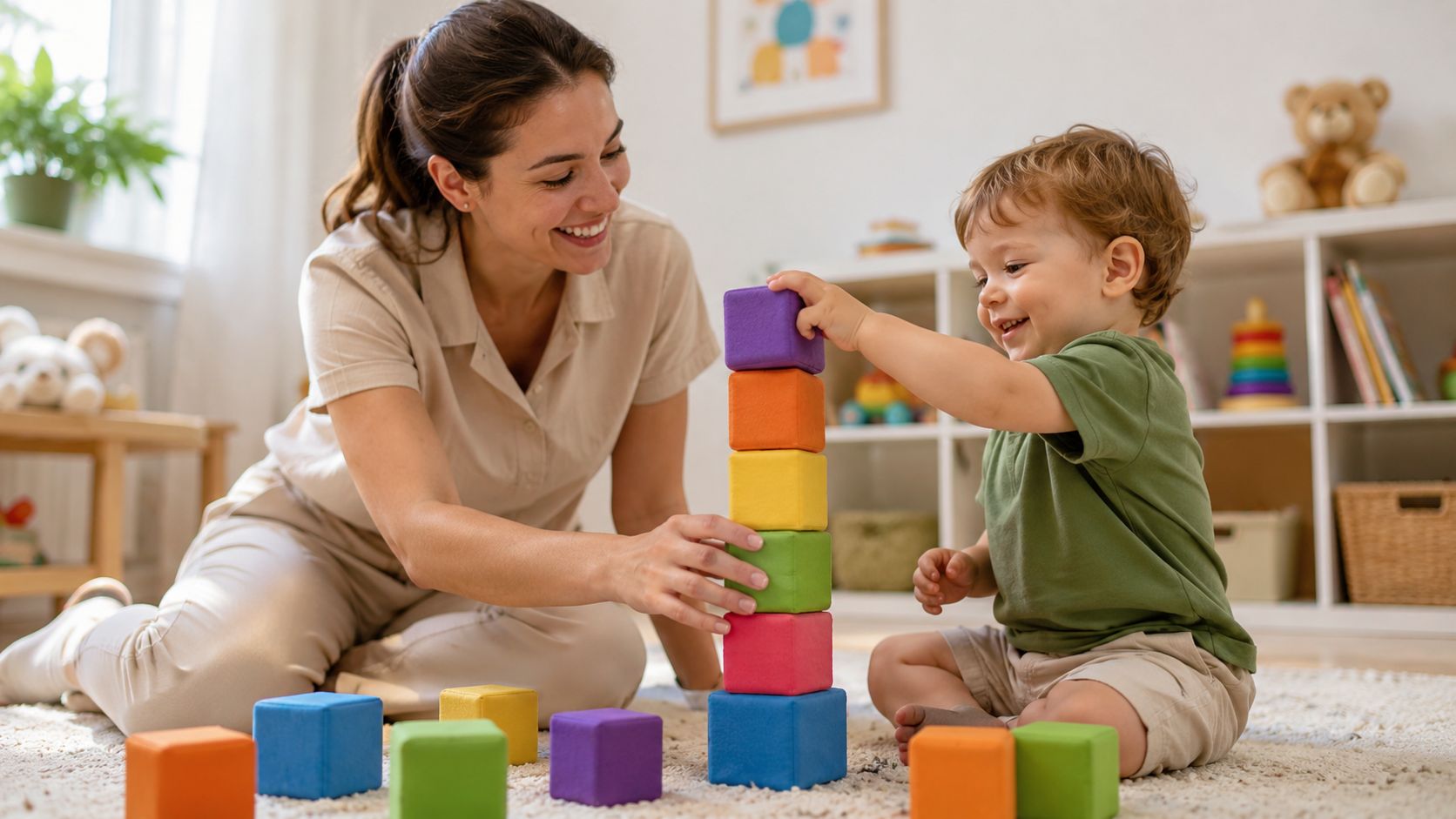
The most effective developmental support rarely looks elaborate. It looks like ordinary, repeated, responsive play. In a private home, that's good news. You don't need specialist equipment to nurture growth well. You need time on the floor, predictable routines, conversation, and adults who know when to step in and when to let the child work something out.
Home activities that build real skill
- For gross motor growth: Create simple movement pathways with cushions, masking tape lines, low furniture, tunnels, or a push toy. Outdoors, use hills, steps, and uneven surfaces when safe. Children build coordination through varied movement, not by being told to “be careful” every few seconds.
- For fine motor confidence: Offer playdough, chunky crayons, stacking cups, posting activities, pegs, fabric scraps, and kitchen tools such as whisks or silicone brushes during supervised play. Hands strengthen through use.
- For language development: Narrate daily care without overwhelming the child. Sing repetitive songs. Pause after a question. Label what the child is looking at, not only what you want them to notice.
- For cognitive growth: Hide objects under cloths, rotate puzzles, offer containers with lids, sort laundry by colour, and invite pretend play with dolls, scarves, cardboard boxes, and toy animals.
- For social and emotional skills: Practise turn-taking in low-stakes games, name feelings calmly, model repair after conflict, and use routines that help children anticipate what happens next.
The best activity is often the one the child repeats by choice.
What works and what usually doesn't
What works is responsive participation. Sit nearby. Follow the child's interest. Add one step of challenge, then wait. Experienced nannies often make the difference in this manner. They don't over-direct, and they don't leave learning entirely to chance.
What usually doesn't work is over-scheduling, over-correcting, or relying on battery-operated toys to do the interaction for you. Children learn language from human exchange. They learn regulation from co-regulation. They learn problem-solving by trying, failing, and trying again.
If you want more ideas for structured play that still feels natural in a home setting, these activities in nurseries translate surprisingly well to one-to-one care.
Understanding Variation Versus Developmental Red Flags
Some variation is entirely ordinary. A child may walk later than another child in the same family. A toddler may understand complex language yet say little. A preschooler may be highly sociable at home and reserved elsewhere. Difference alone isn't the issue. The more useful question is whether development appears to be moving forward, unevenly perhaps, but forward.
A concern deserves more attention when a child seems persistently unable to do skills that support everyday functioning, loses skills they previously used, or shows a pattern that remains worrying across settings and over time. In such instances, calm observation matters more than alarm.
Variation that is often typical
- Temperament differences: Some children warm up slowly, some leap in.
- Uneven profiles: Strong physical confidence alongside slower speech, or the reverse, can happen.
- Context-dependent behaviour: A child may communicate differently with parents, nannies, grandparents, or in group settings.
- Recovery after disruption: Sleep changes, travel, illness, or a house move can temporarily affect behaviour and regulation.
Signs that should prompt a conversation
A more careful discussion may be wise if a child:
- Isn't responding to sound or social interaction in expected everyday ways
- Shows very limited eye contact, gesture, or shared attention over time
- Has marked difficulty with movement, balance, or coordination compared with their own previous pattern
- Uses far fewer communicative attempts than expected for their stage
- Loses words, social engagement, or physical skills they had already developed
If a skill disappears, don't wait and see for too long. Note what changed and raise it.
For nannies in particular, professionalism matters here. You're not diagnosing. You're observing, recording, and sharing concerns carefully. Families who need more individualized support may also benefit from specialist in-home care, such as a special needs nanny, especially when routines, communication, or therapies need consistent reinforcement at home.
Documenting Progress and Partnering with Families
Good observation is one of the clearest marks of a professional caregiver. In a private household, though, documentation has to be handled with tact. Parents don't want a stream of anxious commentary. They do want clear, respectful insight into how their child is doing, especially when routines are shared across multiple adults.
How to keep developmental notes useful
The strongest notes are brief and factual. Record what you saw, the context, and any pattern.
For example:
- Observation: “Pointed to the banana and said a clear approximation of the word at breakfast.”
- Context: “Happened after repeated naming during snack preparation.”
- Pattern: “Using more purposeful pointing across the week.”
This is far more useful than “speech improving” or “seems behind today”.
How to raise concerns without damaging trust
Start with shared goals. Parents and nannies both want the child understood and supported. Use language that invites collaboration:
- Try: “I've noticed a pattern I think is worth discussing.”
- Try: “I'm seeing strengths here, and one area I'd like us to keep an eye on.”
- Try: “Would it be helpful if I kept a short record for a couple of weeks so we can look at it together?”
Avoid loaded labels, comparisons with siblings, or statements that sound like a diagnosis. Families also differ in how they view privacy, health information, and professional boundaries. In multilingual, multicultural, or high-profile households, that sensitivity matters even more.
If medical or developmental information needs to be shared across parents, caregivers, and professionals, secure systems are better than scattered messages or informal notes. These solutions for family medical information sharing are a helpful example of how families can organise sensitive records more safely and consistently.
Your Partners in Nurturing Potential
Child development milestones are most useful when they make adults more observant, not more anxious. Children develop through relationship, repetition, play, and daily care. Some move quickly in one area and steadily in another. That's often part of healthy development.
What matters most is the quality of support around the child. Calm observation helps adults notice progress. Thoughtful routines create space for growth. Honest partnership between parents and caregivers makes it easier to celebrate strengths and respond early when something needs attention.
Frequently Asked Questions
Do bilingual children reach language milestones differently
Bilingual children may distribute language across two languages rather than showing everything in one. That can make their profile look different from a monolingual child at first glance. What matters is the child's overall communication, including understanding, gestures, attempts to express meaning, and growth across both languages.
Should screen time be used to support milestones
Screens don't replace conversation, movement, hands-on play, or co-regulation. High-quality content used thoughtfully can have a place in some families, but it works best when an adult is present and talking about what the child is seeing. Passive viewing isn't a strong developmental tool for young children.
How often should nannies update parents on developmental progress
Brief daily notes are useful for practical matters, but developmental updates are usually best shared through clear examples over time. A weekly summary or a planned check-in often works well. If a concern feels significant, raise it sooner and privately.
What if a child seems advanced in one area and behind in another
That's common. Development is often uneven. A child may have strong reasoning and imaginative play while still needing support with speech clarity, coordination, or emotional regulation. Look at the whole child, not a single standout skill.
If you're looking for exceptional childcare support with a thoughtful understanding of child development milestones, Superstar Nannies can help you find a nanny who brings professionalism, warmth, discretion, and genuine developmental insight to your home.